
- What is the type of humor used in the meme-based posts (i.e. Satire, pop culture, self-deprecating, wordplay, absurdism, etc.)?
- What are the prevalent themes and messages in the meme-based posts?
- What are the cultural references present in the meme-based posts?
- What are the branding strategies employed through the memes?
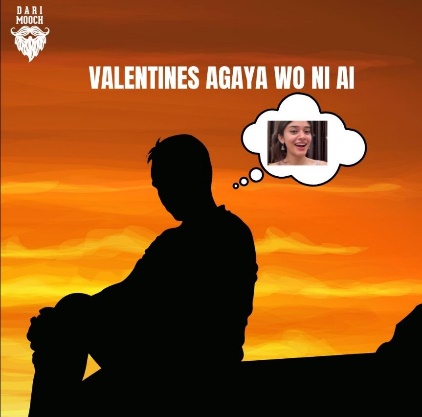
- One-sided love: a common male-centric humor - a common struggle among young men.
- Romantic struggle
- Meme is not of a promotional nature but engaging, making the brand feel more like a friend.
- Roman Urdu in meme text
- Using Islamic religious concepts and symbols like namaz/prayer, Ramadan, and heaven/hell.
- Meme templates of Indian dramas and films.
- Integration of Pakistani actors in the meme template.
- Aural analysis points to the use of local Pakistani music in Punjabi and Saraiki.
- Pop culture references like The Simpsons, Iron Man, and the Boys.
- A common dilemma among young adults (Gen Z & Millennials), is who often over-spend on trendy products.
- The brand's products (perfume and body care) are subtly placed with other popular items, making them feel like an essential part of a luxurious lifestyle.
- The meme indirectly promotes consumerism, reinforcing the notion that self-care and enjoyment are worth spending on.
- The meme is targeted at women.
- The brand engages the audience of South Asia by using Pakistani and Indian actors in meme templates. Celebrities like Hania Amir, Fahad Mustafa, Shahid Kapoor, and Akshaye Khanna are prominent faces in the memes.
- The memes employ a mix of English and Roman Urdu in the meme texts.
- There are references to Pakistani products such as "prickly heat powder", "Black Cat Talcum powder", "Tang" and "Faiza beauty cream".
- Pakistani clothing brands such as "Ethnic", "Outfitters", "Monark" and "Bonanza Satrangi" were also displayed in a meme creating relevance with Pakistani audiences.
- The aural analysis points to the use of South Asian music (O Rang Rez from the movie Bhaag Milka Bhaag and "Ahista Ahista (remix) by Musarrat Nazir").
- Iride takes a hit at major car-hailing services operating in Pakistan.
- It sets itself up as a rider-friendly service.
- Iride is a better car-hailing service than others in the market.
- Demeaning other brands.
- Relatable for those who have less spending power such as students or youngsters.
- Cake design promotion
- Relatable: Meme subjects include sibling relationships, relationships between husband and wife, generational gap, family expectations, relationship struggles, struggles of finding jobs, experiences during Ramadan, etc.
- Absurdism: The brand used absurdist elements like cats and dogs personified as human characters, the brand character "Meowbaksh", a cat derived from another meme, comparing drama characters or the Cricket team to cookies, and the idea of marijuana in cookies.
- Wordplay: Wordplay in memes gives them a playful vibe e.g. "Marie" biscuit standing in for the word "marry". Use of Gen-z slang such as "Gets cooked",
- Pop-Culture: Another prominent style was referencing pop culture like characters from the Pakistani drama "Bulbulay", the local TV show "Shark Tank", actor "Fahad Mustafa" from the drama "Kabhi Mei Kabhi Tum" and ARY news. Such a choice of reference makes the brand relatable to Pakistani audiences.
- Product placement
- Product promotion
- Cultural relevance: Bulbulay drama
- Roman Urdu in meme text.
- Characters from Pakistani drama and film.
- Pakistani cricket team
- Poking fun at the accent of people of Lahore.
- The political atmosphere of Pakistan
- Local TV show i.e. "Shark Tank" and channel ARY News.
- Mention of local beverages and products such as Rooh Afza, Tang, Pakoras, Cocomo, Samosas, Kashmiri tea, and tea.
- Use of South Asian music by Vishal Mishra, Bilz, Kashif, and Local Train.
- Ramadan experiences like Iftar food.
Abstract
This study attempts to understand meme marketing dynamics in the Pakistani online media landscape. It focuses on how Pakistani brands using memes take advantage of cultural references, wordplay, trendy templates, and music to engage the online user base. This study employs a qualitative design utilizing the multi-modal analysis to examine 87 meme-based posts from the Instagram pages of 5 Pakistani brands across 4 industries: Men's grooming products, fragrances, ride-hailing service, and baking. This study is guided by theoretical frameworks such as narrative transportation theory, Shifman's 3 meme dimensions, and self-congruity theory. The findings revealed that brands used local cultural references, religious motifs, regional music, and wordplay to engage their demographics. Brand logos and products were imbedded in the memes and humor styles such as self-depreciation, absurdism, sarcasm, pop-culture, visual puns, and wordplay were used.
Keywords
Meme-Marketing, Pakistani Brands, Gen-Z, Narrative Transportation Theory, Self Congruity Theory, Pop-Culture, Brand Identity, Brand Prominent Meme-Marketing
Introduction
Memes, the term coined by evolutionary biologist, Richard Dawkins in his 1976 book The Selfish Gene, stands for a replicable idea, behavior, style, or practice that spreads within a culture through imitation. He stated that like genes in biology, memes also go through the process of variation, competition, selection, and inheritance. Internet memes go through a similar process where they are shared, repackaged (through mimicry or remixing), engaged in competition, and selected. The memes that are culturally relevant, entertaining, and funny are those that go viral and survive (Shifman, 2013).
Meme-marketing refers to the use of memes as a tool for marketing products, fostering brand-consumer relations, enhancing brand recognition, and developing brand identity. Due to its accessible, popular, and reusable nature, memes have become a means for a brand to go viral online without spending much capital. Brands take advantage of trendy memes and remix them through editing to incorporate their own message; allowing them to promote products, instill narratives, incorporate brand logos for recognition, etc. It allows them to communicate ideas to their consumers easily and maintain a relationship not bound by space or time. Memes that utilize cultural narratives and social connections are better at engaging audiences, although brands that use meme-based content without genuine understanding may come off as being exploitative and seen with skepticism among Gen-Z audiences i.e. the generation born between 1997 and 2012 (Vardeman, 2023).
Memes create a participatory dynamic between the brand and the consumer allowing for consumer-brand engagement resulting in the development of brand loyalty and re-purchase intention. The presence of elements such as humor, entertainment interactivity, and timely subject matters influence consumer-brand engagement which results in the co-creation of brand values (Cheung, 2020).
Types of Meme Marketing Being Used in the World
There has been a rise in the use of social media by brands to market their products, establish their brand identity, and stay relevant in the online lives of social media users. Brands using memes to appeal to consumers through humor allow them to be part of the in-group culture. Strategies such as meme marketing have proven fruitful in engaging audiences as social media has a vast consumer base with diverse demographics using different platforms to fulfill their consumption needs (Abbas, Ahmad, Hassan, & Ahmed, 2024). Moreover, memes with their characteristics of being simple, accessible, replicable, and entertaining have made them extremely popular in the social media landscape.
There are mainly 2 types of meme marketing: (1) Brand prominent meme marketing (2) Brand subtle meme marketing. Brand prominent meme marketing which incorporates the brand within the meme has been reported to be more efficient in capturing audience attention which results in the viewer associating the meme with the brand which further leads to engagement. Such media also creates better immersion, supporting the narrative transportation theory. Narrative transportation acts as a key catalyst in creating audience engagement. When the advert has narrative elements, the viewers don't perceive it as a traditional persuasive marketing tactic but rather have a better attitude toward it. This doesn't only include video format memes but also image macros which can achieve a transportation effect.
To engage with users having low brand knowledge, brand prominent marketing has been the better approach, this is in alignment with associative network theory. When a brand is displayed prominently in a meme, it creates mental associations/nodes within the mind of the viewer and this helps the individual who has low brand knowledge connect with the brand (Razzaq, 2023).
Effects Of Meme Marketing
Meme marketing has proven to be effective in consumer engagement and customer purchase intention. Memes due to their humorous nature and relatable subjects create positive engagement and develop emotional connection which allows the consumer to retain the information in the content. Positive engagement builds trust with the consumer, and they lower their mental guard. If the consumer is impressed by the meme, they are more likely to purchase the product as well (Rathi, 2023) Memes fuel the desire for Gen-Z to consume authentic, creative, and out-of-the-box. Memes being multi-modal, easy to edit, and based on cultural units of meaning allow them to be machinations for creative output. Furthermore, they serve as a device for fulfilling gratification needs among the users. They help them connect with other users and display their knowledge of contemporary trends. By prioritizing humor, relevance, and iconicity in memes, brands can increase their spread (Malodia, 2022). It is important to understand that while a humorous meme might drive engagement, it may not aid in brand recall, but it does have a positive impact on sharing intention and humor perception (Yang, 2022).
Comparison Of Meme Marketing with Other Marketing Strategies
Consumers perceive meme marketing as more authentic, creative, and inhibiting out-of-the-box thinking such as the use of dark humor, absurdism, and self-depreciation which is absent in traditional adverts. This novel experience allows the viewer to lower their mental guard. The persuasive nature and lack of novelty in traditional advertising repels modern consumers. According to a study, users express greater intention towards sharing humorous content, this makes meme-based content more shareable and thus provides the brand an avenue for going viral organically (Yang, 2022). Memes with strong bandwagon cues i.e. having a high level of engagement are perceived as funnier by the viewer and the viewer is inclined to share it forward.
Meme marketing is more effective in maintaining viewer interest than traditional advertising because of online users' greater affinity towards memes thus by using memes towards demographics that are inclined towards such content, brands can effectively communicate their message. It is favorable to marketers to utilize memes as a marketing strategy as they lead to better acceptance of the marketing message (Kiljańczyk, 2023).
Meme Marketing as a Strategy for Targeting Gen-Z
A major factor in the success of meme-marketing has been the consumption patterns of Gen Z who use social media extensively and are the most engaged in meme creation, remixing, and sharing. Around 69% of Gen Z's use Instagram multiple times a day and 41% have reported that they use Instagram for brand discovery. 58% claim that social media is their main source of news and 54% say they consume social media for entertainment. According to a study (Eser, 2024), memes bring in 10 times more organic engagement than standard marketing posts in the online landscape (Tama-Rutigliano, 2018) For Gen-Z, engagement with memes fulfils their three needs (1) entertainment (2) social interaction (3) information. Humor acts as a main hook that makes the consumer stay with the content (Ferdian Arie Bowo, 2024). Brands taking advantage of these consumption patterns have adopted memes as a tactic to engage audiences and market products (Shahzad & Siraj, 2020).
The Gen-Z audience is attracted to adverts that feel authentic to them and are creative in their messaging. They are inclined to relatable adverts that aren't sales (Madrid, 2023). Moreover, studies suggest that Gen-Z users show attraction towards absurdist content, i.e. content that shows illogical and irrational elements. The presence of absurdity alters the brand perception and creates a feeling of authenticity and creativity in the minds of the Gen-Z audience (NOE, 2023). Brands that use meme-based advertising without understanding the meme culture or show insincerity are seen as exploitative among Gen-Z online users and evoke a negative perception (Vardeman, 2023).
Fernandez (2024) presented that by attracting the attention of Gen-Z through meme-based content, interest in the brand's product/service can be achieved. The capturing of interest and communicating value acts as a step towards evoking desire for the marketed product. The employment memes require care as misrepresentation of memes and brand value can cause reputational damage.
Meme Marketing and Social Media in Pakistani Context
Around 29.5% of the Pakistani populace uses social media and according to figures calculated by ad planning tools of social media platforms, approximately, 54.38 million users who are above 18 are using social media. Instagram, its user base is around 17.30 million in the country, and at the start of the year 2024, its ad reach was equal to 15.6% of the local internet user base (Kemp, 2024).
In Pakistani society, memes are a prominent form of expression used not only for mere entertainment but also for social commentary, celebrity gossip, political beef, illuminating social ills, criticizing authority, economic distresses, forming alliances and distinctions between ideological groups (Haq, 2021). Memes reflect the nation's cultural identity, ideas, values, issues, and interests. Memes act as a vehicle to deliver messages that can't be propagated in other formal settings. Due to their characteristics of being easily accessible and remixed; converting complex issues into their simpler parts and giving them a humorous twist, memes are a go-to option for Pakistanis to disseminate messages.
Social media is a vital source for Pakistani brands to market themselves through memes but there remains a gap in the understanding of how these brands utilize memes and the nature of the embedded themes and cultural messages. This study examines how Pakistani brands use memes on Instagram to engage audiences, focusing on humor styles, cultural relevance, and both explicit and implicit brand messaging. This study aims to analyze how Pakistani brands use memes as a format to engage the online populous, particularly Instagram.
Literature Review:
Relationship between Gen-Z and Memes
For Gen-Z, memes are an avenue for online communication, expressing likes, dislikes, social commentary, framing social issues, and presenting philosophical views like nihilism, existentialism, or absurdism in a simplified yet humorous manner. Phrases from memes have become infused in our everyday discourse, offering a novel and creative way to communicate ideas and emotions. Memes shape our individual as well as our group identities by allowing us to create, borrow, remix, and share content online (Bowo, 2024).
Memes (image macros), combine features of both wordplay and jokes and they efficiently perform two functions (1) to create humor and (2) to build social connections. When memes are shared online, they strengthen the digital social connections of those engaged in the process of meme-making, remixing, and consuming. Creating memes involves elements of creativity such as wordplay to create twists in the pre-made template. Engaging memes represent a display of verbal and visual creativity which evoke an emotional response from the viewer (Geeraerts, 2018).
Memes are an avenue for self-expression and identity construction for the Gen-Z. Memes allow them to express their beliefs, frame issues, create humor, and even express inner conflicts like depression, anxiety, or purposelessness in a humorous manner. It allows them to personalize content that reflects their perspective and allows them to connect with others with a similar outlook. This is in sync with the concept of Networked Individualism presented by Limor Shifman in the book Memes in Digital Culture which states that we are required to form unique individual identities in the digital space but simultaneously we are also forming social communities online. We participate in this online space by creating, borrowing, and sharing content with each other which helps us communicate across platforms (Shifman, 2013; Ali, 2019).
Meme Literacy and Comprehension
Meme literacy can be defined as having the ability to understand, interpret, and engage with memes. It includes recognizing meme templates, formats, and trends. It also includes recognizing visual and audial cues and cultural references. Elements in a meme can be labeled to convert them into a multi-modal metaphor that emphasizes a particular meaning. As a meme can be re-labeled endlessly, this suggests that it is a metaphor for a generic situation that the viewers can relate to. Sperber and Wilson's relevance theory as argued by Scott (2021), explains that these metaphors are understood in the same manner as verbal metaphors and that stimuli like words and images are cues to meaning (Hussain, 2022). A meme can have multiple layers of interpretation, and it is seen rather than as a deconstruction of its content elements. As the meme has been varied and shared multiple times and without any marker for its origin, it is only completely understood by users with "high meme proficiency" (Geeraerts, 2018). It is clearly understood that memes require some degree of knowledge of the social/cultural context to be appreciated. The brand must recognize if its meme relates to the masses or not.
Deconstructing Memes
To understand how memes convey messages and the elements that constitute those messages and how those elements can be varied to create new meaning, memes must be understood through a conceptual framework. Shifman (2013) breaks down memes into 3 dimensions (a) Content (b) Form and (c) Stance. Content is the main message or theme that the meme is trying to convey, Form is how the message is conveyed i.e. through images, video, or audio. Stance is the tone, attitude (Humorous, Critical, Supportive, etc.), and the communication style that the meme is reflecting of the meme creator. When someone re-creates a meme they might copy the original message, the visual/audial style, or the stance of the original meme. Adopting Shiffman's meme dimensions to understand memes might give us great insights into the use of familiar themes, the use of a familiar template, and the underlying tone in a set of memes (Hussain, Shahzad & Saud, 2021).
Humor as a Marketing Tool
Humor is subjective and is correlated to culture, generation, and personality characteristics. Humor is what makes a meme entertaining, allowing it to be engaging and resulting in being shared with others. From an evolutionary point of view, humor is a complex form of communication, facilitated through language and it emerges in group dynamics, especially among those who are not directly related. It requires enhanced cognition, strengthens social bonds within a group, and reinforces group norms. It involves an understanding of social norms and the capability to detect incongruity (Polimeni, 2006). By consuming and sharing memes, individuals create humor which allows them to be part of an in-group culture. This creates a sense of belonging within the social media landscape. Brands use similar strategies to appeal to audiences through humor and becoming part of the in-group culture. Literature informs that meme-based advertisements do have a positive impact on the purchase intentions of the online user (Rathi, 2023). In countries like Pakistan, social media is used to express anger and repulsion against opposing groups be it the government, sect, ethnicity, ideological group, political party, or individuals; humour is used as a tool to form alliances and distinctions (Haq, 2021).
Research suggests that Gen-Z are more attracted to humorous advertisements that are out of the box, feel authentic i.e. don't try too hard, and are relevant (Madrid, 2023). Moreover, absurdism in content has appeal to Gen-Z; absurdist content is bizarre, irrational, and has illogical relationships (Abbas, Shahzad, & Sadiq, 2025). Absurdity helps to persuade Gen-Z to feel that the brand is authentic and honest as it allows them to communicate these qualities in an effective manner. It makes the brands think out of the box and construct non-standard and unexpected elements in ad messaging (NOE, 2023).
Memes and Brand Image
Brands craft their personalities to make themselves distinct and bring clarity regarding their vision and products. Brands such as Apple are marketed as being sophisticated, modern, and sleek. This is to create appeal towards an audience who sees the brand's personality in harmony with their own ideal self. Bagaskara (2023) states that consumers purchase products from brands whose identity and vision align with their own aspirational identity. There is a strong link between brand loyalty and self-congruity i.e. degree of similarity between self and the brand/product. Moreover, consumers are more likely to stay loyal to brands that are like their own ideals. Brands can use memes to display a certain identity such as being humorous, luxurious, bold, creative, authentic, etc. according to their marketing goals and brand vision. This approach can allow them to relate to their target demographic (Iqbal et al., 2025).
Research Questions
Theoretical Framework
Scholars have explained the use of humor as a communication tool facilitated through language which helps humans form connections especially individuals who aren't related. For it to function, it requires enhanced cognition, and it aids in forming social bonds and strengthening group norms (Polimeni, 2006). Memes use a similar strategy to appeal to the audience through humor and become part of an in-group culture. Self-congruity theory has played a vital role in helping understand how consumers view a brand in relation to themselves, and how self-perception and brand perception should be in alignment for brand identification and positive attitude (Bagaskara, 2023). Narrative transportation theory helps in understanding how storytelling in adverts can enhance emotional connection with the audience leading to favorable attitudes (Razzaq, 2023).
Methodology
This study is comprised of a descriptive and qualitative research design and employs digital content analysis to understand themes, patterns, and insights from the collected memes. The approach was supported by Multi-Modal analysis to infer meaning from the memes' texts, images, videos, gestures, and audio. It was to gain an in-depth understanding of how the Pakistani brand utilized memes to engage online audiences. Instagram was selected for its popularity among the meme-literate Gen-Z as they are the largest user base of the platform and are the primary audience for meme-based content.
87 meme-based posts posted over the last 6 months were collected from the Instagram pages of 5 Pakistani brands across 4 industries. Purposive sampling was applied for their gathering. The brands were selected on their active meme usage as a marketing strategy. While the majority of brands had 6 months of content available, one brand i.e. Iride, a newly launched ride-hailing service had only 3 months of content online. Its inclusion in the sample is justified by its active meme usage and its unique approach to online marketing. It also added a variety in the industries of brands in the sample. It fulfilled the purposive sampling criteria of this study.
The following brands were part of the sample as mentioned in Table 1. All the brands selected utilize memes as an avenue for engagement and marketing.
Table 1
| BRAND | INDUSTRY | NO. OF FOLLOWERS | NO. OF MEMES |
| CRUMBLE PAKISTAN | Food | 406K | 27 |
| DARI MOOCH | Men's Grooming | 143K | 22 |
| SCENT'S N SECRETS | Fragrances | 163K | 20 |
| IRIDE | Ride-hailing service | 9,170 | 10 |
| THECAKEKITCHEN | Food | 3,723 | 8 |
Digital content analysis was applied to gather insights regarding the type of humor, cultural relatability, branding strategies, and overall themes in the brands' memes.
Figure 1 Analysis Goals
Figure 2 Multi-Modal analysis
Findings and Results
Dari Mooch
Dari Mooch is a Pakistani men's grooming brand that sells oils, face wash, body wash, body spray, shampoos, etc. Their product lineup is male-oriented and so is their marketing campaign.
Humor, Style, and Tone
The brand uses humor that is highly localized and culturally relevant. The prominent humor types are relatable, self-depreciation, and wordplay. The humor relies heavily on male-centric experiences such as dating, attractiveness, and romantic troubles. Additional humor subjects include religion, personal commitments, cricket, sibling relationships, Pakistan, and friendships. The issues are from the male perspective and thus designed for male engagement.
Aural analysis points to the use of pop songs, local Punjabi, and Saraiki music adding to the cultural appeal. Jingles from cartoons like SpongeBob, and trending soundtracks like "tab tabi", "Oppenheimer soundtrack" and "Windows startup sound" are all relevant to Gen-Z audiences.
A sample of a meme and its analysis is given below.
Cultural Reference: Valentine's Day (Widely Cultural)
Humour Type: Relatable - Self-depreciating
Branding Level: subtle (small size brand logo on the top left allowing the joke to take the centre stage)
Themes
Cultural References
The brand appealed to the regional culture particularly South Asians using:
Branding Strategy
Subtle branding: In the majority of the sample memes, the brand placed its brand logo on the top of the template. The size is small to give the joke center stage.
Strong branding: However, the brand utilized memes to promote their 11.11 sales, giveaways, and Valentine day's promotions.
In one meme, the brand's product lineup was intermingled with other items during Ramadan. Subtly, adding brand's product as a part of everyday experiences.
In one meme, the brand placed its product as part of the meme using the problem-solution advertising technique.
The brand posited itself as someone who deeply understands men's struggles.
Themes
The prominent themes detected in the memes are stated below in Table 2.
Table 2
| THEMES | DESCRIPTIONS |
| Male Grooming and Self Care | Promoting grooming awareness, setting grooming standards for men, and placing personal hygiene as a priority. |
| Social Validation | Identifying beards as a source of pride and female validation. |
| Product Promotion | Subtly promoting sunscreens, deodorants, and Moisturiser. |
| Promoting consumerism | Encouraging spending through the display of shared experiences and enticement through sale hype. |
| Brand Promotion and giveaways | Promoting 11.11 sales and prize giveaways. |
| Romantic struggles | Acknowledging men's struggles relating to love, dating, and one-sided affection. |
| Religiosity | Men struggle against immoral acts like staring at women and cursing during Ramadan. |
| Audience Segmentation | The majority of memes are targeted towards men's issues and vulnerabilities. |
| South Asian Cultural references | Pakistani and Indian drama serials and films |
| Pop Culture | Bully Maguire dance scene, The Simpsons, Tom and Jerry, Iron Man, The Boys. |
Scents N Secrets
Scents n Secrets is a Pakistani fragrance brand that sells perfumes to males and females. 20 memes were collected as a sample from their Instagram page.
Humor, Style, and Tone
Scents n Secrets employed humour that is based on pop-culture relevance. Pakistani and Indian actors like Hania Amir, Fahad Mustafa, and Shahid Kapoor are a prominent part of meme templates. The pronounced humor is relatable, dark, involves wordplay, is self-deprecating, and relates to pop culture. The tone is sarcastic, emotional, and playful. Humorous subjects include relationship dramas, the generational gap, the husband-wife relationship, relationship with parents, sibling relationships, product comparisons, and online spending. Most humor is directed toward the female audience and their experiences.
Given below is a sample analysis of the brand's meme.
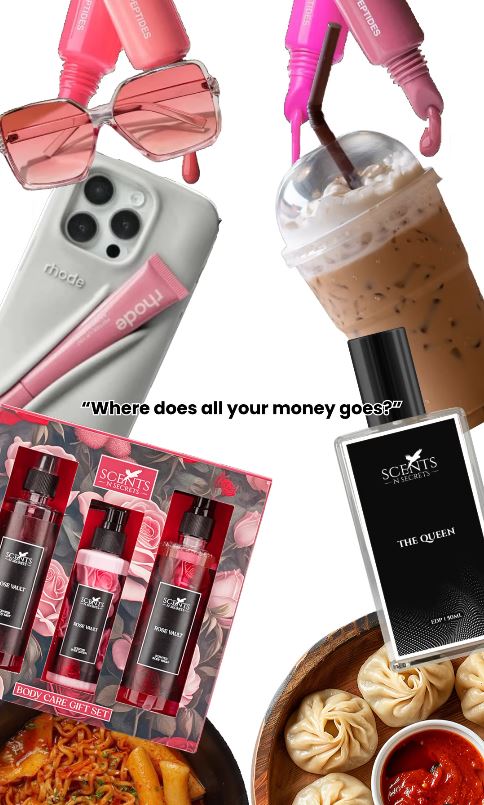
Cultural reference: Overspending is universal
Humor type: relatable
Branding level: Strong (inclusion of brand's product with other items)
Themes
Cultural References
Branding Strategies
Subtle branding: A small brand logo is present in the majority of the memes at the bottom of the template which helps in subtle recall.
Strong branding: The brand uses a comparison format to showcase its products and compare them with other items such as "prickly heat powder", "Black Cat Talcum powder", "Tang" and "Faiza beauty cream".
Moreover, the inside of Scents n Secret's store is used as a template in memes cementing brand identity and enhancing brand visibility.
The brand places its products alongside other expensive items such as Rhode lipstick and iPhone to put it in the same league as them i.e. a luxury item.
The brand's bags are placed among bags of other Pakistani brands such as "Ethnic", "Outfitters", "Monark" and "Bonanza satrangi" to give the brand the same stature and part of the experience.
Themes
Table 3 The prominent themes analyzed are stated in Table 3.
| THEMES | DESCRIPTION |
| South Asian Celebrities (Pop-culture adoption) | Inclusion of Pakistani and Indian actors in meme templates. Hania Amir, Fahad Mustafa, and Shahid Kapoor to increase engagement. |
| Promoting consumerism | Encouraging spending on superfluous luxury goods. Memes on online spending |
| Femininity | Templates using trending video of a crying little girl symbolizing the emotionality of women regarding online shopping. Feminine products like pink glasses, lipsticks, and fashion brands like Bonanza/Ethnic. |
| Relationships (family-centric) | Relatable experiences in the relationship between husband/wife, relationship with parents, and relationship with siblings |
Iride
Iride is a newly launched Pakistani ride-hailing service and has adopted meme-marketing as an early launch strategy in brand awareness and promotions. It creatively utilized memes to berate competition, establish a strong brand identity, evoke cultural resonance, and relate to the issues of car drivers.
Despite only providing 3 months of content due to being fresh in the market, the available content revealed meaningful themes and insights that shed light on a unique approach to marketing. The marketing strategy utilized memes as an offensive tool, this made the approach more experimental, and novel as compared to other brands.
Humor, Style, and Tone
The humor is created through sarcastic remarks, wordplay, and cultural relatability. The approach includes offensive jabs at competing services like Yango, Careem, and Indrive whose names have been altered for mockery i.e. "Haleem", "Mango", and "Endrive". Using the hijacking scene from the film "Captain Philips" to represent Iride as the dominant character and other brands as weak.
Much of the humor is also centered around local stereotypes like accents and relatable experiences during Ramadan. This approach gives their content cultural relatability to Pakistani audiences.
A more prominent approach is the creation of a brand mascot i.e. "Iride Man", a masked vigilante with a mustache, and the brand's logo the suit which is clearly inspired by Batman. The mascot is the physical embodiment of the brand and makes it more human. It is a humorous take on the Batman character who is already famous in pop culture. The aural analysis points to the use of trending audios like "tab tab tabi" and popular songs like "Departure Lane by Talha Anjum". These audio tracks are appealing to the online Gen-Z.
Intertwined with humour is the brand's unique selling point towards potential drivers which is of 0% commission. This is an attempt to attract riders and place the brand as being driver-friendly.
Given below is a sample of the brand's meme and its analysis.
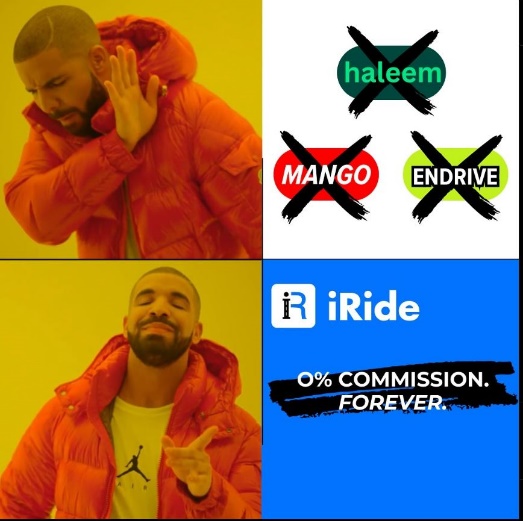
Cultural reference: brand names, Haleem, Mango (Widely Cultural)
Humor type: Sarcasm - Wordplay
Branding level: Strong
Themes
Cultural References
The brand uses cultural anchoring by poking fun at local stereotypes like the accents of the people of Lahore. Relatable experiences during Ramadan like girls having to do all the house chores while boys wait for iftar, the life of hostilities, and the pressure of jobs are also subjects of humor. By relating to the youngsters' need for jobs, the brand poses itself as a solution and a tempting income source.
There are also pop-cultural references like imitating the character of Batman, using Simpsons clip as a meme template, popular songs like Departure Lane by Talha Anjum, and trending audios like tab tab Tabi heavily resonate with Gen-Z audience.
Branding Strategies
Subtle branding: In some memes, the brand establishes itself through its small-sized logos placed on various objects such as prayer caps but it's not central to the joke and is only present for brand recall.
Strong branding: In the majority of the memes, the brand promotes itself heavily through the mascot "Iride Man" and the placement of a large logo on the wall. Moreover, it mocks its competitors through the use of its brand colors and misspelled names. Along with berating competitors, Iride promotes its unique selling point of 0% commission and weekly subscription offer in their memes.
Using the "Iride" mascot, the brand humanizes itself and gives the audience a character to connect with. The similarity with Batman makes it a familiar pop-culture reference that is already appealing to millennials and Gen-Z audiences.
Themes
Table 4 After thorough analysis, the following themes were discovered. Stated below in Table 4.
| THEMES | DESCRIPTION |
| Offensive strategy | Poking fun at competitors like Yango, Careem, and Indrive by first identifying them with their brand colors and then deliberately misspelling their names. |
| Pop-culture references | Popular songs like Departure Lane by Talha Anjum "Iride man" mascot which is an imitation of Batman Scene from the movie "Captain Philips" |
| Promoting unique selling point | Positioning Iride as a beneficial income source for youngsters that don't take commission and offers easy weekly subscription offers to its drivers. |
| Cultural relatability | Light-hearted takes on relatable experiences in Ramadan |
| Brand recognition strategy | Using the "Iride" mascot, the brand humanizes itself and gives the audience a character to connect with. This approach enhances brand recognition. |
The Cake Kitchen
The Cake Kitchen Official is a small-scale baking brand that uses Instagram for the promotion of their cakes. They occasionally utilize memes to increase engagement, build relatability, and appeal to younger audiences.
Humor, Style, and Tone
The Cake Kitchen uses light-hearted comedy to appeal to younger audiences. The humor is playful consisting of wordplay, sarcasm, visual puns, and pop-culture references. They involve baking as a subject of humor by poking fun at amateur baking struggles and cake-ordering issues. The brand also uses memes to flaunt their baking expertise and inform about their prices in a non-conventional manner. The brand's tone is subtly promotional, light-hearted, and playful directed at a younger audience.
A sample meme and its analysis are stated below.
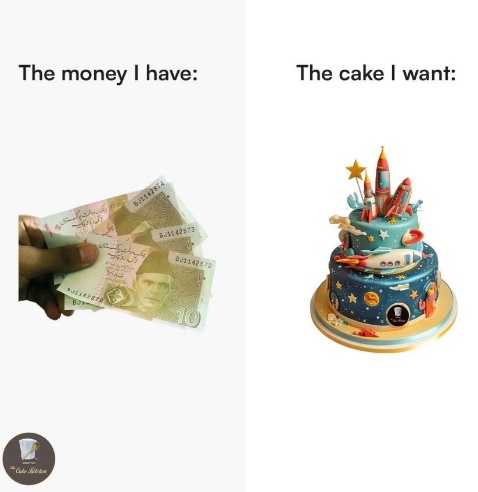
Cultural reference: Pakistani currency notes
Humor type: Relatable - self-depreciating
Branding level: minimal
Themes
Cultural References
The memes use pop-culture references such as an image from the cartoon "SpongeBob", and "Jadoo" characters from the Bollywood film "Koi Mil Gya" which are admired by youngsters.
Local references are also present such as the use of 10 Rupee Pakistani currency notes, and political figures such as Imran Khan, Rehman Malik, and Bilawal Bhutto.
Use of Roman Urdu in meme text.
These references provide The Cake Kitchen with a South Asian identity specifically Pakistani enhancing relatability and familiarity.
Branding Strategies
Strong branding: In half of the memes, the brand promotion takes center stage either by discussing their expertise in baking, their prices or their being customer friendly. The brand's name is part of the meme text, and the brand logo is present in the majority of the memes.
Table 5 Themes
| THEMES | DESCRIPTION |
| Pop-Culture references | Pop-culture references like 'SpongeBob' and the film 'Koi Mil Gaya' |
| Baking | Amateur baking attempts vs professional Brand promoting baking expertise |
| Local References | Pakistani currency Note, Pakistani politicians |
| Customer engagement | Establishing the brand as customer-friendly Understand customer's financial limitations |
| Budget versus buying desire | Relating to young customers who lack the spending power to buy expensive custom cakes |
| Promotion and Pricing | Promoting custom cakes and informing about cake pricing |
Crumble Pakistan
Crumble Pakistan is a local baking brand that has employed meme-marketing as a core strategy for brand awareness, audience engagement, and visibility. A thorough analysis of their memes sheds light on how Crumble Pakistan has extensively utilized memes as a tool for staying relevant among Gen-Z's, catering to experiences of the youth like job struggles, family expectations, and relationship struggles. Moreover, creating brand characters like "Meowbaksh" which is borrowed from a meme but has become the face of Crumble Pakistan has enhanced recognition among the meme-literate. The brand also does political satire on the country's ongoing events.
Additionally, Crumble Pakistan integrates its logos, application, and products creatively in its memes by creating personas, developing brand-specific linguistics like "Cookiyan", placement of their cookies and ice-cream cups in the memes. Much of the memes are brand-centric and the humor style is relatable, uses wordplay, sarcasm, surrealism, and pop culture references, and has absurdist elements like cats and dogs personified as humans. Moreover, the brand also uses its own employees as meme subjects to enhance brand recognition and create this in-group dynamic among its followers.
Humor, Style, and Tone
Crumble Pakistan employs the following humorous styles:
The brand uses storytelling to create humor e.g. The character "Meowbaksh" and several other characters represented through cats and dogs from different memes are put into a narrative based on varying situations. An example of this is "Meowbaksh on the popular TV show Shark Tank.
The aural analysis points to the use of South Asian music like "Aankhen meri har jagah dhunden tujhe" by Vishal Sharma, "Choo lo" by Local Train, "Tere nainon mein" by Bilz and Kashif. Such a choice of audio makes the brand more Gen-Z-centric.
Given below is a sample of the brand's meme analysis.
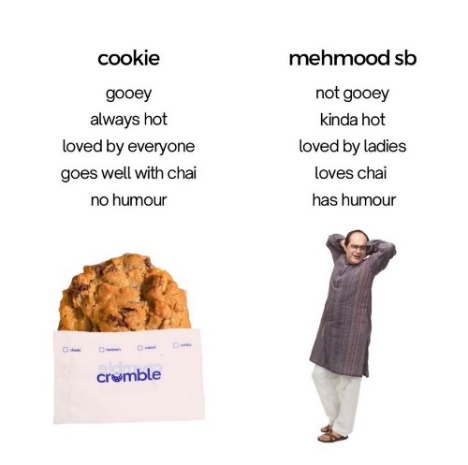
Cultural Reference: Mehmood Saab (a character from the Pakistani drama Bulbulay)
Humor type: absurdism - pop culture
Branding level: Strong (product placement and promotion of its quality)
Themes
Cultural Reference
Crumble content relates to South Asian audiences as it consists of:
Branding Strategies
Strong branding: The brand heavily utilized memes to establish its identity, promote products, integrate brand-specific lingo, make employees part of the memes, and create brand personas to increase brand recognition and give the audience something to connect with. It removes the layer of artificiality and makes the brand feel like someone alive, someone with a unique personality.
Another prominent aspect of the brand's meme strategy was their use of company and employee memes which help the brand create an in-group dynamic where the audience feels part of the group. By creating a brand character "Meowbaksh", the brand has created an identity for the audience to connect with. It helps in making funny narratives and enhances brand awareness.
The brand merged its products with other conventional food items, for instance in memes about Iftar, the brand placed its cookie box with conventional iftar items like Tang, Rooh Afza, Samosas, etc. This made their products become part of the usual iftar experience and posited it as a good choice for iftar.
There is direct product placement in memes such as comparison memes where the Crumble cookies are being compared to the Pakistani cricket team and Bulbulay character. The humorous and absurdist elements help to subtly promote their cookie's quality in a non-conventional manner. They also utilized memes for promotion of their mobile application "Crumble Pakistan".
Cultural integration like references to Pakistani actors, films, drama, South Asian music, and political situations helped them relate to Pakistani audiences.
Themes
Table 6 The themes derived from the analysis are listed in Table 6 below.
| Themes | Description |
| Product Placement | Placing brand bags, cookies, and cups in the meme. |
| Brand Characterization | Turning a meme into a brand character "Meowbaksh". |
| Product integration with already popular items | Relating the products with already popular food items. |
| Pop Culture References | Pakistani drama, film, and actors. South Asian music. Anime template |
| Relationships | Sibling relationships Romantic struggles Family dynamics Generational gap |
| Gen-Z Centric | Use of Gen-Z-related slang like "get cooked". Reference to contemporary singers like "Talha Anjum" and "Departure Lane". Job-seeking struggle of youth. |
| Online communication | WhatsApp chats, voice mails, Online shopping |
| Absurdist elements | The use of absurdist elements like cats and dogs as human characters is achieved through editing. Representing food items as human beings through face swap editing. |
| Brand identity | Memes centered around the company and employees. |
| Cultural references | Rooh afza, Kashmiri tea, Tang, pakoras, samosas, Cocomo, ARY news, Pakistan cricket team. |
| Political Satire | Poking fun at internet disruption by the govt. In the country. |
| Storytelling | Creating narratives with absurd situations such as food items represented as women tempting the main character and the character "Meowbaksh" on Shark Tank. |
Discussion
The analysis of the 87 memes collected from the 5 brands (Table 1) shed light on creative and novel ways of utilizing memes in the field of marketing and that meme-based advertising is not just a tool for humor and engagement but also for product placement, crafting brand identity, developing narratives, targeting specific demographics, cultural development, creating in-group humor and product promotions.
Targeting Specific Demographics
All five brand-crafted memes with the objective of reaching their target demographic. Dari Mooch oriented their memes towards issues concerning male users. Scent's n Secrets memes centered around the feminine experience. Crumble Pakistan tried to identify itself with the Gen-Z population through the usage of absurdist elements, slang, issues concerning youth, and the use of pop-culture references. This aligns with Madrid (2023) and NOE (2023) who stated that Gen-Z shows attraction to absurd content as it makes them feel that the brand is authentic and not artificial as they are with conventional advertising. Moreover, Gen-Z's show appeal towards content based on out-of-the-box ideas and are relevant. The Cake Kitchen used light-hearted humor as their target demographic is teens, pre-teens, and parents. Their humor was based on wordplay, reference to the cartoon SpongeBob and the film "Koi mil Gya". Unlike other brands, their content doesn't use self-depreciation, music, relationship struggles, or target other brands but rather they keep it light-hearted.
Memes as an Offensive Strategy
Iride, the newly launched ride-hailing app, used memes not only to promote its unique selling point but also to berate the competition. Using Shifman's (2013) 2 dimensions of content and form, we observe how Iride used the opposing brand's colors and misspelled names (wordplay) to take a jab at them. This approach makes the brand look bold and witty but also immature. The choice of deliberately altering competitors' names and using their colors aligns with the idea (Geeraerts, 2018) that to evoke emotions, a display of verbal and visual creativity is required such as wordplay or use of iconography i.e. "Captain Phillips" hijacking scene to establish dominant and weak characters. Haq ((2021) explains how humor is used in the Pakistani social media landscape to form alliances and distinctions. This helps the brand in contrasting one's identity, values, and ideas with the opposing brands and ridiculing them through humor rather than anger or violence.
Product Promotion and Brand Awareness
Brands employed a mix of approaches when displaying their brand logo and products in their memes. Crumble Pakistan used strong branding of their logo and products to enhance brand recognition. The use of brand-centric characters such as "Meowbaksh" and "Cookie Cat" were observed. Moreover, the use of the comparison format in memes was used to contrast products. The memes were narrative relying on relatable scenarios, this corresponds to (Razzaq, 2023) who stated that brand-prominent meme marketing is much more engaging and attracts the audience, it is supported by the idea that if narrative in the meme exists, the viewer doesn't perceive it as a persuasive marketing tactic as seen in conventional adverts.
Additionally, brands such as Iride also used narratives to elucidate their ideas, for example, a meme featured a father talking about his hosteler son who wants to look for a job. Another advantage of narrative in prominent brand meme marketing is that with repeated exposure to brand logos, products, and characters, associations are built in the viewers' minds regarding the brand and the story; this is most effective in the case of viewers who have low brand knowledge (Razzaq, 2023).
Crumble Pakistan placed their product i.e. cookie box alongside traditional iftar items, creating the notion that cookies can be a part of the iftar meal. This was a method of incorporating a product in the array of already popular products. Scent's N Secrets placed its products along with luxurious products such as Rhode lipsticks and iPhone to give their product the same stature. This makes their products desirable and part of the luxury experience. Bagaskara (2023) also found that self-congruity and brand loyalty are linked to each other.
"Dari Mooch" and "Scents n Secrets" used a mix of subtle and strong marketing techniques in their content. The majority of the memes had their logo placed at the top or bottom of the meme template. Obvious product placement was absent in the majority of the memes but rather the theme of the memes indirectly relates to ideas the brand wants to propagate, for example, in a meme by Dari Mooch, a woman left a man because he had shaved his beard. The humor here relied on the idea of female validation and the South Asian standard of masculinity. This aligns with Bagaskara (2023) who states that a brand's narrative and its alignment with the consumer's own values and ideals foster brand loyalty and emotional attachment.
Use of Cultural References
All the brands under the sample utilized cultural elements in their memes to enhance relatability; use of Roman Urdu text, South Asian dramas and films as meme templates, South Asian music, mention of local products and brands, pop-culture references, use of local music and trending audios were present. Such choices were all relevant to the Gen-Z audience. This corresponds with (Madrid, 2023) who explains that Gen-Z audiences are more attracted to content that feels authentic and is relevant to them. There was also the use of religious elements like prayers, iftar, and relatable experiences during Ramadan. Their use pointed to an intention of appealing to the South Asian's connection with religion.
All the above employment of cultural references allowed these memes to be relevant to their demographics. This approach aligns with Scott (2021) and Geeraerts (2018) who stated that memes are metaphors for relatable situations; to decode memes requires shared social knowledge and memes can have multiple layers of interpretation.
Crafting Characters Through Memes
Iride created a mascot by the name "Iride Man", the character wears a costume that is a clear imitation of Batman but with a mustache and the brand's logo on the chest. In one of the reels, the character has been placed into a narrative where he is chasing down a villain as the Batman movie soundtrack plays in the background. Such a character is not only humorous but also provides the brand with a face people can relate to. This aligns with (Reddy, 2024) who explains how brand mascots have a strong relation with consumer purchase intentions. This corresponds with Iride's approach towards building the "Iride man" character for self-identity and audience engagement.
Crumble Pakistan has also crafted the character of "Meowbaksh"; the identity has been created by the brand to evoke humor through comical narratives. The character is placed in relatable and whimsical situations; these situations aren't only humorous but give the brand an avenue for promoting brand products in an unconventional and non-traditional setting. This aligns with (Razzaq, 2023) which states that narratives in advertising allow for more convincing and authentic ways of promoting which causes the viewer to lower their mental guard as they no longer perceive it as a persuasion tactic as done by traditional forms of advertising.
Gen-Z Engagement
The meme-based content created by these brands, especially by Crumble Pakistan, Scent's n Secrets, and Dari Mooch is centered around the struggles and experiences of Gen-Z. The meme content of these brands revolves around relationship struggles, sibling relationships, family values, and expectations, the pressure of finding jobs, romantic life, validation of the opposite gender, and superfluous spending on consumer products. This allows the Gen-Z to see themselves and their life in these memes. Bowo (2024) states that memes cater to the emotional, social, and informational needs of the Gen-Z demographic. This approach strengthens the connection between Gen-Z consumers and these brands.
Conclusion
This study analyzed the meme-based content of 5 brands collected through their Instagram accounts. The study was explorative, designed on qualitative grounds utilizing digital content analysis supported by multi-modal analysis. A total sum of 87 memes were part of the sample which not only included images but also reel format posts. The multi-modal analysis consisted of Visual analysis, Textual analysis, Aural Analysis, and Gestural analysis. The study's objective was to understand how these Pakistani brands utilized memes for the propagation of ideas, promotion of products, and brand awareness. Analysis of humor style, presence of cultural references, and branding strategies shed light on patterns and the way through which brands employ memes to reach their target demographic.
The brands utilized memes to engage with their young and meme-literate audiences. Humor styles included self-depreciation, relatability, absurdity, use of wordplay, visual puns, and pop-culture references. Music played a major role in making the content culturally enriched and adding emphasis to the joke. Pop culture references were used to engage the South Asian audience.
There was a mix of strong and subtle branding done by these brands such as some memes contained the brand logo (Dari mooch & Scent's n Secrets) on the top or bottom of the meme not affecting the overall joke and letting the meme subject take the centre stage. Meanwhile, in other memes, the product placement was present and took center stage in the joke (as done by Crumble Pakistan & Iride). Some memes placed the brand's products alongside luxurious items to grant their own products the same stature and make them desirable. On the other hand, some memes placed the brand's products alongside already popular items to make their products part of the experience. Other memes mentioned local Pakistani products such as 'Tang',' Rooh Afza', 'Kashmiri tea', 'Cocomo', 'BlackCat talcum powder', 'Faiza beauty cream' and 'prickly heat powder'. Pakistani clothing brands such as "Ethnic", "Outfitters", "Monark" and "Bonanza Satrangi" were also mentioned as producing relevance with Pakistani audiences. By placing the brand's products with popular items, the brand capitalized on their popularity to promote its own products in an unconventional manner.
Two brands (Iride & Crumble Pakistan) created characters to connect with the audience; characters were used in meme narratives that allowed the brand not only to engage with the audience through humor but also to promote products and increase brand awareness.
The brands had centered their memes around topics that dealt with experiences and struggles of the youth i.e. Gen-Z such as romantic struggles, family values and expectations, job searching, sibling relationships, romantic struggles, and financial challenges. By using such topics, the brands posed themselves as empathetic which leads to fostering meaningful connection with their audience.
Limitations
This study was conducted around the Pakistani cultural context, thus the style and type of humor, the cultural references, and the branding strategies might be exclusively in relation to the Pakistani audiences and not be applicable in other cultures/nations.
References
- Abbas, Q., Ahmad, R. W., Hassan, A. A. U., & Ahmed, D. (2024). Vlogging Culture in Pakistan and Its Impact on the Society. Competitive Research Journal Archive, 2(04), 388-402. https://thecrja.com/index.php/Journal/article/view/71
- Abbas, Q., Shahzad, F., & Sadiq, T. (2025). Psychological Effects of Violence Shown in Media Content on Children: A Study of Parents’ Perception. Media and Communication Review, 5(1), 34-55. https://doi.org/10.32350/mcr.51.03
- Razzaq, A., Shao, W., & Quach, S. (2024). Meme marketing effectiveness: A moderated-mediation model. Journal of Retailing and Consumer Services, 78, 103702. https://doi.org/10.1016/j.jretconser.2023.103702
- Ali, T. S. (2019). The Use of Internet Memes on Social Media Platforms. Faculty of Arts Journal, 16.
- Eser, A. (2024, July 24). Gen Z social media statistics: Insights into digital behavior trends. WorldMetrics. https://worldmetrics.org/gen-z-social-media-statistics/
- Shahzad, F., & Siraj, S. A. (2020). Analysing intermedia agenda setting influence between social media and electronic media: A perspective from Pakistan. Journal of Peace, Development and Communication, 4(2), 478-496. http://dx.doi.org/10.36968/JPDC-V04-I02-25
- Bowo, F. A., Anisah, A., & Marthalia, L. (2024). Meme Marketing: Generation Z Consumer behavior on social media. Jurnal Indonesia Sosial Sains, 5(02), 188–201. https://doi.org/10.59141/jiss.v5i02.995
- Iqbal, N., Arif, M. A., Abbas, Q., Mahmood, Q., Anwar, M. N., & Mansoor, M. (2025b). Green Influencers: The Power of Social Media in Shaping Eco-Conscious Communities. ASSAJ, 3(2), 402–412. https://doi.org/10.55966/assaj.2025.3.2.001
- Kemp, S. (2024, February 23). Digital 2024: Pakistan. DataReportal. https://datareportal.com/reports/digital-2024-pakistan
- Madrid, V. (2023). Advertising and humor (ScholarWorks, 20). https://scholarworks.calstate.edu/concern/projects/4q77g0893
- Cheung, M. L., Pires, G. D., Rosenberger, P. J., & De Oliveira, M. J. (2020). Driving consumer–brand engagement and co-creation by brand interactivity. Marketing Intelligence & Planning, 38(4), 523–541. https://doi.org/10.1108/mip-12-2018-0587
- Kiljańczyk, M., & Kuczamer-Kłopotowska, S. (2023). From humor to strategy: An experimental survey on internet memes in social media marketing. European Management Studies, 27. https://bibliotekanauki.pl/articles/32083844.pdf
- Rathi, N., & Jain, P. (2023). Impact of meme marketing on consumer purchase intention: Examining the mediating role of consumer engagement. Innovative Marketing, 20(1), 1–16. https://doi.org/10.21511/im.20(1).2024.01
- Noe, I. (2023). Clicking into the absurd: Analyzing the effectiveness of absurdity in advertising (p. 55). https://hdl.handle.net/1794/29019
- Polimeni, J., & Reiss, J. P. (2006). The first joke: exploring the evolutionary origins of humor. Evolutionary Psychology, 4(1). https://doi.org/10.1177/147470490600400129
- Bagaskara, R., & Marsasi, E. G. (2023). The effect of Self-Congruity and trust toward brand loyalty based on Image Congruity Theory. Indonesian Journal of Economics and Management, 3(2), 231–244. https://doi.org/10.35313/ijem.v3i2.4726
- Fernandez, R., Uy, C., & Manalo, R. (2024). EXPLORING THE EFFICACY OF DIGITAL MEME MARKETING CAMPAIGNS IN GENERATING LEADS WITHIN THE GENERATION Z DEMOGRAPHIC. Journal of Computational Innovation and Analytics (JCIA), 3(1), 37–59. https://doi.org/10.32890/jcia2024.3.1.3
- Hussain, S., Shahzad, F., & Saud, A. (2021). Analyzing the state of digital information warfare between India and Pakistan on Twittersphere. SAGE Open, 11(3). https://doi.org/10.1177/21582440211031905
- Hussain, S. (2022). Analyzing media–government relations on policy issues in the semi-democratic milieu of Pakistan. Journalism, 23(8), 1770-1788. http://dx.doi.org/10.1177/1464884920969086
- Scott, K. (2021). Memes as multimodal metaphors. Pragmatics & Cognition, 28(2), 277–298. https://doi.org/10.1075/pc.21010.sco
- Shifman, L. (2013). Memes in a Digital World: Reconciling with a Conceptual Troublemaker. Journal of Computer-Mediated Communication, 18(3), 362–377. https://doi.org/10.1111/jcc4.12013
- Shifman, L. (2013). Memes in Digital Culture. The MIT Press .
- Malodia, S., Dhir, A., Bilgihan, A., Sinha, P., & Tikoo, T. (2022). Meme marketing: How can marketers drive better engagement using viral memes? Psychology and Marketing, 39(9), 1775–1801. https://doi.org/10.1002/mar.21702
- Tama-Rutigliano, K. (2018, August 10). Memes: A digital marketing tool for every industry. Forbes. https://www.forbes.com/sites/forbescommunicationscouncil/2018/08/10/memes-a-digital-marketing-tool-for-every-industry/?sh=5e4511ba2664
- Haq, I. U., Hussain, B., & Saeed, M. (2021). The role of humor in understanding the trolling behavior of social media users in Pakistan. International Journal of Media and Information Literacy, 6(2). https://doi.org/10.13187/ijmil.2021.2.321
- Vardeman, C. (2023). Advertising to Gen-Z college students with memes? A focus group study. Qualitative Market Research an International Journal, 27(1), 1–18. https://doi.org/10.1108/qmr-05-2023-0073
- Reddy, V. V., & Singh, D. (2024). Creating connections through characters: A study of brand. Advances in Decision Sciences, 18.
- Yang, G. (2022). Using funny memes for social media marketing: The moderating role of Bandwagon Cues. Journal of Promotion Management, 28(7), 944–960. https://doi.org/10.1080/10496491.2022.2054904
Cite this article
-
APA : Abdullah., Abbas, Q., & Rehman, M. M. U. (2025). A Multi-Modal Discourse Analysis of Meme-Marketing Strategies Used by Pakistani Brands on Instagram. Global Social Sciences Review, X(II), 196-215. https://doi.org/10.31703/gssr.2025(X-II).16
-
CHICAGO : Abdullah, , Qamar Abbas, and Muhammad Munib Ur Rehman. 2025. "A Multi-Modal Discourse Analysis of Meme-Marketing Strategies Used by Pakistani Brands on Instagram." Global Social Sciences Review, X (II): 196-215 doi: 10.31703/gssr.2025(X-II).16
-
HARVARD : ABDULLAH., ABBAS, Q. & REHMAN, M. M. U. 2025. A Multi-Modal Discourse Analysis of Meme-Marketing Strategies Used by Pakistani Brands on Instagram. Global Social Sciences Review, X, 196-215.
-
MHRA : Abdullah, , Qamar Abbas, and Muhammad Munib Ur Rehman. 2025. "A Multi-Modal Discourse Analysis of Meme-Marketing Strategies Used by Pakistani Brands on Instagram." Global Social Sciences Review, X: 196-215
-
MLA : Abdullah, , Qamar Abbas, and Muhammad Munib Ur Rehman. "A Multi-Modal Discourse Analysis of Meme-Marketing Strategies Used by Pakistani Brands on Instagram." Global Social Sciences Review, X.II (2025): 196-215 Print.
-
OXFORD : Abdullah, , Abbas, Qamar, and Rehman, Muhammad Munib Ur (2025), "A Multi-Modal Discourse Analysis of Meme-Marketing Strategies Used by Pakistani Brands on Instagram", Global Social Sciences Review, X (II), 196-215
-
TURABIAN : Abdullah, , Qamar Abbas, and Muhammad Munib Ur Rehman. "A Multi-Modal Discourse Analysis of Meme-Marketing Strategies Used by Pakistani Brands on Instagram." Global Social Sciences Review X, no. II (2025): 196-215. https://doi.org/10.31703/gssr.2025(X-II).16