
- To analyze the representation of gender-binary relations in Pakistani television commercials;
- To explore the semiotic portrayal of gender positioning in Pakistani television commercials;
- To highlight the representation of gender socialization patterns in Pakistani television commercials.
- How Pakistani Electronic Media represent gender binary relations in television commercials?
- How gender roles and socialization patterns are portrayed in Pakistani television commercials?
- The ratio of women appearance in news section carries less representation that is 9% in print media section, 5% in radio and 0% in television respectively. The appearance in televised content pertaining to celebrity participation is totally negligible in Irish and British media research conducted by Ross andS Lester (2003).
- The percentage of female victimization likely falls under the domestic violence against women that is almost 26% in newspapers, 28 % in radio and 24 % in television contents respectively.
- Females performing domestic roles have been described three times more than men. The excessive representation of women in house generates a discourse of women domestication.
- Saussure et al., (1983) defined semiology as a field of science in which all signs function as an ingredient of social life.
- Barthes (1977) described that semiology is a system of signs that includes objects, pictures, non-verbal expressions, musical sounds and their interrelationship.
- Eco (1976) states that semiotics has deep connection with all things which can be considered as signs. He posits that semiotic theory must discuss how signs are generated and interpreted. For this purpose, a message whether verbal, non-verbal or written undergoes a medium and channel to reach its target audience. To understand it, a sign with established characteristics is required.
- Fiske (1990, p.40) defined semiotics as "the study of signs and the way they work."
Abstract
The current study investigates the prevalent gender-binary narrative in Pakistani television commercials. It tends to portray the dominant gender representational mechanisms which are implicitly employed by the advertisers. Television commercials, having the power to (re)frame the ideology of larger audience through visual/linguistic content and agency to pave the way for social change have become one of the most viable social institutions of disseminating information to a wider audience. The theoretical underpinning of the study is based on the theory of semiotics outlined by Dyer in "Advertising as Communication". Semiotics is considered a critical tool for investigating meaning making process in media discourse because of its wide-ranged acceptability and reliability. The data for the current study comprise television commercials which are broadcast on popular Pakistani television channels. The sampling technique is purposive in nature including only those commercials which largely reflect gender representation. The study finds the commercials presenting layers of meanings at symbolic level of semiotic modes where men and women are displayed in stereotypical manner, subscribing to patriarchal structures.
Keywords
Semiotics, TV Commercials, Gender-binaries, Representation
Introduction
The modern era is reliant on technology where media forms frame the ideology of people. According to Cook (2005), we encounter media discourse(s) on daily basis which work as one of the social institutions in all contemporary societies, paving the way to social change through its powerful ideology. Television commercials are viable source of constructing and (re)presenting gender binaries through marketing of the products. These commercials generate a secondary narrative about the underlying power relations. Such power patterns are reflected through visual/textual modes. The commercials entail human representation as a source of cultural text for the advocacy of products. Roy (1998) views that commercials not only provide the information about the product or human subjects (behavior, manner, action and roles), but they also give an insight into power relations as well as gender roles and the paradigms of their authority.
Gender representation is a social construct where the voices of masculinity and femininity are materialized through different genres of media discourse. Such manifestations of gender representational mechanisms are context dependent and make gender positioning/binaries a topic of genuine research within a socio-cultural paradigm. The studies conducted in western context show double layered and contrastive results. The early researches in west represented women in an oppressed and subjugated manner. Their achievements and responsibilities were neither acknowledged nor appreciated but the current trends in gender research have presented women in public domains where their efforts as members of society are displayed and acknowledged. Referring some recent studies in Pakistani context, such as, Khan and Ullah (2014) highlighted some stereotypical results as far as gender representation is concerned. With this aim in mind, the study highlights the prevalent gender narrative in media discourse especially in the latest television commercial.
Research Objectives:
The study attempts:
Statement of the Problem:
Research in the paradigm of gender has always remained an area of immense interest for the scholars all over the world. According to Courtney and Whipple (1983), most of the studies conducted in western context have postulated variant results where the representation of men/women has been reported as stereotypical but the latest studies have shown women in authoritative positions in public domains. Studies in Pakistani context such as Rasul (2000) and Shahwar (2013) also showcased gender binaries. These studies have shown women as a marginalized gender in different domains of social interaction. The current study intends to highlight the existing gender patterns in Pakistani televised content and seeks to get an insight into whether the current gender binaries subscribe to or subvert the conventional gender norms. Roy (1998) suggested that there is deficiency of a critical research pertaining to gender representation in developing countries such as Pakistan, India and Bangladesh. That is why, the current research explores as to how Pakistani electronic media commercials (re)present gender relations through visuals and signs at symbolic level.
Significance of the Study
This study utilizes a new method of analysis for a detailed interpretation of the commercials at connotative and ideological level. It provides a unique and in-depth approach towards critically analyzing the commercials by focusing each and every textual/verbal/symbolic feature incorporated in the televised advertisements. Advertising contains a complete process of signification where the above-mentioned signifier and signified are semiotically decoded. The significance of this study also lies in its focus on how semiotic in-depth interpretations unfold gender portrayal in the Pakistani televised advertisements. This research may benefit the policy makers for devising strategies of gender participation in several paradigms such as sports, academia and occupational domain. It may also be valuable for the academic practitioners, at university level, in order to inculcate pedagogic media skills among the students.
Research Questions
Delimitations of the Study
The research is limited to the commercials which are aired on some of the most popular Pakistani television channels. The content pertaining to foreign commercials has been excluded from the overall population, selected for the study. A total number of fifty commercials were brought under consideration for the analysis. The overall population of the study was divided into five different categories where each category had ten commercials in it. The time frame for the collection of required data comprises one complete year, that is, 2016 to 2017.
Literature Review
This chapter has been divided into different sections for the better theoretical understanding of the variables of this research. It focuses on importance and historical overview of the media in the portrayal of gender. Advertisements, whether print or commercial, play vital role in representation and construction of gender identity and their image in a social context. This part reviews the representation of men/women and their socially assigned roles in print media and electronic media with reference to researches carried out by scholars internationally in general and Pakistani context in specific. Moreover, the last part of the section provides theoretical perspective on the underpinnings of the study.
Advertising in Pakistani Context
Advertising in Pakistani context has a long history referring to the partition of sub-continent into Pakistan and India. It was limited to some urban areas due to lack of resources and print media was most popular medium among the other genres of media discourse. Media development in Pakistani context was a gradual process and the advancements were made in four phases.
According to McNair (2003), advertising is a paid source of selling or buying products where human representation is an essential part of communicating the adverts voice. Apart from promotion of the products, gender representation in the advertisements develops another secondary discourse of binary power relations. The representation of gender is purely social construct and these commercials reveal socially assigned gender roles and position/socialization. Cook (2005) views television advertising becoming an increasing popular medium of entertainment where socially defined gender power relations are reflected in the commercials.
Gender Representation in Media
Media has acquired a status of social institution and is also considered one of the pillars of democracy. It is a reliable source of propagating information within state as well as across the world. Apart from sharing news, it highlights the socially dominant power structures and actualizes the socio-cultural norms by making the audience accept its implicit narrative within media content. Gender representation is a sub-topic of investigation in media content. The following sections explain as to how media, in any of its form, highlight gender power patterns as far as binary relations, roles/positioning and socialization are concerned.
Lippmann (2017) considers exploring the relationship between media (Print, electronic, social, embedded, and digital) and gender representation a point of debate and research since 1970's. Researchers started investigating the aforementioned phenomenon after the boom of feminism which highlighted the disparities in the treatment and roles assigned to men/women by media. He throws light on how print media presents the socio-cultural image of gender reality. People develop their understanding on the basis of what they have perceived from media. The power and hegemony of media in interpreting information cannot be overlooked. Media has been regarded as fourth pillar of any state due to this reason.
Gender Representation in Print Media
The importance of print media can never be overlooked being a cheap and easily available source of information, entertainment and education. Print media images and text not only strengthen the beliefs but also represent socio-cultural values, favoring dominating structures. Hall (1997) argues that print media text shares cultural meaning through visual or linguistic signs. Representation of cultural meanings shared with society can only be propagated either via images or linguistic representation. These images cultivate culturally constructed meanings at symbolic level.
Representation of gender in print media can be viewed from multi-perspectives, such as, analyzing the ratio of men and women in the workplace advertisements, in sports section, in news section and magazines. Traditionally, gender depiction refers to presentation of men/women where men are given their due rights and powers while women are deprived of their rights. They are shown subjugated/suppressed by the male dominant voices and are positioned low in gender relations. Media Development and Diversity Agency MMDA (2008) declare media as one of the important pillars of democracy. It further reports that inequalities and biased cultural distribution of power has been naturalized by media through its different genres like print, electronic and social media.
The very first study conducted on the gender stereotyped image was on print media content. The images in newspapers and magazines disseminate gender stereotyped ideology. Courtney and Lockeretz (1971) affirm,
The advertisements reflected four types of stereotypes; A woman's place is in the home, Women do not make important decisions or do important things, Women are dependent and need men's protection, and Men regard women primarily as sexual objects (p. 94).
The study conducted by Adams (2003) also dealt the same theme of women representation in Print media. The study was based on Delta William of Missouri and attempted to answer two main questions. The first question sought to analyze whether or not sexist patterns still exist in the 21st century's media portrayal of gender. The second question in particular dealt with the understanding of language which is used to promote sexist beliefs for the depiction of genders. In order to answer the research questions and to generate a sound discussion, Adams (2003) tried to correlate both language and print media's representation of women. She strengthened the existing views with regard to gender representation in print media by relating her study with previous researches.
Gender Representation in Electronic Media (Commercials)
Arendt (2010) conducted his study on the basis of 'Cultivation Theory'
propounded by Gerbner's (1976). The main difference between both studies lies in the data used for analysis that is television content and print media content. Gerbner et al. (1976) investigated that television content has been a great reason and one of the primary sources of depicting gender socialization, providing information and entertainment. Arendt (2010) investigated the effects of gender cultivation theory and individual's exposure to electronic media with regard to societal behaviors, perceptions and attitude. He concluded his study on the basis of findings that the readers who were exposed to televised content had different approach towards societal subject matters as compared to the ones who were not exposed to the media. In view of these findings, it can be suggested that media in either of its form frames and sets the ideology and perception of the people who are directly linked or exposed to media sources like print media.
Similarly, Ross and Lester (2003) investigated the representation of men/women in news coverage section. They studied the representation of genders in Britain and Ireland news reports of media. It was a part of Global Media Monitoring Project (2010). This project explored the disparities and gender biases found in Irish and British Print, radio and electronic media. The findings of the study only reveal the representation of women, indicating their less number in coverage section as compared to men in diverse contexts which are as following:
Rajesh (2014) conducted a study on Indian television commercials and attempted to highlight the prevalent trends as far as gender representation was concerned. He also portrayed sensitivity of the masses towards the acceptability of such gender narrative being aired on different Indian television channels. He drew the results of his study by traditionally placing gender in their specified roles and positions. He traced the elements of society driven ideology where stereotyped representation of gender is naturalized.
Theoretical Stance of the Study
The study is based on the theory of semiotics. Some of the recent studies conducted in western and Asian context, as mentioned in previous sections, analyzed the print/televised advertisements with the help of content analysis which appears quite superficial as the content analysis only provides the ratio of gender occurrence in quantitative form. It does not provide an in-depth analysis of the semiotic modes which are employed by advertisers especially in running visuals (commercials). Contrarily, semiotic analysis offers a detailed analysis at multiple levels, such as, connotative, denotative and ideological. This analysis decodes the ideology driven codes (textual/visual) and identifies as to how these signs work to disseminate an underlying ideology. The following definitions of semiotics provide of wide range of its use:
Research Methodology
This study is qualitative in nature and also falls under the descriptive as well as explanatory paradigm of research. Polkinghorne (1983) is of the view that qualitative approach of research contains several sub-methods, such as, Discourse Analysis, ethnography, semiotics and critical discourse analysis for critically investigating the commercial to derive meanings at connotative and ideological level.
Data Collection
The data is comprised of the most repeated/viewed commercials which are being aired on popular Pakistani television channels. The data has been collected during the prime time viewership in Pakistani context, that is, from 7pm to 8 pm. The researcher has watched different television channels, such as, Geo, Ary, Hum and Express on regular basis in order to gain the required data. The commercials have been categorized into further five sections and the advertisements are brought under the relevant categories; which range from banking and insurance, detergents and cleansers, medical and personal hygiene, cellular companies and cosmetics, food and beverages to electronic and vehicle products.
Population
The population of the study comprises fifty commercials which were gathered after consistent observation of the afore-mentioned television commercials.
Sample
Since, it was very difficult to analyze all the commercials, therefore, a representative sample of five commercials has been selected from five different categories to avoid any sample bias. The rationale for selection of the commercial from each category lies in its ratio of occurrence during the prime time viewership. The researcher employed Non-probability purposive sampling technique to collect the required data.
Theoretical Framework of the Study
The theoretical foundation of this study, for critical analysis of gender binary relations in Pakistani television commercials, is based on theory of semiotics proposed by Dyer (1982). According to Dyer (1982), Jhally (1990) and Williamson (1978), the application of semiotics is an appropriate tool of investigating textual/visual codes which are employed in the commercials to communicate some underlying ideologies at symbolic level to the larger audience.
Dyer's Analytical Model
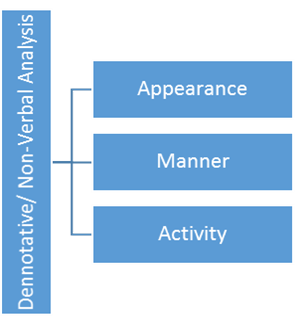
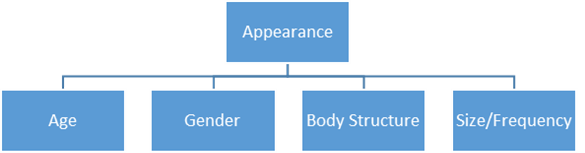
Dyer's (1982) analytical model offers analysis of the commercials at two levels, focusing denotative and connotative/ideological parameters. At denotative level, description of Manners, settings, props, activity and appearance is brought under analysis. It also brings forth some significant semiotic modes and signs (signifier/signified) which are employed by the advertisers. Whereas, connotative analysis presents the implied interpretation of pre-identified signs by relating these signs to prevalent contextual socio-cultural norms. These connotative interpretations promote certain underlying ideologies which are decoded at this level. Moreover, the textual part, such as; element of voice over, adjectives and taglines of the commercials are also analyzed at connotative/ideological level.
Denotative Analysis


Data Presentation and Analysis
The data for the undertaken study is divided into different categories, comprising human activities in diverse domains. The most broadcast/viewed commercials are screened and analyzed category-wise.
Orient Electronic Commercial


The commercial has been analyzed at two levels as per the analytical framework, discussed in methodology part.
Denotative Analysis
The commercial comprises four characters; parents, their daughter and son-in-law. The parents and other two young characters are highlighted in different domains of activity where each character is traditionally presented, performing his/her socially constituted role. The parents have been shown worried about managing the dowry of their daughter. The setting of the commercial appears an amalgam of in-door (where parents are depicted in a dialogue about the dowry items to be purchased) and outdoor (where the characters are displayed being seated in the vehicle and discussing over the electronic products in the outlet).
The physical appearance and expressions of the characters are reflective of their roles in a social paradigm. The commercial signifies the male characters taller than other female characters, highlighting gender positional value in Pakistani context. Moreover, the girl is also portrayed gleefully performing her traditional role during her reverie by offering a glass of water and some edibles to her spouse, which is symbolically meaningful. Goffman (1979) presented the same aspect that women are presented with smiling expressions and are shown willingly accepting their traditional roles. The background setting in the commercial appears natural where gender roles/paradigms of activity are also naturalized.
Connotative/ Ideological Analysis
The commercial consists of several signs which implicitly generate an underlying cultural ideology with regard to gender representation in Pakistani televised content. The key signs employed in this commercial are money, placement of characters in the car, wedding cards and edibles/glass of water. Money and the wedding cards are symbolically signify the responsibilities of father in the commercial. The said signs connote that society has endowed the financial responsibility on male members. In the commercials, the father is shown arranging money while he is concerned about the forthcoming event of his daughters' wedding. Moreover, the father, controlling the finances represents the financial stability, independence and possessions to be dominated by the male members of the society.
On the other hand, the seating placement in the car is highly symbolic and presents an underlying ideology of gender power structure. The commercial depicts two male characters being seated in the front seats and the other two female characters in the rear seats of the car. The afore-mentioned seating plan signifies the existing family patterns where the male members are placed at first position as compared to their female counterparts. Likewise, the portrayal of a male member on the driving seat semiotically generates another discourse of male supremacy and their driving power on the other gender. Such representation of gender binaries lead to promoting traditional patriarchal narrative.
The girl is placed modernly by giving respect to her expression of choice. There are certain instances in the commercial where the audience is led to believe that gender binaries and position are modernly dealt with, but the very next moment the said notions are shattered; when the edibles and glass of water are presented by the girl to her spouse during her reverie. These notions are indicative of the girls' traditional and subservient role. The girl has been shown submissively passing smiling expressions to her spouse and gladly accepting the subservient role. This emotive representation of the girl naturalizes the patriarchal dominant binary structures.
In the same manner, the background male voice-over in the commercial represents the predominant patriarchal structures which are prevalent in the Pakistani televised content. These power structures are further endorsed and materialized by placing men/women in their respective stereotyped paradigms.
Maggi Noodles Food Commercial

This commercial has also two levels in accordance with theoretical framework.
Denotative Analysis
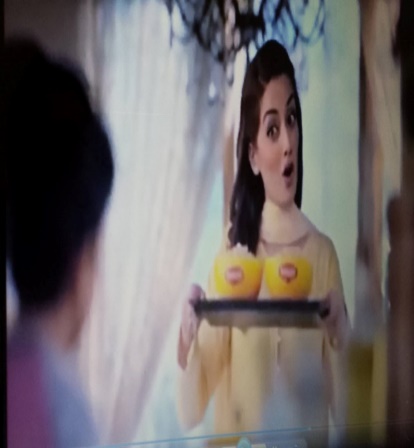
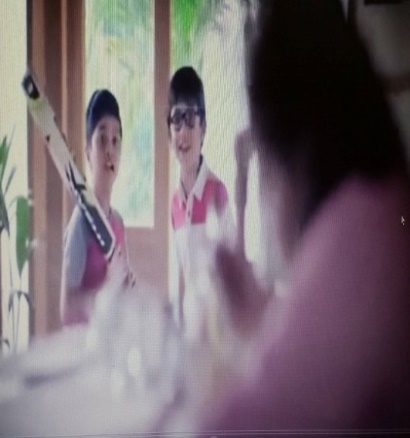
This advertised content has been screened from food and beverages category. It comprises four characters including two males and two females. Initially, the male characters (boys) are presented in the outdoor domain, whereas, the female characters (mother & daughter) are displayed within domestic paradigm. The boys are shown fighting over some matter with regard to their game. The mother is placed in the kitchen holding two maggi bowls, depicting her domain of activity. The commercials seem to be set in in-door as well as out-door paradigms but the representation of in-door activity is of higher ratio.
The expression and behavior of the characters are displayed in line with their socially acquired knowledge. The commercial reveals utilization of many props, such as, bowls and spoons and also implicitly highlights the relational value of these props with gender they are associated with. The frequency of the females' occurrence is greater than other male characters as the commercial is mostly set in domestic paradigm.
Connotative/Ideological Analysis
Signs are an integral part of the commercials where culturally constituted constructs are transmitted to larger audience with the help of several semiotic codes/modes. Some major signs incorporated in this commercial are: kitchen accessories (bowl, spoon), bat, furniture and some other domestic elements which are shown in the backdrop of the commercials. The signs of bat and bowl as attached in the commercial are evident of gender domain of activity. The relational value of bat with boys highlight that they are placed in public paradigm, whereas, the girl is presented within domestic range holding a food item. This portrayal of gender generates a stereotyped narrative of gender socialization where men are attached with laborious activities in public domain and women are displayed in domestic domain as a housewife, cook or caretaker. By showing this content, the advertisers are trying to inculcate the said gender socialization/roles notions among the broader audience. Sherrow (1996) and Woolum (1998) also reported that their study postulated the same results in the western context; where men and women are dealt with differently by allocating them variant domain of activity.
This commercial depicts binary oppositions through representing parallel characters of the same gender (mother and daughter). The mother has been shown as a model to overtly showcase the stereotyped feminine roles which are passed on to next generation. The girl is shown acquiring the same roles unconsciously which were performed by her mother. The binaries represented are made to appear quite natural to the intended targeted audience and also symbolically signify that the same patterns are to be followed by the viewers.
The manifestation of masculine and feminine voices is stereotypical in nature. The depiction of mother in this commercial valorizes the traditional part of women position in social paradigm. She has been shown nurturing and concerned about the health of her children. Moreover, she not only feels pleasure in serving her family but also affirms the conventional role of women within domestic range. Such placement of gender in this commercial seems in line with the results reported by Roy (1998).
Safeguard Soap Commercial
This commercial has been taken from the category of medical and hygiene. It has also been analyzed at two levels, keeping in view the theoretical stance of the study.

Denotative Analysis
The commercial tends to highlight the significance of an anti-bacterial soap which is used to get rid of invisible germs. It encompasses five characters in all; three boys are shown playing and chatting in the park while their mothers are looking after their activities. The commercial starts with a discussion among the boys about the super powers of the advertised product. On the other hand, their mothers are also displayed conversing about their children's health. In the middle of the commercial, a male doctor is shown experimenting the efficacy and elucidating the chemical formulation of the product which fights against the germs. The inclusion of male voice as a medical expert gives an insight into deeper social constructs. The ending remark of the mother highlights her satisfaction and socially constituted responsibility of tendering/nurturing the children.
The commercial appears to be set in out-door paradigm. It also highlights family ties where expression of the female characters is shown concerned about their children. The emotive attachment of the mothers with the advertised product makes it popular. The eye-contact of the actors is directed towards audience, highlighting the performance of the advertised product.
Connotative/Ideological Analysis
The commercial is representative of women's conventional role as they are portrayed as responsible mothers and house-wives. Throughout the commercial, they are shown tending their children and looking after their needs. This representation of women in this commercial seems to be in line with the results reported by Vesterrgaard and Shroder (1985), which have also highlighted the positioning and role of women in western context as house-wives and mothers. There are multiple signs employed in the commercial. The brand name in this commercial serves as a 'currency' as discussed by Roy (1998); where 'safeguard' implicitly connotes the motherly qualities. The brand qualities are associated with the quality of mothers such as looking after and bringing up their children in best possible manner. Capturing mothers (women) in the commercial is highly suggestive to impart a message to the intended audience (mothers) that every dedicated mother who wants a better hygienic growth of her children should utilize the advertised product.
The expert opinion of the male doctor during the commercial is highly suggestive of male dominance and authority in social relations. Female voice-over at the backdrop of the advertisement provides an insight into female characters responsibility as mothers and caretakers. Their happiness and sense of satisfaction towards the end of the commercial reflect their socially elaborated stereotyped roles and paradigms of activity. Moreover, their gleeful expressions make such power structures and conventional gender binaries appear natural and realistic.
Jubilee Insurance Commercial


The afore-mentioned commercial has been interpreted at two levels, keeping the analytical framework in view.
Denotative Analysis
This commercial explicates awareness about an insurance agency (Jubilee Insurance) among people with the help of characters. It includes four characters, having different roles to be performed in various domains. The commercial commences with the scene of male central character, who is shown worried about the higher education of his talented son and also about the marriage of his daughter. This worry of the male central character denotes his financial responsibility which is assigned by society as head of the family. On the other hand, his wife is presented serving family members and fulfilling the needs of children/husband as far as food is concerned. At the end, the portrayal of the son holding a degree and the daughter in her bridal dress is evident of their trust on the advertised insurance company.
The expressions of the characters in this commercial are meaningful with regard to their social responsibility. The actors work as social agents while promoting certain underlying ideological assumptions. The setting of the commercial reflects a blend of in-door and out-doors domains. The domains of activity, in the advertisement, also provide an insight into the roles performed by the characters.
Connotative/Ideological Analysis
The binary oppositions showcased in this commercial are related to responsibilities shared by husband and wife with regard to financial stability and domesticity. The publicity of the advertised product implicitly generates a cultural/social narrative; where the male central character is shown searching for the economic means to meet out the financial demands of his family as far as education of his son and marriage of his daughter are concerned. On the other hand, the female character is depicted fulfilling the domestic needs of the family. These roles as indicated in this commercial identify the position, ways of socialization, responsibilities and socially constituted gender power structures. The hegemony of the male central character not only valorizes patriarchal narrative but also makes it acceptable/natural through such media discourses.
The physical representation of both characters (male & female) is highly suggestive and reproduces their identities in this commercial. The girl is depicted wearing a necklace, earnings and carrying a long-strapped bag around her arm which transforms her identity as an object of beauty to captivate the attention of her spouse. Whereas, the dress and physical description of the male character provides an insight into the activity and his role as a professional in public paradigm. Moreover, the role of the mother is skillfully modelled for her daughter as she was also depicted helping her mother in the park. She has been shown under the training with the expectation to perform the same role of a housewife and mother. The advertisement promotes a traditional patriarchal narrative to the next generation.
The voice-over in the background of the commercial is male dominated which highlight the authority and superiority of men in family relations. The pensive tone in backdrop seems in line with the tense expressions of the male character signifying that children education and marriage fall under masculine domain of activity. Such implicit portrayal of gender relations gives rise to patriarchal structures.
Lemon Max Commercial

It is analyzed denotatively as well as connotatively in accordance with the framework as outlined in the methodology part.
Denotative Analysis
This commercial is about the publicity of a product (Lemon Max Long Bar) which is utilized to wash utensils. It broadcasts two popular television actors for marketing of the said product. The commercial commences with the arrival of male central character, who signals his wife for a long drive. His excitement disappears when his mother, from a corner, orders his wife that she is supposed to wash all the utensils before she does anything else. The very next moment, the female character is shown smiling and satisfied while she starts singing about the qualities of the advertised product. Then she describes the formulation of the product and discloses the secret that the product carries power of thousands of lemons, due to which it fights against the stains and removes them within no time. Finally, performance of the advertised product has been shown in terms of its efficacy, aroma and utilization for a longer span of time.
The appearance and physical description of the commercial represent two generations; where young male and female characters are representative of youth, whereas, the mother represents older generations. The overall occurrence frequency of the female central character (daughter-in-law) is higher than that of other characters because she has been presented as consumer of the product which signifies some underlying cultural ideology. The commercial is being set within domestic paradigm (kitchen); where female character is presented indulged in domestic affairs.
Connotative/Ideological Analysis
The image of mother-in-law, in this commercial, confirms the traditional and stereotypical roles to be performed by women. She makes her daughter-in-law stay at home assuring the domestic task to be done at the earliest. She wants her to continue the same practice which she did undergo in her own time. Her conversation implies the culturally restricted roles assigned to women since long. She is an embodiment of social and cultural norms which make the women of new generation realize that their foremost and prior responsibility is to look after the house. They are also made realize their domain of activity that is domesticity; and such realization implicitly inculcates subservient attitude among the new generation women.
The commercial comprises several signs, such as, Kitchen, portrait of a model on the refrigerator and a calendar. The whole commercial has been set in the kitchen indicating domain of the female character. The picture of young model on refrigerator is used as signifier which works as the 'currency'. This signifier provides an insight into the latest modern trends which are prevalent among women. The physical description of the young lady in the advertisement suggests her inclination towards fashion but even modernity could not alter her socially constituted role as a caretaker; where her prime responsibility is to look after the domestic affairs. On the other hand, the girl has also been presented as an object of beauty to grab the attention of her husband. Vestergaard and Shroder (1985) also reported that women should look pretty to captivate their husbands' attention.
The numerous dates displayed on the calendar along with a young lady, washing utensils, signify the never ending routine of women in domestic range. The dates implicitly denote that women are supposed to perform the same role round the year. This portrayal of young lady in the commercial subscribes to stereotypical gender narrative and promotes patriarchal ideology.
Conclusion
The semiotic investigation of commercials highlights the manner of Pakistani electronic media representation of gender-binaries, gender socialization and gender positions with regard to different domains of activity. The interpretation of the commercials demonstrates that men and women are conventionally/stereotypically depicted in the televised content; where women are presented as mothers and housewives, who are assigned the role of caretaker; tendering/nurturing children and fulfilling the needs of their husbands within domestic paradigm. Whereas, men are showcased exercising their power/authority in public/private paradigms. Moreover, in a few commercials, the female characters are depicted enjoying certain level of freedom in terms of their socialization which afterwards gets harnessed by their matrimonial alliance. Therefore, the findings from the past and present serve to point out that 'liberation' is just a convenient media rhetoric while reality lags a long way behind. The sample undertaken for the current study does not subvert the existing gender binary narrative in Pakistani context. Therefore, it can be concluded that Pakistani televised content (commercials) subscribes to traditional and stereotypical gender patterns, thereby, endorsing patriarchal ideological narrative.
References
- Adams, C. (2003). Women and politics: Deleta Williams and the local press (Master's thesis, Central Missouri University, Warrensburg, Missouri).
- Arendt, F. (2010). Cultivation Effects of a Newspaper on Reality Estimates and Explicit and Implicit Attitudes. Journal of Media Psychology, 22(4), 147-159. doi:10.1027/1864-1105/a000020
- Barthes, R. (1977). Rhetoric of the image. London: Collins Sons and Co.
- Cook, T. E. (2005). Governing with the news: The news media as a political institution. Chicago: University of Chicago Press.
- Courtney, A. E., & Lockeretz, S. W. (1971). A Woman's Place: An Analysis of the Roles Portrayed by Women in Magazine Advertisements. Journal of Marketing Research, 8(1), 92. doi:10.2307/3149733
- Courtney, A. E., & Whipple, T. W. (1983). Sex Stereotyping in Advertising. Lexington, MA: D. C. Heath, 14(3), 67-67.
- Dyer, G. (1982). Advertising as communication. London: Methuen.
- Eco, U. (1976). A theory of semiotics. Bloomington: Indiana University Press.
- Fiske, J. (1990). Introduction to communication studies. London: Routledge.
- Gerbner, G., & Gross, L. (1976). Living With Television: The Violence Profile. Journal of Communication, 26(2), 172-194. doi:10.1111/j.1460-2466.1976.tb01397.x
- Goffman, E. (1979). Gender Advertisements. New York: Macmillan Books.
- Hall, S. (1997). Representation : cultural representations and signifying practices. Milton keynes: The Open University.
- Jhally, S. (1990). The codes of advertising: Fetishism and the political economy of meaning in the consumer society. New York: Routledge.
- Lippmann, W. (2017). Public Opinion (First edition.). London: Taylor and Francis, 2017.
- McNair, B. (2003). An introduction to political communication. London: Routledge.
- Polkinghorne, D. (1983). Methodology for the human sciences: Systems of inquiry. Albany: State University of New York Press.
- Rajesh, R. (2014). Gender Justice in Advertisements: Study of Indian Commercials. International Research Journal of Social Sciences, 3(1), 17-20.
- Ross, S. D., & Lester, P. M. (2003). Images That Injure: Pictorial Stereotypes in the Media. Praeger.
- Roy, A. (1998). Images of Domesticity and Motherhood in Indian Television Commercials: A Critical Study. The Journal of Popular Culture, 32(3), 117-134. doi:10.1111/j.0022-3840.1998.3203_117.x
- Saussure, F, In Bally, C., In Sechehaye, A., Riedlinger, A., & Harris, R. (1983). Course in general linguistics.
- Shahwar, D. (2013). A Study of Audience Perception about the Portrayal of Women in Advertisement of Pakistani Electronic Media. J. Glob. & Sci. Issues, 1(2), 15-26.
- Ullah, H., & Khan, H. N. (2014). The Objectification of Women in Television Advertisements in Pakistan. FWU Journal of Social Sciences, 8(2), 26-35. Retrieved from sbbwu.edu.pk/journal/FWUJournal ,Winter%202014%20Vol.../4.%20The%20Objectif..
- Vestergaard, T., & Shroder, K. (1985). The Language of Advertising. New York: Blackwell.
- Williamson, J. (1978). Decoding advertisements: Ideology and meaning in advertising. London: Boyars.
Cite this article
-
APA : Nasir, M. H., Safiullah, M., & Hussan, S. (2018). Manifestation of Gender-Binaries in Pakistani Television Commercials: A Semiotic Analysis. Global Social Sciences Review, III(I), 355-375. https://doi.org/10.31703/gssr.2018(III-I).21
-
CHICAGO : Nasir, Muhammad Haseeb, Muhammad Safiullah, and Sana Hussan. 2018. "Manifestation of Gender-Binaries in Pakistani Television Commercials: A Semiotic Analysis." Global Social Sciences Review, III (I): 355-375 doi: 10.31703/gssr.2018(III-I).21
-
HARVARD : NASIR, M. H., SAFIULLAH, M. & HUSSAN, S. 2018. Manifestation of Gender-Binaries in Pakistani Television Commercials: A Semiotic Analysis. Global Social Sciences Review, III, 355-375.
-
MHRA : Nasir, Muhammad Haseeb, Muhammad Safiullah, and Sana Hussan. 2018. "Manifestation of Gender-Binaries in Pakistani Television Commercials: A Semiotic Analysis." Global Social Sciences Review, III: 355-375
-
MLA : Nasir, Muhammad Haseeb, Muhammad Safiullah, and Sana Hussan. "Manifestation of Gender-Binaries in Pakistani Television Commercials: A Semiotic Analysis." Global Social Sciences Review, III.I (2018): 355-375 Print.
-
OXFORD : Nasir, Muhammad Haseeb, Safiullah, Muhammad, and Hussan, Sana (2018), "Manifestation of Gender-Binaries in Pakistani Television Commercials: A Semiotic Analysis", Global Social Sciences Review, III (I), 355-375
-
TURABIAN : Nasir, Muhammad Haseeb, Muhammad Safiullah, and Sana Hussan. "Manifestation of Gender-Binaries in Pakistani Television Commercials: A Semiotic Analysis." Global Social Sciences Review III, no. I (2018): 355-375. https://doi.org/10.31703/gssr.2018(III-I).21