
Abstract
This study investigated the most dominant patterns of code switching in Pashto English bilingual data. The data was collected in the form of a semi-structured interview and analyzed in the light of the framework of the Matrix Language Frame model. The study found out that insertion is the dominant pattern of code switching. The Embedded Language noun was the most prevalent switched element in the morpho-syntax frame of Matrix Language. The second most embedded language insertion in the matrix language was the English nonfinite verbs in Pashto light verb construction. The Embedded language island was the third most dominant pattern. The switched elements in the bare DP and the bilingual VP are content words following the Morpheme Order and System Morpheme principles of Pashto.
Key Words
Alternation, Congruent Lexicalization, Insertion, Patterns of code Switching, Morphosyntactic Constraints.
Introduction
The present study is about the dominant patterns of code-switching (CS) in Pashto and English bilingual data. Code-switching refers to, ‘‘all cases where lexical items and grammatical features from two languages appear in one sentence” (Muysken, 2000, p. 1). The patterns of code-switching have not been explored in detail in Pashto and English bilingual data. Different researchers have proposed different models focusing on different aspects of CS like Constraints Model of Poplack (1980), Matrix Language Frame Model (MLF) of Myers-Scotton (1993), later on augmented with her 4-M Model for morpheme classification. Within the Chomskyan paradigm, the Functional Head Constraint Model of Belazi et al., (1994) and Minimalist Constraints Model of MacSwan (1999, 2000).
Features of the Three Code-Switching Patterns
Exploring the typological aspects of CS, Muysken (2000) has proposed three types of code-switching patterns: insertion, alternation, and congruent lexicalization. Muysken (2000) never favored a single model of code-switching, and on that accounts, he favored finding the general properties of grammar and focused on the existing patterns in CS.
The Pattern of Insertion
The pattern of insertion, which is akin to borrowing could be studied in the light of the MLF model (Myers-Scotton, 1993b) as Embedded Language (EL) and Matrix Language (ML) distinction is an integral part to study intrasentential code-switching (Backus, 1996). In this process, the pattern of code-switching takes place at lexical, or phrase level. If there is a real switch between languages, there is a plausible distinction between ‘insertion’ and ‘alternation’ (Muysken, 2000). The constituent structure as the first analysis feature to examine code-switching at sentence level. In code-switching, what is inserted is constituent. To identify the pattern of insertion; constituent is marked as the first feature. The Embedded language island in the following example functions as a single constituent and is integrated into the matrix language frame of Swahili (Myers-Scotton, 1993b).
1) Ni-ka-wash all the clothes.
lsg-PST-wash all the clothes
I washed all the clothes.
The second diagnostic feature is nested a b a for the pattern of insertion. The fragment(s) following and preceding the EL item(s) share the same grammar. The third diagnostic feature for the pattern of insertion is the selected element. The following Example illustrates this point in detail, where Hindi DP saarrii jaaydaad is a selected element in an integrated as object complement to English verb give (Bhatt, 2014).
2) He gave his saarii Jaaydaad to his youngest son.
all fortune
He gave all his fortune to his youngest son.
The forth diagnostic feature for insertion at sentence level analysis is content morpheme. The EL item in the matrix language frame is a content morpheme. The following example taken from Khan and Bukhari (2014) best illustrates this point. The EL nouns leadership, youth and role are embedded in Pashto postposition at complement position are all content morphemes.
3) aw [[de leadership ke] [[da youth]] [s? role] [day]]
and this.DST leadership in youth role be. PST
And what is the role of youth in this leadership.
The Pattern of Alternation
In alternation, one language is replaced in a sentence halfway by the other. Often the two languages function at the clause level. In this type of code-switching, the switch is taking place between two languages in which both grammar and lexicon are involved (Backus, 1996). The following example shows that the first segment is embedded in the Spanish language and the second segment in the English language (Treffers-Daller, 1994).
4) Andale pues and do come again.
That’s all right then, and do come again.
The Pattern of Congruent Lexicalization
In this pattern, a shared structure with respect to grammar and vocabulary is used within a single clause between the two languages. In this pattern, the grammatical convergence leads to a pattern of congruent lexicalization. The convergence is not different from code-switching and frequent convergence in a bilingual setting could be due to two reasons: The frequency of homophonous words in two languages and the equivalence in the structure and linear syntactic categories of two languages (Muysken, 2000). Apparently, it is not possible to draw a distinction between language style/dialect shifting and code-switching but actually it could be counted as a subtype of code-switching. Linear and structural equivalence play a crucial role to produce the congruent structure. The following example presents a smooth switch at the linear equivalence site (Giesbers, 1989).
5) a) as [wij nou zegge] da we et anders wille, wa dan
If we now / say that we want something else, what then?
b) Weet jij [whaar] jenny is?
Do you know where Jenny is? (Dutch: waar Jenny is)
The second example above (6b) shows congruency in the English word where and Dutch waar, Jenny is a name in both the languages, and is homophonous. This pattern of code-switching shows the mixing of some functional categories which is an indication of congruent lexicalization (Myysken, 2002).
The Application of Matrix Language Frame Model and 4-M model
Matrix Language Frame model (MLF) was proposed by Myers-Scotton (1993) to analyze Swahili-English bilingual data. It is a very comprehensive and detailed about between Embedded Language and Matrix Language. One of the distinctions in the model is between Content and System morphemes. ML is responsible for the grammatical frame and the EL is inserted as content morphemes in the bilingual constituents. The MLF model is based on the principle of the morpheme order principle and the system morpheme principle. In the process of code-switching, the bilingual clause follows a morpheme order and system morphemes of matrix language.
The Application of 4-M Model in the Present Study
The theoretical framework used to discuss the present data was the 4-M model (Myers-Scotton, 2002) providing more explanation and classification of the morphemes types as in the following figure. It is divided into 4 types of morpheme: the late system morpheme and the content and early system morpheme (Myers-Scotton, 2002).
Showing Morpheme Classification ((Myers-Scotton, 2002)
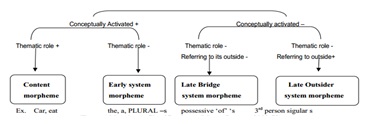
According to the 4-M model, nouns are the most prevalent content morphemes which receive the thematic roles of a clause and verbs. Due to this level of activation, they are considered as conceptually activated morphemes. The other type of conceptually activated morphemes are early system morphemes. In English, these morphemes are the definite article and the indefinite articles, determiners and plural marking (Myers-Scotton, 2002). Late system morphemes (LSM) are classified into two types: the bridge and outsiders system morphemes. They are responsible for the main architecture of the clause and the relationship of VP and NPs within the clause. To develop larger constituents within the phrases, the bridge system morphemes play a crucial role as they keep these constituents in well-formedness in relevant languages. In constructions, ‘of’ is the best example of the bridge system morpheme. Outsider late system morphemes determine agreement morphology and try to retain the co-indexing such as between a verb and its arguments. Some of the pronominal clitics co-indexing subject and object is an example of outsider system morphemes such as in Spanish and other Roman languages (Myers-Scotton, 2016). Another aspect of outsider system morpheme is case marking, as it clearly indicates a predicate-argument structure. The following example shows the integration of Dutch NP in the grammatical frame of bilingual clause inflected with Turkish instrumental suffix (Backus, 1996).
6) ondan sonar lauw water-nan y?kay?nca …
then after lukewarm water-with wash.while …
And then, while you’re washing [it] with lukewarm water …
The use of MLF and 4-M model along with the diagnostic features for the patterns of code switching brings more precision and clarity in the explanation of Pashto-English bilingual data.
Aims and Objectives
The present study has the following objectives to explore:
• The dominant patterns of code-switching in Pashto and English bilingual data
• The patterns of the embedded language single elements in matrix language constructions
• The patterns of embedded language multiword integration in matrix language
Population and Sampling
The target population for the present study was all English Pashto bilinguals. Eight fluent English-Pashto bilinguals were selected in the present research work from the target population through convenience sampling technique. All participants were educated and Pashto-English code-switching was a prevalent style of the sample population. They were sharing the same regional background and culture. They learned Pashto as their first language and English as their second language in English language classrooms. Their ages ranged from 20 years to 22 years.
Data Collection Procedure
The data was recorded in three different settings. In each settings, only one topic was administered for discussion. The three topics selected were unemployment, present government and human rights. Each topic was recorded for two hour and a total of 6 hours recorded data was collected.
Data Coding
The collected data was transcribed to Roman English with the help of toolboxes for proper identification of morphemes in three different layers. The first one, among these was for the representation of morphemes (their level). The second one, was for the representation of data at the gloss level followed by translation at the last level. It was found that the data were quite homogenous.
Statistical Analysis of Data
The data was analyzed in two key steps: in step one, chi-square goodness of fit test was conducted to compare the frequencies of the categories of English element(s) in Pashto constructions and English embedded island in a different construction of Pashto. While in step two, the chi-square test of association was carried out to compare the frequencies of the categories of both variables i.e., embedded lexical items and light verb constructions (LVCs) patterns in Pashto-English CS.
Data Analysis and Discussion
The chi-square goodness of fit analysis was carried out to compare the English single element in different constructions of the Pashto language. The results revealed that the noun was significantly used more frequently in different constructions of Pashto as compared to other elements of English i.e., adjective, adverb and verb.
Table 1. Chi-Square Goodness of Fit Test Comparing English Elements in Pashto Constructions
| Types | F | % |
| English Nouns | 80 | 57.1 |
| English Adjectives | 16 | 11.4 |
| English Adverbs | 4 | 2.9 |
| English nonfinite verbs | 40 | 28.6 |
| Total | 140 | 100 |
| P | .001 | |
| ?2 | 96.34 | |
The chi-square goodness of fit analysis was carried out to compare the English single element (Noun) in different constructions of Pashto language. The results revealed that the nouns in determiner constructions and nouns in prepositional Phrase were significantly used more frequently in different constructions of Pashto as compared to other types of noun i.e., a noun in (d?) possessive construction and noun in determiner complex construction.
Table 2. Chi-Square Goodness of Fit Test Comparing English Element (Nouns) In Pashto Constructions
| Types | F | % |
| Bare noun | 20 | 14.3 |
| EL noun in ML DP constructions | 4 | 2.9 |
| EL noun in DP constructions | 23 | 16.4 |
| EL noun in ML PP constructions EL noun in ML (d?) possessive constructions | 24 9 | 17.1. 6.4 |
| Total P ? | 80 | 100 .001 20.12 |
The study shows that 57% of EL nouns are the dominant pattern of insertion in the Pashto-English bilingual data.
Nouns in Bare DP Constructions
The switched elements in the bare DP and the bilingual VP are content words following the MO and SM principle of the Pashto. Pashto is the matrix language and the EL nouns leader in bare DP and the EL nonfinite verb blame is integrated with BCVs construction conjugated with the Pashto light verb kaw. According to the diagnostic features for the Patterns of code-switching both EL lexical items are single constituents and EL elements are making nested a b a structure. This is a plausible example of the patterns of insertion. The outsider system morpheme is from Pashto as subject and verb agreement marked on pronominal markers on the verb.
1) Aghe ke mung [IP[NP leaders] [V blame kaw -o]]
that. DP in 1PL leaders blame do.IPFV-1PL
In that, we blame the leaders.
The matrix language is Pashto and follows the principles in the bilingual clause. The Pashto light verb shaw is responsible for tense, subject and verb agreement and aspect. The EL switched element prisoner as bare DP in the subject position and the EL nonfinite intransitive verb release in bilingual VP are content words. In the following example, the EL bare noun cassette as a single constituent has been inserted in the morphosyntactic frame of Pashto. It is also making a single constituent and both the switched elements are nested a b a structure. On the basis of these pieces of evidences, the pattern of insertion is plausible.
2) ta way che [IP [DP [NP prisoners] [ release shw -i]]
you say. that prisoners release do.PFV-3PL
You are saying that the prisoners have been released.
Nouns in Determiner Phrase Constructions
In the example below, the Morpheme Order and System morphemes that are crucial for the matrix
language are from Pashto. The EL noun issue is inserted in Pashto DP construction da is making a single constituent. In this example, the focus is on the insertion of EL nouns in Pashto determiner construction (DP). The second EL element sensitive is a modifier to Pashto noun and a content word. The EL elements are making nested a b a structure. According to diagnostic features: the single constituent, the nested a b a, and the selected position of the bilingual elements determine that insertion is the dominant pattern of CM.
3) [IP [NP daa issues] [AP pura sensitive]] we]
those issues enough sensitive 3PL.COP. IPFV.F
Those issue were very sensitive.
Nouns in Prepositional Phrase Constructions
The following example shows the insertion of EL nouns show in Pashto preposition phrase PP construction. According to Pashto grammar, the PP construction is always marked by oblique cases and functions as an indirect object. The other EL element time as a noun, functions in bare DP construction in Pashto. Both EL nouns are making nested a b a structure as preceded by subject and followed by the light verb kaw. Both the switched elements are content words and function as a core argument with its verbal predicate. Pashto provides the morphosyntactic frame and according to the features diagnosis, the single constituent, the nested a b a, the selected elements and their property as content words is a plausible example of insertion.
4) Taa maa ta [IP[PP pa show ke] [NP time] [V raa ko]]
2SG 1SG to in show in time give do.PST -3SG
You gave me time in the show.
Nouns in the Possessive Constructions (D?)
The EL nouns are integrated into two different constructions in Pashto. As content word and single constituents, the EL nouns tuition and concept are incorporated in the Pashto possessive construction headed by da. Both the EL elements are making nested a b a structure and at complement position are core argument to the verbal predicate. The diagnostic features strongly indicate the pattern of code-switching of EL nouns in Pashto possessive constructions is a plausible example of the patterns of insertion.
5) Z? [IP [PP da tuition da concept]]helaf zeka [V yu -m]]
1SG.NOM of tuition of concept against because COP.PRS.IPFV -1SG
That is why I am against the concept of tuition.
EL Adjective in ML Constructions
The EL adjective meaningful modifies the ML noun baas in its attributive use. According to 4-M model of morpheme classification, the English adjective meaningful functions as a content morpheme. In the light of the diagnostic features, the EL adjective is making a nested a b a structure. The single constituent, the nested a b a, the selected element and their property as a content word is a clear indication that insertion is the dominant pattern of CM.
6) ra za [IP [NP sam meaningul baas] [V ka -o]]
let’s come very meaningful discussion do.IPFV.1SG
Let’s come to a meaningful discussion.
Only two EL adverbs, in the data, were found at clause-peripheral level. In the following example, the EL adverbs either is switched at a major clause boundary. According to Muysken (2000) proposed diagnostic features, the pattern of alternation is plausible in terms of peripherality. Poplack (1980) called such switching as tag-switching. According to its clause-peripheral position and function as tag-switching, the adverb either qualifies the pattern of an alternation. The same could also be noticed in the second example (14b). According to Poplack (1980), somehow in the following sentence is tag-switching and functions at the clause-peripheral position. The tag-switching and clause-peripheral provide strong support to declare it a pattern of an alternation.
7)
a) [AP Either]k pa college ke hagho [PP pa class ke] [V na yi]
either in college in their in class in no.do.3.IPFV
Either in college, it is not in their class then.
b) [APSomehow] de sa [VP [NP serious [V na day]
Somehow DEM.PROX.M.3 some serious no COP.PRS.IPFV.M.3
Somehow he is not serious.
The Patterns of nonfinite verbs in ML Light Verb Construction
The chi-square test of independence was carried out to investigate the association between English lexical elements and LVCs patterns in Pashto–English CS. The results revealed that there was a significant association between English lexical elements and light verbs construction patterns in Pashto and English code-switching showing that ka (kaw/keg) was more frequently used as light verb.
Table 3. Showing Chi-Square Test of Association of Embedded Lexical Items in Light Verb Construction Patterns in Pashto and English Code Switching
| English Lexical Elements | Kaw (do/make) | Keg (become) | Copula (be) | |
| f(%) | f(%) | f(%) | ||
| Verb (infinitive) | 22(66.7) | 9(27.3) | 2(27.1) | |
| Participle | 0(0.0) | 0(0.0) | 2(100) | |
| Gerund | 1(50.0) | 0(0.0) | 1(50.0) | |
| Verb particle | 0(0.0) | 2(100) | 0(0.0) | |
| Total | 23(59.0) | 11(28.2) | 5(12.8) | |
| P | .008 | |||
| ?2 | 17.46 | |||
| Cramer’s V | .543* |
The following example shows the patterns of EL light verb integration in the Pashto transitive light verb construction kaw. The light verb construction is the most prevalent construction provided by ML to EL nonfinite verbs. Pashto light verb kaw plays a crucial role in the integration of EL nonfinite verb conclude. The Pashto light verbs are marked for tense, aspect, modality and subject-verb agreement. It is clear that Pashto, being matrix language is responsible for the morphosyntactic frame in these constructions. According to the diagnostic features, conclude is a single constituent making nested a b a structure. The switched element in the bilingual VP is an example of a content word.
8) Za ba da habare [V conclude kaw -am]
1SG. NOM . FUT DEM.PROX discussions. conclude do.PRS.PFV-1SG
I will conclude this discussion.
The EL noun chapter in Pashto possessive construction is integrated along with the Pashto determiner de and the EL nonfinite verb start is incorporated into Pashto light verb kaw-o for tense, aspect and subject-verb agreement. Most of the EL nonfinite verbs in VP construction are single constituents, in the nested a b a structure. The diagnostic features: the single constituent, the nested a b a, the selected element and the EL property as content word support that insertion is the dominant pattern of CM.
9) che [IP[ PP daa chapter] sanga [V start ka-m]]
that this chapter how start do.PRE.IMP-1SG
That how should I start this chapter?
Embedded Language Islands in Pashto-English Code Switching
The chi-square goodness of fit analysis was carried out to compare the English embedded island in different constructions of Pashto. The results showed that the adjective in the embedded island was significantly used more frequently in different constructions of Pashto as compared to other types of embedded language. The following table shows the results.
Table 4. Chi-Square Goodness of Fit Test Comparing English Embedded Island in Different Construction of Pashto
| Type | f | % | |
| EL NPs Island in ML | 19 | 24 | |
| In ML PPs | 9 | 11 | |
| In the Determiner construction | 10 | 12 | |
| In the possessive construction | 11 | 14 | |
| Embedded Island as PPs | 4 | 5 | |
| Adjective in EL Island | 27 | 34 | |
| Total | 80 | 100 | |
| P | .001 | ||
| ?2 | 25.60 |
Embedded Islands in Pashto-English Code Switching
The embedded language islands are a combination of words, and generally they are collocations, formulaic in their composition and idioms (Myers-Scotton, 2009). They are fixed expression following Morpheme Order and System Morpheme Principles of the ML and are integrated with the overall maximal projection of the ML. An embedded island with a noun as the head may be well-formed only at the N-bar level, not at the NP level; that is because the ML controls the larger constituent (Myers-Scotton, 2002). The EL NP law and order being a fixed expression is inserted as a single constituent in the matrix language frame as shown in the example below. The switched NP is in the nested a b a structure, following the insertion patterns. The embedded NP in the Pashto frame is a selected element functioning in the complement position to its verbal predicate. The switched elements are content words. The diagnostic features show that insertion is the dominant pattern.
10) che pa de ke [IP[NP law and order] [V rawala -i]]
That in this in law and order bring.IPFV -3PL
That you should bring law and order here.
The multiword live show is incorporated into the grammatical frame of Pashto. EL islands live show as fixed expression is working as collocation following the structural dependency of the EL for the well-formedness.
11) Agha [IP [NP live show] [V wa]]
that live show COP.PST.#SG.F.IPFV
This was a live show.
The EL Islands, code of conduct as collocation (fixed expression) behaves as a single constituent. According to Myers-Scotton (2000), the multiword items always retain the order of EL. The EL multiword is embedded in the morphosyntax of Pashto. It is making a core argument with verbal predicate. This is a plausible example of insertion.
12) da Islam [IP [NP tol code of conduct ]ba dalta [V apply kawu]
Islam’s entire code of conduct will here apply COP.PRS.IPFV -3PL
We should apply the entire code of conduct of Islam here.
The EL Island previous caller is integrated into the ML possessive construction. The English multiword is marked in the Pashto morphosyntax frame by the possessive marker da. EL islands must observe structural dependency in the EL to qualify as islands. Most of the time they are in the form of phrases. There are also two more EL switched elements in the Pashto-English bilingual clause. The English viewer is marked by Pashto preposition marker sara and the English nonfinite verb share is incorporated in Pashto light verb kaw construction.
13) [IP[PP d? previous caller habara] za[PP viewer sra] [V share kaw -am]]]
of previous caller talk 1SG.NOM viewer with share PRS.IPFV -1SG
I will share the point of view of the previous caller with the audience.
The EL element gerund blackmailing is used at clause-peripheral indicating the pattern of an alternation. The second switched element as EL phrase in a sense functions as an idiomatic expression in the morphosyntax frame of Pashto. The English gerund blackmailing is used as an integral part of the Pashto clause and functions as a core argument with the verbal predicate.
14) [IPNP Blackmailing] hu [PP in a sense] [TP war –ta]na –shay[way –?l -e]]
Blackmailing in a sense 2SG not- PRS.PFV say -2PL
In one sense indeed, it cannot be called blackmailing.
15) …che [IP [PP as a profession] daa d? cha [V yi]]
…COMP as a profession this of who COP.PRS.PFV.3SG
If as a profession someone has it.
In example above (22), the embedded element as a profession as fixed expression is integrated in the Pashto morphosyntax. In a matrix language clause, the EL phrase strictly observes the structural dependency rules of embedded language.
Conclusion
The study investigated the most dominant patterns of code-switching in Pashto and English bilingual data. The results of the collected data analyzed in the light of the matrix language frame model showed that EL noun was the most prevalent type of insertion. These nouns are integrated in different constructions of the Pashto morphosyntactic frame. The most dominant pattern of insertion was the insertion of English noun in Pashto DP and PP construction. In most cases, the PP construction was an oblique case marking an indirect object in Pashto. The second most dominant pattern of code-switching was the EL nonfinite verbs in the light verb construction (do/make) of Pashto. The most amazing pattern was the EL nonfinite verbs in the light verb construction of Pashto language. The role of Pashto light verbs kaw was of great significance. The phi features: person, number, gender and case was marked on Pashto light verbs. The third pattern of code-switching was the EL multiword insertion in different constructions in Pashto. The switched elements in the bare DP and the bilingual VP are content words following the Morpheme Order and System Morpheme principles of Pashto. Insertion was the dominant pattern of code-switching and even with EL multiword expression, it followed the principles of well-formedness of the EL internal structure but as placement, it followed the rules of the Matrix Language within the bilingual clause.
References
- Backus, M. (1999) Evidence for lexical chunks in insertional code switching. In E.L. Brendemoen & E. Ryen, (Eds.), Language encounters across time and space, (pp. 93-109). Oslo: Novus Press.
- Belazi, H. M., Edward J. R. & Almeida J. T. (1994). Code switching and X---bar theory: The functional head constraint. Linguistic Inquiry, 25(2), 221-237.
- Bhatt, M. (1995). The structure of complex predicates in Urdu. Stanford, California: CSLI Publications.
- Khan, A. A., & Bukhari, H. N. (2014). Descriptive study of compound verbs and light verbs constructions in Pashto-English Code Switching. Kashmir Journal of Language and Research, 17(2). 2-14.
- MacSwan, J. (1999). A minimalist approach to intrasentential code switching. New York: Garland Press.
- MacSwan, J. (2000). The architecture of the bilingual language faculty: Evidence from code switching. Language and Cognition, 3(1), 37-54.
- Muysken, P. (2000). Bilingual speech: A typology of code switching. Cambridge: Cambridge University Press.
- Myers-Scotton, C. (2002). Contact linguistics, bilingual encounters and grammatical outcomes. Oxford, UK: Oxford University Press
- Myers-Scotton, C., & Jake, J. (1993) Duelling Languages: Grammatical Structure in Code switching. Oxford: Clarendon Press.
- Myers-Scotton, C., & Jake, J. (2009). Contact Linguistics: Bilingual Encounters and Grammatical Outcomes. Oxford: Oxford University Press.
- Poplack, S. (1980) Contrasting patterns of code-switching in two communities. In M. Heller (Eds.), Code switching, anthropological and sociolinguistic approaches, (pp.17-44). Berlin: Mouton de Gruyter.
- Treffers-Daller, J. (1994). Mixing Two Languages: French-Dutch contact in a comparative perspective. Berlin: Mouton de Gruyter.
Cite this article
-
APA : Khan, A. A., Anees, M., & Rahman, G. (2020). The Patterns of Code-Switching in Pashto-English Bilingual Data. Global Social Sciences Review, V(I), 123-133. https://doi.org/10.31703/gssr.2020(V-I).13
-
CHICAGO : Khan, Arshad Ali, Muhammad Anees, and Ghani Rahman. 2020. "The Patterns of Code-Switching in Pashto-English Bilingual Data." Global Social Sciences Review, V (I): 123-133 doi: 10.31703/gssr.2020(V-I).13
-
HARVARD : KHAN, A. A., ANEES, M. & RAHMAN, G. 2020. The Patterns of Code-Switching in Pashto-English Bilingual Data. Global Social Sciences Review, V, 123-133.
-
MHRA : Khan, Arshad Ali, Muhammad Anees, and Ghani Rahman. 2020. "The Patterns of Code-Switching in Pashto-English Bilingual Data." Global Social Sciences Review, V: 123-133
-
MLA : Khan, Arshad Ali, Muhammad Anees, and Ghani Rahman. "The Patterns of Code-Switching in Pashto-English Bilingual Data." Global Social Sciences Review, V.I (2020): 123-133 Print.
-
OXFORD : Khan, Arshad Ali, Anees, Muhammad, and Rahman, Ghani (2020), "The Patterns of Code-Switching in Pashto-English Bilingual Data", Global Social Sciences Review, V (I), 123-133
-
TURABIAN : Khan, Arshad Ali, Muhammad Anees, and Ghani Rahman. "The Patterns of Code-Switching in Pashto-English Bilingual Data." Global Social Sciences Review V, no. I (2020): 123-133. https://doi.org/10.31703/gssr.2020(V-I).13