
Abstract
This paper examines the construction of scientific identity in Hope Jahren's Lab Girl (2016) through Life Writing Studies and Paul Ricoeur's theory of narrative identity. While previous research has focused on gender, environmental writing, and science communication, limited attention has been paid to how scientific identity is formed in the memoir. Using qualitative narrative analysis, the study explores how memories of childhood curiosity, laboratory experiences, scientific failures, friendships, and professional growth are woven into a narrative of becoming. Findings reveal that scientific identity develops gradually through autobiographical storytelling rather than existing as a fixed trait. The memoir demonstrates that identity is shaped by personal experiences, relationships, and reflection. By emphasising the role of narrative in presenting the lived experience of science, this study contributes to scientific memoir scholarship and extends Ricoeur's narrative identity theory to contemporary life writing and autobiographical studies.
Keywords
Scientific Memoir, Life Writing Studies, Narrative Identity, Narrative Analysis, Lab Girl
Introduction
I
n the last few decades, scientific memoir has become a significant literary form that combines the disciplines of science and personal experience. Although, historically, scientific knowledge has been conveyed in journal articles, laboratory reports, and technical monographs, many scientists are now turning to memoir as a means to describe the human experiences of science discovery. Scientific memoir emphasizes feelings, doubts, relationships, and mundane reality, rather than the academic publications that emphasize the objectivity of scientific knowledge. Memoir is not just a recounting of a personal experience, as Couser (2011) states, it is a literary genre that allows writers to make sense of their lives and give meaning to important events. Scientific memoir merges scientific explanation with autobiographical reflection to show science as a very human practice, reflecting curiosity, perseverance, collaboration and memory.
There has been growing interest in the scientific memoir in Life Writing Studies, a field dedicated to understanding how people construct and tell their stories. Instead of being a clear account of fact, life-writing is a process of constructing identity through remembering, selection and ordering of experience, according to scholars. Smith and Watson (2010) argue that autobiographical narratives are mediated and influenced by cultural conventions, personal views and target readers. Similarly, Eakin (2008) states that identity is essentially a narrative since people make sense of themselves by making sense of their experiences. Memoir is thus not just a process of recall, but a continuous self-construction, a process whereby memory and narration create meaningful understandings of self. This view puts life writing into perspective as a suitable genre for the study of scientific memoir because it allows a focus to shift from the science to the science-writer.
Theories of narrative identity further develop the link between storytelling and identity. Ricoeur (1992) maintains that identity is not given, but is being produced continuously through narrative, which in turn allows the individual to link elements of his childhood, adulthood, professional development and aspirations for the future into a meaningful life story. Likewise, Bruner (2004) believes that stories are not just accounts of identity but a construction of it. Moreover, as Hyvärinen (2020) puts it, narrative analysis aims to explore why stories make meaning in terms of their structure, sequence, voice and interpretation, instead of just as vehicles for information. These two views imply that autobiographical texts are a performance of the narrative, in which identities are continually generated and negotiated.
Lab Girl (2016) by Hope Jahren is an example of such changes, because it is a scientific writing that also tells a personal story in an unconventional way that defies the boundaries between professional and personal writing. Jahren does not confine science to the realm of impersonal knowledge, but rather weaves together memories of childhood, laboratory life, academic challenges, friendships, and family experiences. Scientific observations continue to be embedded in personal narratives and set science as an activity that arises from curiosity, perseverance, a sense of community, and emotional involvement. From a child's curiosity about plants to an internationally celebrated scientist, the memoir chronicles Jahren's life as much as her scientific career, revealing the process of scientific discovery as an experience of memory and personal change.
Research on Lab Girl has primarily focused on various themes including women in science, science communication, environmental writing, and ecofeminist criticism, and while the scholarly interest in Lab Girl is increasing, it has remained largely underutilized by scholars. The studies have yielded important lessons in the conduct of science, the ethics of science, and science communication. They, however, have tended to consider the memoir document evidence for social and environmental issues rather than examine the impact of the narrative structure on the construction of scientific identity. For this reason, little has been done to investigate how childhood experiences, laboratory failures and successes, group interactions, and autobiographical thinking are told in order to create the scientist's identity. As noted in the previous thesis, however, Lab Girl has not been studied in a systematic way as a story of scientific becoming, and there remains a gap in the study of scientific memoir and life writing.
To address this, the present study examines how Lab Girl produces scientific identity in an autobiographical narrative. The article builds on the theory of Life Writing Studies, Ricoeur's theory of narrative identity and narrative analysis to examine how Jahren conjures up memories of curiosity, laboratory work, failure, friendship and scientific discovery into a unified narrative of professional becoming. The study suggests that scientific identity is not pre-narrated but is being produced along the way as it is organized in the memoir. The article adds to Life Writing Studies by showing how scientific memoir is a place of identity construction, extends scholarship on narrative identity to contemporary science writing, and enriches research on scientific memoir by introducing Lab Girl as a literary text that is a space for meeting science, memory and autobiography. The next sections summarise the relevant scholarship, describe the methods for this study, and summarise the construction of scientific identity in the memoir.
Literature Review:
Life Writing and Identity
Life writing is one of the most vibrant areas in modern literary research, including genres such as autobiographies, memoirs, diaries, letters, and other genres of personal narrative that examine the connections between lived experience and self-representation. Life writing has been discussed as a creative and interpretive process that shapes, manoeuvres and expresses a person's identity, rather than a record of factual events, by scholars. The importance of memoir therefore is not just in the telling of life events but also in the way that authors construct memory into a narrative that helps readers understand the self.
According to Sidonie Smith and Julia Watson (2010), autobiographical texts are always mediated, in the sense that the author omits, orders, and analyzes the experiences in a specific cultural, historical, and personal context. The "I" in the autobiographical text must consequently be interpreted as a constructed "I" and not as a stable identity, which is constantly created in the process of narrating. This view questions the previous notion that memoir is a reflection of an already defined self and makes the point that selfhood is created by the decisions made in the narration of memory, voice, and perspective.
Likewise, Paul John Eakin (2008) argues that narrative is essential to identity formation because it is through the process of making sense of experience in the form of a story that people come to know themselves. Eakin says that autobiographical writing helps people create a sense of continuity between the experiences of childhood and adulthood, between success and failure, between relationships and experiences, in a meaningful structure. Thus, identity is not "given," but rather a continuous "accomplishment" that is achieved through interpretation and recollection.
Altogether, these views frame life writing as a fruitful paradigm for the analysis of Lab Girl. This study does not interpret Hope Jahren's memoir as only a record of scientific accomplishments or her personal history but rather as a story in which scientific identity is being built. The memoir shows the intertwining of personal experience, professional development, and memory in the ongoing process of becoming a scientist, thus exemplifying the main tenet of life writing scholarship, namely that identity is narrated and not simply reported.
Narrative Identity in Memoir
Life Writing Studies demonstrates autobiographical narratives' role in identity construction, but the concept of narrative identity elucidates how this construction is accomplished. Narrative theorists reject the concept of identity as an unchanging, independent property, instead of this, they see it as a process whereby people make themselves intelligible to themselves and others through the construction of narratives of their lives. Memoir is not just a remembrance of what came before; it is a storytelling process, an ordering of, and a selection of, memories in order to create meaning. It is not about the collection of life experiences, rather it's about the interpretive process of telling stories.
One of the best theories to explain this process is given by Paul Ricoeur's theory of narrative identity. In Oneself as Another, Ricoeur (1992) states that personal identity is constantly formed with the help of narrative as stories provide temporal coherence between past, present and future. Although human experience is fragmented, made up of separate memories, connections and events, narrative brings them together to create a meaningful whole and to help a person know who they are. Ricoeur's point of difference is between permanence (idem) and selfhood (ipse), meaning that some things can change in character from one moment to the next, but that what happens in a narrative can be perceived as a continuity in the sense that the individual can re-experience the event from a different perspective, thus creating a new life story. The understanding of identity, therefore, should not be seen as a condition that is fixed or pre-determined but rather an interpretive product of a process.
This idea of a narrative identity is supported by Jerome Bruner (2004), who suggests that people make sense of their lives through stories, not piece by piece facts or chronologically; this means that they construct their sense of self through these stories. Narratives create patterns in experience by making connections between actions, motivations, and consequences. Hence, autobiographies are more than just accounts of experiences, they are a way of constructing identity and life trajectory. Bruner's view focuses on the idea of the ability of storytelling to be a creation of identity, in the sense of making a coherent account of becoming out of lived experience.
Methodologically, Hyvärinen (2020) also maintains that narrative analysis concerns the meaning-making process in narratives in terms of their structure, sequencing, voice and interpretation. When analyzing a memoir, narrative analysis focuses on the manner in which the author has arranged experiences to convey specific perceptions of self, rather than using the narrative as a factual source of information. This is particularly applicable to scientific memoir, in which the personal recollections, experiences in the workforce, and scientific information are all woven together into a unified story. The approach becomes analytical, therefore, rather than asking what happened, asking how the story is told, and asking how the telling helps with identity formation.
Theorising is the conceptual basis for reading Hope Jahren's Lab Girl as a story of scientific becoming instead of a story of a scientific career. Childhood wonder, laboratory work, setbacks, friendships, and professional success are recreated in the memoir in a way that brings a sense of coherence to the unfolding story, and ultimately, scientific identity comes into being. Based on this theory, the study analyses the lived experience transformed into literary construction of the scientific self in the process of autobiographical storytelling.
Scientific Memoir as a Literary Genre
This new genre of memoir, scientific memoir, has become a unique kind of life writing, combining scientific information with personal story telling. Scientific memoir is not primarily a process of scientific discourse, eschewing authorial voice and the emphasis on objective, empirical, and technical language, but rather a process of living, feeling, and learning that involves personal relationships. The genre of science fiction science communication is a blend of science and storytelling that conveys scientific inquiry as a human experience, not just an intellectual one (Couser, 2011).
The assumptions of the total objectivity and neutrality of science have been challenged by scholars more and more. Haraway (1988) asserts that science is always situated, dependent on the social and historical context of the scientist. Likewise, Daston and Galison (2007) show that objectivity is not a given but is historically produced in the evolution of scientific practices. Such viewpoints have led to an interest on the part of literary scholars in the human aspects of scientific work as well as its intellectual product.
Scientific memoir is then not only a way of communicating science, but also a literary examination of professional identity as well. Scientists tell stories of curiosity, experimentation, collaboration and failure, not just scientific achievements (Couser, 2011). This insight is valuable for the analysis of Lab Girl as a memoir which constructs scientific identity.
Previous Studies on Lab Girl
Hope Jahren's Lab Girl has been the subject of growing scholarly interest since it was published in 2016, in literary studies, environmental humanities, gender studies, and science communication. There are essentially four categories of existing scholarship, each in its own field. A major focus of research about women in science is the experience of gender discrimination, academic inequality and problems women encounter in scientific institutions, as would be done by Jahren (1988) and Harding (1986). Second, scientific memoir studies reveal the hybrid structure of the scientific memoir and as a result of this the interweaving of scientific knowledge and autobiographical narration in order to humanise the practice of science (Couser, 2011). Third, the study of science communication suggests that Lab Girl managed to convey scientific information at a level that was comprehensible to readers, enhancing their capacity to engage with science (Jahren, 2016). Lastly, ecological readings of the memoir are environmental and ecofeminist, addressing ecological ethics, plant-human interactions and feminist approaches, all with a view to the role the memoir plays in the field of environmental humanities (Gaard, 2015; Iovino & Oppermann, 2014).
While these studies have enhanced the understanding of Lab Girl, the major concern of the studies has been in relation to the theme. Research on the construction of science identities through the auto-biographical narration of the memoir has been relatively overlooked. To bridge this gap, the present study uses narrative analysis to explore the role of memory, storytelling, and lived experience in the construction of a narrative of the scientific self.
Methodology
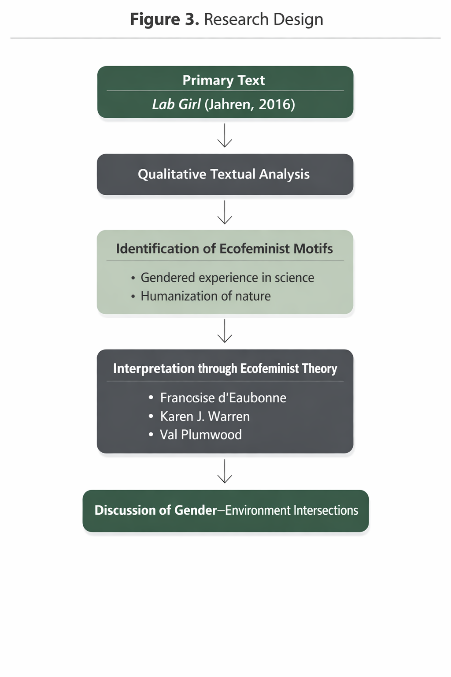
The method used in this study is qualitative research which focuses on textual analysis as a method of analyzing the data to explore the articulation of ecofeminist concerns in Hope Jahren's Lab Girl (2016). The qualitative approach is appropriate for this inquiry because of its focus on depth, context and meaning, and not on numerical measurement of the inquiry so that the inquiry could focus closely on how gender, science and the natural world are interwoven in one sustained inquiry rather than reducing it to countable variables (Sarfo & Ofori, 2017).
The methodology of this study is in the framework of the interpretive aspect of qualitative study. Reading Jahren's memoir as a place where personal experience and cultural structure converge (Drysdale, 2013) provides a platform for Weber's approach to interpretive understanding, which sees meaning in the subjective significance actors give to their own actions. This is complemented by the difference between the explanatory goals of natural sciences, on the one hand, and the interpretive goals of the human sciences, on the other, that is emphasized by Dilthey, in light of which the appropriateness of a meaning-oriented approach is apparent in the text under analysis, which is itself a scientist's reflection on lived experience (Makkreel & Rodi, 2021). Later, the qualitative theorists extended this interpretive approach by recognizing that the results of the research are not the truth but rather a reading of reality, and this is the approach that is reflected in the present research with Lab Girl (Agostinho, 2005; Manning & Kunkel, 2014; Silva, 2008).
In this context the main analytical tool is the textual analysis. The memoir is read carefully for reoccurring themes, motifs, and narrative strategies that document ecofeminist issues, most importantly, the discrimination Jahren experiences by women in scientific institutions, and how she becomes emotionally attached to the plants she researches. These two strands are considered as complementary aspects of the same ecofeminist logic that connects the domination of women and that of nature (d' Eaubonne, 2022; Warren, 1987). The analysis of how Lab Girl counters the hard subject-object dichotomy of conventional scientific writing is also informed by Plumwood's (1993) critique of patriarchal dualism.
The analysis is based mainly on the text of the memoir itself, but with some additional secondary ecofeminist scholarship to situate Jahren's account within a larger critical context. It is a juxtaposition of the close examination of the text and the theoretical underpinning that enables the study to explain how Lab Girl has reconceptualized scientific practice as an emotion-laden and ecologically involved enterprise, not one that happens in isolation, objectively. Major Ecofeminist Themes Identified in Lab Girl is given below:
Table 1 Major Ecofeminist Themes Identified in Lab Girl
Theme
Description
Theoretical Foundation
Key Focus in Lab Girl
Humanization of Nature
Nature is represented as a living, relational entity rather than a passive resource, emphasizing mutual dependence between humans and the natural world.
Ecofeminism challenges anthropocentric and exploitative views of nature by advocating relational ethics (d' Eaubonne, 1974; Warren, 2000; Plumwood, 1993).
Plants are portrayed as companions, teachers, and active participants in scientific discovery, reflecting ecological interconnectedness.
Gendered Experience in Science
The memoir exposes the gendered barriers, exclusion, and institutional inequalities encountered by women scientists.
Ecofeminist theory argues that patriarchal systems simultaneously marginalize women and dominate nature (Warren, 2000; Shiva, 1988).
Childhood exclusion, professional discrimination, institutional invisibility, and emotional labor reveal the challenges of becoming a woman scientist.
Critique of Patriarchal Dualism
The memoir challenges hierarchical binaries such as culture/nature, reason/emotion, and male/female by presenting science as relational rather than dominant.
Plumwood (1993) and Warren (2000) argue that these dualisms sustain both environmental exploitation and gender inequality.
Scientific inquiry is portrayed as integrating care, emotion, collaboration, and ecological responsibility, rejecting the traditional separation between objectivity and lived experience.
Analysis and Discussion:
Humanizing Nature: Plants, Growth, and the Ecofeminist Vision in Lab Girl
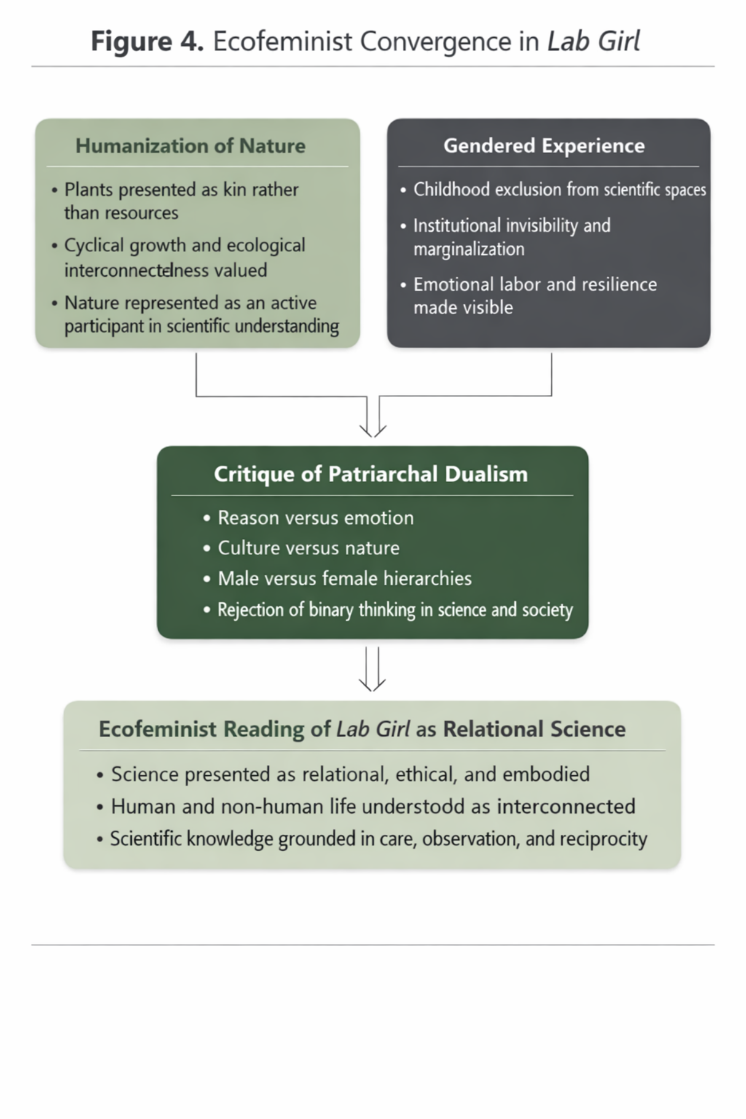
Throughout the book, Jahren's account of the natural world, of trees, seeds and the slow rhythm of architectural growth, is always a companion to be listened to, not a source of raw material for the scientific researcher. This is antithetical to the main tenets of an ecofeminist theory, which sees the core of patriarchal science as viewing nature as a passive object to be measured, controlled, and exploited (d' Eaubonne, 2022). In Jahren's writing, the distance between observer and observed is constantly broken down her intimacy with individual plants is often expressed as kinship and reciprocity, not as the study of a scientist.
This is very similar to Plumwood's (1993) critique of the hierarchical dualisms reason vs emotion, culture vs nature, male vs female that underlie western thought and always privilege the term coded as masculine. Jahren's memoir performs the alternative of a knowledge that is not extractive, rather, a relational one, as Plumwood demands. Her ideas about the slow, cyclical progression of a tree's life a process that is not linear and cannot be hurried resonate with Gaard's (2012) thoughts about the importance of the slow, non-linear becoming in plants and in women's lives, over the productivity that capitalism and patriarchy demand.
This humanization is evidenced by Jahren's story of how she had grown close to a spruce tree over the course of years, and how her sadness for its death is akin to that of her friend's. The moment brings the subject and object together, and thus the ecofeminist critics of Shiva (1988) see a blurring of the lines between the subject and the object, one that is central to the exploitation of both women and the environment. Here, as with the "view from nowhere" (taken from Haraway' s 1988 critique of the scientific impersonality of deferred embodiment), Jahren's assertion that scientific knowledge is unembodied and unpositioned is also telling; she does not obscure her emotional stake in her studied subjects, and her science is always linked to her lived experience as an embodied observer.
When viewed in concert, these scenes imply that in Lab Girl the plant is not just a subject of study, but also a source of wisdom, patience, and self-recognition a different ethic for the environment, one that posits nature as a subject for human, and, in particular, male, achievement (Miles, 2024). In ecofeminist terms, this anthropomorphising of the vegetal realm becomes an integral part of the second great theme of the memoir, the role of women in the institutions that exercise control over the same natural environment.
Gendered Experience and Resistance to Patriarchal Norms in Science
Whereas, Section 4.1 explores Jahren's re-imagining of nature, this section focuses on her re-imagining herself as a woman scientist. Jähren's memoir documents an early, physical sense of being excluded as a girl: long before she had the words, she knew, early on, that her life as a girl was different, that her brothers had freedoms freedom to move around, to explore, to experiment that she did not. This early asymmetry foreshadows the later, adult scientific marginalization she will experience, in which her work will always be demanded to compensate for the work of males for equality to be recognized as such (Merchant, 1980).
Jahren's portrayal of her own childhood in the 'man's room' a space she progressively gained physical and intellectual access to can be understood as a subtle rejection of the historical notion that scientific and intellectual spaces are not 'girl's' (d' Eaubonne, 2022). Her ability to access this scientific and intellectual life is incremental, something she had to learn to do both literally and figuratively, and reflects the pattern of ecofeminist critics who describe this way that women's access is conditional, provisional, and slower than that of men (Merchant, 1980; TallBear, 2019).
TallBear's (2019) analysis of scientific institutions as apparatus that shape who can produce knowledge and what can be deemed to be legitimate knowledge is especially insightful for Jahren's discussion of institutional invisibility, defined as the lack of established models of women scientists to emulate and the need to build one's own professional identity without them. Adams (2023) also makes a similar point about governance structures that are designed to include women's voices, but which, in fact, exclude them from effectively addressing the deeper inequities they are supposed to be solving; Jahren's memoir illustrates this at a personal scale.
Importantly, Jahren is not doing this by playing the neutral and confrontational "scientific man" card that has been so common among scientific authorities. Rather, her story always enfolds emotional work, fragility, and sustained relationship building with her research partner Bill, with her plants, with her own sometimes rocky trajectory into her story of what it means to do science. From an ecofeminist point of view, this is a form of resistance because in the name of the idea of "rigor," it asserts that "care" is not the opposite, and that a woman scientist does not have to forego one in order to practice the other.
Conclusion
The present study explores the science identity formation in the autobiographical narration of Lab Girl by Hope Jahren by examining it through the lens of Life Writing Studies, Ricoeur's theory of narrative identity and narrative analysis. The analysis showed that scientific identity is not a given professional identity but rather it is a process of becoming, constructed from memories of curiosity as a child, laboratory work, scientific failure, working with others, and personal change. Through these experiences, Jahren demonstrates that scientific knowledge is not only created through empirical enquiry, but also through a lived life, emotional strength, and commitment to discovery.
The results reveal that Lab Girl defies the notion of science as impersonal, objective, and detached. Rather, the memoir presents science as a lived practice, demonstrating the ways in which personal connections, institutional conflicts and uncertainty, and persistence shape a scientific identity. The memoir's narrative form shows how identity is constantly created in the process of narration, and how autobiography is an active process of self-construction that is proposed in the field of Life Writing Studies.
The study is a valuable addition to the scholarship in three important ways. First, it moves the discussion of scientific memoir away from the themes of gender, environmental ethics and science communication and towards the narration of scientific identity. Second, it illustrates how narrative analysis can be applied to analyze how the experience of being a professional is organized into meaningful accounts in autobiographical texts. Thirdly, it extends the use of narrative identity theory in literary studies and shows its relevance for science writing today.
The results of this study are limited to Lab Girl, but the analytical approach can be extended to other scientific memoirs to examine how scientists construct professional identity in various scientific fields, cultures, and time periods. Comparative studies of scientific life writing may also be made in the future, in order to explore the differences in narrative strategies as related to gender, institutional context, or scientific fields. These studies would also help to consolidate the dialogue among Life Writing Studies, narrative theory, and the emerging area of literary representations of science.
References
- Adams, W. M. (2023). Conservation and the politics of e-governance: Challenges for environmental justice. Environmental Policy and Governance, 33(1), 45–58. https://doi.org/10.1002/eet.2001
- Agostinho, S. (2005). Naturalistic inquiry in e-learning research. International Journal of Qualitative Methods, 4(1), 1–13.
- Bruner, J. (2004). Life as narrative. Social Research, 71(3), 691–710. https://doi.org/10.1353/sor.2004.0045
- Couser, G. T. (2011). Memoir: An introduction. Oxford University Press.
- d’Eaubonne, F. (2022). Feminism or death: How the women’s movement can save the planet (R. A. Hottell, Trans.). Verso. (Original work published 1974)
- Drysdale, C. (2013). Max Weber. In E. N. Zalta (Ed.), The Stanford encyclopedia of philosophy (Spring 2013 ed.). Stanford University. https://plato.stanford.edu/archives/spr2013/entries/weber/
- Eakin, P. J. (2008). Living autobiographically: How we create identity in narrative. Cornell University Press.
- Gaard, G. (2012). Feminist animal studies in the U.S.: Bodies matter. DEP: Deportate, Esuli e Profughe, 20, 33–54.
- Gaard, G. (2015). Critical ecofeminism. Women's Studies International Forum, 49, 20–22. https://doi.org/10.1016/j.wsif.2015.02.004
- Haraway, D. J. (1988). Situated knowledges: The science question in feminism and the privilege of partial perspective. Feminist Studies, 14(3), 575–599. https://doi.org/10.2307/3178066
- Harding, S. G. (1986). The science question in feminism. Cornell University Press.
- Hyvärinen, M. (2020). Narrative analysis. In A. De Fina & A. Georgakopoulou (Eds.), The Routledge international handbook of narrative and life history (pp. 83–96). Routledge.
- Iovino, S., & Oppermann, S. (Eds.). (2014). Material ecocriticism. Indiana University Press.
- Jahren, H. (2016). Lab girl. Alfred A. Knopf.
- Makkreel, R. A., & Rodi, F. (2021). Wilhelm Dilthey. In E. N. Zalta (Ed.), The Stanford encyclopedia of philosophy (Spring 2021 ed.). Stanford University. https://plato.stanford.edu/archives/spr2021/entries/dilthey/
- Manning, J., & Kunkel, A. (2014). Making meaning of meaning-making research: Using qualitative research for studies of social and personal relationships. Journal of Social and Personal Relationships, 31(4), 433–441. https://doi.org/10.1177/0265407514525880
- Merchant, C. (1980). The death of nature: Women, ecology, and the scientific revolution. Harper & Row.
- Miles, M. (2024). Ecofeminism: Past, present, and future. Routledge. https://doi.org/10.4324/9781003026921
- Plumwood, V. (1993). Feminism and the mastery of nature. Routledge.
- Ricoeur, P. (1992). Oneself as another (K. Blamey, Trans.). University of Chicago Press. (Original work published 1990)
- Sarfo, J. O., & Ofori, P. K. (2017). A book review: Qualitative inquiry & research design: Choosing among five approaches (3rd ed.). Russian Journal of Sociology, 3(1), 31–36.
- Shiva, V. (1988). Staying alive: Women, ecology and development. Zed Books.
- Silva, C. N. (2008). Review: Designing qualitative research (4th ed.) by C. Marshall & G. B. Rossman. Forum Qualitative Sozialforschung / Forum: Qualitative Social Research, 9(3), Article 20. https://doi.org/10.17169/fqs-9.3.996
- Smith, S., & Watson, J. (2010). Reading autobiography: A guide for interpreting life narratives (2nd ed.). University of Minnesota Press.
- TallBear, K. (2019). The critical Indigenous studies of nature. Duke University Press.
- Warren, K. J. (1987). Feminism and ecology: Making connections. Environmental Ethics, 9(1), 3–20. https://doi.org/10.5840/enviroethics19879113
- Warren, K. J. (2000). Ecofeminist philosophy: A Western perspective on what it is and why it matters. Rowman & Littlefield Publishers.
- Wilson-Kovacs, D. (2009). Objectivity by Lorraine Daston and Peter Galison [Book review]. Critical Quarterly, 51(1), 123–125. https://doi.org/10.1111/j.1467-8705.2009.01882.x
Cite this article
-
APA : Saeed, H., Shah, I. A., & Tehseen, M. (2026). Constructing Scientific Identity through Narrative: A Life Writing Analysis of Hope Jahren's Lab Girl. Global Social Sciences Review, XI(I), 228-237. https://doi.org/10.31703/gssr.2026(XI-I).19
-
CHICAGO : Saeed, Hina, Irfan Ali Shah, and Moazma Tehseen. 2026. "Constructing Scientific Identity through Narrative: A Life Writing Analysis of Hope Jahren's Lab Girl." Global Social Sciences Review, XI (I): 228-237 doi: 10.31703/gssr.2026(XI-I).19
-
HARVARD : SAEED, H., SHAH, I. A. & TEHSEEN, M. 2026. Constructing Scientific Identity through Narrative: A Life Writing Analysis of Hope Jahren's Lab Girl. Global Social Sciences Review, XI, 228-237.
-
MHRA : Saeed, Hina, Irfan Ali Shah, and Moazma Tehseen. 2026. "Constructing Scientific Identity through Narrative: A Life Writing Analysis of Hope Jahren's Lab Girl." Global Social Sciences Review, XI: 228-237
-
MLA : Saeed, Hina, Irfan Ali Shah, and Moazma Tehseen. "Constructing Scientific Identity through Narrative: A Life Writing Analysis of Hope Jahren's Lab Girl." Global Social Sciences Review, XI.I (2026): 228-237 Print.
-
OXFORD : Saeed, Hina, Shah, Irfan Ali, and Tehseen, Moazma (2026), "Constructing Scientific Identity through Narrative: A Life Writing Analysis of Hope Jahren's Lab Girl", Global Social Sciences Review, XI (I), 228-237
-
TURABIAN : Saeed, Hina, Irfan Ali Shah, and Moazma Tehseen. "Constructing Scientific Identity through Narrative: A Life Writing Analysis of Hope Jahren's Lab Girl." Global Social Sciences Review XI, no. I (2026): 228-237. https://doi.org/10.31703/gssr.2026(XI-I).19