
Abstract
Pakistan has one of the most active media landscapes in South Asia, but not everyone feels comfortable consuming it; therefore resort to complaining about its content. The study examines the PEMRA complaints through the theoretical lens of cognitive dissonance theory. It's based on a quantitative content analysis, founded on a descriptive study method. It aims to explore the dominant themes in Pakistani media that cause dissonance among the audiences. The study analyses the annual complaints data for the year 2021 that are obtained through the official platform of the media regulatory body, which is the Pakistan Electronic Media Regulatory Authority (PEMRA). Quantitative content analysis was used to analyze the dominant themes in the complaints using a manual coding instrument. The results of this study show that the Pakistani audience is most disturbed by the socio-cultural aspect, as they are disturbed the most by what they believe to be vulgar.
Keywords
PEMRA Complaints, Cognitive Dissonance, Sociocultural Themes, Media Ethics, Vulgarity in Media Content
Introduction
Background of Study
Media regulation has gotten a lot of attention from the public and critics in this modern era, especially with the internet becoming a vibrant source of information and because of the extensive circulation of electronic media on the internet . On online news websites, user-generated feedback, comments, reviews, and, most significantly, complaints provide immediate analysis and influence audience interpretations and perceptions of media credibility (Lee, 2012). But, maybe more critically, as a medium of social equilibrium, the media is expected to be fair and unbiased when dealing with various facets of a democratic society (Khan, 2016). For such objectivity, it is necessary to look at the situation from the standpoint of a consumer, which in this case is the desired audience. Consumer complaints can assist organizations in identifying problems and taking action. Although many scholars (Fernandes & Santos, 2008; Rizwan et al., 2013) have looked into the link between dissonance and complaint intention, there are few studies that look into the content of complaints about mass media in any given environment. Nearly a hundred private television channels are currently broadcasting, addressing a diverse audience (Pakistan Press Foundation, 2014). Soap operas, satire, music programs, films, religious speeches, political talk shows, and current affairs are all broadcast on the television networks throughout the day. Despite an increasing preference for social media in Pakistan (Nielsen & Sambrook, 2016), the function and relevance of television news will continue to expand for some time due to its capacity to influence people through its content. The view of specific media content as objectionable refers not just to local/national media transmission, but also to the integration of worldwide media content and the expectations of Pakistani consumers from it. PEMRA Code, which is based on Article 19 of the Constitution, protects privacy, personal life, and private communication, among other things, which would otherwise be a restriction on media freedom. However, where there is a compelling public interest, these safeguards may not be available. This institution's presence not only represents state regulations, but also the obligation of receiving complaints and requests from Pakistani citizens who are unsatisfied or offended by specific types of media content(s) (Khan, 2016). PEMRA has taken an active role in handling complaints received through its internet portal and email over the years. It has a parallel system of independent 'Councils of Complaints' in each province that deals with public complaints about media conduct and advises PEMRA to act as a regulator when necessary (Iftikhar, 2012).
Complaints are typically perceived as negative responses from those who are displeased (Demirgunes & Avcilar, 2017). It is thought to be one of the methods customers use to relieve stress by engaging in negative behaviours such as complaining and switching. According to the cognitive dissonance theory, conflicts cause psychological discomfort, which leads to customers seeking to minimize or lessen cognitive dissonance (Yap & Gaur, 2014). By definition, cognitive dissonance is a fugitive condition. It is a powerful motivator to overcome the unfavourable situation. Individual activities are often followed by a high level of cognitive dissonance in order to alleviate cognitive dissonance (Salzberger & Koller, 2010). A complaint is an example of such an intent.
This research paper aims to comprehend the relationship between Pakistan's mainstream media and its engagement with the Pakistani public, not only through complaints about specific types of media content(s), but also by examining the content themes that cause dissonance in their negative feedback about those specific types of media content(s). The goal of this study is to conduct a quantitative content analysis to uncover the common patterns that link specific types of media content that Pakistani consumers find objectionable and their demand for its prohibition.
Problem Statement
While there is a prevalent space for complaints offered by the PEMRA's site to all the citizens of Pakistan, there is no clear picture about the themes that prevail in motivating dissonance among the Pakistani audience, and to what extent the content themes dominate one another to cause cognitive dissonance among the public of Pakistan, prompting them to a negative form of feedback.
Significance of the Study
Theoretical Contribution
Cognitive dissonance is primarily a "negative" construct in contrast to satisfaction; it is a transient state that refers to a great desire to overcome an unfavourable situation (Demirgunes & Avcilar, 2017). Negative replies may be valuable for organizations as crucial indicators of strategy (Rizwan et al., 2013). It also appears to be a good idea to include dissonance in ongoing customer satisfaction studies. The interaction of satisfaction and dissonance is the cause behind this. Complaint behavior appears to be determined by cognitive dissonance rather than satisfaction. According to the notion of cognitive dissonance, strong dissonance is a motivating element that encourages the customer to take some action to alleviate the discomfort. Dissonance is linked to negative behaviors (such as filing a complaint) (Rizwan et al., 2013).
This paper intends to apply cognitive dissonance theory to a set of data where it has not been applied before, for a better understanding of audience perceptions regarding the electronic media in Pakistan.
Practical Contribution
Consumer complaint intention has been investigated previously in research (Rizwan et al., 2013), including complaints about the media, Jones & van Putten (2008), also taking into account the theoretical aspect of dissonance theory. Although there is a large vacuum in the literature that has previously examined sentiments and censorship issues in Pakistan, this paper is the first to examine the nature of media-related complaints. As a result, there is a lack of awareness of the topics of complaints against Pakistan's mainstream media.
Research Question
What are the prevalent themes among people's expression of dissonance towards media content?
Research Objectives
To find out the dominant themes in Pakistani media that cause dissonance among the audiences.
Scope
The study investigated the most recurring themes in Pakistani media that cause dissonance among the Pakistani audience. The primary data was mined from the PEMRA website, and therefore, the scope of the study is limited to Pakistani media and Pakistani audiences only. After mining the data, the most dominant themes in Pakistani society in the data were identified through quantitative content analysis. Such a work in the Pakistani media has not been done before at a similar scale; therefore, the descriptive statistics obtained through the study open up new doors for study and research.
Literature Review
Media Role in Pakistani culture is tri-dimensional, i.e., informing, educating, and providing entertainment to the public, which can be perceived both positively and negatively (Khan et al., 2013). Transmission of culture and media are two interrelated factors. The media itself is a powerful conveyor of cultural values and norms (Raza & Akbar, 2013). Recently, modern technologies have influenced everyone in almost all aspects (Zaheer, 2018), but television is a 'need gratification' medium, and it is here to stay (Choudhury, 2018). A modern democratic society accepts media freedom as a cornerstone; however, the media needs to be responsible in what and how it reports (Sultan, 2017).
PEMRA is an independent and constitutionally framed governmental organization that is responsible for issuing licenses to various channels to run and regulating content. It acts as a socioeconomic and administrative mechanism to maintain harmony between governmental and private interests (Rasul, 2012).
When a person files a complaint through PEMRA, that means something they have observed in the media has caused enough dissonance in their thoughts for them to take the effort to structure and file a complaint to the relevant authorities. Therefore, dissonance has been caused in their mind, which they resist accepting.
Studies show that a larger proportion of the male population is exposed to television than females (Khan et al., 2011). In a country like Pakistan, which is driven in the name of religion and moral values, where conflicting beliefs are one of the major drivers of decision-making processes, this paper analyzed the nature of complaints registered with PEMRA by the general public against the media. This requires examination and explanation of the frequencies of the words, types of words used, general intended meaning of the complaint content, media channels targeted, and types of content genres targeted. The word 'Dissonance' refers to the reactionary attitude shown by the general public towards the content shown in the broadcasting media. The public is generally inclined towards reducing internal conflicts and confusion because this results in an uncomfortable state of mind.
Censorship in Pakistani media exists not only in the form of regulations imposed by governmental authorities but also through the idea of demand and supply, where Pakistani citizens have a say in deciding the rights and wrongs about the content being aired (Khan, 2016).
Cognitive Dissonance Theory: The Primary Underpinning Theory
It was put forward in 1956 by Leon Festinger, Henry W. Riecken, and Stanley Schachter, and the theory asserts that when people with strong opinions are presented with information that does not align with their beliefs/opinions, they will tend to disregard the newer information and instead resolve their 'dissonance' by other methods rather than abandoning their viewpoints (Dawson, 1999).
Complaints
The concept of complaints has always had negative connotations (Barlow & Møller, 1996). It means the expression of pain and displeasure. Oxford Advanced Learner's Dictionary describes a complaint as a statement that somebody makes, meaning that they are not satisfied (Oxford Learner's Dictionaries, n.d.). Here, it is pertinent to mention that one meaning of the word complaint relates entirely to the field of health sciences, where it means a non-critical illness (Oxford Learner's Dictionary, n.d.). In the context of this study, that distinction must be kept in mind.
Social Media Complaints
Despite adequate research and studies on complaints relating to the field of business and organizational studies, there is a lack of work regarding the complaints exclusively relating to the domain of media, especially traditional media. There is sufficient work that studies the complaints voiced on social media under various contexts, but not all are related to a thematic analysis that gives insights about media-related dissonance in a population (Bala, 2020; Singh et al., 2021). Some of these publications, however, do provide guidance about how to mine and analyze complaint-based data.
Analyses for Complaints
Content analysis and thematic analysis are generally conducted for studying complaints. There are various definitions of what a thematic analysis is and the ways to conduct it. Braun & Clarke (2006) define thematic analysis as "a method for analyzing qualitative data that entails searching across a data set to identify, analyze, and report repeated patterns."
Berelson (1952) defined content analysis as "a research technique for the objective, systematic, and quantitative description of the manifest content of communication." This definition perfectly encapsulates the essence of our study.
This research paper would employ a greater set of PEMRA complaints, comprising data from at least 12 months. Moreover, content analysis shall be carried out to identify a variety of themes and other descriptive statistics regarding Pakistani media.
Understanding the content types in Pakistani media
Understanding the media's increasing presence and its tempt to contour the world, there arise loads of ethical and social questions that demand to be addressed (Ess, 2013).
Television content has taken an ethical turn, and with the rise of 'infotainment' and many new formats, everyday ethical dilemmas have become the foundation of content and conflict (Hawkins, 2001). In countries like Pakistan, where the law of secularism has failed to work in transparency and with justice, individuals tend to show their disagreements towards what they consider 'alien' to them and find it extremely hard to give it any space. People who are underdeveloped, people enjoy TV as a medium for content consumption because of its easy access to them. Similarly, people still have VCRs, and the similarities in Asian culture provoke most of them to watch Indian movies. The Indian films are most available here in local markets. They show a pattern of selective behaviors. Similarly, the content made in the form of Dramas on Pakistan's national or Private channels shows a great appeal for Western culture. So many third-world countries believe that Western states are cultural imperialists, as the largest number of publications, films, radio, and TV shows are exported by them (Pervaiz, 2004).
Research Design
The research design proposed for this study is a quantitative content analysis research design following a descriptive study method. The dominant themes will be specifically obtained through this quantitative content analysis using manual coding. Vaitkevicius & Kazokiene (2013) have explained a systematized coding mechanism for the quantitative content analysis. Therefore, a codebook will be made that will act as an instrument for dichotomous coding of the complaints and obtain the themes. The data will be the primary data comprising the complaints of Pakistani citizens against the electronic media for any reason. These complaints will be obtained from the website of the Pakistan Electronic Media Regulatory Authority (PEMRA). A descriptive study explores the distribution of variables and new areas of inquiry (Grimes & Schulz, 2002). Since exploring the complaints of PEMRA is a relatively newer scenario, therefore, the proposed research design best suits the study.
Unit of Analysis
The unit of analysis put forward for the study is "individual complaint" registered by the individuals, which we will analyze as chosen by Einwiller & Steilen (2015).
Data Collection Procedure
The annual complaint data for the year 2021 will be obtained through the official platform of the media regulatory body, which is the Pakistan Electronic Media Regulatory Authority, PEMRA (PEMRA, 2021). The data will consist of the details of the complaint that is written by a citizen against a particular media entity, organization, program, or person. It will further consist of the month it was lodged, the complaint ID, the channel, and the written complaint by the complainant.
Data analysis and results
Quantitative Content Analysis and Descriptive Statistics
The descriptive statistics of the study were obtained through quantitative content analysis. This was done by manually dichotomous coding of all the categories, including the themes and subthemes, using the systemized instrument of the coding defined in the codebook. The codebook carved out a framework of lexical terms and contextual meanings to code the themes. By coding all the themes using the standardized codebook, we were able to obtain the number of complaints against each channel, the type of complaints received against the type of channel, and the most dominant themes in the PEMRA complaints. The detailed framework of the interpretation of the themes for the codebook and findings of the study is revealed in the subsequent sections.
Number of complaints against each channel
Table 1.0 depicts the number of complaints against each channel. Some channels received a notable number of complaints, while others had a relatively smaller number of complaints. A total of 39 channels were found in the complaints, and a separate category of others was made for complaints other than channel-related complaints.
Table 1.0 No. of complaints against each channel in 2021
Channel Name | No. of complaints |
Geo News | 378 |
TV One | 158 |
BOL Entertainment | 157 |
ARY Digital | 94 |
Geo Entertainment | 80 |
Hum TV | 51 |
ARY News | 31 |
BOL News | 29 |
Business Plus | 14 |
Samaa TV | 13 |
24 News/Channel 24 | 12 |
Dawn News | 10 |
92 News/Channel 92 | 3 |
A Plus Entertainment/A-Plus | 3 |
Aaj News | 1 |
Abb Takk News/AbbTak | 2 |
ARY QTV | 1 |
Cartoon Network | 3 |
Channel 5 | 1 |
City 42 | 2 |
Dharti TV | 1 |
Discovery Channel | 1 |
Dunya News | 2 |
Express Entertainment | 4 |
Express News | 6 |
Geo Kahani | 1 |
GNN News | 6 |
GTV Network/GTV | 2 |
Hum News | 4 |
K-2 | 1 |
Khyber News | 2 |
KTN | 1 |
Lahore News | 2 |
Multiple Channels | 1 |
Neo News/Neo/Neo TV | 4 |
PNN | 1 |
Public News | 2 |
Sach TV/Such TV | 2 |
Sindhi TV/Sindhi TV News | 2 |
WB | 2 |
Other | 13 |
Grand Total | 1103 |
The statistics of the study revealed that 83% of the complaints were against 6 television channels. These included Geo (34.27%), TV One (14.32%), Bol Entertainment (14.23%), ARY Digital (8.5%), Geo Entertainment (7.2%), Hum TV (4.6%). The remaining 17% of the complaints were against 33 different TV channels and others. This can be observed in Figure 1.2, illustrated below.
Comparison of Complaints of the Most Frequently Occurring Channels
Figure 1 Formulating the themes, subthemes for the codebook:
The complaints were then arranged for coding into multiple categories. The complaints were coded for the channels against which the complaint was lodged. Other categories were to understand the length of the complaint, the type of media, and the type of channel under which the respective channel can be categorized. The type of media refers to the nature of media, whether it is a news talk show, news reporting, an entertainment show, an entertainment drama, advertising, religious programs, infotainment programs, or content for kids and movies. A category for Channel Geography was also used, which highlighted whether the channel was local, national, or international. Additional columns, such as the language of the complaints, were added to check the language and script of the complaint. Similarly, a category for the type of complaint was used to scrutinize duplicate complaints. Other categories that further categorized the complaints were the use of hashtags in complaints, the textual length of the complaints, and complaints about social media.
Media Ethics Theme:
The first theme was the theme of media ethics. Under this theme, the complaints that were coded had 3 further subthemes. These subthemes included misinformation, unethical reporting, and abusive language. The complaints that involved an issue related to fake news, misinformation, disinformation, or any other information-related issue without any political, religious, or sexual angle were included under the category of misinformation. Similarly, any content termed as misleading by the complainant was labeled under the misinformation tab, given that it did not have a political, religious, or sexual angle to it. Additionally, content termed as fabricated, concocted, and planted was also labeled under the misinformation subtheme. This content included planted TV and game shows, misleading information, misguidance, and the use of wrong Quranic verses or Hadeeth were also labeled under the misinformation subtheme.
The subtheme of unethical reporting involved the complaints where the complainant elaborated that there had been on-screen bullying or quarreling of specific persons, copyright infringement, discrimination in reporting issues or news, disrespecting a person, etc. These complaints were specifically labeled under the subtheme unethical reporting.
The third and last subtheme of media ethics involved the use of abusive language without the intent of defamation. The abusive language should not be meant to insult a person, organization, or be generic in nature.
Political Theme:
The second theme was the political theme. Political complaints were the complaints that named a specific political party or a political issue in nature. These complaints did not involve personal complaints or any other of that sort. The political theme had two other subthemes. These subthemes included propaganda and ideological difference. The complaints labeled under the political theme must be required to have a political angle to them. This could also be generic complaints that were political in nature.
A complaint where the complainant had used the name of a political organization, party, or any other entity and highlighted that a specific TV channel had broadcast misinformation, disinformation, fabricated information, mal misinformation about a political party, leader, organization, or entity was labeled under the subtheme of propaganda. Similarly, where the complainant had used the name of a political party, leader, organization, or entity and specifically used the word 'propaganda', it was also labeled under the subtheme of propaganda.
The second subtheme of the political theme, ideological complaints, was the complaints that were political in nature but did not necessarily require the use of the names of a political party, leader, organization, or entity. Rather, this subtheme catered to political complaints that comprised generic political issues in nature, such as the Sindh and Karachi debate, and the Muhajir and Pakistani debate. In these complaints, the complainants should have had to differ from the viewpoint being broadcast on the media. In addition to this, complaints having an issue of unethical reporting cannot be categorized under this subtheme.
Sociocultural Theme:
The third category of themes was the Sociocultural theme. This theme comprised sociocultural complaints that had a socio-cultural angle to them. There were five subthemes under the theme of sociocultural. These included vulgarity, LGBTQ+, alien culture/westernization, violence, and ethnic identities.
The first subtheme of the sociocultural theme was vulgarity. This subtheme included the complaints that were lodged with a sexual angle to them. The complaints should have had certain lexical terms or contextual meanings to be labeled under this subtheme. These lexical terms and contextual meanings included immodesty, boldness, vulgarity, immorality, nudity, decency, shamelessness, intimacy, obscenity, and dressing-related issues. This also encompassed other things such as vulgar slang, unethical, questionable, and uncensored content with a sexual angle. Also, complaints relating to onscreen gender-mixing, illicit relationships, drinking, prostitution, bold dialogues, and incest were also included in it.
Additionally, complaints in Urdu needed to have the same contextual meanings, but the terms differed. The lexical terms in Urdu were fahaashi, uryaani, naazeba, bay hayai, bay hooda, ikhlaqi pasti, ghair ikhlaqi, bay libasi, wahiyat, jinsi bay rah rawi, kotha culture, jism faroshi, sharaab noshi, etc, were also key lexical units for a complaint to be labeled under vulgarity. Complaints labeled under vulgarity needed to have a sexual angle to them, in addition to these lexical terms.
The second subtheme for sociocultural was LGBTQ+. This subtheme only included those complaints that specifically contained a mention of LGBTQ+ or homosexuality. If a complaint had a sexual angle but implied any of the abovementioned contextual or lexical angles, it was to be labeled under the LGBTQ+ category instead of any other subtheme.
The third subtheme was alien culture/westernization. These complaints required the mention of a foreign cultural influence on the Pakistani cultural values. These complaints did not require to have a sexual angle to them but a more cultural and social aspect.
The fourth subtheme under the sociocultural theme was violence. This violence included domestic and social violence being portrayed on the screen, and this violence was supposed to be related to the entertainment TV channels. The violence shown on the news channels was to be labeled under the unethical reporting subtheme of media ethics and not the violence subtheme of the sociocultural theme.
The last and fifth subtheme in the sociocultural subtheme was ethnic identities. Under this subtheme, only those complaints were coded that had any kind of onscreen ethnic discrimination being reported by the complainant. In addition to this, racial discrimination or prejudice, if reported by the complainant, was also coded under the ethnic identities' subtheme.
Religious Theme
The fourth theme was the religious theme. This theme comprised complaints that had a dominant and highlighted religious angle to them. This theme is further comprised of two more subthemes: religious sanctity and sectarianism.
The first subtheme, religious sanctity, comprised the complaints that had a dominant angle of content going contrary to the teachings of the religion of Islam. There was a possibility that several complaints had a mentioning of a religious angle to them, but this subtheme only included those complaints that focused less on other aspects of the content and emphasized more on the religious aspect.
The second subtheme under the religious subtheme was sectarianism. The complaints under this subtheme included a mention of a sectarian onscreen issue being reported by the complainant. This could be a sectarian hatred or discrimination observed by the complainant or any other related aspect in any of the media content.
Nationalist Theme:
The fifth theme used in this study was the nationalist theme. This theme is comprised of three further subthemes. It included the complaints in which the complainant emphasized content going against the state or state institutions.
The first subtheme under the nationalist subtheme was national interests. Under this subtheme, only those complaints were coded in which the complainant had elaborated that certain media content was going against the national interests of Pakistan. Other types of complaints that were coded under the national interests were any content going against the ideology, existence, nuclear assets, state institutions, foreign policy of Pakistan, etc.
The second subtheme under the nationalist theme was against the armed forces of Pakistan. This subtheme catered to the complaints in which the complainant had reported media content that was against the Armed Forces of Pakistan in any way. The third supplementary subtheme was when a complainant had mentioned media content that was going against more than one state institution of Pakistan.
Personal Complaints Theme:
The sixth theme was personal complaints against the media content. This theme had only one subtheme that was named for professional reasons. Under this subtheme, only those complaints were labeled in which the complaint had emphasized that a particular media personality, organization, or program broadcast or hosted content that was against the professional integrity or repute of the individual or the business of the complainant.
Defamation Theme:
The seventh theme was named defamation. This theme comprised two subthemes that were slander and abuse. The first subtheme, slander, comprised the complaints in which the complainant had reported media content that aimed to defame a person, organization, or entity. The second subtheme, abuse, comprised the complaints in which the complainant had mentioned the usage of the word abuse with the intent to defame. These complaints were specifically the ones in which the complainant had reported the use of abusive language with the intent to defame a person, organization, or entity. The intent reported by the complainant in this category is what differentiates it from the abusive language subtheme of media ethics.
Miscellaneous and Others Theme:
There were two other supplementary categories in which the complainant had lodged the complaints, in which the content was ambiguous to an extent that one theme could not be extracted, and therefore, it was labeled as multiple themes. The second category comprised the complaints that were difficult to decipher and determine what theme they reflect and what they are against. This category also consisted of the complaints that were not possible to read or that were not structured or written properly.
Analyzing the themes and the subthemes through manual coding:
Once all the themes and the subthemes were manually coded according to the instruments defined by the codebook, the association of the subthemes under the themes has certain limitations for analysis. A cross-tabulation analysis assists with coded themes, allowing subthemes and themes to form an association (Wattanacharoensil et al., 2017). The cross-tabulation analysis revealed the four most prominent themes in the PEMRA complaints
Sociocultural is the most recurring theme in the PEMRA complaints, followed by media ethics, then political, and then religious themes. Sociocultural themes account for 39.3% of the total PEMRA complaints in 2021. Media ethics themes account for 18%, political 16.5%, and religious 4.3%. The other excluded themes collectively contribute to 8.2% of the complaints, while the complaints that did not have any theme, or were either completely incomprehensible or unreadable, accounted for 13.9% of the total complaints collectively.
Textual Analysis:
Complaints on the PEMRA's website were scrapped for the year 2021. A total of 1103 complaints were scrapped for the said year. First, a textual analysis was conducted on the said data using RStudio and text mining packages. The PDF files of the complaints were loaded into the software, and the corpus was cleaned. Afterward, there were two techniques applied to the data. The first one was to obtain a word cloud of the most frequently used lexical terms during the year 2021. The word cloud highlights the most frequently used terms in data and is effectively used for big data (van Altena et al., 2016). In the case of this study, the word cloud was able to enhance the credibility of the research and strengthen the stability of the findings. Word clouds are also used to obtain themes in data in a clustered way (Oesper et al., 2011).
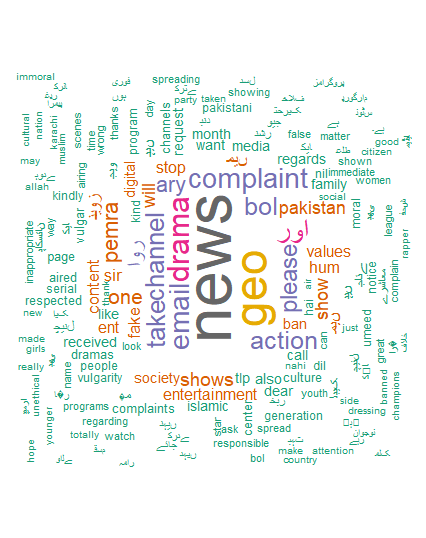
The second part of the textual analysis in this study involved analyzing the most frequently used keywords during the year, which were then categorized month-wise into a table as illustrated in Table 1.4. This depicts the most frequently used terms and their usage every month.
Table 1.4 Frequency of terms across each Month
Months | |||||||||||||
Terms | Jan-21 | Feb-21 | Mar-21 | Apr-21 | May-21 | Jun-21 | Jul-21 | Aug-21 | Sep-21 | Oct-21 | Nov-21 | Dec-21 | Total |
news | 19 | 26 | 6 | 13 | 44 | 26 | 116 | 55 | 387 | 297 | 20 | 4 | 1013 |
geo | 6 | 39 | 53 | 20 | 13 | 0 | 2 | 14 | 339 | 206 | 2 | 2 | 696 |
drama | 111 | 94 | 95 | 23 | 4 | 2 | 10 | 2 | 21 | 24 | 4 | 10 | 400 |
bol | 10 | 12 | 4 | 5 | 10 | 38 | 130 | 11 | 7 | 5 | 23 | 58 | 313 |
ary | 5 | 18 | 58 | 11 | 11 | 19 | 71 | 20 | 8 | 11 | 18 | 4 | 254 |
one | 106 | 73 | 2 | 1 | 7 | 3 | 15 | 3 | 9 | 8 | 8 | 1 | 236 |
shows | 29 | 21 | 27 | 1 | 0 | 16 | 77 | 7 | 4 | 0 | 5 | 10 | 197 |
show | 15 | 24 | 13 | 2 | 10 | 13 | 34 | 6 | 13 | 5 | 24 | 30 | 189 |
fake | 2 | 1 | 1 | 0 | 0 | 12 | 36 | 11 | 54 | 41 | 9 | 0 | 167 |
hum | 12 | 7 | 3 | 6 | 7 | 6 | 39 | 10 | 27 | 32 | 7 | 7 | 163 |
ent | 2 | 20 | 37 | 13 | 7 | 22 | 2 | 6 | 4 | 4 | 7 | 18 | 142 |
entertainment | 8 | 9 | 15 | 2 | 0 | 2 | 81 | 1 | 3 | 1 | 3 | 16 | 141 |
values | 17 | 19 | 38 | 8 | 7 | 6 | 24 | 1 | 4 | 6 | 2 | 7 | 139 |
society | 20 | 35 | 20 | 5 | 0 | 3 | 30 | 9 | 3 | 5 | 2 | 3 | 135 |
digital | 2 | 13 | 55 | 6 | 3 | 9 | 3 | 9 | 8 | 9 | 13 | 4 | 134 |
tlp | 0 | 0 | 0 | 0 | 1 | 0 | 0 | 8 | 49 | 57 | 1 | 0 | 116 |
islamic | 22 | 10 | 17 | 5 | 2 | 4 | 27 | 3 | 10 | 5 | 2 | 5 | 112 |
family | 29 | 25 | 32 | 2 | 2 | 1 | 4 | 3 | 1 | 2 | 0 | 1 | 102 |
Reliability
The reliability of the instruments of the study was checked by taking 5% of random complaints from the years 2020 to 2021. They were then coded by all the researchers of this study and checked for reliability for Themes and Subthemes using Cronbach's alpha value. The obtained Cronbach alpha value for themes was 0.803, and for subthemes was 0.833. A Cronbach alpha value of 0.81 is considered robust, while a minimum value of 0.6 is considered acceptable (Taber, 2018). Therefore, no changes in the instruments of the study were required.
Discussion and Conclusion
Discussion
This study examines how the themes across various electronic media content have been causing dissonance amongst the audience. The findings of the study reveal that the Pakistani audience is most disturbed by the sociocultural aspect, and under that aspect, they are disturbed by vulgarity the most. The second theme by which the audiences are most dissonated is the lack of media ethics in television media. Under media ethics, they are most disturbed by the misinformation being portrayed by the media. Another theme, such as the propaganda which is aimed at political purposes, is also very close in numbers to that of the misinformation. Complainants also feel that alien and westernized culture is being instilled into the Pakistani society, and the audience expresses concern about that in the complaints.
This study also extends to explaining the cognitive dissonance model in understanding the PEMRA complaints. Salzberger & Koller (2010) observe in consumer complaints that the cognitive dissonance theory explains that dissonance is the motivation factor in the scenario that propels a person to lodge a complaint in order to get rid of the dissonance being aroused.
The proposed study, therefore, examines the PEMRA complaints through the theoretical lens of cognitive dissonance theory. It also highlights that there are some underlying themes of content because of which people tend to complain about particular media content. The variation in the channels against which the complaint was lodged shows that some channels broadcast more of the content that leads to dissonance in the audience, while some had less of the content that leads to dissonance. The themes that lead to dissonance have been highlighted in this study, and this study expects to practically contribute to understanding the content type that leads to dissonance. Further, this study aims to guide away from policymakers and the regulatory body to carve out legislation and regulations for the content that causes dissonance in the audience.
Limitations of the study:
First of all, the textual analysis done for the complaints has a margin of error for the complaints in the Urdu script. There are also limitations that exist in the textual analysis itself to analyze the Urdu keywords. Textual analysis is also unable to determine the meaning and connotations of key terms (Carr, 2009). Otherwise, topic modeling and sentiment analysis would have also been possible. Secondly, the complaints on the PEMRA's website are not regularly updated every month. Therefore, the most updated and recent data were not available; otherwise, they could have been employed in this study.
Recommendations
The study recommends that future studies incorporate an element of checking the level of audience sentiments for each content type. It also proposes that the level of dissonance be measured in future complaints to understand, to what degree, and threshold a certain theme or content type causes dissonance in the audience as measured by Menasco & Hawkins (2018). The sentiments in both Urdu and English languages should be done to correctly reflect the sentiments in both languages. Secondly, correlation of certain terms with other terms should be done, and mapping should be done for key terms that reflect the associated lexical terms and themes. Lastly, this study proposes that a stratified sampling approach be used for big data that spans across years. If the societal dynamics are changing every year, a stratified sampling approach will be more convenient and less rigorous (Riffe et al., 2014). Therefore, if the societal dynamics of Pakistan are changing every year, then stratified sampling will work to analyze big data, such as the PEMRA complaints, in an easier manner.
The study examines the complaints of PEMRA for the year 2021 using the cognitive dissonance theory. The cognitive dissonance theory best explains the complaint behavior of the complainants in the context of media content. It contributes to the understanding by highlighting the key themes in the electronic media content that lead to dissonance in the audience. It also examines the diversity of the nature of themes in the registered complaints. The study gives out the descriptive statistics using a quantitative content analysis approach, following a manual coding procedure, regarding what kind of complaints are lodged against what type of content and against which channels. It also highlights what kind of content gets the most complaints from the audience. Complaints against vulgarity, misinformation, propaganda, and foreign cultural influence receive the most complaints in the listed order. The frequency of the occurrence of the themes determines the dominant themes arising in the audience.
Dissonance has an important role to play in the audience because of which they register complaints. If the audience does not feel dissonance, the result would be a lesser number of complaints. The study reveals that because the audience's beliefs are inconsistent with the content being broadcast over the electronic media, they, therefore, lodge complaints because of that dissonance. The study explores a new area of inquiry in the Pakistani media discourse and highlights the gaps in the PEMRA legislation and regulations, which can be filled by the regulatory body, to reduce dissonance in the Pakistani audience that is dissonated by specific content types.
Conclusion
The study examines the complaints of PEMRA for the year 2021 using the cognitive dissonance theory. The cognitive dissonance theory best explains the complaint behavior of the complainants in the context of media content. It contributes to the understanding by highlighting the key themes in the electronic media content that lead to dissonance in the audience. It also examines the diversity of the nature of themes in the registered complaints. The study gives out the descriptive statistics using a quantitative content analysis approach, following a manual coding procedure, regarding what kind of complaints are lodged against what type of content and against which channels. It also highlights what kind of content gets the most complaints from the audience. Complaints against vulgarity, misinformation, propaganda, and foreign cultural influence receive the most complaints in the listed order. The frequency of the occurrence of the themes determines the dominant themes that arise in the audience.
Dissonance has an important role to play in the audience because of which they register complaints. If the audience does not feel dissonance, the result would be a lesser number of complaints. The study reveals that because the audience's beliefs are inconsistent with the content being broadcast over the electronic media, they, therefore, lodge complaints because of that dissonance. The study explores a new area of inquiry in the Pakistani media discourse and highlights the gaps in the PEMRA legislation and regulations, which can be filled by the regulatory body, to reduce dissonance in the Pakistani audience that is dissonated by specific content types.
References
- Bala, S. (2020). Impact on the airline industry of customer complaints filed through social media. Waikato Institute of Technology.
- Barlow, J., & Møller, C. (1996). A Complaint is a Gift: Using Customer Feedback as a Strategic Tool. Berret-Koehler Publishers.
- Berelson, B. (1952). Content analysis in communication research. Glencoe, Ill. : Free Press.
- Braun, V., & Clarke, V. (2006). Using thematic analysis in psychology. Qualitative Research in Psychology, 3(2), 77–101. https://doi.org/10.1191/1478088706qp063oa
- Carr, D. (2009). Breaking New Ground: Innovation in Games, Play, Practice and Theory.
- Dawson, L. L. (1999). When Prophecy Fails and Faith Persists: A Theoretical Overview. Nova Religio, 3(1), 60–82. https://doi.org/10.1525/nr.1999.3.1.60
- Einwiller, S. A., & Steilen, S. (2015). Handling complaints on social network sites – An analysis of complaints and complaint responses on Facebook and Twitter pages of large US companies. Public Relations Review, 41(2), 195–204. https://doi.org/10.1016/J.PUBREV.2014.11.012
- Ess, C. (2013). Digital Media Ethics. Polity Press.
- GHRD. (2021). Sexual Orientation in Pakistan. Global Human Rights Defence.
- Grimes, D. A., & Schulz, K. F. (2002). Descriptive studies: what they can and cannot do. The Lancet, 359(9301), 145–149. https://doi.org/10.1016/S0140-6736(02)07373-7
- Hawkins, G. (2001). The ethics of television. INTERNATIONAL Journal of CULTURAL Studies, 4(4), 412–426.
- Jones, S. C., & van Putten, K. (2008). An analysis of consumer complaints about social marketing advertisements in Australia and New Zealand. Journal of Nonprofit and Public Sector Marketing, 20(1), 97–117. https://doi.org/10.1080/10495140802165550
- Khan, M. A. (2016a). Master’s thesis media landscape in Pakistan and censorship through viewers ’ complaints to PEMRA.
- Khan, M. A. (2016b). Media Landscape in Pakistan and Censorship through Viewers’ Complaints to PEMRA. Yasar University Graduate School of Social Sciences.
- Khan, M. U. H., & Yuosf, M. (2012, May 15). Cognitive Dissonance Theory: A Research Study and Associated Examples from Pakistan – Overseas Pakistani Friends. https://www.opfblog.com/12670/cognitive-dissonance-theory-a-research-study-and-associated-examples-from-pakistan/
- Menasco, M. B., & Hawkins, D. I. (2018). A Field Test of the Relationship between Cognitive Dissonance and State Anxiety: Https://Doi.Org/10.1177/002224377801500417, 15(4), 650–655. https://doi.org/10.1177/002224377801500417
- National Assembly of Pakistan. (1973). The Constitution of the Islamic Republic of Pakistan (p. 10).
- Oesper, L., Merico, D., Isserlin, R., & Bader, G. D. (2011). WordCloud: A Cytoscape plugin to create a visual semantic summary of networks. Source Code for Biology and Medicine, 6(1), 1–4. https://doi.org/10.1186/1751-0473-6-7/FIGURES/2
- Oxford Learner’s Dictionaries. (n.d.). Definition of complaint noun from the Oxford Advanced Learner’s Dictionary.
- Oxford Learner’s Dictionary. (n.d.). Sectarianism noun - Definition, pictures, pronunciation and usage notes | Oxford Advanced Learner’s Dictionary at OxfordLearnersDictionaries.com. Retrieved May 12, 2022, from https://www.oxfordlearnersdictionaries.com/definition/english/sectarianism?q=sectarianism
- PEMRA. (2021). PEMRA Pakistan. https://pemra.gov.pk/complaints.php
- Pervaiz, M. (2004). Media Proliferation: A Study of Patterns of Absorption & Indigenization of Alien Culture. Journal of Research: Humanities. http://pu.edu.pk/images/journal/english/Online_contents/Vol. XL No.2 JRH July 2004.pdf
- Riffe, D., Lacy, S., & Fico, F. (2014). Analyzing media messages: Using quantitative content analysis in research. In Analyzing Media Messages: Using Quantitative Content Analysis in Research. Taylor and Francis. https://doi.org/10.4324/9780203551691
- Salzberger, T., & Koller, M. (2010). Investigating the impact of cognitive dissonance and customer satisfaction on loyalty and complaint behaviour. Brazilian Journal Of Marketing, 9(1). http://ssrn.com/abstract=2677477Electroniccopyavailableat:https://ssrn.com/abstract=2677477
- Singh, A., Saha, S., Hasanuzzaman, M., & Jangra, A. (2021). Identifying complaints based on semi-supervised mincuts. Expert Systems with Applications, 186, 115668. https://doi.org/10.1016/J.ESWA.2021.115668
- Steven, P. (2007). The Stuff of Thought: Language as a window into human nature. Penguin Books.
- Stevens, J. L., Spaid, B. I., Breazeale, M., & Esmark Jones, C. L. (2018). Timeliness, transparency, and trust: A framework for managing online customer complaints. Business Horizons, 61(3), 375–384. https://doi.org/10.1016/J.BUSHOR.2018.01.007
- Taber, K. S. (2018). The Use of Cronbach’s Alpha When Developing and Reporting Research Instruments in Science Education. Research in Science Education, 48(6), 1273–1296. https://doi.org/10.1007/S11165-016-9602-2/TABLES/1
- Vaitkevicius, S., & Kazokiene, L. (2013). The Quantitative Content Processing Methodology: Coding of Narratives and Their Statistical Analysis. Engineering Economics, 24(1). https://doi.org/10.5755/j01.ee.24.1.2350
- van Altena, A. J., Moerland, P. D., Zwinderman, A. H., & Olabarriaga, S. D. (2016). Understanding big data themes from scientific biomedical literature through topic modeling. Journal of Big Data, 3(1), 1–21. https://doi.org/10.1186/S40537-016-0057-0/FIGURES/7
- Wattanacharoensil, W., Schuckert, M., Graham, A., & Dean, A. (2017). An analysis of the airport experience from an air traveler perspective. Journal of Hospitality and Tourism Management, 32, 124–135. https://doi.org/10.1016/J.JHTM.2017.06.003
- World Population Review. (n.d.). Muslim Population by Country 2022. Retrieved May 12, 2022, from https://worldpopulationreview.com/country-rankings/muslim-population-by-country
- .
Cite this article
-
APA : Khalid, F., Warsi, M. S. U. H., & Iqbal, S. (2025). Content Themes in PEMRA Complaints: A Cognitive Dissonance Perspective. Global Social Sciences Review, X(IV), 29-43. https://doi.org/10.31703/gssr.2025(X-IV).03
-
CHICAGO : Khalid, Fatima, Muhammad Sabhi Ul Hussain Warsi, and Sarmad Iqbal. 2025. "Content Themes in PEMRA Complaints: A Cognitive Dissonance Perspective." Global Social Sciences Review, X (IV): 29-43 doi: 10.31703/gssr.2025(X-IV).03
-
HARVARD : KHALID, F., WARSI, M. S. U. H. & IQBAL, S. 2025. Content Themes in PEMRA Complaints: A Cognitive Dissonance Perspective. Global Social Sciences Review, X, 29-43.
-
MHRA : Khalid, Fatima, Muhammad Sabhi Ul Hussain Warsi, and Sarmad Iqbal. 2025. "Content Themes in PEMRA Complaints: A Cognitive Dissonance Perspective." Global Social Sciences Review, X: 29-43
-
MLA : Khalid, Fatima, Muhammad Sabhi Ul Hussain Warsi, and Sarmad Iqbal. "Content Themes in PEMRA Complaints: A Cognitive Dissonance Perspective." Global Social Sciences Review, X.IV (2025): 29-43 Print.
-
OXFORD : Khalid, Fatima, Warsi, Muhammad Sabhi Ul Hussain, and Iqbal, Sarmad (2025), "Content Themes in PEMRA Complaints: A Cognitive Dissonance Perspective", Global Social Sciences Review, X (IV), 29-43
-
TURABIAN : Khalid, Fatima, Muhammad Sabhi Ul Hussain Warsi, and Sarmad Iqbal. "Content Themes in PEMRA Complaints: A Cognitive Dissonance Perspective." Global Social Sciences Review X, no. IV (2025): 29-43. https://doi.org/10.31703/gssr.2025(X-IV).03