
- Literature Review
- Structural Case
- Inherent Case
- Ergative Case in Urdu
- Lexical Case
- Research Methodology
- Data Analysis
- Node layers:
- Functional projections of Node:
- Case Assignment:
- Node layers:
- Functional projections of the node:
- Case Assignment:
- Node layers:
- ii. Functional projections of Node:
- iii. Case Assignment:
- Node layers:
- Functional projections of Node:
- iii. Case Assignment:
- Node layers:
- Functional projections of Node:
- Case Assignment:
- Node layers:
- Functional projections of Node:
- Case Assignment:
- Node layers:
- Functional projections of Node:
- Case Assignment:
- Node layers:
- Functional projections of Node:
- Case Assignment:
- Node layers:
- Functional projections of Node:
- Case Assignment:
- Node layers:
- Functional projections of Node:
- Case Assignment:
- Node layers:
- Functional projections of Node:
- Case Assignment:
- Node layers:
- Functional projections of Node:
- Case Assignment:
- Conclusion
Abstract
The transition from active to passive voice structure is an integral syntactic behaviour in organic languages. The present study explores the syntactic structure of active/passive sentences in English and Urdu, addressing argument structure, case assignment, and the execution of functional projections like VoiceP using Chomsky's Minimalist program(1995) as the theoretical framework. The findings suggest that English passives display the explicit promotion of the internal argument, which is the object-to-subject slot, suppression of the external argument, and the agent(subject) to an adjunct place, generated under the Voice head Phrase. In comparison, Urdu passives contain no overt subject demotion, rather maintaining the designated accusative objects in positions identical to the ones in active sentences. The absence of a by-phrase and the lack of an inert pro subject show that Urdu passives do not represent true passives; rather, they are classified as "active impersonals"(Blevins, 2003), which highlights the implications of their split-ergative orientation.p-ISSN: 2520-0348 e-ISSN: 2616-793xDOI(journal):10.31703/gssrVolume: X (2025)DOI (volume):10.31703/gssr.2025(X)Issue: III Summer (September-2025)DOI(Issue):10.31703/gssr.2025(X-III)www.gssrjournal.comVolume: X (2025)https://www.gssrjournal.com/Current-issueIssue: III-Summer (September -2025)https://www.gssrjournal.com/Current-issues/10/3/2025Scopehttps://www.gssrjournal.com/about-us/scopeSubmissionhttps://humaglobe.com/index.php/gssr/submissionsAbstract
Keywords
Active/Passive Sentences, Internal Argument/External Argument, Minimalist Program, Promotion/Demotion of Subject, Urdu and English
Authors:
Sadia Choudhri:(Corresponding Author)
Lecturer, Department of English, HITEC University, Taxila, Punjab, Pakistan.
(Email: sadia.choudhri@hitecuni.edu.pk)
Pages: 72-89
DOI:10.31703/gssr.2025(X-III).07
DOI link: https://dx.doi.org/10.31703/gssr.2025(X-III).07
Article link: https://gssrjournal.com/article/decoding-english-and-urdu-syntactic-structures-a-minimalist-account-of-voice-alternation
Full-text Link: https://gssrjournal.com/fulltext/decoding-english-and-urdu-syntactic-structures-a-minimalist-account-of-voice-alternation
Pdf link: https://www.gssrjournal.com/jadmin/Auther/31rvIolA2.pdf
Visit Us
Introduction
Language is significant in social interactions. It contributes as the basis for discourse and cohesiveness in society. Thus, it promotes the exchange of opinions, sentiments, and facts, which transforms communities and identities. All languages provide a unique typology that strengthens their awareness of the diversity and complexities (Sirbu, 2015). Among the various complexities, the Active and passive structures are two of the predominant linguistic patterns (Myhill, 2003). These structures fall under the umbrella of syntactic variation across languages. The analysis of syntactic case allocation has frequently been the primary focus of linguistic theory, specifically within the framework of the Minimalist Program (Chomsky, 1995). It attempts to explain language with the most elementary mechanisms. For Interpreting, the way arguments are grammatically and structurally ingrained within clauses involves case assignment, which is determined by voice heads. Voice heads, whether active or passive, play a crucial role in establishing the grammatical relationships between predicates and their arguments, particularly in active and passive constructions. In active voice heads, the object positioned within the c-command domain receives a structural accusative case. In contrast, passive voice heads assign an inherent oblique case to the arguments positioned in the specifier slot. This comparison points out how syntactic operations adjust to varied formations of argument structure (Carnie, 2013; Radford, 2004). Addressing these behaviours brings considerable awareness of cross-linguistic diversity and the universal principles that underlie syntactic case assignment.
In languages such as Urdu, in which grammatical relationships are strongly linked to case marking, the analysis of active and passive Voice heads enables an ample outlet for syntactic inquiry. In comparison to English, Urdu maintains an ergative-absolutive placement in its syntax structure of past tenses, whereas the subject of a transitive verb in the past typically takes an ergative marker, and its object stays unmarked or absolutive (Butt, 1993). These phenomena led to the foundation of the present study. This study focuses on the case assignment in the past tense constructions. Structures of the past tense are useful as they integrate complicated temporal connections impacted by active/ passive Voice head choices and case assignment. This connection between Voice heads and their arguments is important in settings that operate in the past tense. In these instances, changes in structure need to occur to bring together syntactic descriptions with temporal facets. Considering the realisation that this relationship is further entangled by the typological distinctions that differ between head-initial languages (for example, English) and head-final languages (like Urdu), it becomes imperative to perform a comparative study. Radford (2004) maintains that active/passive Voice heads perform as core projections that bind verbal predicates to the structural subjects and objects, a notion that the current research deepens to reflect the variety of past tense patterns.
Despite the syntactic differences between active and passive voice structures in case distribution being documented in English, it is, however, understudied in Urdu. The Urdu language is a language with a complicated case structure. The study of these active and passive voice structures of Urdu's past tenses holds the likelihood of uncovering novel syntactic attributes and facilitating a deeper understanding of Voice structures cross-linguistically. This research thus addresses two specific questions: (1) What syntactic protocols do active/ passive structures involve, determining the case markers of past tense clauses in English and Urdu?; (2) How do the active vs passive syntactic patterns alter case attribution of past tense in English and Urdu? The present study is limited to the syntactic structure of the past tense, which comprises both English and Urdu. Active/ passive voice syntactic structures and case allocation have been explored while excluding the semantic features of argument roles.
This study enhances the Minimalist Program by clearly defining the roles of active and passive voice in assigning cases for past-tense constructions. It broadens our understanding of typological variation by contrasting Urdu with English, highlighting both the unique features of these languages and their shared universal syntactic properties. Furthermore, the findings contribute to applied linguistics, particularly in areas such as translation theory and language training, where effectively parsing and constructing syntactically correct phrases requires knowledge of voice and case assignment.
This section discusses the fundamental theoretical basis of case assignment functions, highlighting the nature of active and passive voice heads and how they correspond with tense and aspect. The Minimalist Program (Chomsky, 1995) governs as the holistic foundation, reflecting the notions based on ideas such as economy, locality, and universal grammar. A particular emphasis has been put on Urdu as a spoken form and its relevance in voice and case assignment analysis. The discourse amalgamates core concepts from classical publications and current scholarship for an in-depth description of the syntactic uses of active and passive voice heads in case assignment.
The Minimalist Approach and Functional Perspectives
The Minimalist Program (Chomsky, 1995) strives to explain the mechanisms of language by demonstrating economy and location, proposing that syntactic patterns emerge using minimal processing power. In this setting, structural projections such as VoiceP and TenseP serve as vital for determining case assignment. That active voice presents the external arguments and allocates the inherent case, which is structural, while TenseP applies the nominative case to the subject in the finite form of statements. The key concepts of economy and locality set restrictions on case allocation. Chomsky (1995) asserts that each functional head can be assigned case just a single time, thus providing simplicity in derivations. It maintains that active voice imparts inherent accusative case to objects, whereas passive voice heads, exhibited by passive structures, place innate oblique case on transformed agents. Radford (2004) clarifies it by focusing on the behavior of these functions in finite expressions, when Tense and Voice collaborate to attribute case to subjects and objects. Kratzer (1996) describes an idea of isolating external arguments from the original verb, adding them into VoiceP as opposed to VP. This dichotomy accords with Minimalist tenets by distinguishing thematic role placement from structural case distribution. Active Voice heads bring external arguments and attribute the accusative case to objects; however, passive voice heads inhibit external arguments, allocating an internal oblique case as a substitute.
Comparison of case attribution in English and Urdu
Case distribution is crucial in specifying syntactic obligations and argument construction. English follows the nominative-accusative case structure, yet Urdu has a split-ergative orientation in its case markers, especially within past tenses. The variants are syntactical, intrinsic, and lexical contexts are significant to interpreting the inner workings of active/ passive voice heads in such languages. There are different types of case discrimination as listed below:
A structural case is given depending on the syntax.
Combinations contrary to lexical or semantic properties. In the English language, the tense indicates the nominative case for the subject present in the clause; however, the active voice head designates the accusative case for the object (Radford, 2004). Urdu maintains a structural nominative case, but its position shifts depending upon tense and aspect. In imperfective aspects, subjects have been given the nominative case, which is typical of English (Kidwai, 2022).
The inherent case corresponds to the thematic roles and is distributed by functional heads that include Voice. In English, passive voice heads utilise the oblique case to external arguments in passive structures, such as by him in Ali was insulted by him. In Urdu passive voice, transformed agents have been identified, but without oblique case markers, which means Saib khaya gaya - Apple was eaten.
In comparison with English, Urdu occupies ergative case markers in past tense usage, having perfective aspects, within which the subject of a verb with transitive form is labelled as ergative and the object has become absolutive (Butt, 1993). Considering that English does not utilize ergative markers, this split-ergative placement fosters a typological distinction.
Lexical cases are presented dynamically by verb-specific criteria. In Urdu, verbs that include baat karna - to talk entail an object within the dative case, emphasising the priority of lexical features above structural patterns (Kidwai, 2022). Even though lexical case is prevalent in English, its implementation is rather confined, generally emerging with prepositions like She passed a salt to him.
These variations demonstrate the significance of case applications on active/ passive voice head function and argument construction, establishing a framework of comparison for the investigation of English and Urdu.
Voice and Case Allocation
Active/ passive voice heads support the association
of syntactic organisation and case attribution, providing multiple roles in active and non-active protocols. In the active voice, exterior/external arguments are put forward, and the structural accusative case is given to interior/internal arguments. On the other hand, passive voice heads hinder external arguments, assigning to an adjunct role or excluding them completely. This approach follows universal grammatical conventions, in which the functional heads distribute case for maintaining syntactic harmony (Woolford, 2006). Legate (2014) introduces a cross-linguistic evaluation suggesting that voice features systematically influence case attribution in both active and passive varieties.
In the context of passive clauses, inactive voice heads cannot allocate the accusative case simply due to their inherent case mapping to external arguments. It causes internal arguments to move upward to the subject place, wherein the nominative case has been designated by TenseP. Kidwai (2022) addresses the specific pattern of voice heads in Urdu, highlighting how they collaborate with Tense and Aspect projections in the role of case. That study shows passive voice heads in Urdu share internal oblique case to lowered agents, echoing processes recognised in different languages, however, with typological peculiarities caused by its split-ergative orientation. These outcomes illustrate the universal nature of voice heads while pointing out parametric differences between languages.
Tense and Aspect
Tense and aspect are essential when devising case allocation protocols. In Minimalism, TenseP places the nominative case to subjects in finite phrases and connects with VoiceP to create the syntactic manifestation of arguments (Carnie, 2013). In active structures, TenseP designates a nominative case to the subject, whereas the active voice head specifies an accusative case to the object. In passive structures, TenseP designates the nominative case to the higher internal argument, whereas the passive voice head labels the oblique case to the lowered external (outward) argument.
Aspect contributes more layering to case assignment, specifically in systems with split-ergative structures. Davison (2004) states that aspectual features, namely perfective and imperfective, often affect case placement in languages that include Urdu. Perfective aspects in the past tense stimulate ergative tagging on subjects, whereas imperfective aspects correspond to nominative-accusative constructions. It underlines the value of aspect in determining the case-assigning processes of voice heads. Kidwai (2024) explains the idea to show the implications of the aspect on Voice and case allocation in Urdu, specifically in non-active constructions when dropped agents acquire oblique case. The resulting outcomes comply with Minimalist principles, emphasising the structured connection of functional projections in case allocation.
Cross-Linguistic Perspectives
Cross-linguistic investigation brings substantial knowledge into the universality and diversity of case assignment procedures. Mahajan (1990) focuses on ergative placement in Hindi-Urdu, addressing the relationships of Voice and Tense projections in case distribution. The examination shows ergative labelling often has connections with aspectual features, with voice heads enhancing the relationship. Woolford (2006) supports the above results by exhibiting that aspect-driven split-ergativity corresponds to universal rules of grammar and facilitating parametric versatility.
Legate (2014) proposes an in-depth evaluation of voice heads in Acehnese, revealing the effect of active and non-active arrangements on case allocation. It illustrates that non-active Voice heads usually limit outer arguments and allot internal oblique case, despite language-specific placement tendencies. The results provided demonstrate the universality of Voice heads and show their capacity for adaptation to typological variances. Polinsky (2016) explores agreement and case assignment in ergative dialects, highlighting the connection between the functional heads and structural dependents. It indicates that Voice heads drive case assignment through integrating structural and internal features, thereby enabling cross-linguistic comparability.
Kidwai (2022) builds on these viewpoints by investigating Voice heads in Urdu, showing their importance in facilitating case allocation inside a split-ergative structure. This study underscores that passive voice heads in Urdu allot oblique case to lowered agents, enabling the inner arguments to obtain nominative case through TenseP. These outcomes harmonize theoretical projections with typological plurality awareness of Voice and case frameworks.
Rationale for the Research
Although ample research on case allocation protocols in English and ergative-aligned structures, such as Urdu, a comprehensive study of active/ passive voice structures and their case-assignment tendency in past tenses in each of these languages has not been undertaken. The present literature mainly highlights one language in isolation, as in the case of assignment in English (Radford, 2004; Kratzer, 1996) or split-ergativity in Urdu (Butt, 1993; Kidwai, 2022), but it requires a thorough cross-linguistic investigation in an organized philosophical structure based on Minimalism. Additionally, the majority of the current scholarship addresses case and alignment frameworks in broad terms, without probing the connection of Voice with tense and aspect in the generation of syntactic structures. For instance, Kidwai (2022) presents explanations for the significance of Voice in Urdu; the research excludes tense-specific choices in perfective and imperfective places, or the effects in linguistic comparison with nominative-accusative languages such as English. This study thus fills a gap by Integrating Voice and Tense, Cross-Linguistic Comparisons with the assistance of the minimalist framework.
The current study analyzes how case assignment occurs in active and passive voice clauses in English and Urdu, specifically focusing on the past indefinite, past continuous, and past perfect tenses. This research employs a qualitative method using purposive sampling and applies content analysis to examine structural variations within the Minimalist framework.
Research Design
The analysis adopted a descriptive and comparative qualitative method to explore and contrast the syntactical behaviour of active/ passive voice in case assignment. It facilitates an in-depth study of voice mechanisms, their relationship with tense and aspect, and cross-linguistic variations in case assignment, by centring on sample instances from English and Urdu.
Data Collection
The data collection of this study is based on two domains. English sentences have been taken from standard English grammar books to maintain competence. The Urdu phrases have been collected from native speakers to reflect true applications and grammar patterns in everyday settings.
Sampling Technique
The sample used was purposive, centred on transitive verb forms in the past indefinite, past continuous, and past perfect tenses. Active and passive sentences have been considered to present even illustrations of voice categories across both languages. A total of 12 sentences were explored, including six in English and six in Urdu, that concentrated on the visual representation of active and passive voice.
Theoretical Framework
The study draws on Chomsky's Minimalist Program (1995), focusing on the notions of economy, locality, and universal grammar. The basic components that guided the process of evaluation include the functional projection of VoiceP and TenseP. Voice P presents the external arguments and allocates the structural accusative case to active voice sentences or the internal oblique case in passive voice. The TenseP attributes the nominative case to subjects present in finite sentences. The second principle is case assignment, in which active voice heads allocate the structural accusative case to the internal arguments in the sentence. While the passive voice heads remove the external arguments and supply the intrinsic oblique case. These notions contribute to understanding the cross-linguistic variation between the two languages.
Data Analysis Procedure
This research incorporated content analysis to carefully recognize and comprehend syntactic sequences. The procedure for analysis was executed in several stages. The first step consisted of syntactical representation to explain voice head arrangements and case allocation processes; syntactic tree representations were utilised for each sentence. The second step comprised finding the role of functional projections (VoiceP, TenseP) in case allocation. Then, to evaluate the relation between Voice, tense, and aspect in active and passive formulations. Moreover, documentation about behavioural patterns of active/ passive voice heads with distinct alignments, such as the nominative-accusative versus split-ergative.
The analysis of this study consisted of English and Urdu sentences in active and passive voice structures. The following analysis exhibited the details of English sentence structure in both active and passive voice perspectives.
English Sentence Structure Description
1 (a) Active Sentence: "They killed a snake"
[They] killed [a snake j ]
PRN.3PL.NOM V. PAST DET N.1SG.ACC
Ex. Arg Agent In. Arg Theme
[They i ] is a pronoun that represents a component external to the phrase. It also shows that [They i ] free in its local domain. [a snake j ] should be identified as a unique entity with separate indices. "They" act like the external argument, serving as the agent of the act. "A snake" is used for the internal argument because it is instantly influenced by the verb.
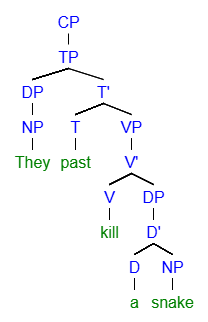
The complementizer (CP) node has an empty specifier (C) as the sentence is in declarative mood. The tense phrase (TP) node provides the information about the tense. It attributes the nominative case to they and the past tense. The verb phrase (VP) encodes the internal position of the predicate, and the verb kill allocates the accusative case to the object, a snake, in the designated sentence.
The determiner phrase (DP) assigns (They) as the subject present in the specifier of TP. While T Head nominates the past tense marker influences the verb (kill). The verb head (V) attributes the accusative case to the object, a snake, which is positioned as the complement of V.
"They" is the subject present in DP and assigned as the nominative case from the Tense head (T). Whereas a snake is the object DP assigned the accusative case from the kill (verb).
1 (b) Passive Sentence: "A snake was killed by them"
[A snake j ] was killed by [them i ]
DET N.1SG AUX.PST V. PAST PREP PRN.3PL
Ex. Arg Theme In. Arg Agent
(Them) It is free to operate in its immediate domain and does not share its indices with the other noun words in the sentence. [A snake j ] is an R-expression that denotes the unique entity and is free in the overall sentence structure. "A snake" fulfils the subject location within the sentence structure (Spec, TP). It acts as the external argument and semantically conveys the theme. "By them" serves as a prepositional phrase adjunct under the verb phrase. It represents the internal argument of the sentence and semantically defines the agent.
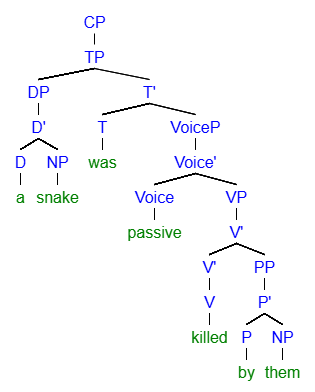
The Complementizer Phrase is null for the declarative sentence. The Tense phrase introduces the (a snake) subject of passive structure, which is the specifier of TP. The T bar is marked by the passive be form and introduces the Voice Phrase head to show the transformation of arguments. The Verb Phrase head introduces the verb (killed) in past participle form and the agentive phrase structure (by them) under the VP node as an adjunct.
Within the Determiner Phrase (DP) node, the object of the active sentence (a snake) is now promoted to the subject position in the passive sentence structure. While the Tense head (T) provides the past tense marking and assigns the accurate verb according to the subject of the passive case. The auxiliary (was) is announced in the T node. The Voice Phrase head shows the transition of an active sentence into passive. The Verb Phrase node shows the predicate of the sentence with the help of the main verb (killed), which assigns the thematic role to an agent (them) and is introduced by the preposition (by) in the PP adjunct.
A snake becomes the subject (DP) and is allocated the nominative case. The agent (them) is shown as oblique and presented by the preposition (by), suggesting its demoted position in the passive sentence construction. There is no accusative case introduced in the passive sentence structure. The agent (external argument) is suppressed, and the promoted theme (internal argument) moves towards the subject position to satisfy the syntactic requirements, such as the Extended Projection Principle (EPP) of the Minimalist Program. As a result of this location, a snake preserves its semantic functionality as the theme, yet being tagged with the nominative case (subject case) and residing in the specifier slot of the Tense Phrase (Spec-TP).
2 (a) Active Sentence: "She was posting a letter."
[She i ] was posting [a letter j ]
PRON.3SG.F.NOM AUX.PST V-PROG DET N.1SG.ACC
Ex. Arg Agent In. Arg Theme
[She i ] a pronoun expression and refers to a single entity. It does not c-command within the clause and is free in its local domain. [a letter j ] is nominated with separate indices. "She" acts as an external argument to serve as the agent of the sentence. "A letter" is identified as the internal argument as it is in the complement slot of the verb.
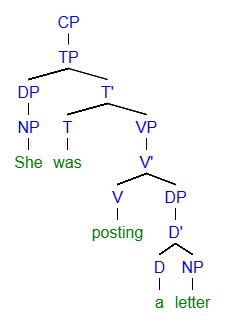
The complementizer (CP) node occupies the empty specifier (C) because the sentence is declarative. The tense phrase (TP) node introduces two types of information, such as DP and T-bar. It attributes the nominative case to She and the past progressive marking of the verb. The verb phrase (VP) encodes the internal slot of the predicate and the main verb posting. Thus, the "a letter" is assigned as the accusative case of the sentence.
The determiner phrase (DP) attributes (she) as the subject of the specifier of TP. While T Head reveals the past progressive marker of the sentence. The VP node introduces the main verb posting and the accusative case to the object "a letter," which is positioned as the complement of V.
She is the subject of the DP and assigned as the nominative case. Whereas a letter is the object DP assigned the accusative case from the posting (verb).
2 (b) Passive Sentence: "A letter was being posted by her."
[A letter j ] was being posted [by her i ]
DET N.1SG AUX.PST ASP. PROG V.PAST PREP PRN.3SG.F
Ex. Arg Theme In. Arg Agent
(Her) is nominated with a unique index as it is free in its immediate domain of the sentence. [A letter j ] is also free in the sentence and is denoted as an R-expression with a separate index. "A letter" fills the subject slot as the specifier of TP (Spec, TP). It is, although it semantically conveys the meaning of the theme, but behaves as an external argument. "By her" is introduced by the Verb Phrase and acts as a prepositional phrase adjunct. It serves as the internal argument of the sentence, but semantically behaves as the agent of the sentence.
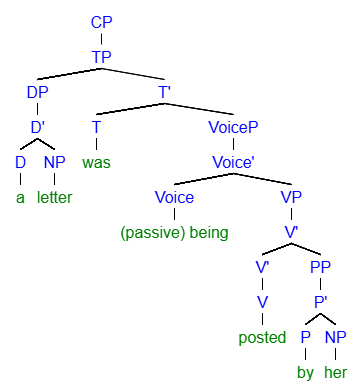
In the above sentence, the Complementizer Phrase is empty as the sentence is declarative. The TP nominates the subject of the passive construction [a letter], which is the specifier of the Tense Phrase. The T-bar is defined by the passive progressive form, and the Voice Phrase node assigns the aspect marker 'being,' which conveys the progressive aspect. Subsequently, the Verb Phrase reveals the main verb (posted) in past participle form and the agentive phrase structure (by her) under the VP node as an adjunct.
The Determiner Phrase (DP) is promoted to the subject position (a letter) in the passive sentence. While the Tense head (T) gives the past tense marking of the progressive be form and allocates the verb according to the subject. The auxiliary (was) and aspectual form (being) are introduced under the Voice Phrase node. The Verb Phrase node exhibits the predicate with the positioning of the main verb (posted), which assigns the thematic role to an agent (her) with the preposition phrase (by) under the PP adjunct.
"A letter" is the (DP) and is assigned the nominative case of the passive sentence. The agent (her) shows the oblique case with the preposition (by). It suggests that the subject is suppressed from its position and demoted. Since there is no existence of the accusative case. "Them," which is the internal argument promoted towards the subject position to satisfy the syntactic requirements, such as the Extended Projection Principle (EPP) of the sentence. Due to this, "a letter" preserves its semantic role as the theme but is labelled as nominative case (subject case-grammatical subject) and is allocated in the specifier position of the Tense Phrase (Spec-TP).
3 (a) Active Sentence: "They had taken lunch"
[They i ] had taken [lunch j ]
PRON.3PL.NOM AUX.PERF V. PAST N.1SG.ACC
Ex. Arg Agent In. Arg Theme
[They i ] occupies the pronoun position in the sentence and exhibits a separate entity within its local domain. [lunch j ] is the unique noun phrase in the object position with distinct indices. "They" serves as the agent of the above active sentence and is nominated as an external argument. While "lunch" is the internal argument and the complement of the verb.
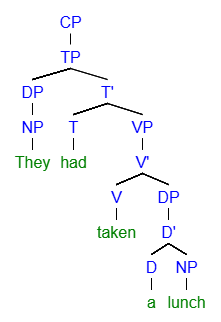
The sentence is in declarative form, and thus the complementizer (CP) node shows the null specifier (C). The tense phrase (TP) node allocated the DP and T-bar of the active sentence. It allocates the nominative case to They and the past perfect markers of the verb. The verb phrase (VP) to allocate the internal slot of the predicate and the main verb is taken. So, the accusative case is assigned by lunch.
The subject of the specifier of TP is identified with the Determiner phrase (DP), which is (they). Whereas the past perfect tense marking is exhibited with the T head. The VP node is under the T node, which allocates the main verb taken and the object lunch of the above active sentence.
"They" is the main subject of DP and assigned as the nominative case. While lunch is the object and is placed under DP to assign the accusative case of an active sentence.
3 (b) Passive Sentence: "Lunch had been taken by them"
[Lunch j ] had been taken [by them i ]
N.1SG AUX.PERF ASP. PERF V.PAST PREP PRON.3PL
Ex. Arg Theme In. Arg Agent
(Them) is chosen with a single index as it is free in its instant domain. While [Lunch j ] is correspondingly free in the sentence and is represented as an R-expression with a distinct index. "Lunch" occupies the subject position and is nominated as the specifier of TP. It is the external argument of the sentence and semantically conveys the sense of the theme. "By them" presents under the Verb Phrase and is introduced with the prepositional phrase adjunct. It is the internal argument, but semantically performs the agent of the sentence.
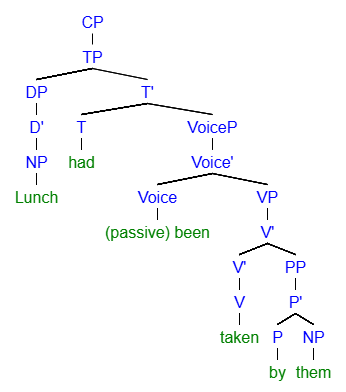
The Complementizer Phrase is null in the sentence. The TP suggests the subject of the passive construction [lunch], which becomes the specifier of the Tense Phrase. The T bar is manifested in the passive be perfect form and declared with the assistance of the Voice Phrase with aspectual auxiliary (been). Afterwards, the Verb Phrase assigns the main verb (taken) in past participle form and the agentive phrase structure (by them) under the VP node as an adjunct.
"Lunch" is promoted to the subject slot under the Determiner Phrase (DP). Whereas the past tense marker of the perfect be form is announced by the Tense head (T). It also allocates a verb according to the subject. The perfect aspectual form (been) is presented under the Voice Phrase head node. The Verb Phrase node displays the predicate with the placement of the main verb (taken), which gives the thematic role to the agent (them) with the preposition phrase (by) under the PP adjunct.
"Lunch" is the nominative case of the passive construction introduced with the node of (DP). The agent (them) displays as the oblique case with the preposition (by). It proposes that the subject is suppressed from its place. Lunch, which is the internal argument, is promoted to the subject position to satisfy the syntactic requirements (EPP) of the sentence. Due to this, lunch maintains its semantic position as the theme but is considered as a nominative case (subject case) and assigned in the specifier location of the Tense Phrase (Spec-TP).
Urdu Sentence Structure Description
1 (a) Active Sentence:
Us ne khirki tor di
(He/She broke the window)
[Us i ] ne [khirki j ] tor de
PRN.3SG.NOM PREP N.1SG.ACC V AUX.PST.SG
Ex. Arg Agent In. Arg Theme
[Us i ] is the pronoun with third-person singular realization. It is free in its domain with a unique index position [Usi ]. [khirkij ] is acknowledged as a distinct entity with a separate index. "Us" is considered to be the external argument and performs the role of the agent in the above sentence. While "Khirki" is the internal argument and behaves as the theme of the action.
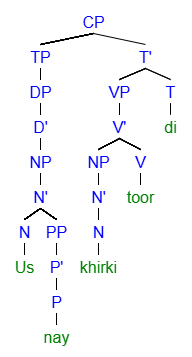
There is no specifier in the complementizer (CP) node. There is the Tense Phrase node with DP and T'. The subject "us" is attached with the postposition "ne," which is the typical structure of the ergative case marker in Urdu.
The determiner phrase (DP) is the specifier of the TP and nominates it to Us. The tense phrase (TP) node comprises the DP node and T-bar. The T' offers the data about DP (Us) with postposition (ne). The VP introduces the absolutive case (Khirki) with the main verb (Toor) and the past tense marker (Di).
Us is the subject of DP and assigned as the object of the ergative case from the Tense head (T). While khirki is the object that has the absolutive case received from the toor (verb).
1 (b) Active Sentence:
khirki ko tora gaya
(Window was broken)
[khirki j ] ko tora gaya
N.1SG PREP V.PST AUX.PST.SG
In. Arg Theme
[Khirki j ] has its separate index. It contains no additional noun phrase in the passive organization of the statement. Khirki is still the internal argument and not promoted to the external argument position, and remains in its initial spot. The agent in the external argument, yet, lacks the adjunct phrase PP and is mute.
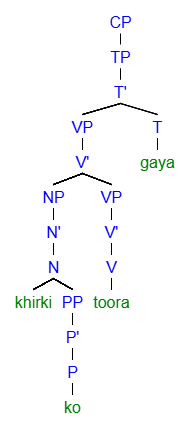
The Complementizer Phrase is void in the above sentence. The Tense phrase obtains the empty slot in the DP position. The Verb Phrase presents the main verb (khirki) and aspect element of past tense marking (gaya).
The Tense Phrase reveals two elements of the sentence (VP and T). The Verb Phrase shows the theme as (khirki) and the main verb (tora). Whereas T indicates the past ending marker (gaya).
Khirki is the accusative case and remains in the passive structure. No explicit subject is possible in this construction.
2 (a) Active Sentence:
Woh Khat likh raha tha
(He was writing a letter)
[Woh i ] [khat j ] likh raha tha
PRN.3SG.NOM N.1SG.ACC V PROG.M.SG AUX.PST.M.SG
Ex. Arg Agent In. Arg Theme
[Woh i ] is the third person singular pronoun of the above past continuous tense. As it is independent in its local domain, it has a unique index [Woh i ]. [khatj ] is identified as a separate entity with a distinct index. "Woh" is the external argument and serves as the agent of the act. "Khat" is the internal argument and acts as the theme of the action, particularly influenced by the verb.
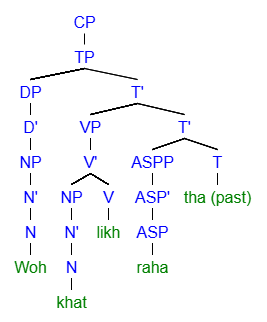
The sentence is in declarative mood, so the complementizer (CP) node has no specifier (C). The tense phrase (TP) node contains the DP node and T bars. The T bar1 provides the information of NP (khat) and V (likh) while T bar2 indicates the aspect marker of the sentence.
The determiner phrase (DP) is the specifier of the TP and nominates it to Woh. The TP head contains two T bars. The T bar1 is used to display the VP of the sentence, which is further divided into NP (khat) and V (likh). The T-bar2 contains the aspect marker of the past continuous tense. The VP comprises the main verb (likh), which combines with its internal argument (khat).
Woh is the main subject of DP and is allotted as the nominative case from the Tense head (T). While khat is the theme and the object that receives the accusative case from the likh (verb).
2 (b) Passive Sentence:
Khat likha ja raha tha
(letter was being written)
[Khat j ] likha ja raha tha
N.1SG V.PST PROG.M.SG AUX.PST.M.SG
In. Arg Theme
[Khat j ] occupies the unique index and is free in its direct domain. There is no other Noun phrase in the sentence of passive construction. Khat is not promoted to the external argument position and maintains its original position. In contrast, the agent or subject with an external argument is silent and not introduced as an oblique or adjunct phrase, the PP.
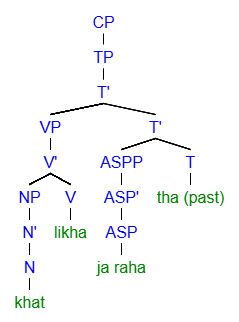
The Complementizer Phrase is empty in its realization. The Tense phrase is also null in its DP position, hence there is no specifier of TP. The Verb Phrase introduces the main verb (likha) and the aspect component of the past progressive tense.
The Tense Phrase is introduced with two T bars. T'1 announces the Verb Phrase with marked object as (khat) and main verb (likha). While T'2 shows the aspect marking (ja raha) with past ending (tha).
Khat is the accusative pronoun in the passive construction of the above sentence. There is no overt subject in this construction.
3 (a) Active Sentence:
Woh kitaab parh chuka tha
(He had read the book)
[Woh i ] [kitab j ] parh chuka tha
PRN.3SG.NOM N.1SG.ACC V PERF.M.SG AUX.PST.M.SG
Ex. Arg Agent In. Arg Theme
[Woh i ] is the pronoun of the above past perfect tense and free in its local domain. It contains the separate index [Woh i ]. [kitabj ] is seen as a separate unit with its distinctive index. "Woh" is the agent of the act and an external argument. "Kitab" serves as the theme and is influenced by the verb (parh). It is the internal argument.
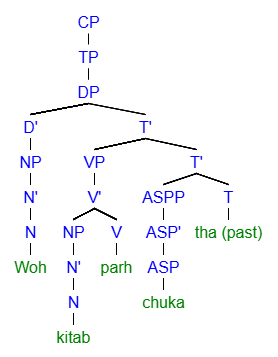
The complementizer node (CP) of the sentence is in a declarative mood. It has no specifier (C). The tense phrase (TP) node comprises the DP node and T bars. The T'1 announces the details of the VP while T'2 shows the aspect marker of the sentence.
The specifier of TP is the determiner phrase (DP), which is Woh. The TP head introduces two T bars. T'1 is utilised to symbolise VP of the assertion and is then split into NP (kitab) and V (parh). While T'2 incorporates the past perfect tense's aspect indicator. The VP includes the main verb (parh), which connects with its internal argument (kitab).
Woh is assigned as the nominative case and the subject of DP. Whereas kitab is the theme and occupies the accusative case of the above sentence.
3 (b) Passive Sentence:
Kitaab parhi ja chuki thi
(The book had been read)
[Kitab j ] parhi ja chuki thi
N.1SG V.PST PERF.F.SG AUX.PST.F.SG
In. Arg Theme
[Kitab j ] is independent in its local domain and maintains the specific index. Kitab is not raised to the external argument place and stays in its initial position. The subject that has an external argument, which is hidden and does not occur using an oblique or adjunct phrase (PP).
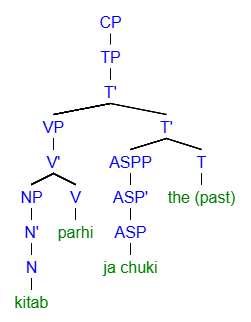
The Complementizer Phrase does not consist of any element. The Tense phrase is likewise void in its DP slot, hence there is no specifier for TP. The Verb Phrase provides the primary verb (parhi) and the aspectual component that defines the past perfect tense.
The Tense Phrase announced two T bars. T'1 states the Verb Phrase with marked object as (kitab) and main verb (parhi). Whereas T'2 showcases the aspect labelling (ja chuki) with the past tense marker (thi).
Kitab is the absolutive case (accusative) and has been retained in the passive formulation of the given sentence, but without an apparent subject.
Comparison of English and Urdu Sentences
The structural depiction of active and passive sentences in English and Urdu displays both universal principles and considerable typological variations. English syntax consists of a Voice Phrase (VoiceP) that allows the rise of an inner argument (object) and lowering of an outer argument (agent). Urdu fails to include the apparent external argument. The difference indicates key deviations in the syntax of the two languages and their argument structures.
Voice Phrase
The passive voice in English is apparent by the
placement of a VoiceP node, and it is crucial in modifying argument structures. The VoiceP provides the rise of the internal argument (e.g., Lunch in Lunch had been taken) to the subject slot (specifier of TP), in which it takes nominative case from the Tense head. In the meantime, the external argument (e.g., the agent) is assigned to an adjunct status inside the VoiceP. This structure indicates that the focus is on the action being performed. This nominative-accusative case orientation is common in English (Kratzer, 1996; Carnie, 2013).
On the contrary, Urdu is not explicit in including a VoiceP node to represent the passive structure. However, the internal argument preserves the same accusative place, such as "Kitaab", and is empty in its DP slot. The external argument (e.g., Us ne) is implied and unknown in the passive structure of Kitaab parhi ja chuki thi. The internal argument retains an accusative argument's agreement and semantic attributes. The syntactical difference in which the external argument is not overtly assigned to an adjunct separates Urdu from English.
An additional variation appears in the case-marking of Urdu sentences. Urdu uses the postposition (ne) in active structures to explicitly express the actor (external argument), such as Us ne khirki toor di. This is typical in ergative case markers, which are the aspect of perfective in Urdu. In contrast, the object is assigned as an absolutive case. This system is unique to Urdu and other South Asian Languages (Mahajan, 1990; Butt, 1993). In passive structures, there is no adjunct slot for the demoted subject. This deficiency of explicit suppression of the subject, which appears in the English construction of passive as an adjunct introduced by by. This syntactic variation shows Urdu's focus on tense and aspect markers for meaning creation, instead of added structural extensions like VoiceP.
The comparative study of English and Urdu active/passive sentences demonstrates an association of universal grammatical principles and typological variations. The two languages correspond to the concept of emphasizing the internal argument in active/passive structures; still, their structural interpretations vary substantially.
The present study focuses on the structural variations of active/passive constructions between English and Urdu by concentrating on the processes of argument promotion and subject demotion. In English passive structure, the VoiceP node simplifies the overt promotion of objects and demotion of agents, whereas Urdu passive structures preserve the traits of active syntax. The absence of a by-phrase and the nonexistence of an inert pro subject indicate that Urdu passives keep core active attributes. These outcomes correlate with Blevins' (2003) idea of the "active impersonal," showing that what is to be in a passive construction of Urdu may reflect an active structural organization. From an instructional perspective, recognizing these variations is necessary for educating students on Urdu and English rules of syntax, mainly for students learning a second language. Trainers need to emphasize that passives in Urdu are in syntax distinctive from those in English, usually determined by tense and aspect as opposed to explicit syntactical modification. This awareness can assist with the development of curriculum, particularly within comparative studies. Further research could look into the impact of the findings for computational syntax, where understanding the "active impersonal" nature of Urdu passives could strengthen natural language processing models.
References
- Blevins, J. P. (2003). Passives and impersonals. Journal of linguistics, 39(3), 473-520. https://doi.org/10.1017/S0022226703002081
- Butt, M. (1993). Object Specificity and Agreement in Hindi/Urdu. In Beals, K., Cooke, G., Kathman, D., Kita, S., McCullough, K. E., & Testen, D. (Eds.), Papers from the 29th Regional Meeting of the Chicago Linguistic Society, Volume 1, pp. 89–103. Chicago, Chicago Linguistic Society. ISBN 978-0-914203-42-1.
- Carnie, A. (2013). Syntax: A Generative Introduction (3rd ed.). Malden, MA: Wiley-Blackwell.
- Chomsky, N.(1995). The minimalist program. Cambridge, MA: MIT press.
- Kidwai, S. (2022). A Survey of Urdu Subjects and Their Properties. The Cambridge Occasional Papers in Linguistics, 14(2), 27-70.
- Kidwai, S. (2024). Voice, Case and the External Argument: The perspective from Urdu (Doctoral dissertation, University of Cambridge). UC Campus Repository https://www.repository.cam.ac.uk/handle/1810/363428
- Kratzer, A. (1996). Severing the external argument from its verb. In J. Rooryck & L. Zaring (Eds.), Phrase Structure and the Lexicon (Vol. 33, pp. 109–137). Dordrecht, Netherlands: Springer. https://doi.org/10.1007/9789401586177_5
- Legate, J. A. (2014). Voice and v: Lessons from Acehnese. MIT Press. https://doi.org/10.7551/mitpress/9780262028141.001.0001
- Mahajan, A. (1990). The A/A-bar Distinction and Movement Theory. Ph.D. Dissertation, MIT. https://dspace.mit.edu/handle/1721.1/13650
- Myhill, D. (2003). Principled understanding? Teaching the active and passive voice. Language and Education, 17(5), 355-370. https://doi.org/10.1080/09500780308666856
- Polinsky, M. (2016). Agreement in Archi from a minimalist perspective. In O. Bond, G. G. Corbett, M. Chumakina, & D. Brown (Eds.), Archi: Complexities of agreement in crosstheoretical perspective (pp. 184–232). Oxford University Press. https://doi.org/10.1093/acprof:oso/9780198747291.003.0007
- Radford, A. (2004). Minimalist Syntax: Exploring the Structure of English. Cambridge: Cambridge University Press. https://doi.org/10.1017/CBO9780511811319
- Sirbu, A. (2015). The significance of language as a tool of communication. Scientific Bulletin" Mircea cel Batran" Naval Academy, 18(2), 405. https://doi.org/10.21279/1454‑864X
- Woolford, E. (2006). Lexical case, inherent case, and argument structure. Linguistic inquiry, 37(1), 111-130. https://doi.org/10.1162/002438906775321175
Cite this article
-
APA : Choudhri, S. (2025). Decoding English and Urdu Syntactic Structures: A Minimalist Account of Voice Alternation. Global Social Sciences Review, X(III), 72-89. https://doi.org/10.31703/gssr.2025(X-III).07
-
CHICAGO : Choudhri, Sadia. 2025. "Decoding English and Urdu Syntactic Structures: A Minimalist Account of Voice Alternation." Global Social Sciences Review, X (III): 72-89 doi: 10.31703/gssr.2025(X-III).07
-
HARVARD : CHOUDHRI, S. 2025. Decoding English and Urdu Syntactic Structures: A Minimalist Account of Voice Alternation. Global Social Sciences Review, X, 72-89.
-
MHRA : Choudhri, Sadia. 2025. "Decoding English and Urdu Syntactic Structures: A Minimalist Account of Voice Alternation." Global Social Sciences Review, X: 72-89
-
MLA : Choudhri, Sadia. "Decoding English and Urdu Syntactic Structures: A Minimalist Account of Voice Alternation." Global Social Sciences Review, X.III (2025): 72-89 Print.
-
OXFORD : Choudhri, Sadia (2025), "Decoding English and Urdu Syntactic Structures: A Minimalist Account of Voice Alternation", Global Social Sciences Review, X (III), 72-89
-
TURABIAN : Choudhri, Sadia. "Decoding English and Urdu Syntactic Structures: A Minimalist Account of Voice Alternation." Global Social Sciences Review X, no. III (2025): 72-89. https://doi.org/10.31703/gssr.2025(X-III).07