
Abstract
This study examines how digital transformation and mandatory CSR policies affect corporate digital responsibility and how employees' competencies moderate this relationship. Mandatory CSR mediates digital transformation and corporate digital responsibility. Bank managers data were analyzed using PLS-SEM to test the moderating and mediation effects. Digital transformation operates through organizational changes, guided by mandatory CSR policies. Corporate digital responsibility ensures clarity in digital practice, whereas employees' competencies enable responsible implementation. Digital transformation positively influences mandatory CSR policies and mediates corporate digital responsibility growth, with employees' competencies as moderators. Based on the Natural Resource-Based View, this research demonstrates how digital absorption, regulatory CSR, and employee expertise develop sustainable corporate actions. The study's originality lies in examining the moderating effects of employees' competencies between digital transformation and Mandatory CSR policy and mediating effects between transformation and corporate digital obligation. The NRBV principle enhances traditional resource-based view by linking environmental sustainability with business policy.
Keywords
Digital Transformation, Mandatory Csr Policy, Corporate Digital Responsibility, Employee Competencies, Proactive Assistance, Relationship Building
Introduction
Rapid technological advancement and Digital Transformation have emerged as driving forces to regulate the operational, strategic, and ethical elements of contemporary businesses(Roša & Lobanova, 2022). As organizations increasingly include virtual technologies, the effectiveness of Mandatory Corporate Social Responsibility (CSR) coverage has become vital in guaranteeing ethical order and sustainable improvement (Al-Omoush 2024). This coverage acts as a bridge between virtual endeavors and giant societal expectations, leading to the emergence of corporate virtual responsibility (CDR) (van der Merwe & Al Achkar, 2022). The CDR tied up with the ethical use of digital technologies and underscored the agency's role in fostering agreements with privacy and security. Within this paradigm, personnel perform a fundamental undertaking by decorating their digital competency, receiving time challenge help, and hastily undertaking data building fulfillment, providing for a worldwide and accountable path towards digital integration (Ferrari, 2012).
Digital transformation has enabled a wide range of systems and abilities, resulting in sweeping changes in people's private and professional behavior with the aid of presenting scope for new lifestyles and enterprise fashion. Consequently, many individuals and companies have undergone digital transformation(Buonocore et al., 2024). Digital technology can enhance the combination of the latest production of products and offerings with new technology and extensive quantities of data to create state-of-the-art and complex digital merchandise and provider networks, which can make human beings' lives less complicated and reveal singular business opportunities (Carl et al., 2024). The phenomenon of CDR is increasing in practice and other studies. Regardless, current research providing aid to corporations and policymakers on the moral challenges of digital transformation is scarce. The present research has provided insights into the conceptualization and definition of CDR (Gursoy et al., 2025) and the use of CDR gear, such as artificial intelligence (Elliott & Copilah-Ali, 2024). However, "most research on CDR is rather conceptual yet" (Carl 2024, 2). Furthermore, the available empirical studies are commonly qualitative (Oduro et al., 2024), focusing on the strategic performance of purchaser digital response and purchaser participation in digital social responsibility (Vo Thai et al., 2024) as well as digital agreement with accurate digital governance.
Some studies have also explored how company techniques and sources, including human capital and stakeholder involvement, affect CDR, and the impact of board attributes on CDR tasks (Vo Thai et al., 2024). Although other researchers have also started to look at how CDR is hooked up with firms' aggressive advantage, the most useful CSR representation of business groups has been a recurring subject matter in medical research during the prevailing age of digitalization (Zhang & Hao, 2024). It is also on the social agendas of commercial enterprises. Otherwise known as digital CSR agendas, these have been necessitated through the exponential advancement of digitalization, and humanity and social duties have necessitated the introduction of virtual CSR agendas of numerous sorts of enterprise corporations. Virtual social duty (DSR) is embedded in bidirectional applications of social media, including Twitter, Instagram, and Facebook (Zheng, 2025). Corporate social responsibility (CSR) is a routine issue for business scholars, and it has long been found that CSR enterprise organizations have long-term advantages. Within the forthcoming digitalized enterprise international, CSR performance turns out to be a mission for a commercial enterprise company (Tananeeva et al., 2025). Inspecting the emergence of corporate digital responsibility as an innovative motive force for company governance. It will examine the theoretical underpinnings of CDR, review present-day first-class exercises in various industry sectors, and examine implications for stakeholders and policymakers. From a multidisciplinary perspective, this study provides recommendations to bridge the gap between technological advancement and social benefits. The goal is to promote a more inclusive and sustainable digital world. (Qadri et al., 2025).
RQ1: Do digital transformations affect Corporate Digital Responsibility?
RQ2: Does a mandatory CSR policy mediate the relationship between digital transformation and corporate digital responsibility?
RQ3: Do employee competencies moderate the relationship between digital transformation and mandatory CSR policy?
Literature Review:
Digital Transformation and Mandatory Csr
Digital transformation strengthens the functionality, responsibility, adherence, and influence of mandatory CSR, enabling corporations to meet their legal duties while featuring essential social changes (Wang et al., 2024). Digital transformation makes an essential contribution to the overall performance of internal and external social responsibilities. Digital transformation's contribution to internal CSR includes shareholder value and worker responsibility. In terms of shareholders, digital transformation can revolutionize enterprise models (Na et al., 2022), reorganize corporate value chains, enhance innovation, relax capital stress, enhance organizational operational efficiency and financial performance, enable companies to acquire an extra reputation and industry prestige, and establish lower exertion prices (Wuttke et al., 2013). From the perspective of the duty of personnel, digital transformation should improve administrative center safety, work efficiency, and decrease working pressure; however, it also increases employees' worry about being replaced by machines, which can cause resistance to digitalization (Na et al., 2022).
Detailed research has shown that digital transformation has both positive and negative impacts on diverse stakeholders, and the conclusion is no longer uniform. Consequently, there is a need to study the effect of digital transformation on CSR, which is an all-encompassing indicator of all stakeholders' pursuits (Zhong & Ren, 2023). Additionally, various methods in value chains correspond to unique stakeholders, and corporate social responsibility can be diverse. However, previous studies fail to examine the extensive digital transformation across numerous segments of the value chain, including digital production transformation, digital advertising transformation, and digital management transformation, and how they affect CSR (Oubrahim et al., 2023). We can determine how digital transformation affects CSR most effectively by integrating digital transformation with value creation activities. For this reason, it's far massive and meaningful to examine the impact of digital transformation across various cost chains on CSR (Xu et al., 2023).
H1. Digital transformation positively influences Mandatory CSR.
Mandatory CSR and Corporate Digital Responsibility
Previous research shows that enterprise groups try to create patron-oriented CSR practices and programs. According to conventional offline CSR practices, clients lack adequate access to an agency's CSR packages of an agency (Khayat, 2024). However, digitalization has reversed this phenomenon because of the interaction between companies and their customers through social media. Through social media, clients deal with the agency's role in the direction of DSR applications and provide opportunities for organizational DSR development. Client interaction with DSR poses a threat to the enterprise in providing the right applications associated with the wishes of involved clients (Goulden et al., 2018). Client interaction with DSR has won the valuable hobbies of students within the last decade because it is the most significant and vital driving force behind a company's better average CSR performance (Agapito et al., 2023). In the present study, we contend that when corporations create their social duty packages based on the desires of stakeholders, such CSR packages enhance stakeholders' agreement and confidence, thus maximizing their CSR performance. Consistent with these arguments, we propose the following hypothesis for the present study (Taghian et al., 2015).
In the age of digitalization, corporations must include digital technologies to stay competitive and attempt to attain monetary desires, and the negative impact of digital technology on monetary performance has been emphasized (Park & Choi, 2019). Some scholars suggest that if firms demonstrate efforts to manage stakeholders' concerns responsibly, they improve their performance and competitiveness. Some researchers suggest that if agencies show off efforts to deal with stakeholder issues in an accountable way, they may strengthen their overall performance and competitiveness. A growing body of research suggests that Corporate Digital Responsibility (CDR) is positively associated with enhanced business performance. For instance, a study of 2106 Southeast Asian firms (Vo Thai et al., 2024). found a significantly positive correlation between CDR adoption and company performance. This finding echoes Khattak and Yousaf (2021), who establish a similar positive link between the CDR and strategic performance. The underlying mechanism for this benefit is that CDR can create a competitive edge, ultimately leading to better economic results (Lobschat et al., 2021). To further clarify this pathway, additional research highlights customer engagement in digital social responsibility as a key mediating factor in the relationship between the CDR and strategic outcomes (Vo Thai et al., 2024).
However, these studies did not shed light on how the CDR influences financial performance and firm reputation. Moreover, these studies were conducted in an advanced global setting. Hence, this study examines and validates the association between the CDR and firm performance in Ethiopia's emerging context. Prior scholars suggest that stakeholders who are more involved in online buying and selling are more enthusiastic about firms' CDR initiatives (Kleeblatt, 2023). In today's digital landscape, customers are increasingly vulnerable to risks such as privacy invasion, identity theft, and data breaches, which can negatively impact a firm's performance by reducing consumer patronage (Maseleme, 2023). Scholars have proposed specific strategies for counteracting these threats and building trust. For instance, Rasoulian et al. (2017) argue that developing robust digital systems to protect stakeholder data and interests can improve financial outcomes(Lee et al., 1988). Beyond security, firms can enhance their relationships through openness and collaboration. According to Scuotto et al. (2017), this can be accomplished by leveraging information and communication technologies (ICTs) to facilitate information exchange with stakeholders. Unless stakeholder vulnerability to issues of data breaches and privacy are resolved, we believe that a firm will be able to have better relationships with its stakeholders in the course of its performance yield enhancements as a result of CDR initiatives (Maseleme). Based on signaling and stakeholder theoretical perspectives, one can anticipate that firms with better CDR practices are more likely to have better financial performance because they fulfill the expectations of stakeholders (Dörr & Lautermann, 2024).
H2. Mandatory CSR policies positively influence Corporate Digital Responsibility.
Employees' Competencies, Digital Transformation, and Mandatory CSR policies
To discover the relationship between frontline personnel tendencies and emblem evangelism, this study explored three factors: digital competence, proactive assistance, and dating status quo. Digital competence illustrates frontline employees' digital skills in using digital channels and structures to connect and offer useful records (Huu, 2023). Digital facility proficiency strongly affects clients' attitudes toward provider companies, resulting in a greater propensity for champion manufacturers (Gilmore & Pine, 2007). Moreover, proactivity among frontline teams of workers refers to their willingness and capability to understand and respond to customer needs ahead of time (Michel et al., 2007). Concurrently, electronic transactions, with their 24/7 availability and extensive variety of electronic charge alternatives, overcome geographical obstacles and prioritize customization and affordability through analytics and automation (Battisti et al., 2022). Customers count on a good deal more than on product release bulletins in a changing provider environment, and they call for customization and meaningful insights (Hamel et al., 2007). By supplying proactive help, the frontline workforce can establish closer relationships with customers and power brand advocacy by offering personalized assistance and understanding. In addition, frontline teams in worker relationship building include their competencies and an effort to establish dating based on the premise of customers' beliefs (Williams, 2007). Studies have shown the importance of rapport and ongoing communiqué as construction blocks for hit courting buildings. In addition, an improved linkage between customers and income employees/representatives has been related to stepped-forward customer delight and loyalty (Davenport et al. 2007).
The influence of CSR perception transcends recognition; it is far more effective as a multiplier for the logo-purchaser connection. If customers sense that a firm is taking action in CSR, it conveys an effective message of genuine devotion to societal and environmental health (Srivastava 2024). Customers do not bear in mind that the organization is simply an enterprise prompted to make profits, but as a firm that is most involved in the well-being of society and the environment. This congruity between customer values and the perceived CSR practices of the business enterprise creates a strong bridge that supports the relationship between company image and client evangelism (Seidi et al., 2025). For this reason, the interaction between corporate photos and customer evangelism gains full capacity when grounded in a strong foundation of actual CSR efforts, thereby cementing the bond between clients and the brand (Hassani, n.d).
H3: Employees' competencies moderate the relationship between digital transformation and Mandatory CSR policy.
Mandatory CSR, Digital Transformation, and Corporate Digital Responsibility
Mandatory CSR policy is typically adopted by institutions and regulatory bodies on corporations to adhere to a few prescribed sets of CSR responsibilities, no longer for income-making functions, but that are legally imposed to abide by. Inside the route of the e-authorities' tasks, a few growing countries have recently introduced an obligatory CSR policy, and India has directed mandatory CSR coverage in the Indian Companies Act 2013 (Section 135) (Goel & Rathee, 2022). The imposition of compulsory CSR policy on businesses not only enhances the overall CSR performance but also the overall performance of the company (Oware & Iddrisu, 2022). Similarly, current corporations are not most effective in meeting obligatory CSR desires, but also in implementing different CSR practices to eliminate sustainability dangers, either social or monetary (Reinhardt et al., 2008). Therefore, agencies are targeting CSR practices so that they can enhance the general CSR performance of the most suitable stakeholders and align stakeholders' CSR expectations. Similarly, compulsory CSR complements firm performance in addition to positively impacting the externalities and areas in which obligatory CSR guidelines contribute to decreasing the level of CO2 emissions and wastewater in China (Foote et al., 2010).
The present day looks at the relationship between digital transformation and CSR, which has predominantly addressed those issues. First, earlier research explored the one-way effect of digital transformation on CSR (Lombardi & Secundo, 2021). Second, it explores the combined impact of digital transformation and CSR from the perspective of outcome variables such as overall economic performance, employer danger, and innovation (Wang & Yan, 2023). As referred to in advance, similar to getting admission to outdoor sources that can facilitate companies' digitalization, embracing more social responsibility assists them in being identified and supported by stakeholders. Subsequently, CSR can play a crucial role in organizations' digitalization, and it can be reasonably assumed that there may be a mechanism of comments between them. However, the general public of contemporary research has ignored this two-way interactive courting and has taken a one-way approach with reference to the relationship between digital transformation and CSR (Dmytriyev et al., 2021).
Based on technological complexities and their undoubted relevance to an organization's reliability, credibility, trustworthiness, and responsibility, firm reputation becomes a more significant consideration to examine as an underlying mechanism in the CDR and firm performance relationships (Oduro et al., 2024). According to stakeholder theory (Freeman, 1984), firms have close relationships with stakeholders. Research suggests that firms' socially responsible behavior ensures value distribution and satisfaction among stakeholders, improving the firm's reputation and increasing stakeholder support, subsequently leading to financial performance. Thus, firm outcomes can influence stakeholders and stakeholders can influence firm performance (Oduro et al., 2024). Similarly, other scholars suggest that when firms address stakeholders' concerns, they receive a better reputation, generating superior performance (Le, 2023). Considering the context of this study, Angermann (2023) suggests that strategic implementation of CDR mitigates the negative consequences associated with digital technologies and provides firms with a favorable position in the market (Oduro et al., 2024). Enhanced reputation leads to a competitive advantage for a firm by attracting and retaining customers and investors, which ultimately propels firm performance. According to the stakeholder principle, financial performance is based on a firm's ability to design and execute techniques that might be capable of effectively managing firm-stakeholder relationships (Minoja, 2012). Given the notion that responsible digital practices enhance a firm's standing in the eyes of stakeholders (Khattak and Yousaf 2021) and that corporate reputation can affect financial performance, we examine the mediating role of firm reputation in CDR and financial performance relationships. Building on stakeholder and signaling theories, we argue that firms' strategic implementation of CDR can improve their reputation, which finally results in higher economic performance (Oduro et al., 2024). This leads to the following hypothesis.
H4: Mandatory CSR mediates between digital transformation and corporate digital responsibility
Natural Resource-Based View (NRBV) theory
The natural resource-based view of the company and its three interrelated techniques offer a conceptual framework for integrating the venture of the natural environment into strategic control. Beyond its utility as a conceptual tool, however, the framework should possess predictive (and ultimately normative) power. Therefore, I propose a theoretical framework that can be implemented to direct future empirical analysis. Principles and related propositions evolve based on key topics: (a) the connection between the natural-aid-primarily based perspective and long-term aggressive advantage, and (b) the relationships between the three techniques. The Natural Resource-Based View (NRBV) principle was proposed by Hart (1995) as an extension of the cutting-edge idea (resource-based view), with the addition of the herbal environment in this concept. NRBV has three phases of strategic functionality: pollutant prevention, product stewardship, and sustainable development. Pollutant prevention occurs when enterprises experience a lot of stress to decrease emissions, effluents, and waste from their production (Jaini & Hussin, 2019). Businesses came to remember that herbal degradation is ongoing due to the wasteful use of assets. In this context, an efficient approach should be formulated to manipulate the process of emissions and effluents and prevent them through housework, alternative materials, recycling, and innovative methods (Koval et al., 2021). Through these procedures, businesses can attain a powerful pricing approach and create proper enterprise recognition to improve their overall performance (Koval et al., 2021). Product stewardship has revolutionized manufacturing and operations to eliminate various pollutants (Lewis, 2017). These agencies seek input from outdoor specialists, such as stakeholders, to assist in the development and layout of a product in a bid to create products with innovative features ( Polonsky & Ottman, 1998).
Organizations employ Life Cycle Analysis (LCA) to inspect the harm generated by the products from the start of the method until the finished products reach the market (Agarwal & Gort, 2002). Further, sustainable improvement seeks to break up the adverse correlation between commercial enterprises and environmental problems and the correlation between the environment and economic growth in emerging markets. Two alerts are coming soon because the groups have decided on a strategy of sustainable development, which is advantageous for extensive funding and long-term involvement in market development (Hart, 1995). As inspiration for marketplace access and improvement, developing marketplaces wished to provide minimal utility of the era and products to set up a long-term vision in shaping their environmental approach (Kang & Montoya, 2014). These three strategic skills are interdependent in terms of achieving sustainable competitive gains. It has dimensions that can be route dependent and embedded (Hart, 1995). In path dependence, companies must implement pollution prevention methods before enforcing the subsequent product stewardship strategy. However, embedded measurements indicate that each pollutant prevention and product stewardship strategy must be completed collectively with the intention of saving the environment (Lane & Watson, 2012). Furthermore, many of these three strategies were possible, while an ununusual vision was attached to sustainable development and the most effective deployable as commitment to the common path (Senge, 1990). For this reason, groups that possess sustainability share imagination and vision without difficulty mobilizing resources and expanding their capability in pollution prevention and product-stewardship (Lewis, 2017).
Methodology:
Measures
Four constructs comprise the study's framework: digital transformation, Mandatory CSR policy, corporate digital responsibility, employee competencies, proactive assistance, and relationship-building. The measures used in this research were taken from previous studies, provided that the gear size applied in this study was thoroughly examined and shows promise in constituting the variation of consideration for revision. This view not only preserves time and facility but additionally beautifies the likelihood of the study's information by way of developing on properly show size frameworks within the subject. Digital transformation has five items (Aral & Weill, 2007). Mandatory CSR policy includes 20 items. Corporate Digital Responsibility includes 20 items (Wade, 2020) (Chun, 2005; Walsh & Beatty, 2007). The last variables is (employee Competencies, Proactive Assistance, and Relationship Building). Employees' competencies consist of five items(Hwang et al., 2022). Proactive assistance consisted of three items (Spitzmuller & Van Dyne, 2013). Relationship-building consists of four items from Schwepker and Good (2021). The framework of this study is shown in Figure 1.
Figure 1.
The findings of the demographic analysis depict an extensive gender gap, with males constituting 98.7% of the population and females constituting an insignificant proportion (1.21%). Pakistan stands at 142 among a list of 146 international locations based on the global gender gap index created by the World Economic Forum (WEF) in 2023 (Secretariat, 2016). Similarly, some earlier studies have documented a fairly low proportion of women compared to adult males in Pakistan (Raza & Sohaib Murad, 2010). Based on work experience, there was an excellent percentage of those aged less than 1 year (10.3%), 2-5 years (10.9%), 6-10 years (45.1%), and > 11 years (33.5%). Senior managers accounted for 76.04% and junior managers accounted for 13. Nine% of the total operating area. The academic stage distribution is composed of grasp ranges for three years (34.1% master's degrees (30.4%), bachelor's degrees (32.3%), and MPhil (3.04) %] ).
Results:
Model Estimation
PLS-SEM, which is also called a non-parametric variance-based total statistical approach, was applied. Second, this technique is more suited for coping with sincere and complex fashions (Hair & Alamer, 2022). This result is more accurate than the standard least squares in conditions defined by normality problems, a lack of values, and a smaller pattern size (Becker et al., 2022). Third, PLS-SEM includes both measurement and structural models. The measurement setup is shown in Figure 2. Similar to Becker et al. (2022), all loadings shown in Table 3 were greater than 0.50. Thus, the objective reliability condition of the participants was fulfilled.
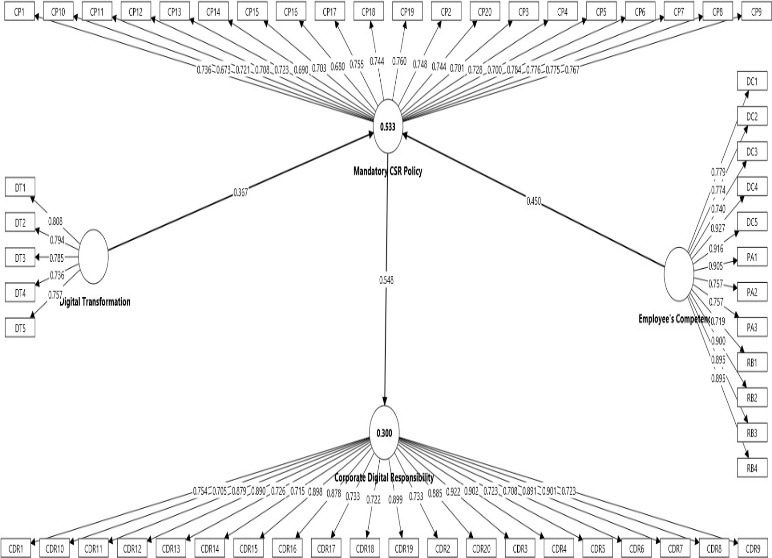
Convergent validity, CR, and alpha were tested using confirmatory factor analysis (Hair et al., 2022). The HTMT is considered even more appropriate when there are small differences between loadings. Henseler et al. (2015) recommend that the HTMT ratio should be set at 0.85 when conceptual differences exist between the variables, and at a minimal acceptable value of 0.90 is argued when the variables are conceptually similar.
Table 1 Convergent Validity
| Constructs | Items | Factor loading | AVE | CR | R2 | Alpha |
| Corporate digital responsibility | CDR1 CDR2 CDR3 CDR4 CDR5 CDR6 CDR7 CDR8 CDR9 CDR10 CDR11 CDR12 CDR13 CDR14 CDR15 CDR16 CDR17 CDR18 CDR19 CDR20 | 0.754 0.733 0.922 0.902 0.723 0.708 0.891 0.901 0.723 0.705 0.879 0.890 0.726 0.715 0.898 0.878 0.733 0.722 0.899 0.885 | 0.662 | 0.880 | 0.299 | 0.972 |
| Digital transformation | DT1 DT2 DT3 DT4 DT5 | 0.808 0.794 0.785 0.736 0.757 | 0.603 | 0.988 | 0.836 | |
| Employee's competencies | DC1 DC2 DC3 DC4 DC5 PA1 PA2 PA3 RB1 RB2 RB3 RB4 | 0.779 0.774 0.740 0.927 0.916 0.905 0.757 0.757 0.719 0.900 0.895 0.895 | 0.696 | 0.894 | 0.959 | |
| Mandatory CSR policy | CP1 CP2 CP3 CP4 CP5 CP6 CP7 CP8 CP9 CP10 CP11 CP12 CP13 CP14 CP15 CP16 CP17 CP18 CP19 CP20 | 0.736 0.748 0.701 0.728 0.700 0.784 0.776 0.775 0.767 0.673 0.721 0.708 0.723 0.690 0.703 0.680 0.755 0.744 0.760 0.744 | 0.535 | 0.864 | 0.530 | 0.954 |
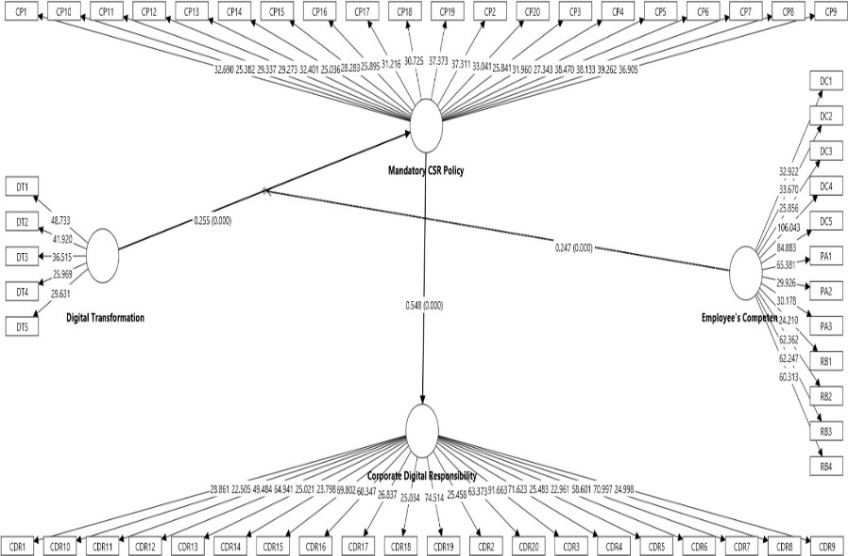
Figure 3 depicts the structural model, which tested several direct and serial mediation paths. Digital transformation positively influences Mandatory CSR policy (beta=0.255, t=4.232), supporting H1. Mandatory CSR policies positively influence corporate digital responsibility (Î ² =0.548 and t=11.984), supporting H2. Employees' competencies moderate the relationship between digital transformation and Mandatory CSR policy (beta=0.247 and t=4.267), thus supporting H3. Employees' competencies positively influence Mandatory CSR policies (beta=0.525 and t=9.340).
Table 2 HTMT Ratio
| Constructs | CDR | DT | EC | CP |
| Corporate digital responsibility | ||||
| Digital transformation | 0.453 | |||
| Employee's competencies | 0.533 | 0.657 | ||
| Mandatory CSR policy | 0.568 | 0.704 | 0.694 |
Hypothesis Testing
Hypothesis Testing
| Hypothyses | Paths | Beta values | t-values | P-values |
| H1 | DT->CP | 0.255 | 4.232 | 0.000 |
| H2 | EC->CP | 0.525 | 9.340 | 0.000 |
| H3 | EC x DT->CP | 0.247 | 4.267 | 0.000 |
| H4 | CP->CDR | 0.584 | 11.984 | 0.000 |
Discussion and conclusion
This study employed the RBV framework for four variables: digital transformations, mandatory CSR policy, corporate digital responsibility, employees' competencies, proactive assistance, and relationship building. Studies reporting a robust and advantageous association between digital transformation and mandatory CSR policy H1. Studies have found that both CSR and DT have a positive relationship and that EC moderates the relationship between CSR and DT (Wang et al., 2024). Huang, G., and L. Shen said that our consequences identify a bidirectional, jointly reinforcing relationship between digital transformation and CSR. Furthermore, we discover that EC undermines the facilitating impact of digital transformation on CSR but complements the advantageous impact of CSR on digital transformation (Huang & Shen, 2024). Mandatory CSR policies influence Corporate Digital Responsibility H2. This research establishes a new idea for a company strategy so that the achievement of CSR becomes measurable and evaluable in terms of the impacts of digital technological innovations on humans, society, and surroundings by thinking about winning Environmental, Social, and Governance (ESG) tips and policies (Weber‐Lewerenz & Traverso, 2025). This study examines the price-based use of digitization and artificial intelligence (AI) as vital drivers to draw new concepts to shape and stimulate an enterprise's takeover of human, social, and environmental responsibility (Weber‐Lewerenz & Traverso, 2025). Employee competencies moderate the dating of digital transformations and mandatory CSR policy H3. Empirical evidence shows that the impact of digital transformation on CSR performance varies in diverse aid endowments and institutional settings (i.e., formal and casual institutions). In particular, this impact of merchandising is best embodied in the inclusion of additional assets (i.e., human resources, cultural sources, employment sources, and monetary sources), with rigorous environmental enforcement or heavy media coverage (Sun et al., 2024). Mandatory CSR mediates digital transformation and corporate digital responsibility, H4. Digital transformation can also be a critical road closer to attaining CSR authenticity, and implies that massive mediating results can, in the long run, contribute to creating a firm's aggressiveness (Liu & Jung, 2021)
Theoretical Implications
The natural resource-based view (NRBV) principle raises classical aid primarily based on the integration of environmental sustainability into enterprise policy. Three interrelated regulations (sustainable improvement, product stewardship, and pollution prevention) were established to enable businesses to acquire sustainable dynamic power. This principle emphasizes that environmental obligations can transform, reduce value, and ensure long-term market ethics. Natural useful resource primarily based view (NRBV) can be related to digital transformation and corporate responsibility by observing environmental sustainability and digital transformation as interrelated policies. Similarly, pollution prevention and product stewardship require an operative transformation and stakeholder combinations. Digital transformation also requires new actions and technologies to reduce digital excretion, increase efficiency, and ensure ethical operations. A mandatory CSR policy acts as an environmental power force; strong firms are forced to engage in responsible digital behaviors, aligning with corporate digital responsibility (CDR), almost as environmental forces operate pollution prevention. Similar to employee digital competency, which plays a part in constant development and stakeholder integration in NRBV by allowing employees to use digital tools ethically and productively, firms can decrease risk and increase transformation.
Practical Implications
In practice, these variables can be applied to a framework to promote responsible and proactive digital practices. Digital transformations occur as the enterprise, where companies follow new technologies to enhance their capability and transformations. Mandatory CSR policies can implement ethical rules and justifiable goals to confirm this shift in obligations with regular expectations. This, one by one, forms corporate digital responsibility (CDR), making sure that digital implementations are clear, protect, and environmentally attentive. Assisting this system, employees' competencies, proactive assistance, and relationship building are essential for attractive implementation. Expert digitally skillful employees can responsibly operate transformation, conduct CSR mandates, and justify CDR standards related to a more ethical and justifiable digital firm.
References
- Agapito, D., Kronenburg, R., & Pinto, P. (2023). A review of destination social responsibility: Towards a research agenda. Current Issues in Tourism, 26(4), 554–572. https://doi.org/10.1080/13683500.2022.2091432
- Agarwal, R., & Gort, M. (2002). Firm and product life cycles and firm survival. American Economic Review, 92(2), 184–190. https://doi.org/10.1257/000282802320189221
- Al-Omoush, K. S. (2024). Drivers of digital corporate social responsibility during unprecedented crises: An institutional perspective. Kybernetes, 53(3), 882–900. https://doi.org/10.1108/K-07-2022-0959
- Aral, S., & Weill, P. (2007). IT assets, organizational capabilities, and firm performance: How resource allocations and organizational differences explain performance variation. Organization Science, 18(5), 763–780. https://doi.org/10.1287/orsc.1070.0306
- Becker, C. M., Bokor, A., Heikinheimo, O., Horne, A., Jansen, F., Kiesel, L., King, K., Kvaskoff, M., Nap, A., & Petersen, K. (2022). ESHRE guideline: Endometriosis. Human Reproduction Open, 2022(2), hoac009. https://doi.org/10.1093/hropen/hoac009
- Buonocore, F., Annosi, M. C., de Gennaro, D., & Riemma, F. (2024). Digital transformation and social change: Leadership strategies for responsible innovation. Journal of Engineering and Technology Management, 74, 101843. https://doi.org/10.1016/j.jengtecman.2024.101843
- Carl, K. V., Mihale-Wilson, C., Zibuschka, J., & Hinz, O. (2024). A consumer perspective on corporate digital responsibility: An empirical evaluation of consumer preferences. Journal of Business Economics, 94(7), 979–1024. https://doi.org/10.1007/s11573-023-01142-y
- Davenport, M. A., Leahy, J. E., Anderson, D. H., & Jakes, P. J. (2007). Building trust in natural resource management within local communities: A case study of the Midewin National Tallgrass Prairie. Environmental Management, 39, 353–368. https://doi.org/10.1007/s00267-006-0016-1
- Dmytriyev, S. D., Freeman, R. E., & Hörisch, J. (2021). The relationship between stakeholder theory and corporate social responsibility: Differences, similarities, and implications for social issues in management. Journal of Management Studies, 58(6), 1441–1470. https://doi.org/10.1111/joms.12684
- Dörr, S., & Lautermann, C. (2024). Beyond direct stakeholders: The extensive scope of societal Corporate Digital Responsibility (CDR). Organizational Dynamics, 53(2), 101057. https://doi.org/10.1016/j.orgdyn.2024.101057
- Elliott, K., & Copilah-Ali, J. (2024). Implementing corporate digital responsibility (CDR): Tackling wicked problems for the digital era: Pilot study insights. Organizational Dynamics, 53(2), 101040. https://doi.org/10.1016/j.orgdyn.2024.101040
- Ferrari, A. (2012). Digital competence in practice: An analysis of frameworks (Vol. 10). Publications Office of the European Union. https://www.ifap.ru/library/book522.pdf
- Foote, J., Gaffney, N., & Evans, J. R. (2010). Corporate social responsibility: Implications for performance excellence. Total Quality Management & Business Excellence, 21(8), 799–812. https://doi.org/10.1080/14783363.2010.487660
- Gilmore, J. H., & Pine, B. J. (2007). Authenticity: What consumers really want. Harvard Business Press. https://books.google.com/books?id=VpTSBgAAQBAJ
- Goel, A., & Rathee, H. (2022). CSR policies in different countries: A comparative analysis. In Corporate social responsibility in the 21st century (pp. 59–76). IntechOpen. https://doi.org/10.5772/intechopen.94512
- Goulden, M., Spence, A., Wardman, J., & Leygue, C. (2018). Differentiating ‘the user’ in DSR: Developing demand side response in advanced economies. Energy Policy, 122, 176–185. https://doi.org/10.1016/j.enpol.2018.07.013
- Gursoy, D., Başer, G., & Chi, C. G. (2025). Corporate digital responsibility: Navigating ethical, societal, and environmental challenges in the digital age and exploring future research directions. Journal of Hospitality Marketing & Management. Advance online publication. https://doi.org/10.1080/19368623.2025.2465634
- Hair, J., & Alamer, A. (2022). Partial least squares structural equation modeling (PLS-SEM) in second language and education research: Guidelines using an applied example. Research Methods in Applied Linguistics, 1(3), 100027. https://doi.org/10.1016/j.rmal.2022.100027
- Hamel, E., Terpstra, V., & Stopford, J. (2007). [No complete bibliographic details available; likely incomplete citation].
- Hart, S. L. (1995). A natural-resource-based view of the firm. Academy of Management Review, 20(4), 986–1014. https://doi.org/10.5465/amr.1995.9512280033
- Hassani, M. A. K. (n.d.). Corporate Social Responsibility (CSR) as a catalyst for brand image perception. ResearchGate. https://www.researchgate.net/publication/388410835_Corporate_Social_Responsibility_CSR_as_a_catalyst_for_brand_image_perception
- Huang, G., & Shen, L. (2024). The bidirectional relationship between digital transformation and corporate social responsibility: A legitimacy perspective. Sustainability, 16(7), 3029. https://doi.org/10.3390/su16073029
- Huu, P. T. (2023). Impact of employee digital competence on the relationship between digital autonomy and innovative work behavior: A systematic review. Artificial Intelligence Review, 56(12), 14193–14222. https://doi.org/10.1007/s10462-023-10492-6
- Hwang, I., Shim, H., & Lee, W. J. (2022). Do an organization’s digital transformation and employees’ digital competence catalyze the use of telepresence? Sustainability, 14(14), 8604. https://doi.org/10.3390/su14148604
- Jaini, A., & Hussin, N. (2019). Towards developing a framework of enviropreneurial marketing strategy for SMEs in Malaysia. International Journal of Academic Research in Business and Social Sciences, 9(9), 348–358. https://doi.org/10.6007/IJARBSS/v9-i9/6314
- Polonsky, M. J., & Ottman, J. (1998). Stakeholders’ contribution to the green new product development process. Journal of Marketing Management, 14(6), 533–557. https://doi.org/10.1362/026725798784867707
- Kang, W., & Montoya, M. (2014). The impact of product portfolio strategy on financial performance: The roles of product development and market entry decisions. Journal of Product Innovation Management, 31(3), 516–534. https://doi.org/10.1111/jpim.12111
- Khayat, H. Y. (2024). From a customer-centric to a stakeholders-centric approach: A corporate social responsibility reforms and the long-term financial performance. مجلة, 11(3), 28–46. https://journals.ekb.eg/article_374798.html
- Kleeblatt, C. L. M. (2023). Corporate digital responsibility: Does it pay to be good? Understanding how active CDR can lead to a competitive advantage for firms [Master’s thesis, Universidade Católica Portuguesa]. Repositório Institucional UCP. https://repositorio.ucp.pt/handle/10400.14/42379
- Koval, V., Mikhno, I., Udovychenko, I., Gordiichuk, Y., & Kalina, I. (2021). Sustainable natural resource management to ensure strategic environmental development. TEM Journal, 10(3), 1022–1030. https://doi.org/10.18421/TEM103-25
- Lane, R., & Watson, M. (2012). Stewardship of things: The radical potential of product stewardship for re-framing responsibilities and relationships to products and materials. Geoforum, 43(6), 1254–1265. https://doi.org/10.1016/j.geoforum.2012.03.011
- Lee, J., Bae, Z. T., & Choi, D. K. (1988). Technology development processes: A model for a developing country with a global perspective. R&D Management, 18(3), 235–250. https://doi.org/10.1111/j.1467-9310.1988.tb00590.x
- Lewis, H. (2017). Product stewardship in action: The business case for life-cycle thinking. Routledge. https://doi.org/10.4324/9781351284882
- Liu, H., & Jung, J.-S. (2021). The effect of CSR attributes on CSR authenticity: Focusing on mediating effects of digital transformation. Sustainability, 13(13), 7206. https://doi.org/10.3390/su13137206
- Lombardi, R., & Secundo, G. (2021). The digital transformation of corporate reporting–A systematic literature review and avenues for future research. Meditari Accountancy Research, 29(5), 1179–1208. https://doi.org/10.1108/MEDAR-04-2020-0870
- Maseleme, P. (2023). The impact of data privacy breaches on consumer privacy concern and patronage in the City of Johannesburg [Master’s thesis, University of the Witwatersrand]. WIReDSpace.
- Michel, S., Bowen, D. E., & Johnston, R. (2009). Service recovery management: Closing the gap between best practices and actual practices. Academy of Management Perspectives, 23(4), 68–83.
- Minoja, M. (2012). Stakeholder management theory, firm strategy, and ambidexterity. Journal of Business Ethics, 109(1), 67–82. http://dx.doi.org/10.1007/s10551-012-1380-9
- Na, C., Chen, X., Li, X., Li, Y., & Wang, X. (2022). Digital transformation of value chains and CSR performance. Sustainability, 14(16), 10245. https://doi.org/10.3390/su141610245
- Oduro, S., Haylemariam, L. G., & Umar, R. M. (2024). Influence of corporate digital responsibility on financial performance: The mediating role of firm reputation. Business Ethics, the Environment & Responsibility. Advance online publication. https://doi.org/10.1111/beer.12766
- Oubrahim, I., Sefiani, N., & Happonen, A. (2023). The influence of digital transformation and supply chain integration on overall sustainable supply chain performance: An empirical analysis from manufacturing companies in Morocco. Energies, 16(2), 1004. https://doi.org/10.3390/en16021004
- Oware, K. M., & Iddrisu, A.-A. (2022). Moral capital of CSR and firm performance: Does a shift from voluntary to mandatory policy matter in an Indian context? Society and Business Review, 17(1), 3–21. https://doi.org/10.1108/SBR-03-2021-0041
- Park, H., & Choi, S. O. (2019). Digital innovation adoption and its economic impact focused on path analysis at national level. Journal of Open Innovation: Technology, Market, and Complexity, 5(3), 56. https://doi.org/10.3390/joitmc5030056
- Qadri, U. A., Ghani, M. B. A., Abbas, U., & Kashif, A. R. (2025). Digital technologies and social sustainability in the digital transformation age: A systematic analysis and research agenda. International Journal of Ethics and Systems, 41(1), 142-169. https://doi.org/10.1108/IJOES-08-2024-0239
- Raza, A., & Sohaib Murad, H. (2010). Gender gap in Pakistan: A socio‐demographic analysis. International Journal of Social Economics, 37(7), 541-557. https://doi.org/10.1108/03068291011055478
- Reinhardt, F. L., Stavins, R. N., & Vietor, R. H. K. (2008). Corporate social responsibility through an economic lens. Review of Environmental Economics and Policy, 2(2), 219-239. https://doi.org/10.1093/reep/ren008
- Roša, A., & Lobanova, L. (2022). Ethical responsibility of a company in the context of digital transformation of work: Conceptual model. Sustainability, 14(18), 11365. https://doi.org/10.3390/su141811365
- Secretariat, C. (2016). Advancing gender equality: Case studies from across the Commonwealth. Commonwealth Secretariat. https://books.google.com/books?id=psA8DQAAQBAJ
- Seidi, R. B., Marcão, R., Santos, V. R., Monteiro, S. C., Martinho, F., & Reis, I. P. (2025). Corporate social responsibility in the medical device industry. In Strategic management, regulatory challenges, and global governance of MedTech (pp. 21–52). IGI Global. https://www.igi-global.com/chapter/corporate-social-responsibility-in-the-medical-device-industry/377161
- Senge, P. (1990). Peter Senge and the learning organization. Dimension, 14, 1–5. https://alisalmi.com/wp-content/uploads/2023/02/the-learning-organization-by-Senge.pdf
- Spitzmuller, M., & Van Dyne, L. (2013). Proactive and reactive helping: Contrasting the positive consequences of different forms of helping. Journal of Organizational Behavior, 34(4), 560–580. https://doi.org/10.1002/job.1848
- Srivastava, V. K. (2024). Impact of corporate social responsibility (CSR) initiatives on brand reputation: A study on how CSR activities enhance brand reputation and consumer loyalty in the context of sustainable marketing practices. International Journal of Science and Research, 13(2), 1051–1060. https://www.researchgate.net/publication/384695217
- Sun, Z., Wang, W., Wang, W., & Sun, X. (2024). How does digital transformation affect corporate social responsibility performance? From the dual perspective of internal drive and external governance. Corporate Social Responsibility and Environmental Management, 31(2), 1156–1176. https://doi.org/10.1002/csr.2615
- Taghian, M., D’Souza, C., & Polonsky, M. (2015). A stakeholder approach to corporate social responsibility, reputation and business performance. Social Responsibility Journal, 11(2), 340–363. https://doi.org/10.1108/SRJ-06-2012-0068
- Tananeeva, Z., Luu-Xuan, D., & Long, N. T. (2025). The impact of digital transformation, corporate social responsibility, and market orientation on firm performance: Evidence from Vietnamese commercial banks. Business Management, 35(1), 25–49. http://bm.access-bg.org/index.php/bm/article/view/87
- van der Merwe, J., & Al Achkar, Z. (2022). Data responsibility, corporate social responsibility, and corporate digital responsibility. Data & Policy, 4, e12. https://doi.org/10.1017/dap.2022.2
- Vo Thai, H. C., Hue, T. H. H., Chen, P. F., & Tran, M. L. (2024). Unraveling the influence of human capital and stakeholder engagement on corporate digital responsibility: Implications for firm performance in Southeast Asia enterprises. Corporate Social Responsibility and Environmental Management, 31(3), 1934–1958.
- Wang, F., Jia, Y., Li, G., Lam, M., & Liu, Y. (2024). An empirical study of the relationship between digital transformation, corporate social responsibility and financial performance. Business Ethics and Leadership, 8(1), 57–73.
- Wang, L., & Yan, J. (2023). Effect of digital transformation on innovation performance in China: Corporate social responsibility as a moderator. Frontiers in Environmental Science, 11, 1215866. https://doi.org/10.3389/fenvs.2023.1215866
- Weber‐Lewerenz, B., & Traverso, M. (2025). How can corporate digital responsibility (CDR) be measured in line with corporate social responsibility (CSR)? A new theoretical approach in construction 4.0. Sustainable Development, 33(1), 287–308. https://doi.org/10.1002/sd.3094
- Williams, M. (2007). Building genuine trust through interpersonal emotion management: A threat regulation model of trust and collaboration across boundaries. Academy of Management Review, 32(2), 595–621.
- Wuttke, D. A., Blome, C., Foerstl, K., & Henke, M. (2013). Managing the innovation adoption of supply chain finance—Empirical evidence from six European case studies. Journal of Business Logistics, 34(2), 148–166. https://doi.org/10.1111/jbl.12016
- Xu, Y., Wang, L., Xiong, Y., Wang, M., & Xie, X. (2023). Does digital transformation foster corporate social responsibility? Evidence from Chinese mining industry. Journal of Environmental Management, 344, 118646. https://doi.org/10.1016/j.jenvman.2023.118646
- Zhang, K., & Hao, X. (2024). Corporate social responsibility as the pathway towards sustainability: A state-of-the-art review in Asia economics. Discover Sustainability, 5(1), 348. https://doi.org/10.1007/s43621-024-00577-9
- Zheng, W. (2025). Digital vines: Mapping China’s network of global platform ecosystems. Information, Communication & Society, 1–17. https://doi.org/10.1080/1369118X.2025.2467340
- Zhong, X., & Ren, G. (2023). Independent and joint effects of CSR and CSI on the effectiveness of digital transformation for transition economy firms. Journal of Business Research, 156, 113478. https://doi.org/10.1016/j.jbusres.2022.113478
Cite this article
-
APA : Ashfaq, K., Abbas, N., & Naaz, T. (2025). Integrating Digital Transformation with Corporate Social Responsibility for Enhanced Digital Responsibility: Moderation and Mediation effects. Global Social Sciences Review, X(III), 168-182. https://doi.org/10.31703/gssr.2025(X-III).15
-
CHICAGO : Ashfaq, Khurram, Nasir Abbas, and Tahreem Naaz. 2025. "Integrating Digital Transformation with Corporate Social Responsibility for Enhanced Digital Responsibility: Moderation and Mediation effects." Global Social Sciences Review, X (III): 168-182 doi: 10.31703/gssr.2025(X-III).15
-
HARVARD : ASHFAQ, K., ABBAS, N. & NAAZ, T. 2025. Integrating Digital Transformation with Corporate Social Responsibility for Enhanced Digital Responsibility: Moderation and Mediation effects. Global Social Sciences Review, X, 168-182.
-
MHRA : Ashfaq, Khurram, Nasir Abbas, and Tahreem Naaz. 2025. "Integrating Digital Transformation with Corporate Social Responsibility for Enhanced Digital Responsibility: Moderation and Mediation effects." Global Social Sciences Review, X: 168-182
-
MLA : Ashfaq, Khurram, Nasir Abbas, and Tahreem Naaz. "Integrating Digital Transformation with Corporate Social Responsibility for Enhanced Digital Responsibility: Moderation and Mediation effects." Global Social Sciences Review, X.III (2025): 168-182 Print.
-
OXFORD : Ashfaq, Khurram, Abbas, Nasir, and Naaz, Tahreem (2025), "Integrating Digital Transformation with Corporate Social Responsibility for Enhanced Digital Responsibility: Moderation and Mediation effects", Global Social Sciences Review, X (III), 168-182
-
TURABIAN : Ashfaq, Khurram, Nasir Abbas, and Tahreem Naaz. "Integrating Digital Transformation with Corporate Social Responsibility for Enhanced Digital Responsibility: Moderation and Mediation effects." Global Social Sciences Review X, no. III (2025): 168-182. https://doi.org/10.31703/gssr.2025(X-III).15