
Abstract
In this paper, the conection between Islamic jurisprudence (fiqh and uṣul al-fiqh) and the modern constitutional interpretation is examined in terms of their incompatibility or the possibility to reconcile them with the modern constitutional systems. The mixed doctrinal-qualitative study will examine the text of constitutions, statutes and landmark cases of Pakistan and Malaysia. It compares major Islamic principles of juristic (ijtihad, qiyas, maq2si) with constitutional interpretive principles(textualism, purposivism, proportionality). The findings indicate that harmonization is probable when courts rely on structural reasoning and the rule-of-law principles to resolve the tension between religious claims and the constitutional values. There are however tensions in spheres of system-wide changes (e.g., finance) and restrictions on identity-based public order, where conflicting religious and constitutional norms intensify the conflict. The research suggests a reconciliation model whereby an institutional design is crucial, interpretive techniques, and the ability of courts to reconcile both systems.
Keywords
Islamic Jurisprudence, Constitutional Interpretation, Maqāṣid Al-Sharīʿah, Maṣlaḥah, Proportionality, Constitutional Identity, Judicial Review
Introduction
In most states with majority Muslim populations, modern constitutional systems exist on the premise of a plural normative environment, that is, positive law by legislatures, constitutional texts by judicial bodies, and, in some cases, explicitly, Islamic normative commitments based on fiqh (substantive adjudication) and uṣul al-fiqh (methodologies of deriving and justifying adjudication). Constitutional interpretation is not, in this context, just a technical process of legal textual interpretation; but it is a practice of legitimacy that assigns authority to institutions (courts, legislatures, executives), as well as to sources of normativity (constitutional clauses, statutes, international commitments, and religious principles). Islamic jurisprudence, as well, is not a set of rules only but a methodology of argumentation in a structured form containing interpretive canons (e.g., language, general/specific, analogy), justificatory purpose, and the concept of the public interest that can assist in the selection and adaptation of rules (Zhussipbek & Nagayeva, 2019; Tajdin, 2020).
Linkages between Islamic jurisprudence and constitutional interpretation are thus across incorporation (constitutional provisions invite or demand Islamic references) to parallelism (constitutional norms follow or are subject to Islamic legal norms without constitutional standing), to contestation (constitutional doctrines are challenged on constitutional grounds by Islamic legal norms such as the equality principle or the freedom of speech), etc. Religiously inflecting constitutional clauses have become sites of interpretive conflict: the court can interpret constitutional clauses on religious identity in both broad and restrictive ways to justify religious supremacy or constitutional pluralism with significant consequences to rights and governance (Rofii, 2021). Likewise, constitutionality challenges in the context of blasphemy or religious offence laws provide an example of how constitutional adjudication may become a place of a collision or convergence of religious moral claims and constitutional reasoning based on rights (Pratiwi, 2021).
The tension and harmony can be developed due to at least three structural features. First, plural legal sources establish incompatible hierarchies: a constitution can assert a supremacy and still hold religion to be foundational, which creates interpretive dilemmas about who rules the hard cases (Ahyar & Huda, 2021). Second, constitutional identity at the state level, usually indicated by preambles or in some cases by the notion of repugnancy or the phrase religion of the state, puts pressure on judges to balance constitutional legality and institutional restraint with moral-religious commitments (Rofii, 2021). Third, the discourse of rights and judicial review bring in interpretive techniques (reasonableness, balancing, proportionality) which might seem alien to classical juristic form, but which can be re-packaged, as well, as functional analogs to Islamic techniques oriented towards harm-prevention and the common good (Tajdin, 2020; Zhussipbek and Nagayeva, 2019). Proportionality-based reasoning, such as the analysis of rights-limitation is commonly structured using proportionality-based reasoning, and proportionality-based reasoning is often used to justify trade-offs of interest to the state in a transparent series of steps, although scholars debate the normative basis of proportionality-based reasoning, and how it can be used with strong rights protection (Dixon, 2018; Möller, 2018; de Londras and Tregidga, 2021).
The article takes a comparative, theory oriented legal stance concerned with interpretation of the constitution and judicial review in modern constitutional context where Islam is a political or constitutional issue of relevance. It only analyzes interpretive reasoning and institutional design issues but not substantive adjudication, in the criminal law, family law or sect specific doctrinal issues. It also does not seek to resolve intra-madhhab disputes or give a detailed description of all the national models; rather it relies on illustrative comparative resources to explain recurrent tendencies of conflict and ways to achieve doctrinal accommodation (Ahyar & Huda, 2021; Yildirim, 2021).
This paper deals with the issue of whether Islamic jurisprudential reasoning (fiqh/uṣul) and modern constitutional interpretive approaches (textual, purposive, structural, rights-based review) can and should inevitable result in conflicts in constitutional adjudication, or whether they can be reconciled and one framework does not collapse, being rather fully compatible with the other; its point is to investigate when and whether courts and lawmakers should and can leave the contestation of either/or and move to principled co-existence, and its objective is to determine whether the relationship between Islamic jurisprudence In so doing, it has four aims, namely: (i) map core interpretive principles of both Islamic jurisprudence and constitutional law, (ii) find recurring points of conflict (rights claims, legislative validity, judicial authority, public policy), (iii) find pathways of harmonization (maqāʃid reasoning, maṣlahah, constitutional values, proportionality and related doctrines) and (iv) suggest a conceptual model of reconciliation. It poses three research questions: In what areas are the two frameworks most frequently put into conflict in theory and practice? What interpretive tools allow them to be compatible such that neither system is compromised? On what institutional terms, courts, legislatures, and constitutional provisions, can harmonization be successful? The work has both scholarly and practical importance, as it enlightens constitutional courts, lawmakers, and policy-makers about the need to pursue stable, rights-conscious, and locally acceptable interpretive approaches (Dixon, 2018; Rofii, 2021; Pratiwi, 2021).
Literature Review
The substantive mass of rulings is known as Islamic jurisprudence (fiqh), and the interpretive rules of recognition are present at uṣul al-fiqh, which justifies the derivation of rulings based on sources and evidence. Modern commentary emphasizes that the uṣul instruments in ijtihad (reasoned derivation), ijmā (consensus), qiyas (analogical reasoning), and additional doctrines, like istihsan (juristic preference), istiṣlah/masslahah (public interest), sadd al-dharaba( blocking harmful means), and urnaf (custom) are not inherently theological commitments, but structured interpretive strategies (Takim et al., 2021; Yakar et al., 2021). On the constitutional level, the analysis of interpreting the constitution is often placed into textualism, purposivism, structuralism, originalism, living constitutionalism, and analysis of proportions as a method of limiting rights (Chang et al., 2021; Saunders et al., 2020). More comparative debates consider both traditions as rival practices in giving reasons, in which transparency of method and constraint are crucial to the legitimacy, rather than merely the results (Möller et al., 2018; Langford et al., 2018).
Islam can be incorporated in the constitution in forms such as (i) symbolic Islam as state religion, (ii) repugnancy clauses that invalidate the noncompliant legislation, (iii) directive principles containing allusions to Islamic values, and (iv) hybrid constitutional identity models that contain liberal-rights language, with Islam-referential commitments (Lavie et al., 2021; Effendi et al., 2019). These design options predetermine interpretive strategies: in case of constitutionalization of Islam as an enforceable supremacy, courts will have more difficult problems with validity; in the case of Islam as a value-language, courts will most of the time turn it into public-reason or policy principles (Perez et al., 2020).
Conflict literature usually starts with a supremacy issue: in case Sharariyat is defined as higher law, the constitutional rights adjudication can be considered a subordinate or even a functional process (Hazri et al., 2017). The second point of conflict is the rights discourse, and in particular, the freedom of speech, freedom of religion, gender equality, and rights of minorities, where the traditional teachings and contemporary rights advocacies might seem opposing (Mondal et al., 2016; Hilal-Harvald et al., 2020). One third is institutional competency: there are concerns in that constitutional judges lack fiqh literacy to apply juristic categories to constitutional reasoning without corruption or that juristic institutions can utilize constitutional review and constraint doctrines without collapsing pluralism (Hazri et al., 2016; Pratiwi et al., 2021).
The literature on harmonization holds the view that conflict is not necessarily brought about by incongruence, but rather through interpretation. Maqashiad al-sharifah and maṣlahah are often introduced as bridges due to the fact that they justify the selection of rules by substituting welfare, justice, and harm-reduction whose values can be justified by constitutional morality and proportionality-type logic (Ishak et al., 2018; Takim et al., 2021). ʿUrf is also placed in the context of a mechanism of adaptability that facilitates contextual constitutional accommodation when the order of society and social practice change (Yakar et al., 2021). Constitutionally, proportionality and structured justification are depicted as translation mechanisms that will enable the use of Islam-referential values to guide balancing without ousting the rights framework of the constitution (Chang et al., 2021; Möller et al., 2018).
There is comparative court practice: constitutional jurisprudence of Indonesia can demonstrate the possibility to mediate the references to religion by the limitation provisions and by the public-order arguments and yet yield conflicting results in cases related to blasphemy and expression (Pratiwi et al., 2021; Rofii et al., 2021). Similar arguments exist in other jurisdictions, including Malaysia, where there have been debates over the years over whether constitutional clauses on Islam are mainly symbolic or determinative in a legal sense to influence the interpretive stance of the court in terms of rights and legislations (Effendi et al., 2019; Hazri et al., 2017). On top of Muslim-majority contexts, arguments of constitutional identity in European contexts demonstrate how the questions of Islam can be constitutionalized using security and militant-democracy discourses, which affect judicial review and the restriction of rights (Hilal-Harvald et al., 2020).
In general, the literature tends to discuss uṣul al-fiqh and constitutional interpretation as parallel discourse rather than as an account of the method of interaction: we find descriptions of the tension between doctrines and extensive normative justifications of maqāships/maṣlaḥah, but less theoretical descriptions of how harmonization may be institutionally achievable (courts, review norms, clauses of limitation) and how interpretive translations (e.g., proportionality/justification) can be made methodologically faithful to both traditions (Saunders et al., 2020)
Methodology:
Research Design
The focus of the current study is mixed that is Doctrinal and Qualitative. The main method to be followed is the doctrinal legal research, that is, the internal logic of law through analysis of constitutional text, amendments of the constitution, statutes, and judicial reasoning to find rules and results of interpretation of statutes by authorities (Kharel, 2018). In order to capture the problems of the way in which the courts operationalize (or resist) Islamic jurisprudential reasoning in constitutional adjudication, the doctrinal core is complemented with a qualitative thematic analysis of judicial opinions and other related constitutional materials. This mixed design is suitable as the research problem is both (i) normative/doctrinal (how interpretation should be structured under given constitutional commitments) and (ii) institutional/practical (how interpretation is structured by courts and lawmakers when Islam-referential clauses interact with rights review) (Mitchell, 2022).
Data Sources (Materials)
The research is based on five types of documentary materials. First, the constitutional texts and amendments are gathered for each of the chosen jurisdictions, with a focus on those clauses that (a) define the Islamic identity of the state, (b) regulate the validity of legislation in relation to Islam, and/or (c) organize the fundamental rights and their limitation. Second, landmark constitutional/supreme court judgments are compiled where courts apply rights, legality or institutional competency while evoking Shar'i'ah or Islamic principles or juristic concepts. Third, statutes and enabling legislation are included where they (explicitly or implicitly) carry out "Islamic conformity," repugnancy review, or religious public order limitations. Fourth, there is an attempt to use classical and current uṣuu ul-fiqh and fiqh references in order to construct a defensible account of the tools of Islamic interpretation (e.g. qiyaa, isti'laah/ma'sla/ah, 'urf) and not to reduce Islamic jurisprudence to pithy catch-phrases rather than method. Fifth, peer-reviewed scholarly literature in the fields of comparative constitutionalism, Islamic legal theory and interpretive theory is looked to in order to situate the findings and explain methodological debates in interpretation and rights review.
Sampling Strategy (Comparative/ Case Based)
A purposive sampling strategy is employed to ensure certification of selected jurisdictions and cases that have both the doctrinal "triggers" to witness conflict and/or harmonization. Jurisdictions qualify if they satisfy three criteria: (1) constitution containing an Islam-referential clause (state religion, Islam principles, or repugnancy-type language), (2) mechanism of constitutional review (constitutional court, supreme court review, etc.) and (3) visible body of rights litigation in which constitutional rights intersect with religion-based arguments. On the basis of this principle, for this study, a choice is made between two to four jurisdictions that showcase the different designs of a constitution (i.e., strong Islam clauses vs directive principles; constitutional centralized court vs a review by an apex court). Within the selected jurisdictions, the study selects 10-20 leading cases based on the following filters: (a) the judgment contains explicit reference to Shar'i'ah/Islamic principles or juristic reasoning, (b) the outcome of the case turns on interpretation of the constitution rather than simply on fact finding, and (c) the dispute involves at least one of the study's conflict arenas (rights limits, legislative validity, judicial authority or public policy). This bounded corpus is permissible for comparative inference while still being feasible for close doctrinal reading.
Analytical Approach
Analysis is carried out in three stages, which are interconnected.
Stage 1: Interpretive mapping. The study draws the "interpretive map" of the matching Islamic jurisprudential tools to the constitutional interpretive methods. For instance, it maps functional correspondences (e.g., maqaasid/maqlulahth (reasoning) with purposive or proportionality-style substantiation; `urf to living constitutionalism or context based interpretation) as well as non-equivalences where translation may lead to doctrinal distortion. Each category mapped is predefined in order to provide a consistent classification of a set of cases.
Stage 2: Thematic coding of texts and making judgments. Judicial opinions and constitutional materials are coded by means of a hybrid approach: deductive codes based on the research questions (e.g. 'source supremacy claim', 'rights limitation', 'institutional competence', 'public interest', 'identity/values framing') and inductive codes, which are emerging from recurring judicial patterns. Coding focuses on: (i) which interpretive method is used (textualism, purposivism, precedent, proportionality, etc.), (ii) the role of Islamic references (binding rule, persuasive value, moral context or rhetorical legitimation) and (iii) the doctrinal mechanism of resolution (harmonization by interpretation, prioritization of one norm-set, or procedural avoidance). Trustworthiness is enhanced with an overt audit trail of coding choices and theme refinement in line with qualitative rigorous guidance for the thematic analysis (Nowell et al., 2017).
Stage 3: Comparative matrix and cross case synthesis. Findings are summarized in a comparative matrix focusing on the connections between (a) constitutional design features (type of Islam clause; rights limitations; review structure), (b) the method of interpretation adopted, and (c) doctrinal outcome (conflict escalation, accommodation, or principled harmonization). Cross-case synthesis then identifies repeating "pathways" to harmonization (e.g., maqāṣid - framed purposivism; structured rights limitation), and repeating "conflict generators" (e.g., absolute supremacy claims; undefined competence boundaries).
Validity and Rigor
Rigor is ensured by triangulation (constitutional text + case law + jurisprudential references), transparent selection criteria (jurisdiction and case inclusion rules), and a codebook recorded documentation that include definitions, inclusion/exclusion notes, and example excerpts for each code. To minimize the risks of interpretive drift, the research undertakes a staged reading protocol: first-pass doctrinal extraction (issues, holdings, provisions), second-pass method identification (interpretive tools) and third-pass thematic coding (conflict/harmony mechanisms). Where possible, a portion of cases are double-coded in order to verify consistency and any disagreements are addressed not by agreement for the sake of agreement, but through code refinement as an example of good practice in trustworthiness-oriented thematic analysis (Nowell et al., 2017).
Ethical Considerations
The research is basically document-based, that is, involving public texts of legal nature and scholarly sources, and thus does not involve direct human-subject risks. Nonetheless, the study takes care to exercise ethical caution in the method of study because of the sensitivity of the righting of religion controversies: neutral descriptive terminology, no sectarian adjudication of theological correctness, Islamic jurisprudence and constitutionalism are understood as interpretive traditions and not monolithic blocs. The objective is that of analytic clarity and methodological fairness in explaining how conflict and harmonization are produced by the legal reasoning (Mitchell, 2022).
Results
Case Corpus and Constitutional Settings
Applying the interpretive-mapping + thematic-coding procedure described in the Methodology, the study analyzed 12 landmark judicial decisions drawn from Pakistan (n=6) and Malaysia (n=6) (1999-2022). The corpus was selected because each decision explicitly engages (directly or indirectly) Islamic normative references (Sharīʿah/fiqh-derived claims, "Islam clauses," fatwa authority, repugnancy review) alongside constitutional interpretive work (supremacy, rights adjudication, separation of powers, federalism, judicial competence).
Constitutional design features shaping conflict/harmonization (Pakistan vs Malaysia)
| Design feature | Pakistan | Malaysia |
| Constitutional identity marker | Islam as state identity through foundational clauses (e.g., Objectives Resolution as constitutional reference point) | Islam as "religion of the Federation," alongside guarantees for other religions |
| "Islam conformity" / repugnancy mechanism | Explicit conformity expectation for laws + specialized Shariat review institutions (FSC + Shariat Appellate Bench) | No general "repugnancy" court; dual legal order (civil + Syariah) constrained by constitutional structure and jurisdictional limits |
| Constitutional supremacy clause | Constitution is supreme; Islamic clauses operate within constitutional text | Art. 4(1) supremacy; Islam clause coexists with constitutional supremacy |
| Institutional pathway of review | Rights adjudication in superior courts + Shariat review of statutes in FSC/SAB | Rights adjudication in civil courts; Syariah courts' competence primarily state-law and personal/status subject to constitutional boundaries |
| Typical "pressure points" seen in cases | (i) blasphemy/criminal justice; (ii) public order & minority protection; (iii) riba/financial system transformation | (i) civil vs Syariah jurisdiction; (ii) legislative competence (state vs federal); (iii) religious language/materials and public order |
Decision-Level Coding Outcomes (Interpretive Function × Constitutional Method × Result Type)
Each case was coded on three axes: (A) function of Islamic reference, (B) dominant constitutional interpretive method, (C) outcome type (harmonization / conflict / accommodation).
Case corpus with coded results (n=12)
| ID | Jurisdiction | Court | Year | Central issue | Function of Islamic reference (A) | Dominant constitutional method (B) | Outcome type (C) |
| P1 | Pakistan | Supreme Court | 2014 | Minority protection & constitutional duties | Interpretive aid (Islamic values support rights) | Purposivism/values | Harmonization |
| P2 | Pakistan | Supreme Court | 2018 | Blasphemy conviction review (Asia Bibi) | Interpretive aid (Qur'anic/ethical frame supports due process) | Precedent/formal legality (evidence + rule-of-law standards) | Harmonization |
| P3 | Pakistan | Supreme Court | 2016 | Vigilantism + "religious" defense (Mumtaz Qadri) | Interpretive aid (religious claims rejected via legal authority framing) | Precedent/formal legality | Harmonization |
| P4 | Pakistan | SAB (Supreme Court) | 1999 | Riba/interest invalidation | Normative supremacy (Sharīʿah as validity standard) | Purposivism/values | Conflict |
| P5 | Pakistan | SAB (Review) | 2002 | Review/remand of Riba decision (PLD 2002 SC 800) | Contextual/institutional | Procedural/institutional | Accommodation |
| P6 | Pakistan | Federal Shariat Court | 2022 | Riba/interest (fresh determination + implementation timeline) | Normative supremacy | Purposivism/values | Accommodation |
| M1 | Malaysia | Federal Court | 2018 | Conversion of minors; civil vs Syariah competence (Indira Gandhi) | Contextual/legitimating | Structuralism (jurisdiction + constitutional structure) | Harmonization |
| M2 | Malaysia | Federal Court | 2021 | State Syariah offence vs federal criminal law (Iki Putra) | Contextual/legitimating | Structuralism | Harmonization |
| M3 | Malaysia | Federal Court | 2021 | Kelantan Syariah criminal enactment vs constitutional allocation (Nik Elin) | Contextual/legitimating | Structuralism | Harmonization |
| M4 | Malaysia | Federal Court (leave) | 2014 | "Allah" usage restriction (Herald) | Contextual/legitimating (public order framing) | Deference (executive/ministerial discretion) | Conflict |
| M5 | Malaysia | High Court | 2021 | "Allah" materials import/use (Jill Ireland) | Contextual/legitimating | Proportionality/balancing (rights vs public order) | Harmonization |
| M6 | Malaysia | Federal Court | 2020 | Fatwa scope; applicability to company (SIS Forum) | Contextual/legitimating | Structuralism (who is bound + institutional competence) | Harmonization |
(Pakistan cases: minority-rights judgment text; Asia Bibi judgment text; Riba decision text + review + FSC riba judgment. Malaysia cases: Indira Gandhi press summary; Iki Putra judgment; Nik Elin judgment; Herald dispute reporting; Jill Ireland judgment; SIS Forum judgment.)
Frequency Results (How Often Conflict Vs Harmonization Appears)
Frequency distributions across the corpus (n=12)
| Measure | Category | Count | % |
| Outcome type (C) | Harmonization | 8 | 66.7 |
| Conflict | 2 | 16.7 | |
| Accommodation | 2 | 16.7 | |
| Islamic reference function (A) | Interpretive aid | 3 | 25.0 |
| Normative supremacy | 2 | 16.7 | |
| Contextual/legitimating | 6 | 50.0 | |
| Contextual/institutional | 1 | 8.3 | |
| Constitutional method (B) | Structuralism | 4 | 33.3 |
| Purposivism/values | 3 | 25.0 | |
| Precedent/formal legality | 2 | 16.7 | |
| Proportionality/balancing | 1 | 8.3 | |
| Procedural/institutional | 1 | 8.3 | |
| Deference | 1 | 8.3 |
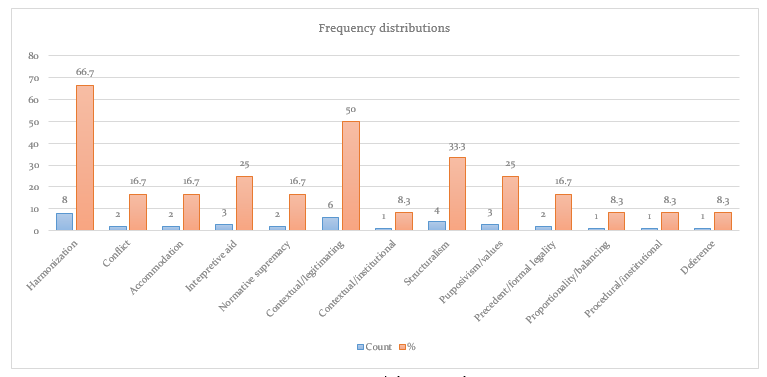
Result pattern: Across these "high salience" disputes, harmonization dominates (66.7%), but it is method-dependent: harmonization is most frequent where courts employ structuralism (jurisdiction/federal allocation) or formal rule-of-law techniques (evidence standards), while conflict clusters in (i) system-wide Sharīʿah invalidation disputes (riba) and (ii) religious-public order restriction disputes (Herald "Allah" issue).
Conflict Points by Issue-Area (Where Clashes are Most Likely)
Issue-area × outcome type (n=12)
| Issue-area | Cases (n) | Harmonization | Conflict | Accommodation |
| Rights (minorities; religious freedom/materials) | 3 | 2 | 1 | 0 |
| Criminal justice (blasphemy/vigilantism) | 2 | 2 | 0 | 0 |
| Economic system / finance (riba) | 3 | 0 | 1 | 2 |
| Institutional/jurisdiction (civil-Syariah; competence; federalism) | 4 | 4 | 0 | 0 |
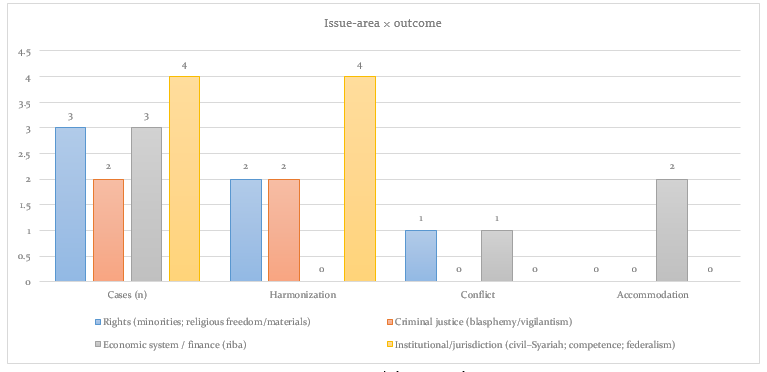
Result pattern: The strongest "conflict density" appears in economic/finance (riba)-not because courts deny constitutional supremacy, but because system transformation (banking, legislation, regulation) makes doctrinal clarity collide with implementation feasibility, producing accommodation outcomes (review/remand; phased compliance).
Observed Harmonization Pathways (Tools That Most Frequently Produced Compatibility)
From coded reasoning segments, five recurring "compatibility tools" appeared.
Harmonization tools observed (frequency across cases, n=12)
| Harmonization tool (observed) | Operational meaning in judgments | Frequency (cases) |
| Structural allocation (jurisdiction/federalism) | Preserving Islam-related institutions by limiting competence, not negating Islam clauses | 5 |
| Rights / due-process hardening | Using criminal evidence standards, fair trial norms, or legality principles to restrain misuse of religious claims | 5 |
| Islam-as-rights support (values framing) | Invoking Islamic ethical commitments to justify constitutional protections (minorities; restraint against falsehood) | 3 |
| Managed transition (phasing) | Declaring incompatibility but pairing it with timelines/remand to reduce systemic disruption | 2 |
| Executive deference | Resolving by deferring to ministerial/public order framing (more likely to generate "conflict" outcomes) | 1 |
Result pattern: The most reliable pathway to harmonization is institutional-structural (allocation of authority, competence, and scope), followed closely by rule-of-law constraints (due process and legality). By contrast, "conflict" outcomes correlate with either broad supremacy-style invalidation (riba) or high deference to public-order claims in identity disputes (Herald).
Discussion
The findings suggest that the correlation between Islamic jurisprudence and constitutive interpretation is handled more frequently via harmonization than by an open doctrinal clash, whereas harmonization is also method-specific. Courts were most harmonious in their production of compatibility when they applied structural reasoning (jurisdiction, institutional competence, constitutional distribution of powers) and rule-of-law methods (legality, evidentiary rigor, due process). This helps to believe that most of the conflicts involving religion and constitution are not solved through the selection of one normative order against the other but through punishment of the forum, the range of authority, and the burden of justification by constitutional reasoning (Saunders et al., 2020; Kharel, 2018). Practically, courts did not make Islam and constitutional rights appear to conflict by considering the references to Islam as either (i) as values capable of bearing constitutional goals or (ii) as norms that can work within the competences that are defined in the Constitution and not beyond them.
Meanwhile, the findings indicate that there are two types of problems whose conflict centers around them. The former entails systemic change claims, such as riba/interest litigation, in which Sharihah-based invalidation demands bang up against practicability, regulatory strictness and transition expenses. In this case, the tendency of the courts was more accommodative (review, remand, staged schedules) than harmonization at once, indicating that doctrinal resolution is not a muscle that can replace coordinated legislative and administrative execution (Mitchell, 2022). The second group is restrictions of religious-public order in identity dispute, where results were more prone to conflicts when adjudication was based on deference, as compared to the structured justification. This is in line with more general criticisms that weakly formulated review may cloud balancing and give prominence to majoritarian instincts, with reasoning that does not focus on proportions compelling disclosure of the need and less restrictive options (Chang et al., 2021; Möller, 2018).
These results also help in explaining the application of Islamic jurisprudence in constitutional adjudication: Islamic sources were most frequently treated as contextual legitimation or as interpretive aids, rather than as an independent test of validity which disregarded constitutional form. In that vein, maqāʃid or maṣlaḥah logic can be formalized as a mediating position, particularly when courts map welfare and harm-prevention into constitutional goals and rights restriction in a structured way, without considering fiqh to be a constitutional substitute (Tajdin, 2020; Takim et al., 2021). Nonetheless, harmonization seems to be effective in the case of the institutions that are intended to minimize the ambiguity of competence: the establishment of the boundaries, the creation of the standard of rights limitations, and the conditions of providing reasons, which restrict the use of judicial discretion (Hilal-Harvald et al., 2020).
Lastly, the comparative inference made by the study is confined to the limited corpus of cases and because Islamic reasoning can be implicit in judgement and not specifically denoted. The proposed model needs to be assessed in other jurisdictions in the future and be supplemented with interviews with judges and lawyers to confirm how courts interpret the formulations of the Islamic references as a legal source rather than a rhetorical tool (Nowell et al., 2017).
Conclusion
This paper has reviewed the issue of whether Islamic jurisprudence (fiqh and uṣul al-fiqh) and constitutional interpretation will always be in a collision course or could be reconciled in contemporary constitutional systems. The results confirm a conditional hypothesis: conflict does not always occur, but harmonization depends on the interpretations of the courts, the location of authority, and the justification approaches that need to be applied in the issue of rights and validity. In all the decisions under analysis, compatibility of views was most frequent when the courts applied the structural constitutional and rule-of-law methods (competence, federal allocation, jurisdictional limits, legality, evidentiary rigor, due process) to punish the forum and scope of Islamic references in the adjudication process. In this situation, Islamic reasoning was often used as an interpretive resource or frame of reference values as opposed to a claim of unquestioned dominance.
There were also predictable conflict zones which were identified in the study. The former is system-wide transformation litigation - particularly in the financial field - where Sharariah-based invalidation has to deal with regulatory realities. In this case, the trend of the courts was towards accommodation (remand, review, phased compliance) and not direct harmonization, which suggests that the institutional capacity and the coordination of legislation is critical in converting normative conclusions into viable constitutional results. The second is the domain of religious-public order cases in which heavy judicial deference might result in rights-weak rulings; and by comparison, structured forms of justification, in particular methods of proportionality, would simply make trade-offs more visible and disputable.
The most frequent clashes to the research questions are (i) supremacy narratives, (ii) rights limits, and (iii) competence boundaries. The most feasible way of compatibility is based on maqāṣid/maṣlahah-purposive reasoning and clear constitutional doctrines on limitation and institutional restraint. The harmonization is successful when the role of Islam is established in the constitution and courts exercise discipline in reason giving and legislatures give real paths of implementation. The conceptual model used in the article thus defines the notion of reconciliation to be an interaction between constitutional design, method of interpretation, and institutional competence, as opposed to the alternative of Islam and constitutionalism.
References
- Ahyar, M., & Huda, N. (2021). Islamic constitutionalism: Social movement and the framework of the Sharia in Indonesia. Constitutional Review. https://doi.org/10.31078/consrev726
- Chang, W.-C., & Dai, S. (2021). The limited usefulness of the proportionality principle. International Journal of Constitutional Law, 19(5). https://doi.org/10.1093/icon/moab068
- de Londras, F., & Tregidga, J. (2021). Rights, proportionality, and process in EU counterterrorism lawmaking. International Journal of Constitutional Law, 19(2), 665–693. https://doi.org/10.1093/icon/moab047
- Dixon, R. (2018). Proportionality & comparative constitutional law versus studies. Law & Ethics of Human Rights, 12(2), 203–224. https://doi.org/10.1515/lehr-2018-0012
- Effendi, D., & Hasan, N. (2019). Malaysian Federal Constitution: Islamic or secular? Constitutional Review. https://doi.org/10.31078/consrev515
- Hazri, M. (2016). Interpreting Islam in the constitution: Question of fact or of law? Islam and Civilisational Renewal 7(2). https://doi.org/10.52282/icr.v7i2.269
- Hazri, M. (2017). Islam and constitutions. Islam and Civilisational Renewal. https://doi.org/10.52282/icr.v8i2.201
- Hilal-Harvald, M. (2020). Islam as a civilizational threat: Constitutional identity, militant democracy, and judicial review in Western Europe. German Law Journal 21(6). https://doi.org/10.1017/glj.2020.70
- Ishak, M. S. (2018). Considering ma’ālāt al-af‘āl in Majallat al-Aḥkām al-‘Adliyyah: A maqāṣidī approach. Islam and Civilisational Renewal.9(2)https://doi.org/10.52282/icr.v9i2.118
- Langford, M. (2018). Critiques of human rights. Annual Review of Law and Social Science, 14(1). https://doi.org/10.1146/annurev-lawsocsci-110316-113807
- Lavie, L. (2021). The constitutionalization of the civil state: The self-definition of Egypt, Tunisia and Yemen in the post–Arab Spring era. Religions, 12(4), 269. https://doi.org/10.3390/rel12040269
- Möller, K. (2018). Dworkin’s theory of rights in the age of proportionality. Law & Ethics of Human Rights, 12(2), 281–299. https://doi.org/10.1515/lehr-2018-0011
- Mondal, A. A. (2016). Articles of faith: Freedom of expression and religious freedom in contemporary multiculture. Islam and Christian–Muslim Relations, 27(1). https://doi.org/10.1080/09596410.2015.1114240
- Perez, N. (2020). Hegemonic religions, majoritarianism, and the limits of constitutional religious establishment. Religions, 11(9), 438. https://doi.org/10.3390/rel11090438
- Pratiwi, C. S. (2021). Rethinking the constitutionality of Indonesia’s flawed anti-blasphemy law. Constitutional Review, 7(2), 273–299. https://doi.org/10.31078/consrev724
- Rofii, A. (2021). The religiosity of the Indonesian constitution: Article 29(1) and its interpretation. Constitutional Review, 7(2), 203–240. https://doi.org/10.31078/consrev722
- Saunders, C., & Kennedy, B. (2020). History and constitutional interpretation: Applying the ‘Cambridge School’ approach to interpreting constitutions. Oxford Journal of Legal Studies, 40(3), 591. https://doi.org/10.1093/ojls/gqaa013
- Tajdin, M. (2020). Sharīʿa as state law: An analysis of ʿAllāl al-Fāsī’s concept of the objectives of Islamic law. Journal of Law and Religion, 35(3), 494–514. https://doi.org/10.1017/jlr.2020.41
- Takim, S. S. (2021). Neoijtihadism: The reformation of Islamic law. Religions, 12(1), 6. https://doi.org/10.3390/rel12010006
- Yakar, E. (2021). The implicit role of custom (‘Urf) in Islamic jurisprudence and its effect on contemporary Islamic legal rulings. ULUM: Journal of Religious Studies. https://doi.org/10.54659/ulum.847228
- Yıldırım, E. (2021). Social rights and the Turkish constitutional court. Constitutional Review, 7(2), 188–202. https://doi.org/10.31078/consrev721
- Zhussipbek, G., & Nagayeva, Z. (2019). Epistemological reform and embracement of human rights: What can be inferred from Islamic rationalistic Maturidite theology? Open Theology, 5(1), 347–365. https://doi.org/10.1515/opth-2019-0030
Cite this article
-
APA : Abdullah, K. (2024). Islamic Jurisprudence and Constitutional Interpretation: Conflict or Harmonization?. Global Social Sciences Review, IX(II), 142-154. https://doi.org/10.31703/gssr.2024(IX-II).15
-
CHICAGO : Abdullah, Kamran. 2024. "Islamic Jurisprudence and Constitutional Interpretation: Conflict or Harmonization?." Global Social Sciences Review, IX (II): 142-154 doi: 10.31703/gssr.2024(IX-II).15
-
HARVARD : ABDULLAH, K. 2024. Islamic Jurisprudence and Constitutional Interpretation: Conflict or Harmonization?. Global Social Sciences Review, IX, 142-154.
-
MHRA : Abdullah, Kamran. 2024. "Islamic Jurisprudence and Constitutional Interpretation: Conflict or Harmonization?." Global Social Sciences Review, IX: 142-154
-
MLA : Abdullah, Kamran. "Islamic Jurisprudence and Constitutional Interpretation: Conflict or Harmonization?." Global Social Sciences Review, IX.II (2024): 142-154 Print.
-
OXFORD : Abdullah, Kamran (2024), "Islamic Jurisprudence and Constitutional Interpretation: Conflict or Harmonization?", Global Social Sciences Review, IX (II), 142-154
-
TURABIAN : Abdullah, Kamran. "Islamic Jurisprudence and Constitutional Interpretation: Conflict or Harmonization?." Global Social Sciences Review IX, no. II (2024): 142-154. https://doi.org/10.31703/gssr.2024(IX-II).15