
Abstract
Given sharp increase in ecological problems, focus of environmental discussions is on carbon neutrality and sustainable development. This study explores how environmental taxes, investment in renewable energy, and reliance on natural resources and sustainable technologies affect progress of sustainable development. This research established for OECD analysis from 1994 to 2024 by using a novel intelligent Bayes topology based on structure learning shows that environmental taxes, renewable energy investment, climate mitigation technologies and economic progress will ensure environmental sustainability of the OECD economies. With increase of external factors of climate change, the financial sector and reliance on natural resources are undermining ecological sustainability. In addition, we are conducting economic classification on OECD dataset to identify the differences in experience between the G7 and other OECD economies. At the conclusion of our analysis, we put forward strong suggestions on environmental policies that enhance sustainability.
Keywords
Renewable Energy Investments, Environmental Fiscal Policies, Climate Mitigation Technologies, Climate Change, Intelligent Bayes Topology.
Introduction
Recent climate change policies have accelerated move towards net-zero emissions and sustainable development (Caglar et al., 2025; Liu et al., 2025; Ren & Zhu, 2025). The complexity of modern economic systems makes it difficult for global policy to mitigate climate vulnerabilities such growing greenhouse gas concentrations, ocean acidification, and precipitation patterns (Li et al., 2023; (Cai et al., 2025). Recently observed by EU Copernicus, rising temperatures have reduced global glacier extent to a record low (Zhang et al., 2025; Dong & Yu, 2024; Duan, 2025). An integrated policy framework that aligns industrial transitions with ecological sustainability and net-zero criteria is needed to address these difficulties (Zhu et al., 2024; Xu et al., 2025). The 1992 Rio Earth Summit, 1997 Kyoto Protocol, and 2015 Paris Climate Agreement strive to limit global warming to 2°C (B´arcena-Ruiz & Sagasta, 2024). The 29th Conference of the Parties held recently in Baku, Azerbaijan, proposed an upper limit on coal consumption, a 1.5-degree Celsius temperature rise limit, and a doubling of the Global Climate Fund to strengthen emerging countries. Despite these efforts, recent reports on global inventories indicate that international environmental cooperation is insufficient (Caglar et al., 2023).
Industrial economies such as the Organization for Economic Cooperation and Development (OECD) use environmental taxes to change energy demand, environmental compliance, and sustainable development. The 1972 United Nations Conference on the Human Environment allowed OECD economies to adopt the "polluter pays" principle and required industries and industrial units to bear external environmental costs. Hence, the taxes levied on the environment have been very popular (Sadiq et al., 2022). In recent decades, ETs have become significant policy mechanisms for green economic routes. According to the Eurostat (Wu et al., 2024), environmental taxes account for 5.5% and 2.2% of social, government, and tax revenues respectively, contributing to the transition to sustainable development. Environmental map costs and systems are inefficient in balancing environmental and economic prospects, and thus cannot stimulate environmental policy thresholds (Li, 2023).
Environmental fiscal policy frameworks affect transportation, energy, resource management, and the macroeconomy. Environmental taxes foster a cleaner economy and can increase public revenue and change energy use and environmental implications, according to Guo and Wang (Guo & Wang, 2018). However, this method is criticised. According to the "green paradox theory," environmental taxes might boost energy prices to reduce demand, especially in industrial sectors, but they may accidentally accelerate fossil fuel extraction if firms expect stronger controls (Zhao et al., 2023). Wolde-Rufael and Weldemeskel (Wolde-Rufael & Weldemeskel, (2020) argue that delays between policy formulation and implementation can increase resource extraction, increasing environmental deterioration. Environmental taxation can improve sustainability, promote renewable energy, and internalise energy market costs. Severe climate change could reduce GDP by up to 30% in vulnerable nations by 2099, although greenhouse gas emission reduction initiatives could lower world GDP by just 1% (Newell et al., 2021).
To achieve global sustainable development goals and long-term ecological transformation, an integrated, forward-looking approach is needed (Yan et al., 2025; Li et al., 2024; Yang et al., 2024). Despite advances in alternative energy, natural resources still supply most of the world's energy, contributing to atmospheric emissions. These resources provide the ingredients needed for industrial and manufacturing growth, underpinning contemporary economic models. Natural resource endowments are essential to plant, animal, and human survival, demonstrating how resource efficiency is essential to ecological sustainability (Bashir et al., 2025).
Therefore, investment is needed in renewable energy, technological infrastructure, and strict environmental regulations in order to strike a balance between net-zero targets and economic sustainability. The efficiency of renewable energy sources such as wind power, solar power, hydrogen, and biofuels enables governments of various countries to formulate alternative plans for fossil fuels. Theoretical research indicates that investment in renewable energy reduces atmospheric emissions (Golpîra et al., 2023). A strong climate mitigation infrastructure is essential for tackling ecological issues, promoting sustainable economic growth, and freeing industrialisation from finite natural and fossil resources (Balsalobre-Lorente & Shah, 2024; Caglar et al., 2024; Kartal et al., 2024). A net-zero carbon transition requires incorporating environmental technologies into industrial and manufacturing processes.
This study examines OECD economies, which are among the world's most industrialised and wealthy. So, their aggressive industrial practices have led to resource consumption, biodiversity loss, and climate change, threatening the long-term feasibility of the environment. Despite having only 17% of the global population, member countries of the Organization for Economic Cooperation and Development (OECD) accounted for 40% of emissions in 2021. They emitted 9.6 metric tonnes per person, more than double the global average of 4.7 (World Bank, 2024). Only 9% of the 350 million tonnes of plastic waste created annually in these nations is recycled, and air pollution kills 500,000 people prematurely.
This study explores how to address climate change in advanced industrialized economies through environmental taxes, investment in renewable energy, natural resource indices, technologies for mitigating climate change, economic growth, and the development of financial markets. The report makes significant contributions to the environmental policymaking gaps. First, it acknowledges that environmental and global warming issues persist despite international policy initiatives, requiring a deeper look at how policy interacts with natural resource management and decarbonisation to find the core reasons of environmental deterioration. Second, the study uses a novel, multi-dimensional climate change measure that includes carbon emissions, intensity, and footprint to better understand environmental deterioration. Thirdly, the Environment Agency is using an environmental tax and a climate change mitigation technical indicator to assess how institutions and policy initiatives impact the Sustainable Development Goals. Fourth, utilize changes in financial markets and investment in renewable energy to analyze how financial and energy reforms affect long-term ecological sustainability with an advanced Bayes topology approach. Research by the Organization for Economic Cooperation and Development (OECD), the Group of Seven (G7), and non-OECD economies shows that environmental fiscal policies, investment in renewable energy, and climate change mitigation technologies support the transition of industrialized and emerging countries to sustainable development.
Latest Literature Synthesizing:
Climate change & Environment Taxes and
Fiscal and taxation policies can incentivize sustainable business practices by internalizing pollution costs, addressing climate change hazards from environmental externalities (Chu, 2025; Bashir et al., 2025). Conventional public spending can crowd out sustainable economic shifts, according to recent environmental study on the SDG transition (Bashir et al., 2024). Environmental fiscal policies have been developed to match income and expenditure instruments and accelerate renewable energy expansion's ecological advantages (Li & Zhou, 2022). Using market-based mechanisms with fiscal spending support-based and incentive-based approaches can improve resource and energy efficiency (Bovenberg & Goulder, 2002). Environmental fiscal strategies fix market failures by adjusting private costs for externalities and reflecting genuine societal costs (Su et al., 2023). In particular, environmental taxes limit the significant impact of industry on the environment and enhance resource and energy efficiency (Bashir et al., 2025). Therefore, environmental finance and fiscal policy drive zero by promoting ecology and facilitating sustainable industrialization and production.
Regional differences in environmental taxation policies affect their efficacy. Depren et al. (2023) demonstrated that carbon taxes targeting specific countries have helped Nordic countries reduce their impact on the industrial environment in recent decades. Kartal (2024), the institutional support of the European Union for environmental finance policies, when considering national factors, industrial and energy taxes may have conflicting impacts on ecological sustainability. In a study of OECD environmental reforms, Bashir et al. (2021) cautioned that environmental governance changes are necessary for energy and environmental levies to succeed in varied economic circumstances. Kumbhakar et al. (2022) studied environmental finance reforms in Canadian provinces and found that carbon taxes have aligned greenhouse gas emissions from the manufacturing sector and production capacity with policies for Sustainable Development Goals. It is reported that climate policies and neutral carbon income taxes benefit all industries (Kumbhakar et al., 2022). However, even a slight increase in taxes will affect employment in sensitive carbon-intensive sectors, as job opportunities shift to the cleaning services industry. Environmental taxes have an impact on corporate policies, and policy and institutional frameworks have a significant influence on the industrial transformation of industrialized economies (Cui, 2024).
Climate Change & Abundance of Natural Resources
Nature provides rich materials in many places without human interference (Li et al., 2024). Even though these minerals are widely available and used, research on their environmental impacts at local and national levels is scarce (Hu & Zheng, 2023). Bansard & Schroder (2021) analysed global mineral resource trade and stressed that sustainable development in the Global South requires natural resource distribution. Emerging economies can support long-term environmental sustainability projects with resource export revenue. Abundant natural resources can also attract foreign commerce and investment, enable sophisticated manufacturing technologies and reduce ecological pressures (Wu, 2022). However, overusing natural resources can affect the environment. The "natural resource curse" argument links resource dependency to slower industrial transformation and weaker institutional development (Canh et al., 2020). Nguyen & Nguyen (2025) suggest that resource-rich nations export resources rather than use them locally to address this issue, albeit this may encourage over-extraction and cause short-term environmental damage (Song et al., 2020). In particular, emerging economies struggle to meet sustainable development goals in resources sector due to technological constraints (Langnel et al., 2021).
Another set of work highlights the complex impacts of abundant natural resources. Shittu et al. (2021) found that resource rents can enhance the fiscal capacity and environmental sustainability of emerging economies in Asia. Rui et al. (2023) studied the flows of energy and resource trade and found that natural resource donations directed financial resources towards long-term environmental changes. Ma et al. (2024) studied the situation of resource supply and found that the revenue from natural resources could help reduce companies that consume large amounts of energy, although this process was inconsistent. Bashir et al. (2025) studied how the mineral policies of the BRICS countries affect economic and environmental balance, pointing out that market fluctuations influence resource costs and manufacturing growth, increasing the demand for resources. The environmental impact of direct resource exploitation has been studied. Attílio et al. (2024) and Stepanov and Makarov (2022) concluded that the export of fossil fuels is related to industrial pollution in energy-exporting economies. Orazio (2024) also studied mining emissions and warned that the diversification of the mining process might threaten environmental sustainability and that policy approaches aimed at addressing emissions generated by industrialization and mining might be necessary.
Climate change, REI & CMT
Conserving ecological resources, enabling sustainable industrialisation, lowering air pollution, and improving energy efficiency need switching to green energy (Bashir et al., 2025). Decarbonization requires a strong environmental and technological infrastructure. Some studies have explored how renewable energy can determine the path of sustainable development. Cheng et al. (2021) analysed energy policies in the context of global climate issues and found that renewable energy and climate change mitigation technologies are crucial for fossil fuel replacement plans and environmental sustainability. Ma et al. (2023) said investments in RE and environmental infrastructure help set policy benchmarks for the SDG transition, but institutional commitment is needed. Wei and Huang (2022) examined regional policy disparities and compliance mechanisms in growing Asian countries and found that RE resources mitigate industrial growth's climatic externalities. Wang et al. (2023) examined BRICS sustainable energy scenarios and found that environmental-technological infrastructure promotes green growth. They also warned that economic and industrial restrictions will likely keep BRICS officials prioritising fossil fuels. Jiang et al. (2024) further explored how climate mitigation techniques affect green total factor productivity, showing that coal's dominance in China's energy mix affects the industrial ecological footprint. Xie et al. (2025) added that RE sector technology innovation boosts environmental protection and renewable investment viability.
Other environmental literature investigates how climate mitigation technologies spur technical innovation to serve the SDGs. Yurdakul and Kazan (2020) used a structural equation model to examine institutional policymaking in Turkey's environmental infrastructure and found that firm-level technological progress Granger-causes renewable energy deployment improvements, reducing the regional ecological footprint. Similarly, Irandoust (2016) found that a balanced energy and innovation strategy could promote environmental technologies and renewable energy to reduce greenhouse gas emissions. Chen et al. (2022) established a nonlinear causal relationship between environmental challenges and energy innovation in emerging economies, pointing out that global technology transfer has accelerated the transition to green energy and reduced environmental pressure. Wei et al. 2024) studied the gradual integration of technologies in the energy sector and found that technological cooperation is of vital importance.
Research Gap
Our literature evaluation suggests that more study is needed to address current constraints and better understand the interaction between climate change and government policy tools. Environmental taxation is increasingly examined as a policy instrument impacting sustainable development, however there is a research gap in evaluating its climate change impact across economic groups, such as the G7 with the rest of the OECD. Given the complexity of modern sustainable development initiatives, it is necessary to conduct a comprehensive and standardized economic analysis to understand how environmental taxes affect the use of renewable energy, climate mitigation technologies and natural resources. These surveys will answer key questions. It has been proven that environmental taxes can reduce greenhouse gas and carbon emissions, but their long-term impact on investment in renewable energy has not been studied. Regional differences and tax responses tailored to specific departments can provide insight and sensitivity for environmental policy reforms.
Theoretically speaking, it is not clear how environmental taxes interact with climate mitigation and the efficient use of natural resources. The dynamic feedback loop between technological infrastructure and resource consumption has not been fully considered, especially between income and countries. Many studies have shown that green technologies can decoupled economic growth from environmental damage, but this study explores how environmental fiscal policies interact with climate change mitigation technologies to accelerate or slow down this process. An effective tax approach requires a better understanding of the consistency between targeted environmental policies and investments. These strategies must address current environmental challenges, promote sustainable resource management, and build the capacity to adapt to climate change.
Research Data, Variables & Analytical Methods:
Underpinnings Justifications
This research report utilizes Agenda 29 of the Conference of the Parties and the 2030 Sustainable Development Goals to study environmental taxation, renewable energy investment, the utilization of natural resources, and climate mitigation technologies. Contemporary economic and environmental policies are highly complex and require a sustainable development framework to address climate change, environmental inequality, resource depletion and a flexible economy. This research is influenced by many hypotheses. The dual distribution theory and the environmental mitigation theory hold that environmental taxes can absorb industrial environmental costs through market processes, thereby reducing adverse external factors. According to the theory of energy transfer, investing in renewable energy is crucial for the carbon of the energy industry and moving away from fossil fuels. The resource dependence theory emphasizes that decision-makers must balance the use of energy and natural resources. Our theoretical approach highlights the fundamental goals of the member states of the Organization for Economic Cooperation and Development (OECD): to protect the environment, energy and resource security, and sustainable economic growth in accordance with the recommendations of the 29th Conference of the Parties. According to this report, the OECD region can enhance environmental resilience through strategic environmental taxes, energy efficiency and resources. In accordance with the requirements of the 29th Conference of the Parties, we have established an analytical framework to assess the political impact of fiscal, resource and energy initiatives. This analysis presents new perspectives and suggests policy changes for the Organization for Economic Cooperation and Development (OECD) to align with the 2030 Sustainable Development Goals. It helps test environmental fiscal policies, reduce greenhouse gas emissions, and enhance energy security at both the national and regional levels. Our analysis examines the relationships among environmental taxation, renewable energy investment, climate change, natural resource index, energy transition, environmental regulations, environmental innovation and banking development in the Organization for Economic Cooperation and Development economies from 1994 to 2024.
Intelligent new Bayes Topology
Table 1 Variables explanations
| Category | Indicator | Description | Data Source |
| Climate Change | CO₂ Emissions | Annual net carbon dioxide emissions (metric tons) | World Development Indicators (WDI) |
| Carbon Intensity | Quantity of CO₂ emitted per unit of GDP | Our World in Data | |
| Ecological Footprint | Aggregate demand on biocapacity, measured in global hectares | Global Footprint Network, OECD | |
| Environmental Taxes | Environmental Tax Revenue | Revenue from environmental taxes as a percentage of GDP | OECD Database |
| Financing in Renewable Energy | Investments in Renewables | Capital flows into wind, solar, geothermal, and other renewable energy projects | Our World in Data |
| Natural Resources | Resource Rents | Income derived from the extraction of minerals, fossil fuels, and forest resources | Our World in Data |
| Technology of Climate Mitigation | Energy Transition Patents | Annual patent filings for technologies enabling the shift to low-carbon energy | OECD Database |
| Environmental Technology Patents | Patent counts for technologies that reduce pollution or enhance resource efficiency | OECD Database | |
| Collaborative Environmental Patents | Patents resulting from international co-invention in environmental technologies | OECD Database | |
| Developments of Financial Markets | Financial Development Index | Composite index reflecting market access, depth, and operational efficiency | International Monetary Fund (IMF) |
| Economic Output | GDP per Capita | Gross domestic products divided by midyear population, in constant 2017 US dollars | World Development Indicators (WDI) |
This study employs a Bayesian neural network based on structure learning for analysis based on constraints and surveys to discover randomly varying police relationships and potential distributions. Based on Directed Acyclic Graphs (DAGs) (HongXing et al., 2024), a connection structure is constructed between the random variables X and Y and Z: Z is the node that fundamentally affects X, X to Y. The occupation of the bully is the connection between the probability P (X,Y∣Z). The SLBNN framework is used for the analysis basis. Result-based analysis measures the interrelationships among random variables, while restriction-based analysis looks for barcodes and network orientation (Wu et al., 2025). These methods can reliably infer the structure and potential correlations of variables.
SBL Bayes Technique
Based on the method, the analysis based on the outcome determines the quality of bise by determining the maximum component between the ring vectors. The previous P(Y) distribution and network probability provide the possibility of a specific network structure being developed later based on the X dataset.
P( Y ) = (P ( Y , X ))/( ∑ Y' P ( Y', X) ) =(P ( Y ) P ( X ))/( ∑Y' P ( Y' ) P( X ))
(Lin & Jia, 2018) emphasized that determining an effective Bayesian structure for N-P networks is computationally difficult. Several search and genetic methods approximate a suitable network structure. In this study, Bayesian network structure is evaluated using scoring functions, as formalized in equation (1).
Dirichlet Bayes Network Scores
Given a parameter vector θ and dataset X, the
Dirichlet Bayesian network score for network Y is written as follows (Alhussam et al., 2020):
YX: SX( Y ) = log( P( Y ). ∑p ( X).P( θ│Y ) dθ )
Furthermore, the discrete dataset can be approximate using:
YX (Y,X)=log(P(Y)) + ∑t=1n ∑k=1qt ( log((Г(Ttk' ))/(Г(Ttk+Ttk' )))+∑n=1rt log((Г(Ttkn+Ttkn' ))/(Г(Ttkn'))))
For the dataset X, Ttkn, represents the total number of observations, while the variant Xt represents the value of n-th, and the original composition represents the value of n-th. Before describing the probability distribution, the super distribution, using the network and the parameter α = αtkn = T'tkn, pointed out the false count before.
Information theory scores
We analyze the Bayesian neural network using information-theoretic methods, following (Heine & Black, 2018). Their theory views the network as a way of information where effective and significant node actively forward numeric information to next artificial node. This study uses information theory to construct and report entropy and mutual information scores to evaluate the network's structure and operation.
Entropy Scores
Within the Bayesian network's structural assumptions, entropy measures random data indicator information loss. Notably, deterministic processes underpinning major variables reduce entropy. Given dataset X, network Y entropy score is:
H(X,Y) = -T∑tn ∑kqt ∑nrt (Ttkn)/(T) log(Ttkn)/(Ttk)
Ttkn denotes the number of numeric values X dataset of the model, where Xt has the n-th value and its parent set the k-th configuration. N represents the dataset's total observations.
MIS of Information Theory Scores
The current empirical research uses MIS (mutual information score) of information theory score to assess the link between variables xk and xn, like (Shayanmehr et al., 2023). The expression is:
I( xn , xk ) = ∑xn, xki P( xn , xk) log( P (xn, xk ))/( P (xn) P ( xk))
The intelligent new Bayes topology total edges are indexed by i. The PC (Peter-Clark) approach infers an ideal network structure from data likelihood.
Findings of Intelligent New Bayes Topology
This section explains the results of applying deep learning based intelligent new Bayes topology. We report the potential outputs from a Bayes topology using two main methods to determine its optimal structure. Basically, this analysis evaluates the conditional dependencies and probability distribution among higher variables of the Bayes topology.
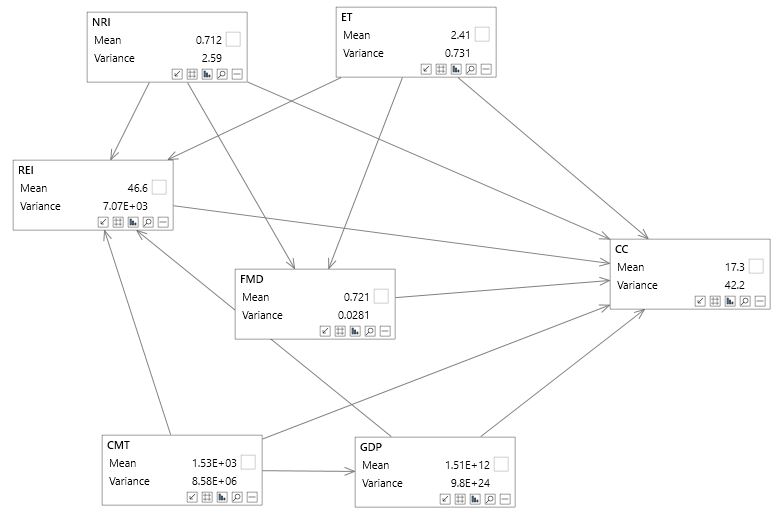
Figure 1 shows the Bayesian intelligent network topology that models OECD nations' probabilistic correlations between major economic and environmental factors. Six nodes make up the network: Renewable Energy Investment (REI), Climate Mitigation Technologies (CMT), Environmental Taxation (ET), Climate Change (CC), GDP, and Financial Market Development. The directional arrows between these nodes show how data-inferred causal or predictive connections, such as higher environmental taxation, may affect renewable energy investment or GDP. The means and variances for each variable summaries the data distribution used to build this model. This network illustrates the complicated relationship between fiscal policy, technological adoption, financial progress, and environmental effects in mature industrial economies. Our next analysis shows the interaction intensity of new Bayes topology node for OECD economies. First, we offer OECD estimates, focusing on how CMT, GDP, NRI, FMD, ET& REI are significantly associated with CC.
Table 2 Interaction intensity of new Bayes topology with panel of OECD
| X | Y | MIS | SMT | By Y To X | By X To Y | X Bayes entropy | Y Bayes entropy |
| CMT | GDP | 1.0805833 | 0.0545851 | 0.1149366 | 0.0357915 | 9.4015572 | 29.356546 |
| CMT | REI | 0.1031009 | 0.0135193 | 0.0109664 | 0.0176215 | 9.4015572 | 6.4846346 |
| GDP | REI | 0.0900825 | 0.0049988 | 0.0029837 | 0.0153965 | 30.1910748 | 3.8476453 |
| NRI | REI | 0.0629140 | 0.0162432 | 0.0331881 | 0.0107530 | 1.8956792 | 6.5365244 |
| GDP | CC | 0.0563453 | 0.0033657 | 0.0018663 | 0.0171229 | 30.1910748 | 4.2555675 |
| CMT | CC | 0.0508136 | 0.0080071 | 0.0054048 | -0.0154418 | 9.4015572 | -4.6542478 |
| ET | REI | 0.0373325 | 0.0104972 | 0.0295815 | 0.0425745 | 1.2620223 | 6.3457245 |
| ET | FMD | 0.0359200 | 0.0802732 | 0.0284622 | -0.0978537 | 1.2620223 | -1.5475421 |
| FMD | CC | 0.0191838 | 0.0131235 | -0.0522607 | -0.0058298 | -0.3670784 | -4.4575241 |
| NRI | CC | 0.0120155 | 0.0046335 | 0.0063384 | 0.0036514 | 1.8956792 | 2.5472547 |
| ET | CC | 0.0119484 | 0.0052490 | 0.0094676 | -0.0036310 | 1.2620223 | -2.5475842 |
| REI | CC | 0.0111271 | 0.0024344 | 0.0019018 | -0.0033814 | 5.8508424 | -2.5475842 |
| NRI | FMD | 0.0025601 | 0.0033496 | 0.0013505 | -0.0069742 | 1.8956792 | -1.5472654 |
Bayesian network analysis shows significant directional correlations among important variables in Table 2. Environmental taxation (ET), financial market development (FMD), climate mitigation technologies (CMT), and renewable energy investments (REI) all negatively affect climate change (CC), suggesting that policy and market reforms in these areas reduce climate impacts in OECD economies. However, the natural resources index (NRI) and GDP are positively correlated with CC, demonstrating that economic expansion and resource reliance still cause climatic pressures. The data also shows that CMT, GDP, NRI, and ET all positively affect REI, demonstrating how technological and economic variables encourage green investment. Finally, ET and NRI negatively affect FMD, suggesting that environmental fees and resource reliance may initially slow financial market expansion.
The joint probability distributions in graphs A-F of Figure 2 show that the number of observations is largest when climate change (CC) and other data indicators are extreme. Red, yellow, and white. Bayes investigation and analysis indicate that there is a strong potential connection between climate change and environmental taxes, investment in renewable energy, natural resource indices, climate mitigation technologies, gross domestic product, and the development of financial markets.
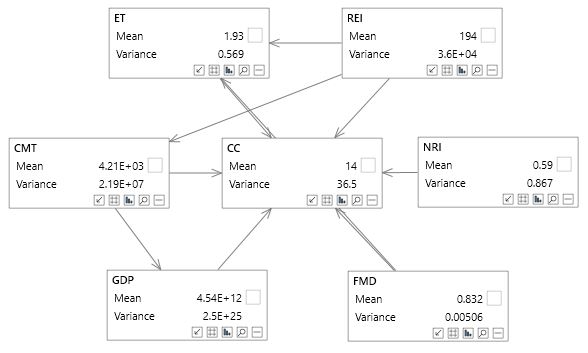
The EMT, GDP, CC, REI, NRI, and FMD are modelled in a Bayesian network structure for the G7 economies in Figure 3. Inferred causal connections show how variables like financial market growth or renewable energy investments may affect climate change measures and economic output in this group of advanced economies. Statistics underpin the network's conditional dependencies, and the means and variances show each variable's central tendency and dispersion. This structure illustrates the unique interaction of technological, economic, and environmental elements in G7 sustainable development pathways. Our next analysis shows the interaction intensity of the new Bayes topology node for the G7 economies of OECD. First, we offer OECD estimates, focusing on how CMT, GDP, NRI, FMD, ET& REI are significantly associated with CC.
Table 3 Interaction intensity of new Bayes topology with G7 panel of OECD
| X | Y | MIS | SMT | By Y To X | By X To Y | X Bayes entropy | Y Bayes entropy |
| CMT | GDP | 1.0329602 | 0.0509722 | 0.1046511 | 0.0336910 | 8.8705177 | 31.635353 |
| REI | ET | 0.4384218 | 0.1123994 | 0.0657887 | 0.3855791 | 7.6640934 | 2.6584653 |
| REI | CMT | 0.3633920 | 0.0439553 | 0.0545299 | 0.0368159 | 5.6640934 | 8.487353 |
| NRI | CC | 0.2777955 | 0.1216873 | 0.2061567 | -0.0863193 | 3.3474970 | -2.8463522 |
| CMT | CC | 0.0488981 | 0.0074718 | 0.0049540 | -0.0151941 | 6.8705177 | -4.846365 |
| GDP | CC | 0.0424316 | 0.0025050 | 0.0013839 | 0.0131848 | 28.4763523 | 2.7463524 |
| FMD | ET | 0.0350292 | -0.8065809 | -0.0286208 | 0.0308072 | -2.2239064 | 2.7465322 |
| FMD | CC | 0.0235361 | 0.0236031 | -0.0192303 | 0.0073134 | -2.2239064 | 4.8476534 |
| REI | CC | 0.0110142 | 0.0022291 | 0.0016528 | -0.0034224 | 4.6640934 | -4.8476563 |
| ET | CC | 0.0003882 | 0.0001783 | 0.0003414 | -0.0001206 | 3.1370478 | -2.7465234 |
Mutual information and entropy-based measures are used to assess the Bayesian network's G7 panel variable relationships in Table 3. The natural resources index (NRI) has a significant adverse association with climate change (CC), while climate mitigation technologies (CMT) and renewable energy investments (REI) are highly and positively associated to GDP and environmental taxation, respectively. NRI, REI, ET, and CMT all have a negative correlation with CC, suggesting they reduce climatic pressures in G7 economies. However, GDP and financial market development (FMD) have a positive association with CC, demonstrating that economic growth and financial expansion in these nations still have climatic implications.
This study compares G7 and non-G7 OECD economies as well as the OECD as a whole. Figure 4 shows the potential allocation of the G7 in areas such as CC, ET, REI, NRI, CCMT, GDP & FMD as well. When data values are severe, sub-diagrams A through E are framed in black, indicating a weaker probabilistic relationship in those places, as expected. The core portions of the graphs are heavily shaded red, yellow, and white, indicating that most observations are around mid-range variable values. This pattern shows a probabilistic association between climate change and G7 variables.
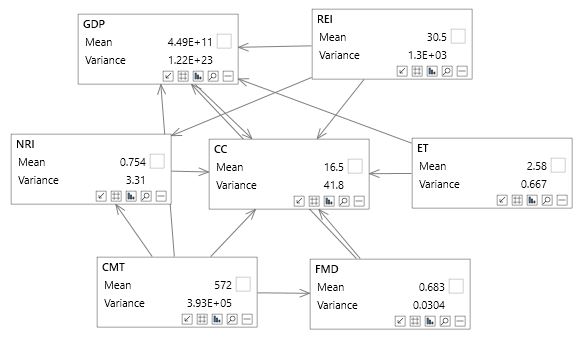
Figure 5 shows a Bayesian network structure modelling non-G7 OECD economies' probabilistic key variable interactions. GDP, REI, NRI, CC, ET, CMT, and FMD are the network's seven nodes. The directed linkages show how environmental fees and financial development may affect climate change and economic growth in industrialised nations. Means and variances for each variable create the statistical distribution that shapes the network. This visualisation shows how policy and economic interactions affect OECD countries outside the G7's environmental sustainability. Our next analysis shows the interaction intensity of the new Bayes topology node for the rest of the economies of OECD. First, we offer OECD estimates, focusing on how ET, FMD, NRI, GDP, CMT, and REI are associated with CC.
Table 4 Interaction intensity of the new Bayes topology with rest panel of OECD
| X | Y | MIS | SMT | By Y To X | By X To Y | X Bayes entropy | Y Bayes entropy |
| REI | NRI | 0.2079137 | 0.0592257 | 0.0415525 | 0.1030586 | 4.0036328 | 3.0174308 |
| CMT | GDP | 0.1668090 | 0.0093039 | 0.0212248 | 0.0059577 | 6.8591381 | 25.547245 |
| FMD | GDP | 0.1157390 | 0.0083653 | -0.3532273 | 0.0041337 | -0.3276614 | 25.457855 |
| GDP | CC | 0.0960609 | 0.0061411 | 0.0034309 | 0.0292351 | 25.987796 | 3.2858053 |
| CMT | FMD | 0.0823919 | 0.0218793 | 0.0104836 | -0.2514544 | 6.8591381 | -0.3276614 |
| REI | CC | 0.0605661 | 0.0146128 | 0.0121044 | -0.0184326 | 7.0036328 | -3.2858053 |
| CMT | CC | 0.0493031 | 0.0088476 | 0.0062733 | -0.0150049 | 6.8591381 | -3.2858053 |
| FMD | CC | 0.0471055 | 0.0318480 | -0.1437627 | 0.0143361 | -1.3276614 | 3.2858053 |
| REI | GDP | 0.0341079 | 0.0020670 | 0.0068166 | 0.0012182 | 4.0036328 | 27.9987796 |
| CMT | NRI | 0.0297993 | 0.0060343 | 0.0037917 | 0.0147709 | 6.8591381 | 2.0174308 |
| ET | GDP | 0.0283922 | 0.0019436 | 0.0233369 | 0.0010141 | 2.2166190 | 27.9987796 |
| ET | CC | 0.0053061 | 0.0023570 | 0.0043614 | -0.0016149 | 3.2166190 | -3.2858053 |
| NRI | CC | 0.0017163 | 0.0006473 | 0.0008507 | -0.0005223 | 2.0174308 | -3.2858053 |
Table 4 shows non-G7 OECD economies' Bayesian network node relationships' strength. Renewable energy investment (REI) and the natural resource index (NRI) have the strongest positive mutual information, while climate mitigation technologies (CMT) and financial market development (FMD) both positively link to GDP, reinforcing technology and finance's role in economic growth. However, CMT and FMD are inversely related, suggesting trade-offs. Importantly, REI, CMT, environmental taxes (ET), and NRI all have a negative relationship with climate change (CC), supporting their involvement in mitigation, while GDP has a positive link, demonstrating the environmental cost of economic expansion in these emerging and developed economies. Then, we report the probability distribution between climate change indicators and data. The current research shows the independent variables on the axes and axes respectively, while the joint distribution indicates the power of random variables in the network structure with colours on the right side of the chart.
Figure 6 shows the common probability distribution of climate change tax and environmental tax, renewable energy investment, natural resource index, climate change mitigation technology, gross domestic product and the development of financial markets in non-OECD G7 member economies. As mentioned in previous sections, sub-diagrams A through E have black borders to indicate outlier findings. The bulk of the graph area is red, white, and yellow, indicating that these economies' key tendencies of the selected variables have a high probability association with climate change.
Conclusion and Policy Implications
There is an increasing political consensus that the Sustainable Development Goals should be given priority to mitigate the environmental impact of climate change. This study conducted a pilot analysis of environmental taxes, renewable energy investment, technologies for mitigating climate change, consumption of natural resources, economic growth, development of financial markets and climate change in the economies of the Organization for Economic Cooperation and Development (OECD). Intelligent new Bayes topology approach used to discover that renewable energy investment, environmental taxes, climate mitigation technologies and economic growth based on strict environmental and macroeconomic policies can reduce climate change in the OECD region. On the contrary, both the consumption of natural resources and the development of financial markets have damaged the environment. The report also compares G7 and non-G7 OECD policy initiatives on climate results. Finally, panel causality analysis determines variable causality. The report makes various renewable energy investment and environmental fiscal policy proposals within modern environmental policies. First, environmental tax design should include local government participation to allow flexible, context-specific modifications like targeted subsidies or differential tax structures to promote the net-zero transition. Second, authorities should link tax refunds to verifiable environmental performance to encourage industry compliance and ecological compensation. Third, green and sustainable bonds, climate risk insurance, and climate policies should be better integrated to forecast and manage geographic and spillover dependencies across green financing, energy transition, and regulatory compliance.
Multiple targeted strategies can boost renewable energy (RE) investments. First, governments should tailor RE investment policies to RE enterprises' external difficulties to mitigate negative effects. This covers RE project risk prevention and supervision to boost investment efficiency. Second, investment plans for renewable energy should comply with national and international infrastructure standards to make renewable energy economically feasible in terms of demand and supply. Thirdly, investment should give priority to the infrastructure for the distribution and access of renewable energy. Environmental tax revenue can provide the best funds for expanding renewable energy and stabilizing energy demand. Fourth, the policy framework for renewable energy should assess the impact of net zero on the transition from the indirect effects of renewable energy. Consider the infrastructure for quantitatively calculating how to accelerate the development of renewable energy risks and establish climate models to develop decarbonization methods. Energy, agriculture, building, and manufacturing depend on natural resources, but overuse causes environmental problems. We recommend the following to lessen resource use's environmental impact: To promote sustainable resource management, authorities should first create a natural resource taxation structure with flexible fiscal subsidies. Second, environmental policies should promote circular economy models, maintain minimum reserve requirements for important minerals, improve recycling systems, and integrate with relevant Sustainable Development Goals to address resource governance. Third, mining activities should have tight resource extraction permits to address environmental and climate issues. Fourth, an innovative environmental technology framework should include extended producer responsibility (EPR) rules to reduce resource-intensive production and services. Finally, a multi-stakeholder collaboration approach encompassing financial, industrial, and regulatory representatives should be established to raise synergistic policy cooperation on ecological issues within the environmental agenda.
At the conclusion of this experimental study, we noticed many limiting factors, which offer opportunities for future research. In order to accurately reflect the uncertainty in environmental decision-making, after research, traditional wave methods, the interdependent relationship between local waves or other advanced economic models should be adopted to handle the problem of parameter uncertainty. Secondly, given the constraints on traditional financial markets, especially in developing countries, studying the flow of energy capital from developed economies to emerging economies, with a focus on sectoral ecological impacts, can enrich theoretical debates. Finally, future research can assess how the frequency of political shocks affects energy and economic prospects, thereby deepening our understanding of the constraints imposed by market forces on the development of sustainable development Goals.
Funding Acknowledgement
All of this research was carried out without any financial assistance from outside sources.
Author Contribution
Rabia Akram is sole contributor and responsible for conceptualization, novel methodology, investigation, analytical, and writing of this whole empirical research.
Competing Interest of Study
There is no conflict of interest in this empirical research.
Obtainability of Research Data
It is a confidential research dataset. However, it can only provide of request.
Appendix
Table A1
Table A1
Data and variables information
| State | (CC) | (ET) | (REI) | (NRI) | (CMT) | (GDP) | (FMD) |
| Mean value | 2.223 | 3.370 | 2.435 | 1.782 | 3.835 | 10.85 | 1.752 |
| Median value | 2.225 | 1.415 | 2.515 | 1.195 | 4.860 | 9.974 | 1.781 |
| Max. value | 2.600 | 4.380 | 2.000 | 9.060 | 3.310 | 11.35 | 2.002 |
| Min. value | 0.072 | 1.002 | 0.190 | 1.009 | 1.970 | 12.90 | 1.295 |
| Std. Dev. value | 1.155 | 1.826 | 1.722 | 2.708 | 1.595 | 1.530 | 1.150 |
| Skew. value | 1.170 | 1.172 | 0.238 | 1.392 | 3.130 | 1.638 | 1.690 |
| Kurt. value | 2.700 | 2.700 | 4.100 | 2.875 | 19.49 | 2.920 | 2.835 |
| Jarque-Bera | 6.12 | 42.6 | 18.7 | 12300 | 0.365 | 42.6 | 57.6 |
| Probability | 0.148 | 0.170 | 0.103 | 0.208 | 0.834 | 0.200 | 0.160 |
| Observations | 724 | 724 | 724 | 724 | 724 | 724 | 724 |
Descriptive Statistics (Adjusted) is an Excel table A1 that provides a summary of the most important statistical characteristics for the seven core variables that were utilized in the research. These variables are CC, ET as well as the REI, NRI, CMT technologies, and the development of the financial market for GDP and FMD. It provides information on the central trend (middle, medium), dispersion (standard deviation and range), and distribution form (deviation and skewness), with each variable offering 724 observed pieces of information. The outcomes of the Jarque-Bera test and the probabilities that are associated with them provide information about whether or not the data for each variable follows a normal distribution. This information is essential for validating the statistical methods that are utilized in the subsequent Bayesian network and econometric analyses. The author, Rabia Akram, was entirely responsible for contributing to and being responsible for the conceptualization, methodology, investigation, analysis, and writing of this research in its totality.
Figure A1
Correlation Matrix
The correlation matrix (Figure A1) quantitatively shows the linear correlations between the seven study variables. These associations' strength and direction are indicated by the -1 to 1 values. The research shows numerous key patterns. Climate Change (CC) has a moderate positive connection with GDP (0.33), Renewable Energy Investment (REI, 0.28), and Climate Mitigation Technologies (CMT, 0.31), showing that increased economic production and green investments increase climate pressure in the sample. In particular, Environmental Taxation (ET) has negative associations with CC (-0.26), REI (-0.51), and CMT (-0.47), suggesting that greater taxes reduce climate impacts but may also reduce green investment. REI and CMT (0.78) and CMT and GDP (0.95) had the strongest positive associations, indicating a close relationship between green technology adoption, renewable energy investment, and economic activity. In contrast, the Natural Resources Index (NRI) has weak relationships with most variables, demonstrating it influences the modelled system independently.
References
- Attílio, L. A., Faria, J. R., & Silva, E. C. D. (2024). Countervailing impacts of fossil fuel production and exports of electrical goods on energy transitions and climate change. Journal of Cleaner Production, 464, 142797. https://doi.org/10.1016/j.jclepro.2024.142797
- Balsalobre-Lorente, D., & Shah, S. A. R. (2024). Stay circular economy, empowerment, and natural resource utilization factual factors for SDG 12? The principal role of digital technologies. Journal of Environmental Management, 370, 122459. https://doi.org/10.1016/j.jenvman.2024.122459
- Bansard, J., & Schroder, M. (2021). The sustainable use of natural resources: The governance challenge. Springer.
- Bárcena-Ruiz, J. C., & Sagasta, A. (2024). Environmental taxes when firms care about environmental corporate social responsibility. International Review of Economics and Finance, 96, 103684. https://doi.org/10.1016/j.iref.2024.103684
- Bashir, M. F., Galariotis, E., Jamaani, F., & Roubaud, D. (2025). Analyzing how energy vulnerability, energy efficiency and economic complexity impact climate change: Comparative evidence from G7 and BRICST economies. Journal of Risk Finance. Advance online publication. https://doi.org/10.1108/JRF-02-2025-0106
- Bashir, M. F., Jamaani, F., Troise, C., & Bresciani, S. (2025). Assessing the impact of environmental taxes, energy structure and renewable energy investments on climate change: Empirical evidence from top-10 polluting economies. Sustainable Development. Advance online publication. https://doi.org/10.1002/sd.2754
- Bashir, M. F., Ma, B., Shahbaz, M., Shahzad, U., & Vo, X. V. (2021). Unveiling the heterogeneous impacts of environmental taxes on energy consumption and energy intensity: Empirical evidence from OECD countries. Energy, 226, 120366. https://doi.org/10.1016/j.energy.2021.120366
- Bashir, M. F., Madaleno, M., Sharif, A., & Bashir, M. (2025). Natural resources demand, energy transition, and global mineral market: An assessment of BRICS mineral policy. Resources Policy, 100, 105452.
- Bashir, M. F., Pan, Y., Shahbaz, M., & Ghosh, S. (2023). How energy transition and environmental innovation ensure environmental sustainability? Contextual evidence from top-10 manufacturing countries. Renewable Energy, 204, 697–709.
- Bashir, M. F., Sharif, A., Staniewski, M. W., Ma, B., & Zhao, W. (2024). Environmental taxes, energy transition and sustainable environmental technologies: A comparative OECD region climate change analysis. Journal of Environmental Management, 370, 122304. https://doi.org/10.1016/j.jenvman.2024.122304
- Bovenberg, L., & Goulder, L. H. (2002). Environmental taxation and regulation. In A. J. Auerbach & M. Feldstein (Eds.), Handbook of Public Economics (Vol. 3, pp. 1471–1545). Elsevier.
- Caglar, A. E., Avci, S. B., Gökçe, N., & Destek, M. A. (2024). A sustainable study of competitive industrial performance amidst environmental quality: New insight from novel Fourier perspective. Journal of Environmental Management, 366, 121843.
- Caglar, A. E., Demirdag, I., Destek, M. A., & Daştan, M. (2025). Achieving ecological sustainability in European countries: Does low carbon energy lead to a carbon neutrality pathway? Science of the Total Environment, 958, 177915. https://doi.org/10.1016/j.scitotenv.2024.177915
- Caglar, A. E., Gökçe, N., & Şahin, F. (2023). Sustaining environment through municipal solid waste: Evidence from European Union economies. Environmental Science and Pollution Research, 31(4), 6040–6053.
- Cai, X., Xiang, H., & Akbari, F. (2025). Integrated sustainability perspective to interconnect circular economy, environmental development, and social status: Designation of sustainable development spillovers. Socio-Economic Planning Sciences, 101, 102253.
- Canh, N. P., Schinckus, C., & Thanh, S. D. (2020). The natural resources rents: Is economic complexity a solution for resource curse? Resources Policy, 69, 101800. https://doi.org/10.1016/j.resourpol.2020.101800
- Chen, Y., Yao, Z., & Zhong, K. (2022). Do environmental regulations of carbon emissions and air pollution foster green technology innovation: Evidence from China’s prefecture-level cities. Journal of Cleaner Production, 350, 131537. https://doi.org/10.1016/j.jclepro.2022.131537
- Cheng, Y.-S., Li, R., & Woo, C.-K. (2021). Regional energy-growth nexus and energy conservation policy in China. Energy, 217, 119414. https://doi.org/10.1016/j.energy.2020.119414
- Chu, T. (2025). Environmental tax reform roles and strategies of local governments: A quasi-natural experiment from China. Sustainable Futures, 9, 100453.
- Cui, G. (2024). How do environmental taxes affect the environmental investment of high-emission enterprises: Evidence from China. Journal of Environmental Management, 370, 122629. https://doi.org/10.1016/j.jenvman.2024.122629
- D’Orazio, P. (2024). Assessing the fiscal implications of changes in critical minerals’ demand in the low-carbon energy transition. Applied Energy, 376, 124197. https://doi.org/10.1016/j.apenergy.2024.124197
- Depren, Ö., Kartal, M. T., Ayhan, F., & Kılıç Depren, S. (2023). Heterogeneous impact of environmental taxes on environmental quality: Tax domain based evidence from the nordic countries by nonparametric quantile approaches. Journal of environmental management, 329, 117031. https://doi.org/10.1016/j.jenvman.2022.117031
- Dong, X., & Yu, M. (2024). Green bond issuance and green innovation: Evidence from China’s energy industry. International Review of Financial Analysis, 94, 103281. https://doi.org/10.1016/j.irfa.2024.103281
- Duan, N. (2025). The quest for balance: The journey of energy, environment and sustainable development. Energy & Environmental Sustainability, 1(1), 100001. https://doi.org/10.1016/j.eesus.2024.12.001
- Golpîra, H., Sadeghi, H., & Magazzino, C. (2023). Examining the Energy-Environmental Kuznets Curve in OECD Countries Considering their Population. Environmental science and pollution research international, 30(41), 94515–94536. https://doi.org/10.1007/s11356-023-28923-w
- Guo, L., & Wang, Y. (2018). How does government environmental regulation “unlock” carbon emission effect?—evidence from China. Chinese Journal of Population, Resources and Environment, 16(3), 232–241.
- Heine, D., & Black, S. (2018). Benefits beyond Climate: Environmental Tax Reform. In The World Bank eBooks (pp. 1–63). https://doi.org/10.1596/978-1-4648-1358-0_ch1
- HongXing, Y., Naveed, H. M., Memon, B. A., Ali, S., Haris, M., Akhtar, M., & Mohsin, M. (2023). Connectedness between Currency Risk Hedging and Firm Value: A Deep Neural Network-based Evaluation. Computational Economics, 63(2), 599–638. https://doi.org/10.1007/s10614-022-10353-4
- Hu, N., & Zheng, B. (2023). Natural resources, education, and green economic development. Resources Policy, 86, 104053. https://doi.org/10.1016/j.resourpol.2023.104053
- Irandoust, M. (2016). The renewable energy-growth nexus with carbon emissions and technological innovation: Evidence from the Nordic countries. Ecological Indicators, 69, 118–125. https://doi.org/10.1016/j.ecolind.2016.03.051
- Jiang, Y., Guo, Y., Bashir, M. F., & Shahbaz, M. (2024). Do renewable energy, environmental regulations and green innovation matter for China's zero carbon transition: Evidence from green total factor productivity. Journal of environmental management, 352, 120030. https://doi.org/10.1016/j.jenvman.2024.120030
- Kartal M. T. (2024). Quantile-based effect of energy, transport, and total environmental tax on ecological footprint in EU5 countries. Environmental science and pollution research international, 31(13), 20033–20047. https://doi.org/10.1007/s11356-024-32214-3
- Kartal, M. T., Taşkın, D., Shahbaz, M., Kılıç Depren, S., & Korkut Pata, U. (2024). Effects of Environment, Social, and Governance (ESG) Disclosures on ESG Scores: Investigating the Role of Corporate Governance for Publicly Traded Turkish Companies. Journal of environmental management, 368, 122205. https://doi.org/10.1016/j.jenvman.2024.122205
- Kumbhakar, S. C., Badunenko, O., & Willox, M. (2022). Do carbon taxes affect economic and environmental efficiency? The case of British Columbia’s manufacturing plants. Energy Economics, 115, 106359. https://doi.org/10.1016/j.eneco.2022.106359
- Langnel, Z., Amegavi, G. B., Donkor, P., & Mensah, J. K. (2021). Income inequality, human capital, natural resource abundance, and ecological footprint in ECOWAS member countries. Resources Policy, 74, 102255. https://doi.org/10.1016/j.resourpol.2021.102255
- Li, S., Cifuentes-Faura, J., Talbi, B., Sadiq, M., Mohammed, K. S., & Bashir, M. F. (2023). Dynamic correlated effects of electricity prices, biomass energy, and technological innovation in Tunisia’s energy transition. Utilities Policy, 82, 101521. https://doi.org/10.1016/j.jup.2023.101521
- Li, S., Sun, H., Sharif, A., Bashir, M., & Bashir, M. F. (2024). Economic complexity, natural resource abundance and education: Implications for sustainable development in BRICST economies. Resources Policy, 89, 104572. https://doi.org/10.1016/j.resourpol.2023.104572
- Li, Y., Qian, K., Wang, Z., & Xu, A. (2024). The evolution of China’s wind power industry innovation network from the perspective of multidimensional proximity. Technology Analysis and Strategic Management, 37(12), 3285–3299. https://doi.org/10.1080/09537325.2024.2405145
- Li, Z. (2023). Do geopolitical risk, green finance, and the rule of law affect the sustainable environment in China? Findings from the BARDL approach. Resources Policy, 81, 103403. https://doi.org/10.1016/j.resourpol.2023.103403
- Li, Z., & Zhou, Z. (2022). Research on the impact mechanism of fiscal and tax policies on carbon emissions under the dual carbon goals. Frontiers in Business, Economics and Management, 6(2), 32–37. https://doi.org/10.54097/fbem.v6i2.2637
- Lin, B., & Jia, Z. (2018). The energy, environmental and economic impacts of carbon tax rate and taxation industry: A CGE based study in China. Energy, 159, 558–568. https://doi.org/10.1016/j.energy.2018.06.167
- Liu, K., Luo, J., Faridi, M. Z., Nazar, R., & Ali, S. (2025). Green shoots in uncertain times: Decoding the asymmetric nexus between monetary policy uncertainty and renewable energy. Energy & Environment. https://doi.org/10.1177/0958305x241310198
- Ma, B., Destek, M. A., Shahzad, L., & Bashir, M. F. (2024). Fintech, natural resource abundance, environmental regulations and energy consumption in BRICST and G7 economies: Empirical evidence from novel climate change index. Resources Policy, 91, 104873. https://doi.org/10.1016/j.resourpol.2024.104873
- Ma, B., Sharif, A., Bashir, M., & Bashir, M. F. (2023). The dynamic influence of energy consumption, fiscal policy and green innovation on environmental degradation in BRICST economies. Energy Policy, 183, 113823. https://doi.org/10.1016/j.enpol.2023.113823
- Newell, R. G., Prest, B. C., & Sexton, S. E. (2021). The GDP-Temperature relationship: Implications for climate change damages. Journal of Environmental Economics and Management, 108, 102445. https://doi.org/10.1016/j.jeem.2021.102445
- Nguyen, C. P., & Nguyen, B. Q. (2025). Do natural threats matter for natural resources rents? Global evidence. Resources Policy, 102, 105509. https://doi.org/10.1016/j.resourpol.2025.105509
- Ren, Z., & Zhu, Y. (2025). The trade-off between middle class and ecological footprint: Empirical cross-country analysis. Ecological Economics, 235, 108631. https://doi.org/10.1016/j.ecolecon.2025.108631
- Rui, Z., Peng, W., Qin, X., & Wang, J. (2023). Assessing carbon cap-and-trade policies on hybrid renewable energy investments: Implications for pricing and capacity decisions. Resources Policy, 86, 104113. https://doi.org/10.1016/j.resourpol.2023.104113
- Sadiq, M., Wen, F., Bashir, M. F., & Amin, A. (2022). Does nuclear energy consumption contribute to human development? Modeling the effects of public debt and trade globalization in an OECD heterogeneous panel. Journal of Cleaner Production, 375, 133965. https://doi.org/10.1016/j.jclepro.2022.133965
- Shayanmehr, S., Radmehr, R., Ali, E. B., Ofori, E. K., Adebayo, T. S., & Gyamfi, B. A. (2023). How do environmental tax and renewable energy contribute to ecological sustainability? New evidence from top renewable energy countries. International Journal of Sustainable Development & World Ecology, 30(7), 650–670. https://doi.org/10.1080/13504509.2023.2186961?urlappend=%3Futm_source%3Dresearchgate.net%26utm_medium%3Darticle
- Shittu, W., Adedoyin, F. F., Shah, M. I., & Musibau, H. O. (2021). An investigation of the nexus between natural resources, environmental performance, energy security and environmental degradation: Evidence from Asia. Resources Policy, 73, 102227. https://doi.org/10.1016/j.resourpol.2021.102227
- Song, M., Zhao, X., & Shang, Y. (2020). The impact of low-carbon city construction on ecological efficiency: Empirical evidence from quasi-natural experiments. Resources Conservation and Recycling, 157, 104777. https://doi.org/10.1016/j.resconrec.2020.104777
- Stepanov, I. A., & Makarov, I. A. (2021). Greenhouse gas emissions regulation in fossil fuels exporting countries: opportunities and challenges for Russia. Post-Communist Economies, 34(7), 916–943. https://doi.org/10.1080/14631377.2021.1943918
- Su, Y., Zhu, X., Deng, Y., Chen, M., & Piao, Z. (2023). Does the greening of the tax system promote the green transformation of China's heavily polluting enterprises?. Environmental science and pollution research international, 30(19), 54927–54944. https://doi.org/10.1007/s11356-023-26027-z
- Wang, H., Peng, G., Luo, Y., & Du, H. (2023). Asymmetric influence of renewable energy, ecological governance, and human development on green growth of BRICS countries. Renewable Energy, 206, 1007–1019. https://doi.org/10.1016/j.renene.2022.12.125
- Wei, T., Pan, H., Duan, Z., & Xie, P. (2024). New energy technology innovation and energy poverty alleviation in China. Renewable Energy, 235, 121348. https://doi.org/10.1016/j.renene.2024.121348
- Wei, Z., & Huang, L. (2022). Does renewable energy matter to achieve sustainable development? Fresh evidence from ten Asian economies. Renewable Energy, 199, 759–767. https://doi.org/10.1016/j.renene.2022.07.101
- Wolde-Rufael, Y., & Weldemeskel, E. M. (2020). Environmental policy stringency, renewable energy consumption and CO2 emissions: Panel cointegration analysis for BRIICTS countries. International Journal of Green Energy, 17(10), 568–582. https://doi.org/10.1080/15435075.2020.1779073
- World Bank. (2024). World Development Indicators 2024. https://databank.worldbank.org/source/world-development-indicators
- Wu, C., Wang, R., Lu, S., Tian, J., Yin, L., Wang, L., & Zheng, W. (2025). Time-Series Data-Driven PM2.5 Forecasting: From theoretical framework to Empirical analysis. Atmosphere, 16(3), 292. https://doi.org/10.3390/atmos16030292
- Wu, H. (2022). Trade openness, green finance and natural resources: A literature review. Resources Policy, 78, 102801. https://doi.org/10.1016/j.resourpol.2022.102801
- Wu, L., Hu, S., & Zhao, Z. (2024). Environmental regulation and renewable energy technology innovation: Firm-level evidence from China. Energy, 312, 133655. https://doi.org/10.1016/j.energy.2024.133655
- Xie, S., Jamaani, F., & Bashir, M. F. (2025). Natural resources consumption, renewable energy investments and digital infrastructure: Analyzing climate change in top‐10 resource consuming economies. Sustainable Development, 33(4), 6328–6342. https://doi.org/10.1002/sd.3483
- Xu, A., Dai, Y., Hu, Z., & Qiu, K. (2025). Can green finance policy promote inclusive green growth?- Based on the quasi-natural experiment of China’s green finance reform and innovation pilot zone. International Review of Economics & Finance, 100, 104090. https://doi.org/10.1016/j.iref.2025.104090
- Yan, M. R., Yan, H., Chen, Y. R., Zhang, Y., Yan, X., & Zhao, Y. (2025). Integrated green supply chain system development with digital transformation. International Journal of Logistics Research and Applications. Advance online publication. https://eclass.upatras.gr/modules/document/file.php/MECH1277/%CE%95%CE%A1%CE%93%CE%91%CE%A3%CE%99%CE%95%CE%A3-PAPERS%20%CE%91%CE%9D%CE%9F%CE%99%CE%9E%CE%97%202025/Integrated%20green%20supply%20chain%20system%20development%20with%20digital%20transformation.pdf
- Yang, X., Chen, J., Li, D., & Li, R. (2024). Functional-Coefficient Quantile Regression for Panel Data with Latent Group Structure. Journal of business & economic statistics : a publication of the American Statistical Association, 42(3), 1026–1040. https://doi.org/10.1080/07350015.2023.2277172
- Yurdakul, M., & Kazan, H. (2020). Effects of Eco-Innovation on Economic and Environmental Performance: Evidence from Turkey’s Manufacturing Companies. Sustainability, 12(8), 3167. https://doi.org/10.3390/su12083167
- Zhang, Y., Ding, Y., & Yan, W. (2025). United in green: Institutional dual ownership and corporate green innovation. Finance Research Letters, 84, 107814. https://doi.org/10.1016/j.frl.2025.107814
- Zhao, Z., Gozgor, G., Lau, M. C. K., Mahalik, M. K., Patel, G., & Khalfaoui, R. (2023). The impact of geopolitical risks on renewable energy demand in OECD countries. Energy Economics, 122, 106700. https://doi.org/10.1016/j.eneco.2023.106700
- Zhu, Y., Zheng, Y., & Ren, Z. (2024). Household welfare loss from energy price crisis: Evidence from China. Energy Economics, 138, 107836. https://doi.org/10.1016/j.eneco.2024.107836
Cite this article
-
APA : Akram, R. (2025). Navigating Nexus between Renewable Energy Investments, Environmental Fiscal Policies, Climate Mitigation Technologies and Climate Change: A Novel Intelligent Bayes Analytical Assessments. Global Social Sciences Review, X(IV), 58-78. https://doi.org/10.31703/gssr.2025(X-IV).05
-
CHICAGO : Akram, Rabia. 2025. "Navigating Nexus between Renewable Energy Investments, Environmental Fiscal Policies, Climate Mitigation Technologies and Climate Change: A Novel Intelligent Bayes Analytical Assessments." Global Social Sciences Review, X (IV): 58-78 doi: 10.31703/gssr.2025(X-IV).05
-
HARVARD : AKRAM, R. 2025. Navigating Nexus between Renewable Energy Investments, Environmental Fiscal Policies, Climate Mitigation Technologies and Climate Change: A Novel Intelligent Bayes Analytical Assessments. Global Social Sciences Review, X, 58-78.
-
MHRA : Akram, Rabia. 2025. "Navigating Nexus between Renewable Energy Investments, Environmental Fiscal Policies, Climate Mitigation Technologies and Climate Change: A Novel Intelligent Bayes Analytical Assessments." Global Social Sciences Review, X: 58-78
-
MLA : Akram, Rabia. "Navigating Nexus between Renewable Energy Investments, Environmental Fiscal Policies, Climate Mitigation Technologies and Climate Change: A Novel Intelligent Bayes Analytical Assessments." Global Social Sciences Review, X.IV (2025): 58-78 Print.
-
OXFORD : Akram, Rabia (2025), "Navigating Nexus between Renewable Energy Investments, Environmental Fiscal Policies, Climate Mitigation Technologies and Climate Change: A Novel Intelligent Bayes Analytical Assessments", Global Social Sciences Review, X (IV), 58-78
-
TURABIAN : Akram, Rabia. "Navigating Nexus between Renewable Energy Investments, Environmental Fiscal Policies, Climate Mitigation Technologies and Climate Change: A Novel Intelligent Bayes Analytical Assessments." Global Social Sciences Review X, no. IV (2025): 58-78. https://doi.org/10.31703/gssr.2025(X-IV).05