
- To identify and analyze the linguistic and discursive strategies used by media outlets to positively frame Artificial Intelligence (AI) in news articles.
- To explore the connection between positive AI frames in media narratives and broader societal goals, such as fostering trust and promoting technological adoption.
- How do media outlets use framing elements, linguistic tools, and discursive strategies to construct positive narratives about Artificial Intelligence (AI) in newspaper articles?
- How do the positive frames about AI in media narratives align with societal goals, such as fostering public trust and promoting the adoption of AI technologies?
- Balance AI coverage by mentioning both its pros and cons so that the public attains a full-angle view of the technology.
- Encouragement for a lot of different perspectives from different stakeholders, like ethicists, technologists, and marginalized communities, so it shows a broader perspective and does not allow a one-sided narrative when it comes to A.I.
- Do further research and investigate specific framing techniques used by specific media outlets and how these frames affect public perception. Future studies should also explore the cultural differences in framing AI.
- Promote public awareness of media literacy and framing in designing new programs that emphasize the role of framing while highlighting the need for critical engagement with AI-related content to empower decision-making.
- Enable journalists and AI experts to work together to ensure accurate, responsible, and ethically sound AI media coverage while fostering transparency and informed discourse about AI.
Abstract
The framing of Artificial Intelligence (AI) in media discourses affects society's perceptions of AI and its adoption. This research explores the positive narratives of Artificial Intelligence through the lens of framing theory and Positive Discourse Analysis (PDA). This research draws on 15 newspaper articles published on platforms including The News, The Week, and BBC to identify the linguistic and discursive strategies employed to present AI in a positive light. By combining theoretical insights from framing theory and PDA, the study illustrates how media narratives help in creating empowering and inclusive representations of AI. The findings offer important lessons for academics, policymakers, and people in the media and underscore the value of constructive media discourse in determining how society views potential future technologies.p-ISSN: 2520-0348 e-ISSN: 2616-793xDOI(journal):10.31703/gssrVolume: X (2025)DOI (volume):10.31703/gssr.2025(X)Issue: III Summer (September 2025)DOI(Issue):10.31703/gssr.2025(X-III)www.gssrjournal.comVolume: X (2025)https://www.gssrjournal.com/Current-issueIssue: III-Summer (September-2025)https://www.gssrjournal.com/Current-issues/10/3/2025Scopehttps://www.gssrjournal.com/about-us/scopeSubmissionhttps://humaglobe.com/index.php/gssr/submissionsAbstract
Keywords
Artificial Intelligence, Media Framing, Positive Discourse Analysis, Framing Theory, Positive Narratives, Media Discourse, Societal Perception
Authors:
Warda Fareed: MPhil Scholar, Department of English Literature and Linguistics, COMSATS University Islamabad, Pakistan.
Nasir Muhammad:(Corresponding Author)
MPhil Scholar, Department of English Literature and Linguistics, COMSATS University Islamabad, Pakistan.
(Email: nasirmuhammad.0336@gmail.com)
Muattar Hayat: MPhil Scholar, Department of English Literature and Linguistics, COMSATS University Islamabad, Pakistan.
Pages: 90-99
DOI:10.31703/gssr.2025(X-III).08
DOI link: https://dx.doi.org/10.31703/gssr.2025(X-III).08
Article link: https://gssrjournal.com/article/positive-discourse-analysis-of-media-narratives-on-artificial-intelligence
Full-text Link: https://gssrjournal.com/fulltext/positive-discourse-analysis-of-media-narratives-on-artificial-intelligence
Pdf link: https://www.gssrjournal.com/jadmin/Auther/31rvIolA2.pdf
Visit Us
Introduction
How we define artificial intelligence (AI) impacts how the world views it, and therefore how it is adopted. Etman (1993) describes the framing theory, which is the selection and salience of some aspects of an issue that provides sufficient evidence for the public to understand an issue and interpret it. Bolstered by this argument and acknowledging that the frames reflect some facets of a true story (and neglect other facets), there are suggestions as to the influence effects on how audiences process information in terms of the consideration effects-influences within and outside of those audiences. In this context, all framing works: "Am I opportunity- or threat-oriented; am I an innovation catalyzer or a possible disruptor?" In addition to framing theory, Positive Discourse Analysis (PDA) focuses on texts that "construct" and generate positive and hope-filled stories. PDA, as proposed by Martin (2004), would be a radically different sort of approach from conventional discourse analysis that may be in many ways oriented toward criticism and more toward what text can do or potentially do in ways that are inspiring and inclusive of progressive social change. This is particularly useful for the narrative analysis of efforts to promote trust and adoption of new technologies like AI.
Using framing theory and PDA methodologies, this study investigates how media's positive narratives are created on artificial intelligence. Identification of the news articles from November and December 2024 was on the platforms The News, The Weekly, and the BBC, with 15 articles that were analyzed. This study aims to uncover the motivational linguistic devices, discursive practices, and construction of the social world that contribute to the positive designations of artificial intelligence, such as rebuilding collective trust in artificial intelligence, as well as empowerment. It highlights the interconnectedness of the framing theory and PDA towards the constructive and empowering discourse on emerging technology AI.
Problem Statement
In academic and public discourse, AI is widely discussed, although the framing of AI in the media is quite polarized, ranging from utopian perspectives to dystopian ones. With the rising concerns around misinformation and trepidation regarding tech innovation, Positive Frame is even more essential than before. However, few studies have explored how some positive narratives are constructed by the media and the linguistic strategies used in this process. This study fills this gap by analyzing the media framing of AI as an innovative but useful and trustworthy instrument. It aims to analyze the discursive strategies and linguistic features behind positive representations of AI and narratively relate image frames with larger social objectives, including enhancing technology adoption and improving common faith. This study strives to shed light on the role media narrative plays in shaping community perceptions of AI as well as the factors that contribute to its ubiquitousness across the sectors.
Significance of the Research
The findings of this paper have significant implications for the relationship between social media and the public perception of artificial intelligence (AI). Using frame theory and Positive Discourse Analysis (PDA), the study connects the dots between communication studies and speech technology and reveals how media impacts audiences. Considering the rapid advancements in artificial intelligence and its application in a variety of areas, public trust and its acceptance are key considerations. The study has also added to those aims by identifying mechanisms successfully utilized in journalism in news reporting.
The findings from this research are also beneficial for researchers, policymakers, and media practitioners alike. They may apply what learn to analyze the effect of social media within other technology domains. These advocacy strategies can be leveraged by policymakers to develop communications plans that frame AI as an emerging trusted role.
Media practitioners can apply these strategies in crafting stories that not only highlight the value of AI but also respond to public fears, leading to greater education and relevance in messaging for the AI community.
Research Objective
Research Questions
Literature Review
Artificial Intelligence (AI) is rapidly gaining presence in media narratives, and the media play an integral role in public perception and societal attitudes and policies towards this technology. Denoting what the attention to AI is concentrated on, making some more promising than others, media coverage significantly informs the framing of AI conversations, both in positive and negative aspects. Positive Discourse Analysis (PDA) is a lens through which analysis of these media representations can be conducted, asking what is 'going well' in texts, what is being made to seem good (Martin & Rose, 2003). When used to analyse media representations of those developments in real life, they provide amazing insights into how media outlets are framing AI in a way that promotes its possibility of improving society and advancing technology.
As outlined by Entman (1993), Framing Theory explains how media outlets construct particular lenses through which topics are understood and interpreted by the consumer. And media frames can help shape the way issues are seen by humans as they highlight some things and downplay others. This is especially key with regard to AI, whereby the framing of the technology is likely to impact public perception and buy-in. Media frames work by specializing how a topic will be understood by providing a certain context for how to think about it, using language and discourse to frame an issue in a way that conforms it with certain values or ideologies (D' Angelo, 2017). With AI, positive frames frequently place emphasis on its benefits for healthcare, economics, and education, characterizing it as an instrument for addressing challenging global problems. These frames serve to shape public perception of AI for the better, framing AI as promising for society.
Positive Discourse Analysis, as a method, is especially suited to discovering how media representation of AI favours representation of success and transformative potential. According
to Macgilchrist (2005), PDA observes how textualities celebrate successes and positive outcomes, which, in the context of AI, may encompass technological progress, enhanced aspects of productivity, and advancements in quality of life. PDA can also be useful in detecting linguistic strategies used in media narratives that shape a more positive perception of AI. As an example, powerful adjectives like ''innovative, ''groundbreaking, and ''transformative'' are commonly used by media outlets to refer to AI technologies, which serves to increase the importance of the technology under discussion. This strategy for framing is consistent with PDA's focus on pointing out what a text "does well," and the point is to do the best with what you have.
Negative AI portrayals represented a potential threat that needed to be managed and mitigated, in addition to framing strategies focused on highlighting positive outcomes. Counter-discourses can be utilized by media to contest negative frames that dominate, like the frames of AI as a job threat or an invasion of privacy. As Macgilchrist (2005) explains, counter discourses can be employed to help reframe matters and depict them in a positive light. Mutatis mutandis, the media will continue to reshape discourses on the job losses potentially triggered by AI, by placing them in the same narrative frame with AI's ability to generate novel categories of jobs or augment human labor. By framing the AI debate in this way, the dangers of AI are matched with the vast and positive potential of the technology, which in turn forms a basis to encourage public discourse that fosters acceptance and enthusiasm for AI.
Additionally, the use of various linguistic devices plays a fundamental role in how AI is framed within the press. Hadidi et al. (2023) examine in the context of newspaper headlines on how linguistic strategies are used to shape reader perceptions. Headlines in the area of AI tend to use metaphors, adjectives, or types of structure to attract attention to the positive qualities of AI; its "revolutionary" potential or its capacity to "transform" industries. It reinforces the positive framing of AI, positioning it as a force for good. If you think about framing, which is
a media practice, next to linguistics and discursive practice, which is a cognitive practice that makes audiences understand the object that it frames. Narrations of AI with specific words do the work for you to shape the perception of audiences.
Additionally, it is not just about how the information is presented but also how credibility, reliability, and trust are induced. This kind of linguistic trick is designed to pull in readers, to hook them, and heighten their curiosity to read more. As Hadidi et al. And as (2023) points out, newspapers have long made use of ellipses and full sentences in headlines, as these devices can create a sense of incomplete information, encouraging consumers of an advertisement to seek out the complete story behind the advertisement. The table is thus set by what structural narratology might refer to as a "tactical incompleteness," a discursive technique that makes the audience take notice and pushes them to turn their attention towards the article proper. With the case of AI, these strategies can increase enthusiasm for the technology and cultivate a better comprehension of its potential advantages.
As the media outlets influence public perception to a great extent, the way AI has been framed in the media through the strategic use of linguistic devices and framing strategies, and counter-discourses played a significant role. This is where Positive Discourse Analysis comes in handy, as it helps researchers analyze the positive nature of these media narratives and how that frames AI as a beneficial and transformative force. As AI progresses, the framing of its
media representation can help serve as an indicator of wider societal implications posed by AI when it is adopted and integrated across various aspects of society. Analyzing how media organizations frame narratives about AI will provide insight into the extent to which discourse influences social approval of technology.
Research Methodology
This paper conducts a qualitative analysis of media representation of Artificial Intelligence (AI) by analyzing the coverage of various international newspapers in English, showcasing AI benefits. It aims to identify linguistic elements and discursive strategies, and to reflect on the correlation of positive AI frames in media narratives with broader social objectives, such as the creation of trust and the promotion of the acceptance of new technologies. This chapter is organized into (a) research design; (b) population of the study; (c) sample of the study; (d) data collection; (e) data analysis procedure; and (f) theoretical framework.
Research Design
The current study uses a qualitative research design. Such a design allows for an in-depth look into the language used, exposing framing elements and discursive strategies and their relation to societal objectives. Constructing a Narrative of Promises: Newspapers Greenlighting AI and Cultivating Trust. The focus is on newspaper coverage focusing on how newspapers create narratives regarding the benefits of AI, with the goal of building trust and promoting the adoption of the technology through an integrated model informed by framing theory and positive discourse analysis.
Population of the Study
The researcher selected international English newspapers from all around the globe as the study's population, covering diverse points of view and news about AI. Feedback phrases are comprised of articles that understand the benefits of AI, focusing on
several frames and linguistic strategies to present AI in a positive light over the period from November 2024 to December 2024.
Sample of the Study
The sample comprises 15 purposely selected AI articles from top-rated international language newspapers. The articles describe positive impacts of AI and are based on The Guardian (2024), The New York Times, The New Times, BBC, and The Week (2024). The sampling technique of purposive sampling ensures that the articles selected accurately reflect the focus of the study, which is on framing through positive discourse.
Data Collection
The narratives analyzed are global regarding the adoption of AI and its social benefits. 15 articles from November to December 2024 have been collected. These articles were selected because they focused on the positive effects of A.I.: the ways it could improve health care, education, safety, sustainability, and more. The information is designed to detect elements such as framing, linguistic features, and discursive strategies that contribute to a positive portrayal of artificial intelligence in the media.
Theoretical Framework
The research is grounded in two interrelated theoretical approaches: framing theory and Positive Discourse Analysis (PDA). According to Entman (1993), framing theory describes how people frame certain aspects of perceived reality while emphasizing them so that they become the basis for a particular interpretation or perspective with the aim of persuading people to share that interpretation or perspective. Frames serve as cognitive templates that determine how audiences process information by emphasizing some issues and de-emphasizing others. Framing is a vital media discourse tool that constructs the public understanding of complex issues, like Artificial Intelligence (AI). However, we employ framing theory in this study to reveal and analyze the linguistic and discursive strategies deployed to construct affirmative representations of AI, which focus on how certain frames are leveraged to emphasize the benefits of AI while relegating potential risks to the background.
In addition to complementing framing theory, PDA offers a critical but hopeful perspective for doing work on discourse. Different from traditional discourse analysis, which often points to the negative side of power and inequalities, PDA stresses the building and empowering potential of language. PDA seeks to reflect on texts that embody hope, solidarity, and inclusivity, allowing us to analyze how language enables positive change (Martin, 2005). This methodology suits the aims of this study, as it investigates how media frames AI to build trust and promote its use. Hence, by combining PDA with framing theory, this research proposes a thorough analytical framework that explores linguistic strategies of positive framing but also contextualizes them from a societal perspective.
Data Analysis Procedure
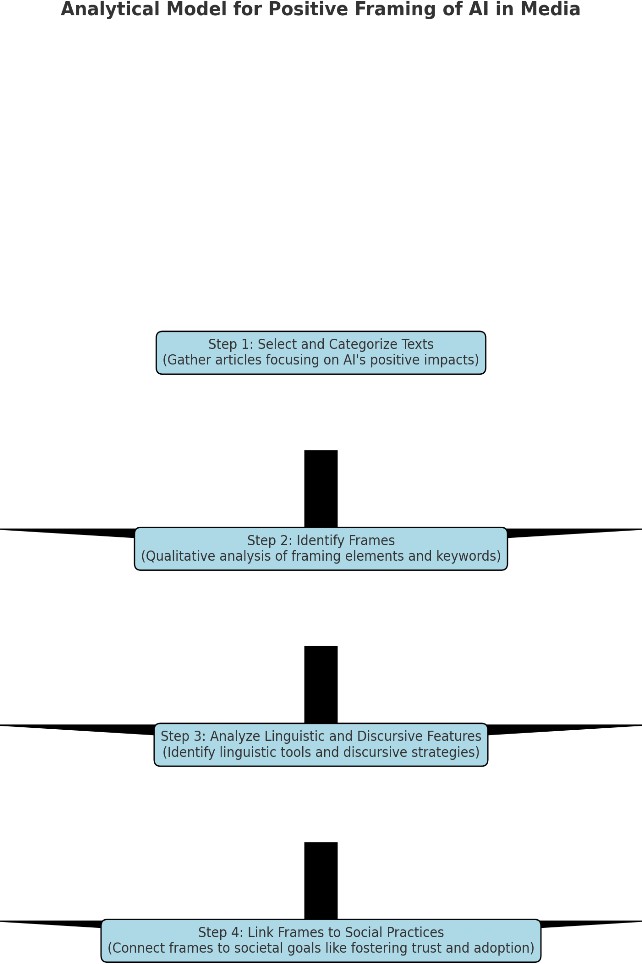
This study used an integrated model based on framing theory and positive discourse analysis to guide the data analysis. The analysis included the following steps:
Selected and Classified Texts: Articles were classified by their focus on AI's positive impacts.
Identifying Frames: A qualitative analysis was performed to identify framing components such as key phrases, topics, and patterns in the articles.
Analyze linguistic and discursive features: The articles were analyzed in terms of linguistic resources (e.g., nouns, verbs, adjectives) and discursive strategies (e.g., argumentation, representation, evaluation of the argument).
Linking Frames to Society-Wider Goals: Frames were linked to larger society-wide goals like building trust with AI, adopting AI, and leveraging AI to better societies.
Data Analysis
Frame - Technological Optimism
Table 1
| Category | Details |
| Keywords | Revolutionary, groundbreaking, innovation, optimism |
| Linguistic Tools | Adjectives: Revolutionary, groundbreaking; Verbs: Enhancing, enabling, improving |
| Discursive Strategies | Problem-Solution Framing: Highlighting AI's role in solving global challenges |
| Emotional Appeal: Using optimistic language to inspire trust | |
| Future Orientation: Emphasizing long-term benefits and advancements |
Description: This frame suggests that AI has the potential to be a transformative force, revolutionizing industries and tackling global challenges. It employs optimistic language to engender trust and facilitate an emphasis on long-term progress.
Analysis: These articles use adjectives like "revolutionary" and "groundbreaking" to stir readers' excitement about artificial intelligence's possibilities. Linguistic tools used to convey a sense of progress and innovation include optimistic verbs (e.g., "enhancing," "enabling"). The problem-solution framing presents AI as a remedy for critical global afflictions, including climate change, healthcare waste, or resource scarcity, and positions AI frames in correspondence with our greater desires as a society to make the world marginally better. By highlighting the potential long-term benefits of AI, the optimistic outlook fosters public confidence and spurs acceptance.
Frame - Human-AI Collaboration
Table 2
| Category | Details |
| Keywords | Collaboration, empowering, fostering, and augmenting |
| Linguistic Tools | Verbs: Augmenting, fostering; Metaphors: AI as a "partner" |
| Discursive Strategies | Humanization: Linking AI to personal stories or experiences to show collaboration |
| Balancing Concerns with Optimism: Highlighting collaboration without displacing humans. |
Description: This frame casts AI as a progress partner, highlighting collaboration between humans and AI. It responds to worries about displacement with an emphasis on empowerment and collaboration.
Analysis: The shift in media tone from portraying AI as a threat to a "partner" might also help humanize the technology itself. Verbs including "augmenting" and metaphors like AI as a "partner" depict AI as an extension of human potential. Articles juggle fears of job displacement with tales of empowerment, for instance, how A.I. is allowing professionals to do more with less work. That reassures the public that AI complements rather than substitutes human creativity and labor.
Frame - Accessibility and Inclusivity
Table 3
| Category | Details |
| Keywords | Accessibility, inclusivity, equity, participation |
| Linguistic Tools | Adjectives: Accessible, inclusive; Verbs: Bridging, enabling |
| Discursive Strategies | Problem-Solution Framing: Demonstrating how AI bridges resource gaps |
| Normalization: Presenting AI as a tool to achieve inclusivity in various sectors |
Description: This frame builds upon existing discussions about the role of AI in closing gaps of resources
and opportunities in society, having progressive impacts on equity and participation spanning sectors. It conditions AI users as a facility for inclusiveness.
Analysis: The language in these articles uses words like "inclusive" and "accessible," a clear alignment with progress to society aligned with progress to everything. Using problem-solution framing shows how AI fills resource gaps (such as making places more accessible to those with disabilities or improving education in isolated regions). The articles also help in normalizing AI as an instrument of inclusion, which upholds the understanding of AI as a democratizer, bridging horizontal as well as vertical socio-economic and cultural divides.
Frame - Ethical and Responsible Innovation
Table 4
| Category | Details |
| Keywords | Ethical, responsible development, trust, fairness |
| Linguistic Tools | Adjectives: Ethical, responsible; Verbs: Mitigating, addressing |
| Discursive Strategies | Legitimization: Referencing regulatory frameworks (e.g., EU AI Act) |
| Balancing Concerns with Optimism: Addressing risks while showcasing responsible practices |
Description: This frame addresses ethical considerations, stressing the importance of responsible AI development. It legitimizes trust by citing regulatory frameworks and balances risk awareness with optimism.
Analysis: Framing development as "ethical" and "responsible" inscribes AI with trustworthiness and alignment with human goals. Mentioning regulatory things, such as the EU AI Act, lends legitimacy and accountability to AI deployment. Articles balancing concern and optimism point to measures being taken to quash risks, while care should be taken in terms of responsible practices. This gives the general public, along with legislative bodies, confidence that AI will follow the ethical pathway and therefore increase their confidence in bringing AI into their lives.
Frame - Practical Benefits in Various Fields
Table 5
| Category | Details |
| Keywords | Problem-solving, improving, enhancing, and increasing efficiency |
| Linguistic Tools | Adjectives: Efficient, transformative; Verbs: Solving, improving |
| Discursive Strategies | Problem-Solution Framing: Demonstrating AI's tangible benefits in healthcare, safety, etc. |
| Statistical Evidence: Using data to validate AI's contributions |
Description: This frame shows a more practical application of AI in the works, especially in healthcare and safety. It employs problem-solution storylines and data-driven evidence that attests to AI's practical advantages.
Analysis: The use of words such as "efficiency" and "problem-solving" reflects AI in real-world uses. Surveys and statistical evidence serve discursive strategies by supporting claims about AI's contributions in fields such as healthcare, safety, or logistics. In emphasizing the immediate, practical benefits, problem-solution framing reinforces AI as a reliable and indispensable tool for solving complex problems and improving everyday life.
Frame - Balancing Innovation with Human Values
Table 6
| Category | Details |
| Keywords | Transformative, human-centric, progress, sustainability |
| Linguistic Tools | Adjectives: Transformative, sustainable; Verbs: Harmonizing, integrating |
| Discursive Strategies | Contrasts and Juxtapositions: Balancing technological advancement with human values |
| Normalization: Depicting AI as a complement to human creativity |
Description: This frame showcases some of the tangible work AI is doing, such as in the fields of healthcare and safety. It employs problem-solution narratives and data-driven evidence to justify AI's utility.
Analysis: The use of words like "efficiency" and "problem-solving" highlights the practical applications of AI. Statistical evidence as a discursive strategy, for instance, buttresses claims about AI's contributions to domains like healthcare, safety, and logistics.
Problem-solution framing emphasizes the immediate, practical advantages, merely reinforcing AI's position as a reliable and essential tool that any government can adopt for solving complex problems and making everyday life better.
Frame - Global and Societal Improvement
Table 7
| Category | Details |
| Keywords | Global impact, societal progress, sustainability, empowerment |
| Linguistic Tools | Adjectives: Empowering, sustainable; Verbs: Advancing, improving |
| Discursive Strategies | Future Orientation: Emphasizing AI's role in achieving global progress |
| Problem-Solution Framing: Positioning AI as a tool for societal betterment |
Description: This frame shows world-beating progress and the potential for AI to improve society. It adopts a forward-looking tone that situates A.I. as a driver of sustainable development.
Analysis: It is noticeable in these articles how much of the future-oriented language at the global level is framed around AI playing a hero role in matters that will determine what the future looks like, such as solving sustainability goals and relevant social structures. The concepts of "empowerment" and "sustainability" bring AI narratives into alignment with more expansive global priorities. Framing AI in a problem-solution mode inherently frames it as something of a means to a better end, which encourages policymakers and the public to see it as a positive force for societal change (even when it may be doing the opposite).
Frame - Potential Challenges Addressed with Solutions
Table 8
| Category | Details |
| Keywords | Challenges, solutions, ethical handling, and problem-solving |
| Linguistic Tools | Verbs: Solving, mitigating; Phrases: "Addressing risks responsibly" |
| Discursive Strategies | Balancing Concerns with Optimism: Highlighting challenges while offering solutions. |
| Legitimization: Referring to institutional and regulatory support to build trust |
Description: This frame identifies barriers to AI adoption but also suggests that responsible actions by tech companies, along with governmental regulation, can help build public trust and foster successful deployment of AI with an optimistic outlook.
Analysis: Acknowledging challenges while offering tangible solutions encourages trust in the responsible implementation of AI. Words such as "solving" and "mitigating" invoke an active role in responding to the ethical dilemmas and risks that arise from technologies. Through references to regulatory and institutional frameworks, they legitimize AI's prospect of overcoming potential pitfalls and being perceived as a well-governed and trustworthy technology.
Conclusion and Recommendations
This study discussed Positive Discourse Analysis (PDA) and Framing Theory as tools for (de)constructing media narratives on artificial intelligence (AI). The way AI is talked about in media texts has foregrounded the critical role of discourse in discursively constructing public perception and attitudes towards technology. Linguistic devices and framing techniques used by media outlets often serve to reify AI as an inherently positive and transformative force with radical benefits for society. Framing strategies such as success framing, negative reframing, and counter-discourses facilitate enabling narratives that fit a positive frame of AI. Additionally, the research highlights how media utilize linguistic techniques, from metaphors and ellipses to full sentences in headlines, to capture readership and reinforce the positive framing of AI. Despite the prevailing framing around positive narratives, this study ought to recognize that such framing has a considerable impact on society, where the public and lawmakers remain credulous in whichever direction the winds of mainstream media blow. This study argues instead for balanced media coverage, in which issues associated with AI are treated seriously without sensationalism, by providing a more diverse range of perspectives.
Recommendations
References
- D’Angelo, P. (2017). Framing: Media frames. The International Encyclopedia of Media Effects, 1–10. https://doi.org/10.1002/9781118783764.wbieme0048
- Entman, R. M. (1993). Framing: toward clarification of a fractured paradigm. Journal of Communication, 43(4), 51–58. https://doi.org/10.1111/j.1460-2466.1993.tb01304.x
- Hadidi, Y., Taghiyev, I., & Ahmadova, S. (2022). Linguistic devices used in newspaper headlines. Khazar Journal of Humanities and Social Sciences, 25(2), 5–21. https://doi.org/10.5782/2223-2621.2022.25.2.5
- Macgilchrist, F. (2005). Positive discourse analysis: Contesting dominant discourses by reframing the issues. European-University Viadrina.
- Martin, J. R. (2003). Working with discourse: Meaning beyond the clause. Continuum.
- Martin, J. R. (2004). Positive discourse analysis: Solidarity and change. Revista Canaria de Estudios Ingleses, 49, 179–200.
- Martin, J. R., & White, P. R. R. (2005). The language of evaluation: Appraisal in English. Palgrave Macmillan.
- The Guardian. (2024, December 14). AI in education: Unlocking potential and expanding access. The Guardian. https://www.theguardian.com/commentisfree/article/2024/aug/24/ai-cheating-chat-gpt-openai-writing-essays-school-university
- The Week. (2024, December 16). The bright side of AI: How it’s transforming industries for the better. The Week.
Cite this article
-
APA : Fareed, W., Muhammad, N., & Hayat, M. (2025). Positive Discourse Analysis of Media Narratives on Artificial Intelligence. Global Social Sciences Review, X(III), 90-99. https://doi.org/10.31703/gssr.2025(X-III).08
-
CHICAGO : Fareed, Warda, Nasir Muhammad, and Muattar Hayat. 2025. "Positive Discourse Analysis of Media Narratives on Artificial Intelligence." Global Social Sciences Review, X (III): 90-99 doi: 10.31703/gssr.2025(X-III).08
-
HARVARD : FAREED, W., MUHAMMAD, N. & HAYAT, M. 2025. Positive Discourse Analysis of Media Narratives on Artificial Intelligence. Global Social Sciences Review, X, 90-99.
-
MHRA : Fareed, Warda, Nasir Muhammad, and Muattar Hayat. 2025. "Positive Discourse Analysis of Media Narratives on Artificial Intelligence." Global Social Sciences Review, X: 90-99
-
MLA : Fareed, Warda, Nasir Muhammad, and Muattar Hayat. "Positive Discourse Analysis of Media Narratives on Artificial Intelligence." Global Social Sciences Review, X.III (2025): 90-99 Print.
-
OXFORD : Fareed, Warda, Muhammad, Nasir, and Hayat, Muattar (2025), "Positive Discourse Analysis of Media Narratives on Artificial Intelligence", Global Social Sciences Review, X (III), 90-99
-
TURABIAN : Fareed, Warda, Nasir Muhammad, and Muattar Hayat. "Positive Discourse Analysis of Media Narratives on Artificial Intelligence." Global Social Sciences Review X, no. III (2025): 90-99. https://doi.org/10.31703/gssr.2025(X-III).08