
- Occupancy rate (%) = (prison population ÷ official capacity) × 100
- Undertrial proportion (%) = (undertrial population ÷ total prison population) × 100
Supplementary outcomes (where available): admissions/turnover, average remand duration, and share of short custodial sentences. - Mediation use rate = mediated/compromised cases ÷ total eligible cases (district-period)
- Compounding frequency = number of compromise/compounding dispositions (district-period)
- Diversion count = cases resolved without custodial admission or with shortened remand (operationalized based on data structure)
- Descriptive statistics on prison overcrowding, undertrial share, offence mix, disposal times, and compromise/settlement rates.
- Comparative analysis between districts with higher vs lower mediation exposure, and pre/post comparisons where a mediation initiative or policy change can be identified.
- Regression modeling (if data permits): multivariable models estimating associations between mediation exposure and (i) occupancy rate, (ii) undertrial proportion, and (iii) remand duration proxies, controlling for offence mix and caseload. Where panel data exist, fixed-effects models (district and time) are used to reduce unobserved heterogeneity. Sensitivity checks test whether results hold when restricting to legally mediation-eligible offences.
Abstract
This paper discusses how restorative justice (RJ) can be used to reduce prison overcrowding in Pakistan, using the mediation process. Slow processing of crimes and high levels of undertrial detention are the reason of overcrowding. The research is a mixed-methods study, which incorporates legal, prison data, and interviews with the stakeholders to determine whether RJ can alleviate overcrowding through diversion of viable cases out of the prison system. The results indicate that mediation can be used to minimise the remand time and prison admissions, especially in minor interpersonal and property cases. Nevertheless, it has minimal effects on more severe crimes like drug crimes. The success of RJ relies on the protection of the safeguards, such as voluntariness, protection of the victims, and judicial supervision. This paper concludes that RJ mediation, when done appropriately, can assist in decreasing overcrowding and enhancing the efficiency of the criminal justice system.
Keywords
Restorative Justice, Mediation, Prison Overcrowding, Undertrial Detention, Diversion, Criminal Justice Reform, Pakistan
Introduction
Overcrowding has emerged as a structural stressor within the criminal justice system of Pakistan that is impacting such realities of custody in ways that go far beyond the limits of space. Overcrowding leads to tension in the institution and the risk of violence, since densely populated high-turnover settings heighten conflict and limit productive supervision (Baggio et al., 2019). It also increases the risks to health of the population: crowded confinement contributes to the spread of infectious diseases and the poor ability to prevent them, and prisons themselves can be considered potential incubators that could release risks in the community due to staff movement and the release of prisoners (Simpson et al., 2019; Simpson and Butler, 2020). These evils are not just humanitarian, but economic and administrative. The overcrowding contributes to the high medical expenses, heavier workloads, the inability to provide the system with adequate safe custody, rehabilitation, and lawful treatment; the end products, which eventually invalidate the very legitimacy of criminal justice.
Similar to overcrowding, is commonly viewed as a prison problem, but it is created at an upstream level, by policing choices, prosecution policies, bail proceedings, and court delay. When small and routine cases are sluggish, the default holding pattern of the system is detention, which overloads the admissions and increases the amount of time is spent behind closed doors prior to trial. One of the primary causes that extend the criminal process has been identified as delay, manifested in the form of gaps in the investigation, frequent adjournment, poor coordination of justice participants, and institutional load on the case (Waqar et al., 2022). Simultaneously, restrictive or inconsistent bail policies may lead to the accused (including those not found guilty) spending more time in pre-trial detention, which adds to untrial detention and additional strain on prison resources (Khokhar and Iqbal, 2024). Simply put, a criminal-to-prison pipeline is mediated by process: in a world where courts and other points of pre-trial decisions are slow or defensively, the prisons take up the slack.
The logic of restorative justice proposes another viewpoint: crime is perceived as a harm needing to be mended by accountability, dialogue, and reintegration, but not as a wrong that needs to be punished by the state. When applied to scale, restorative justice is often mentioned as a measure aimed at decongesting the system by adjudicating appropriate cases without full-scale adversarial litigation, particularly when repairing and agreeing is safely achievable (Braithwaite, 2021). One of these restorative mechanisms, or systems, that can serve as a diversion (pre-trial settlement and withdrawal where permitted by law), or as a complementary process that influences the result and adherence, is mediation, especially victim-offender mediation. It has been shown that under prerequisites (e.g., voluntariness, preparation, competent facilitation), mediation can contribute to the process of offender responsibility-taking and victim-related empathy, which are the mechanisms that are important in the context of meaningful resolution (Jonas et al., 2022; Jonas-van Dijk et al., 2024). The overall ADR environment in Pakistan has grown with both formal legal and institutional curiosity in the mediated resolution, although the rate and regularity of its uptake is uneven (Khan and Abbasi, 2023).
Although there is increased international debate on the notion of restorative justice as a system-pressure release, there is minimal empirical research in Pakistan that relates the mediation practice directly to quantifiable overcrowding pathways (Braithwaite, 2021). Much of the extant discussion focuses on ADR as a solution to backlog, but does not separate the possibility of mediation to decrease prison admissions (diversion), or remand time (shorter case turnaround), or churn on minor cases. Similarly, safeguards, especially regarding voluntariness and power dynamics, are frequently mentioned as an ideation, but are less commonly applied to kidney donation in Pakistan per se (both social and legal) in a manner that safeguards victims and avoids forced settlements (Jonas-van Dijk et al., 2024; Rees and Hobson, 2021).
Against this issue of the long-term pressure of chronic overcrowding of prisons and the human-rights, public-health, and governance impacts of this, the aim of the study is to determine the realistic potential of restorative justice, by operationalizing it as a mediation process, to alleviate overcrowding pressures in Pakistan by breaking the cycle of crime → court delay → remand → prison pipeline. The research question will be to assess the viability of mediation and system implications by (i) the mapping of the legal space at present regarding mediation and compounding/settlement practices (ii), the estimation of the potential of the diversion of various categories of offences best addressed by mediation, (iii), assessing stakeholder attitude toward mediation in criminal cases (police, prosecutors, judiciary, prison administration, victims/communities), (iv) the identification of operational barriers and risks (particularly, coercion, inequality, procedural capture) and (v) a framework of The questions that guide the research include: what are the most mediation-eligible types of offences; does mediation actually decrease the remand time and prison admissions; and what protections should be established in order to prevent the occurrence of coercion and unequal results, which makes the study meaningful to the policy design of focusing on the overcrowding of the upstream and to protect the due process and autonomy of the victims (Khan and Abbasi, 2023; Khokhar and Iqbal, 2024).
Literature Review
Restorative justice (RJ) has developed from community-based methods of reconciliation into institutional forms of justice, including dialogue, reparation, and reintegration, to respond to and repair harm. Modern RJ is generally implemented by three common models: victim-offender mediation (VOM), family group conferencing (FGC), and community or panel-based. Though they vary in form and the roles of participants, these models share values, including the principles of voluntariness, safety, inclusion, respect, accountability, and the repair of harm, which are applied in the context of facilitated communication and agreed outcomes (Kirkwood, 2022). RJ has grown in youth and adult systems in recent decades, with jurisdictions seeking solutions to lower recidivism and enhance victim experiences (Kimbrell et al., 2022; Fulham et al., 2023).
In comparison to traditional criminal processing, when cases proceed through police investigation, prosecution, adjudication and punishment, mediation-based RJ focuses on responsibility-taking and problem-solving, and not necessarily the purely adversarial results. Empirical scholarship is producing more evidence that indicates RJ participation is associated with better psychosocial outcomes of the offender such as increased compunction and better victim empathy--processes that are hypothesized to facilitate desistance (Jonas-van Dijk et al., 2022). The syntheses of evidence also indicate that RJ could result in significant increases in victim satisfaction and perceived fairness and could also retain offender accountability, especially in the case of well-designed procedures and truly voluntary participation (Fulham et al., 2023; Wood and Suzuki, 2024). In the context of the youth justice setting, the latest meta-analytic data show that RJ practices are potentially effective at various outcomes, which is why they should be utilized as an organized alternative to formal prosecution when applied to the appropriate cases (Kimbrell et al., 2022).
Globally, overcrowding in prisons is associated with human-rights issues, health risks, and strains on the prison systems, and most jurisdictions have employed non-custodial interventions to minimize admission and reduce the time in custody (Nudd et al., 2024). Overcrowding may also contribute to institutional unrest and violence in order to support the policy argument of diversion when it is legally and morally justifiable (Baggio et al., 2020). In this regard, RJ mediation is applicable as it can operate as diversion (preventing new admissions to custody) and early case disposal (shortening of pretrial custody). Restorative-based community based diversion programs have recorded rehabilitative and relational positive impacts on the justice-involved youth (McMahon and Pederson, 2020). Evidence of potential improvements in the re-arrest over longer follow-up is also randomized, and one of the youth RJ conferencing program, which supports the idea that diversion can be effective and reduce the need to rely on custody (Shem-Tov et al., 2022).
The legal environment in Pakistan has various "entry points in terms of the restorative practices such as the compounding/settlement used and the already existing ADRs that can be further developed to fit into criminal justice administration. The provincial ADR systems, especially ones based on the structured mediation panels, have been discussed as potentially cost- and time-efficient solutions to civil and selective criminal cases (Bhatti and Rizwan, 2023; Khan et al., 2022). They are developing alongside established conventions of negotiated settlement and reconciliation in specific types of offenses, which offers a viable foundation to examine the question of mediation eligibility and mediation governance as applied to the criminal process in Pakistan (Khan et al., 2022).
There is also contention of RJ mediation. Critics note that mediation may recreate power imbalances and facilitate the purchase of justice, and force victims to settle, all of which are more common in the context of socio-economic inequality and the informal ability to shape the outcome (Barocas et al., 2020; Wood et al., 2021). Especially the issues surrounding sexual violence, and intimate partner violence concerns, where coercion, trauma, and safety risks can be tricky to address; a recent systematic evidence point to the fact that appropriateness hinges on strong safeguards, thorough screening of cases, and survivor-centered design (Kettrey and Reynolds, 2024). Such criticisms suggest that any pledge of mediation in the case of decongesting a prison should be balanced against the requirement of due-process and victim-protection (Wood, 2020).
This paper takes the form of pathway: RJ Mediation diversion/early disposal fewer undertrials and fewer short sentences lead to reduced prison crowding, which is conditioned by safeguards and governance capacity. This paradigm does not consider mediation as an alternative to criminal justice, but as a controlled case-resolution procedure to categories which are legally eligible. Analysis is advised by three propositions: mediation eligible offences (e.g., minor interpersonal/property harms with identifiable victims) have the highest potential of diversion and remand time reduction that are measurable. In the case of mediation where the participants are trained and the screening is transparent, perceived fairness and accountability are enhanced, leading to compliance and desistance. There will be no enforceable protection (voluntariness checks, victim support, transparency) at the P3 level, which will threaten mediation with coercion and unequal results, chopping legitimacy, and scalability (Wood and Suzuki, 2024; Kettrey and Reynolds, 2024).
Methodology:
Research Design
The paper takes a convergent design, mixed-methods approach to determine the reliability of the restorative justice (RJ) as a concept operationalized by mediation to lower the prison population in Pakistan by facilitating diversion and cases being dismissed earlier. It combines three streams of evidence: (i) legal and policy analysis to chart the formal space of mediation and compounding/settlement, (ii) quantitative analysis of prison and case-processing indicators to approximate the effects of diversion and pretrial and (iii) qualitative stakeholder inquiry to understand the practicalities of mediation, potential barriers and risks and to specify the safeguards of legitimacy. Quantitative and qualitative elements are performed simultaneously and integrated during the interpretation by triangulation (agreement, complementarity and contradiction mapping).
Study Setting and Population
The research was carried out on the selected districts in Pakistan that portray the variation in urbanization, caseload pressure and justice infrastructural level. Two to three provinces are drawn to represent institutional diversity (e.g., the police practices, prosecution capacity, and court workload). These institutional environments are: district courts (criminal trial court and magistracy), police stations/investigation and prosecution office and district prisons/jails that are attached to those districts.
The target group of participants in the study consists of justice-system and community stakeholders influencing, delivering, or receiving mediation in criminal cases: judges/magistrates, public prosecutors, police investigators/SHOs, prison administrators, defense attorneys, mediators/ADR panel members, victims/complainants, and accused/offenders (only where ethically acceptable and legally valid). The representatives of the victim support services and human-rights/legal aid organizations are also invited there where possible to reinforce the safeguards analysis.
Data Sources
(A) Prison statistics Official prison records or provincial prison department data are collected to capture (a) occupancy (capacity vs population), (b) undertrial ratio (undertrial vs convicted), (c) sentence profile (share of short sentences and offence types where possible). The data are gathered at a regular unit (prison-level or district-level) in order to provide comparisons across the time and locations.
(B) Court/police case data: Court registers/case management systems and police records (where available) are also tapped into to extract court/police case data such as: (i) case-processing indicators (case disposal time (FIR/filing to disposal), (ii) bail outcomes (grant/deny), and (iii) compounding/settlement frequency or other indicators of mediated case resolution (e.g., withdrawals after compromise, referral to ADR forums, reported mediation outcomes). Categories of offenses are coded to define groups that are mediation eligible (e.g., legally compoundable and minor interpersonal/property issues) and non-eligible groups.
(C) Interviews/FGDs: Semi-structured key informant interviews (and restricted focus group discussions where possible) make credentialing explanatory evidence on how, by whom, what, how voluntariness is provided, and why, the stakeholders support or oppose RJ.
(D) Document review: The legal-policy component examines the existence of legal, procedural, provincial ADR, police/court circulars, model policies and any existing RJ/mediation program documentation, training and any evaluation reports. A legal-process map is created by coding documents to identify entry points of mediation, compounding requirements, and procedural protection.
Sampling Strategy
Purposive selection of districts: Comparisons between sites with relatively more use of mediation/compromise mechanisms and sites with relatively less use are made (because of preliminary scoping and available data). The analysis was based on the 23 year period (e.g. 2436 months) to be able to see the trends and minimize the impact of short-term shock. In case there are monthly prison counts, the design can be used to compare time-series; in case annual summaries are only available, the design aims to compare cross-district differences and year-to-year changes.
Qualitative sampling: Qualitative sample undertakes purposive and snowball sampling to obtain the participants personally involved in the resolution of criminal cases. The number of interviews were approximately 20-40 distributed among the stakeholders to establish the balance (judicial system, prosecution, police, defense, prison administration, mediators, and community/victim side views). Only under the strict screening of its ethics, the victims/accused are included (see Section 3.7).
Variables and Measures:
Dependent Variables (Overcrowding Outcomes)
Independent Variables (Mediation Exposure)
Control variables: offence category (severity/type), district caseload volume, court backlog indicators, bail practice proxies (grant rate, time-to-bail), and socio-legal context indicators available in administrative data.
Data Analysis Plan:
Quantitative Analysis
Qualitative Analysis
Interviews/FGDs are transcribed and analyzed using thematic analysis, with a coding framework organized around: (a) referral pathways and gatekeeping, (b) perceived legitimacy and fairness, (c) power dynamics and coercion risks, (d) willingness to participate, (e) institutional capacity (training, monitoring), and (f) safeguards. To improve reliability, a subset of transcripts is double-coded, and discrepancies are resolved through discussion.
Triangulation and Integration
Findings are integrated by comparing quantitative trends with qualitative explanations (e.g., why mediation is underused despite legal availability; how bail practices interact with mediation; what safeguards determine acceptability). Convergent and divergent results are explicitly documented to refine the implementation framework.
Ethical Considerations
A corresponding institutional review body is asked to approve ethically. Informed consent, confidentiality and confidential data handling Participation is voluntary. Special considerations are given to the victims and the vulnerable participants: (i) trauma-informed interviewing, (ii) no contact that may impact the ongoing proceedings, (iii) privacy-preserving interview and recruitment location, (iv) explicit right to withdraw, and (v) referral information to legal aid/support services in case of distress. Since the focus of the study was on mediation, certain coercion protection is involved in the process of data gathering: the screening of power imbalance is done carefully, joint victim-accused interviews are avoided, and it is not possible to interview in a situation where voluntariness is not guaranteed.
Results:
The Scale of Overcrowding and Where it Concentrates
Pakistan's prison system is operating far above capacity. Official figures show 102,026 prisoners housed in facilities designed for ~65,811, implying an ~155% occupancy level (about 55% over-capacity), while the report also notes prisons averaging ~152.2% overcapacity (NCHR & JPP, 2025).
Overcrowding is not evenly distributed: Punjab and Sindh show the highest operating pressure (Table 2).
Table 1 National overcrowding snapshot (latest available in 2024)
| Source | Prison population | Official capacity | Occupancy (%) | Undertrial/remand (No.) | Undertrial/remand (%) |
| NCHR & JPP Prison Data Report (2024 figures) | 102,026 | 65,811 | 155.0 | 74,918 | 73.43 |
| World Prison Brief (Pakistan, Nov 2024) | 108,643 | 66,625 | 163.1 | 74,918 | 73.4 |
A facility-level extreme illustrates the depth of congestion: Karachi Central Prison was reported at 8,518 inmates vs capacity 2,400 (354.92%) (NCHR & JPP, 2025).
Undertrial Detention is the Dominant Driver
Undertrial prisoners constitute the majority of the prison population. The report places undertrial share at ~73.41% (74,918 persons) (NCHR & JPP, 2025).
Trend data (Table 3) shows that the undertrial share has risen sharply between 2022-2024 in the four-province dataset used for the trend series.
Table 2 Prison footprint and operating pressure by jurisdiction
Table 3
| Jurisdiction | No. of prisons/jails | Operating capacity (%) |
| Punjab | 43 | 173.60 |
| Sindh | 22 | 161.42 |
| Khyber Pakhtunkhwa | 39 | 102.50 |
| Balochistan | 12 | 115.60 |
| Gilgit-Baltistan | 5 | - |
| Azad Jammu & Kashmir | 7 | - |
| Pakistan (avg.) | 128 | 152.90 |
Undertrial stock trend (four-province trend series)
| Year | Total prisoners | Undertrial prisoners | Convicted/other | Undertrial share (%) |
| 2022 | 89,662 | 57,801 | 31,861 | 64.47 |
| 2023 | 100,366 | 72,509 | 27,857 | 72.24 |
| 2024 | 100,647 | 74,918 | 25,729 | 74.44 |
Offence Profile Relevant to Diversion: Drug Cases are a Large and Growing Block
A substantial share of incarceration is linked to drug offences. As of April 2024, 23,367 people were reported imprisoned under the CNSA, with the report noting a 18.98% rise from 2023 to 2024 (NCHR & JPP, 2025).
Table 4 Drug-offence imprisonment trend (CNSA)
Table 5
| Year | Persons imprisoned for drug offences |
| 2023 | 19,638 |
| 2024 | 23,367 |
Drug-offence prisoners by province (2024)
| Province | Drug-offence prisoners (2024) | Share of drug-offence total (%) |
| Punjab | 13,331 | 57.05 |
| Sindh | 3,606 | 15.43 |
| Khyber Pakhtunkhwa | 2,884 | 12.34 |
| Balochistan | 3,546 | 15.18 |
| Total | 23,367 | 100.00 |
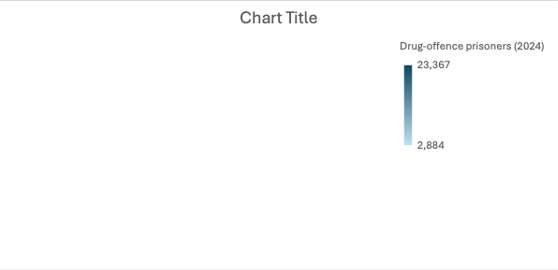
Implication for mediation potential: because drug offences are generally not mediation-eligible (public/State wrong), this block of admissions limits how much overcrowding can be reduced through mediation alone, even if mediation performs well in interpersonal/compoundable disputes.
Who is in Custody: Women and Juveniles (and the Offence Mix)
Women prisoners increased steadily from 2019-2024 (Table 6), with Punjab holding the largest share of the female prison population (Table 7).
Table 6 Female prison population trend
Table 7
| Year | Female prisoners |
| 2019 | 1,175 |
| 2020 | 1,391 |
| 2021 | 1,399 |
| 2022 | 1,445 |
| 2023 | 1,492 |
| 2024 | 1,550 |
Female prisoners by province/region (2024)
Figure 2
| Province/Region | Female prisoners (2024) | Share of female total (%) |
| Punjab | 1,084 | 69.9 |
| Sindh | 269 | 17.4 |
| Khyber Pakhtunkhwa | 137 | 8.8 |
| Balochistan | 44 | 2.8 |
| Azad Jammu & Kashmir | 13 | 0.8 |
| Gilgit-Baltistan | 3 | 0.2 |
| Total | 1,550 | 100.0 |
In Punjab's female prisoner profile, theft increased notably from 2023 to 2024 (Table 8), while narcotics and murder remained high.
Table 8 Top offence categories among female prisoners in Punjab
| Offence category (Punjab, women) | 2023 | 2024 |
| Narcotics | 372 | 339 |
| Murder | 287 | 283 |
| Theft | 72 | 131 |
| Kidnapping & Abduction | 40 | 30 |
| Attempted murder | 8 | 23 |
Juvenile prisoners show a mixed provincial trend (Table 9). The report also states 1,584 juveniles are currently imprisoned; this total matches the sum of Punjab+Sindh+KP+Balochistan (2024), while the chart also displays AJK and GB values.
Table 9 Province-wise juvenile prisoners (from the figure)
| Province/Region | 2023 | 2024 |
| Punjab | 752 | 876 |
| Sindh | 407 | 315 |
| Khyber Pakhtunkhwa | 356 | 385 |
| Balochistan | 7 | 8 |
| Gilgit-Baltistan | - | 15 |
| Azad Jammu & Kashmir | 13 | 16 |
Among juveniles in Punjab, theft and other categories appear in the leading offences (Table 10), indicating a measurable pocket where restorative interventions could plausibly reduce custodial exposure if legally and procedurally enabled.
Table 10 Top offence categories among juvenile prisoners in Punjab
Figure 3
| Offence category (Punjab, juveniles) | 2023 | 2024 |
| Murder | 155 | 206 |
| Theft | 131 | 107 |
| Rape | 65 | 88 |
| Narcotics | 49 | 64 |
| Unnatural offences | 73 | 54 |
Existing non-Custodial Capacity is Uneven (Probation/Parole), Limiting "Release Valves"
Across provinces, probation/parole capacity and usage differ sharply. Punjab supervises large numbers on probation but reports very low parole releases; KP reports the highest parole usage.
Table 11 Probation/parole staffing and output (as reported for 2024)
| Province | Probation officers (total) | Probation officers (women) | Probationers supervised | Women probationers | Juvenile probationers | Parole officers | Parole releases (2024) | Individuals supervised via probation (approx.) |
| Punjab | 53 | 13 | 36,015 | 190 | 247 | 17 | 7 | 45,000 |
| Sindh | 19 | 14 | ~590 | 9 | - | - | 0 | - |
| Khyber Pakhtunkhwa | 37 | 6 | 7,183 | 36 | 158 | - | 1,605 | - |
Indicative (Scenario) Effect Size: What Mediation Would Need to Achieve to Move Occupancy
Because undertrial detention is the largest block, mediation's prison-impact depends on how much it can reduce the undertrial stock through (i) early settlement/compounding where lawful, and (ii) faster disposal that shortens remand time. Using the national totals 102,026 population and 65,811 capacity, Table 12 shows the implied occupancy if mediation-related diversion reduced the undertrial stock by 5-20% (scenario calculation).
Table 12 Scenario modelling: diversion of undertrial stock and implied occupancy (computed from reported population/capacity/undertrial totals)
Figure 4
| Scenario: diversion of undertrial stock via mediation/settlement | Estimated reduction (persons) | Estimated new prison population | Implied occupancy vs capacity 65,811 (%) |
| 5% of undertrial stock diverted | 3,746 | 98,280 | 149.3 |
| 10% of undertrial stock diverted | 7,492 | 94,534 | 143.6 |
| 15% of undertrial stock diverted | 11,238 | 90,788 | 138.0 |
| 20% of undertrial stock diverted | 14,984 | 87,042 | 132.3 |
Result takeaway aligned to the research questions: the quantitative pattern suggests that any mediation strategy that does not materially reduce undertrial time/stock will have limited effect on overcrowding, while even modest reductions (e.g., 10% of undertrial stock) could meaningfully lower implied occupancy (~155% → ~144%) if achieved system-wide.
Discussion
The findings show that the prison overcrowding in Pakistan is not caused by the crime convict but by the system throughput and delay as the larger portion of the prison population is occupied by the undertrial prisoners (74,918; 73.41). This trend upholds the conceptual relationship of the study crime into courts into prisons since the slower the investigations and the determinations of bails and trial disposal, the longer the detention as a default holding process. The same report points out that Punjab by itself had 61,813 prisoners in places that have capacity of 37,217, which shows how provincial pressure is concentrated in areas that have the highest level of caseload and admissions (NCHR & JPP, 2025). In that regard, the best way to think of restorative justice (RJ) mediation is as an upstream tool of decongestion: it can lessen the individuals entering custody (diversion) and decrease time in custody (early disposal) but only to criminal categories where compromise/settlement is morally and legally suitable.
When it comes to RQ1 (mediation-eligible offences), the profiles of the offence in women and juveniles indicate viable entry points. In Punjab, theft increased to 131 (20232024) among women and it is one of the primary categories among juveniles (107 in 2024) (NCHR & JPP, 2025). Those are exactly the types of victim-identifiable, less serious disputes which, under the law, might be compoundable and vetted, and, through the help of mediation, resolved through structured mediation and restitution and community supervision as an alternative to remand. But the results also results in understanding the ceiling of mediation: the presence of drug-related incarceration in itself explains the presence of 23,367 prisoners (23.21% of the total) and it has increased significantly with punitive changes in legislation (NCHR & JPP, 2025). Since narcotics offences are usually public-wrong offences and in many cases are not amenable to victim-offender mediation, mediation alone cannot compensate this significant block of admissions. This reinforces the conclusion that RJ mediation should be accompanied by more extensive non-custodial measures (optimization of the bails, probation, diversion of treatment of drug dependence, and specific sentencing reform).
Speaking of RQ2 (reducing remand time and admissions), the prevalence of the undertrial detention implies that the effect of mediation is contingent on the timing of its initiation. When the introduction of mediation takes place at the end of a long adjournment cycles, it will have a minuscule impact on occupancy. The evidence in the report about underutilized parole in Punjab (7 releases in 2024) despite Parole being large in the caseloads suggests that release valves are weak, so pretrial diversion and early disposal are even more significant (NCHR & JPP, 2025). Therefore, the most likely course of action is a controlled referral process at the stage of screening of police/prosecution and earlier court proceedings, with strict deadlines and documented results.
Lastly, the key to legitimacy is RQ3 (safeguards). The real threat of coerced compromise and buying justice exists in Pakistan due to its high level of inequality and their informal pressure. All mediation programs that are aimed at curbing overcrowding should thus comprise of voluntariness checks, counsel availability, victim support, clear records, judicial control over settlements, and vulnerable case exclusion/special treatment (e.g., sexual violence and coercive domestic settings). In the absence of these forms of governance, mediation can decrease formal workload at the expense of due process and citizen trust; compromising scalability and overall performance.
Conclusion
This paper has investigated how restorative justice, as implemented in mediation, can mitigate prison overcrowding in Pakistan by interfering with the channel between the report of criminal activities and the long-standing court proceedings and the custodial imprisonment. The findings indicate that the overcrowding is inherently a pretrial and a case-processing issue, and the clientele of undertrial prisoners constitutes the majority of the prison population, and the occupancy rates are significantly higher than the indicated capacity (NCHR & JPP, 2025). This organization is important, as it suggests that the remand inflow and remand duration are the two major factors that will need to be mitigated to achieve the best congestion relief, rather than simply by post-conviction reforms.
It is realistic that mediation can help to decongest but the effects will be selective and conditional. The most viable ones are legal and ethical cases of disputes in which the victim can be identified, particularly those with lower severity such as property and interpersonal cases with which early referral would help avoid unnecessary custodial placements and quicken case resolution (NCHR & JPP, 2025). Nonetheless, the mass incarceration associated with drug offences, and other non-compoundable groups provides a definite parameter of what may be accomplished by mediation by itself; that is why mediation should be sought as a part of a multi-dimensional approach which also enhances bail, expands the efficacy of probation/parole, and enhances initial screening of cases better.
The paper concludes that Pakistan can play her part of scaling down mediation in the criminal process in case the governance safeguards are not negotiable. Verified voluntariness and access to counsel, victim support and protection, transparent recording of outcomes, independent monitoring, and stringent exclusion criteria among cases with increased risk of coercion are among the priority safeguards. Having such protections and an organized referral process at police, prosecution, and early court phases, mediation may minimize delay-induced detention and help to decrease overcrowding without negating due process and autonomy of the victims.
References
- Baggio, S., Peigné, N., Heller, P., Gétaz, L., Liebrenz, M., & Wolff, H. (2020). Do overcrowding and turnover cause violence in prison? Frontiers in Psychiatry, 10, 1015. https://doi.org/10.3389/fpsyt.2019.01015
- Baggio, S., Peigné, N., Heller, P., Gétaz, L., Liebrenz, M., & Wolff, H. (2019). Do overcrowding and turnover cause violence in prison? Frontiers in Psychiatry, 10, 1015. https://doi.org/10.3389/fpsyt.2019.01015
- Barocas, B., Avieli, H., & Shimizu, R. (2020). Restorative justice approaches to intimate partner violence: A systematic review. Partner Abuse.. https://doi.org/10.1891/PA-2020-0010
- Bhatti, M. U., & Rizwan, M. S. (2023). Alternative dispute resolution in criminal justice system: A case study of the Punjab ADR Act 2019. Pakistan Journal of Social Research, 5(1). https://doi.org/10.52567/pjsr.v5i01.1037
- Braithwaite, J. (2021). Can restorative justice scale up? Crime and Justice, 50(1), 457–510. https://doi.org/10.1086/716093
- Fulham, S., Morris, A., & Christensen, J. (2023). Restorative justice programmes and outcomes: A meta-analysis. Criminology & Criminal Justice.. https://doi.org/10.1177/17488958231215228
- Jonas, J., Zebel, S., Claessen, J., & Nelen, H. (2022). The psychological impact of participation in victim–offender mediation on offenders: Evidence for increased compunction and victim empathy. Frontiers in Psychology, 12, 812629. https://doi.org/10.3389/fpsyg.2021.812629
- Jonas-van Dijk, J., Zebel, S., Claessen, J., & Nelen, H. (2022). The psychological impact of participation in victim-offender mediation on offenders: Evidence for increased compunction and victim empathy. Frontiers in Psychology, 12, 812629. https://doi.org/10.3389/fpsyg.2021.812629
- Jonas-van Dijk, J., Zebel, S., Claessen, J., & Nelen, H. (2024). The working mechanisms of the victim-offender mediation process: How might participation explain psychological outcomes in offenders? The International Journal of Restorative Justice.. https://doi.org/10.5553/TIJRJ.000197
- Kettrey, H. H., & Reynolds, J. R. (2024). Is restorative justice appropriate in cases of sexual assault and intimate partner violence? A systematic review and meta-analysis. Journal of Quantitative Criminology. Advance online publication. https://doi.org/10.1007/s11292-024-09651-8
- Khan, H., Afzal, U., & Iqbal, S. (2022). Comparative analysis of alternative dispute resolution laws in Pakistan: Its adaptation, procedure and compatibility. Annals of Human and Social Sciences, 3(3), 21–26. https://doi.org/10.35484/ahss.2022(3-III)03
- Khan, S. O. H., & Abbasi, M. S. (2023). Legal framework of alternative dispute resolution (ADR) mechanisms in Pakistan: A comparative study with Turkey, Malaysia, and Bangladesh. Law and Policy Review, 2(2), 37–57. https://doi.org/10.5349/lpr.22.03
- Khokhar, H. A., & Iqbal, Z. (2024). A comparative analysis of the legal frameworks governing post-arrest bail in India and Pakistan. Review of Education, Administration and Law, 7(4), 235–252. https://doi.org/10.47067/real.v7i4.375S
- Kimbrell, C. S., Wilson, D. B., & Olaghere, A. (2022). Restorative justice programs and practices in juvenile justice: An updated systematic review and meta-analysis for effectiveness. Criminology & Public Policy. Advance online publication. https://doi.org/10.1111/1745-9133.12613
- Kirkwood, S. (2022). A practice framework for restorative justice. Aggression and Violent Behavior, 63, 101688. https://doi.org/10.1016/j.avb.2021.101688
- McMahon, S. M., & Pederson, S. (2020). “Love and compassion not found elsewhere”: A Photovoice exploration of restorative justice and nonviolent communication in a community-based juvenile justice diversion program. Children and Youth Services Review, 119, 105306. https://doi.org/10.1016/j.childyouth.2020.105306
- Nudd, E., Aon, M., Kambanella, K., & Brasholt, M. (2024). Overcrowding in prisons: Health and legal implications. Torture Journal, 34(3), 41–53. https://doi.org/10.7146/torture.v34i3.147571
- Rees, A., & Hobson, J. (2021). Restorative practice in the criminal justice system: Examining a restorative reasoning programme in a women’s prison. Laws, 10(4), 95. https://doi.org/10.3390/laws10040095
- Shem-Tov, Y., Raphael, S., & Skog, A. (2022). Can restorative justice conferencing reduce recidivism? Evidence from the Make-it-Right program (NBER Working Paper No. 29150). https://doi.org/10.3386/w29150
- Simpson, P. L., & Butler, T. G. (2020). Covid-19, prison crowding, and release policies. BMJ, 369, m1551. https://doi.org/10.1136/bmj.m1551
- Simpson, P. L., Simpson, M., Adily, A., Grant, L., & Butler, T. G. (2019). Prison cell spatial density and infectious and communicable diseases: A systematic review. BMJ Open, 9(7), e026806. https://doi.org/10.1136/bmjopen-2018-026806
- Waqar, M., Iqbal, A., & Abbas Kazmi, S. S. (2022). Criminal justice system and its impacts on criminal trial law, practice and procedure in Pakistan: An analytical study. Pakistan Languages and Humanities Review, 6(3), 289–297. https://doi.org/10.47205/plhr.2022(6-III)24
- Wood, W. R. (2020). The indecent demands of accountability: Trauma, marginalisation, and moral agency in youth restorative conferencing. The International Journal of Restorative Justice, 3(2), 168–193. https://doi.org/10.5553/IJRJ.000038
- Wood, W. R., & Suzuki, M. (2024). Getting to accountability in restorative justice. Victims & Offenders. Advance online publication. https://doi.org/10.1080/15564886.2024.2333304
- Wood, W. R., Russell, T., & Jeffries, S. (2021). Adult restorative justice and gendered violence: Practitioner and service-provider views. Laws, 10(1), 13. https://doi.org/10.3390/laws10010013
Cite this article
-
APA : Abdullah, K., & Rasool, A. (2025). Restorative Justice in Pakistan’s Criminal System: Can Mediation Reduce Prison Overcrowding?. Global Social Sciences Review, X(IV), 184-197. https://doi.org/10.31703/gssr.2025(X-IV).15
-
CHICAGO : Abdullah, Kamran, and Aisha Rasool. 2025. "Restorative Justice in Pakistan’s Criminal System: Can Mediation Reduce Prison Overcrowding?." Global Social Sciences Review, X (IV): 184-197 doi: 10.31703/gssr.2025(X-IV).15
-
HARVARD : ABDULLAH, K. & RASOOL, A. 2025. Restorative Justice in Pakistan’s Criminal System: Can Mediation Reduce Prison Overcrowding?. Global Social Sciences Review, X, 184-197.
-
MHRA : Abdullah, Kamran, and Aisha Rasool. 2025. "Restorative Justice in Pakistan’s Criminal System: Can Mediation Reduce Prison Overcrowding?." Global Social Sciences Review, X: 184-197
-
MLA : Abdullah, Kamran, and Aisha Rasool. "Restorative Justice in Pakistan’s Criminal System: Can Mediation Reduce Prison Overcrowding?." Global Social Sciences Review, X.IV (2025): 184-197 Print.
-
OXFORD : Abdullah, Kamran and Rasool, Aisha (2025), "Restorative Justice in Pakistan’s Criminal System: Can Mediation Reduce Prison Overcrowding?", Global Social Sciences Review, X (IV), 184-197
-
TURABIAN : Abdullah, Kamran, and Aisha Rasool. "Restorative Justice in Pakistan’s Criminal System: Can Mediation Reduce Prison Overcrowding?." Global Social Sciences Review X, no. IV (2025): 184-197. https://doi.org/10.31703/gssr.2025(X-IV).15