
- Employee obligations have no significant influence on job satisfaction among Medical Laboratory Professionals at selected public health sector institutions at the National Government.
- Employee entitlements have no significant influence on job satisfaction among Medical Laboratory Professionals at selected public health sector institutions at the National Government.
- Employer obligations have no significant influence on job satisfaction among Medical Laboratory Professionals at selected public health sector institutions at the National Government.
- Delegation has no significant influence on job satisfaction among Medical Laboratory Professionals at selected public health sector institutions at the National Government.
Abstract
The psychological contract, an implicit agreement shapes employee-employer relationships within organizations. The study investigated the psychological contract's impact on job satisfaction among Medical Laboratory Professionals (MLPs) in Kenya's public health sector. A response rate of 98 (92.7%), for 106 MLPs surveyed with quantitative data analyzed using SPSS version 29. Pearson's correlation coefficient results indicated that employee obligations, employee entitlements, employer obligations, and delegation were significantly associated with job satisfaction (p<0.001), accounting for 57.7% of the dependent variable's variation, with a model fit of 31.70. Multiple regression analysis revealed that employee obligations (p-value =0.578) insignificantly influenced job satisfaction. Delegation (β = 0.362) had the strongest positive and significant association with job satisfaction, employee entitlements (β = 0.351), and employer obligations (β = 0.253), with employee obligations indicating a negative association. A combination of psychological contract elements (obligations and entitlements) and structural elements (delegation) constitute the key drivers for improving job satisfaction.
Keywords
Job Satisfaction, Medical Laboratory Professionals, Psychological Contract
Introduction
Health systems are weak across many parts of the developing world in terms of achieving the global health agenda and Sustainable Development Goals (SDGs). For this reason, the World Health Organization (WHO) developed a common framework of action for assessing health systems composed of six building blocks of the health system. According to the WHO, a well-performing workforce is one that is responsive to the needs and expectations of people and is fair and efficient to achieve the best outcomes possible given available resources and circumstances (World Health Organization [WHO], 2007). Thus, investment in health management systems is required to retain a satisfied healthcare workforce that offers high-quality care to patients in Sub-Saharan Africa (Kim et al., 2021).
Medical Laboratory Professionals are licensed healthcare personnel responsible for conducting vital laboratory tests for disease diagnosis, treatment, and prevention. Their roles require high technical expertise, ethical conduct, and adherence to healthcare standards, making them vulnerable to psychological contract perceptions. They operate within the Kenya Health Policy 2014-2030, which aims to achieve the country's health aspirations. This is in line with Kenya's Vision 2030, the Constitution of Kenya 2010, and global health commitments like the International Health Regulations (IHR, 2005), Global Health Security Agenda (GHSA), and WHO/AFRO Maputo Declaration 2008. The Maputo Declaration emphasizes the importance of basic laboratory testing in healthcare, impacting clinicians, policymakers, and donor organizations (Nkengasong et al., 2018).
With the healthcare sector facing numerous challenges of accessibility, affordability, and quality, healthcare systems form a key part of government strategies across the world. Robust healthcare systems require the right health workforce and necessitate a talent retention strategy, hence paying heed to the psychological contract. The psychological contract is a crucial implicit agreement that shapes employee-employer expectations and the understanding of employment relationships. It lacks legal recourse in case of violation, allowing aggrieved parties to halt contributions or withdraw from the relationship (Longurasia, unpublished thesis; Spindler 1994). Therefore, the importance of creating and sustaining a positive psychological contract cannot be overemphasized.
Globally, "Over 4 billion medical laboratory tests are performed annually in the USA (The American Society for Clinical Laboratory Science [ASCLS], 2023)." "Laboratory testing remains the single highest-volume medical activity affecting Americans (Stone, 2022)." Unperceivable as they are, behind the healthcare curtains, the laboratory personnel need to step out and assert themselves as champions for patients, truth, and the importance of data-driven medicine. The pandemic has highlighted the vital role yet underrepresentation of Medical Laboratory Technologists in the healthcare system (Dignos et al., 2023). Besides being the backbone for the healthcare system and crucial for diagnostic specimen analysis, Medical Laboratory Technologists (MLTs) and Medical Laboratory Assistants (MLAs) are often overlooked, according to Gohar and Nowrouzi-Kia (2022). The inclusion of laboratory medicine among the ten essential services in the US health system by the Institute of Medicine (IOM) marked a new phase and beginning for medical laboratories (Plebani et al., 2021). Laboratory results play a crucial role in every medical decision. With 70% of medical decisions relying on laboratory results, the workforce in medical laboratories has been on the decline for decades.
Koomson et al. (2022) found widespread psychological contract breaches among doctors in Ghana, indicating employers did not satisfy expectations, but found no significant negative link between breaches and job involvement. In Uganda, low pay (61%), a hostile work environment (42%), and a lack of employer support (45%) significantly impacted the provision of healthcare services in public facilities (Najjuma et al., 2016).
Job satisfaction levels among Kenyan healthcare professionals varied, with some counties experiencing low levels. In Busia County, 26.7% (Wamalwa, unpublished thesis), and in Trans Nzoia County, 47.5% (Nyang'ori, unpublished thesis), while in Homabay County, 60% (Tony, 2018). Nursing job satisfaction was as low as 28.2% in Mombasa, Kwale, and Kilifi counties . Makueni County had a 36 percent satisfaction rate, below 50% in most counties . According to Blaauw et al. (2013), this level is lower than in Tanzania (82.6%), Malawi (71 %), and South Africa (52.1%).
Purpose of Study
The purpose of this study is to investigate the influence of psychological contract on job satisfaction among Medical Laboratory Professionals at selected public health sector institutions at the National Government, Kenya.
Hypotheses
Review of Literature
Job dissatisfaction among Medical Laboratory Professionals (MLPs) in Kenya's public health sector is a pressing issue, leading to strikes, turnover, labour disputes, and health risks for patients. Factors such as inadequate wage payments, allowances, and delayed career progression exacerbate dissatisfaction (SRC, 2011-2017). Additionally, issues like staffing shortages, occupational health risks, and poor visibility of clinical laboratory science as a profession contribute to the problem (Association of Public Health Laboratories [APHL], 2020; Kanyina et al., 2017; Waheed et al., 2023). Globally, Percutaneous injuries, including sharps injuries, affect 1 in 10 healthcare professionals annually, leading to high rates of infections like Hepatitis B Virus (HBV) - 37%, Hepatitis C Virus (HCV) - 39%, and Human Immunodeficiency Virus (HIV) - 4.4% mostly prevalent among MLPs due to the nature of their work (Mossburg et al., 2019; WHO, 2002). Occupational blood exposure causes significant psychological stress (Howsepian, 1998; Worthington et al., 2006) and high management costs (Mannocci et al., 2016). Between 2000-2030, 16,000 HCV infections, 66,000 HBV infections, and 1,000 HIV infections could result in 142,261 and 736 premature deaths among Health Care Workers, respectively (Prüss-Üstün et al., 2003).
Moreover, the absence of comprehensive policies and supportive organizational cultures worsens dissatisfaction in healthcare, affecting service delivery and patient outcomes. Retention strategies include improving working conditions and health workers' allowances (SRC, 2011-2017; Wamalwa, unpublished thesis). To tackle challenges in healthcare, a comprehensive approach involving improved working conditions, occupational health and safety, and evidence-based solutions is needed. Most studies have focused on job satisfaction among clinicians, nurses, and healthcare professionals generally (Mathulu & Mbithi, 2016; Nyang'ori, unpublished thesis; Tengah & Otieno, 2019; Tony, 2018; Wamalwa, 2017). Research on the psychological contract's impact on job satisfaction among the Kenyan health workforce is limited, highlighting the need for further study.
Research Methodology
The study employed a descriptive cross-sectional study design. The study focused on Medical Laboratory Professionals (MLPs) at the National Government selected health institutions. Using Yamane's (1973) population sample formula, 106 MLPs practicing at the National Government arrived at. A simple random sampling design was applied to the 106 MLPs using Likert-based self-administered structured questionnaires.
Results and Discussions
This section presents the results of the analysis. Analysis was done through descriptive statistics and inferential statistics. Sections 4.1, 4.2, 4.3, 4.4, 4.5, and 4.6 present descriptive statistics, while Section 4.7 presents the inferential statistics.
Demographic Characteristics of Respondents
Table 1 Demographic Characteristics
| Demographic | Classification | Frequency (N) | Percentage (%) | JS score (M) | SD | P-value |
| Gender | Female | 50 | 51 | 3.51 | 0.57 | .509 |
| Male | 48 | 49 | 3.59 | 0.62 | ||
| Age | 20-35 years | 8 | 8.2 | 3.56 | 0.50 | .999 |
| 36-45 years | 32 | 32.7 | 3.55 | 0.62 | .999 | |
| ˃45 years | 58 | 59.2 | 3.54 | 0.59 | .998 | |
| Level of education | Certificate level | 1 | 1.0 | 3.81 | N/A | |
| Diploma level | 19 | 19.4 | 3.56 | 0.53 | ||
| HND | 2 | 2.0 | 3.92 | 0.33 | ||
| Undergraduate Degree | 50 | 51.0 | 3.53 | 0.60 | ||
| Masters | 24 | 24.5 | 3.51 | 0.64 | ||
| PhD | 2 | 2.0 | 3.91 | 0.81 | ||
| Designation | DDMLS | 1 | 1.0 | 3.29 | N/A | |
| MLT I | 29 | 29.6 | 3.45 | 0.53 | ||
| MLT III | 5 | 5.1 | 3.30 | 0.65 | ||
| PMLTechn | 3 | 3.1 | 4.08 | 0.24 | ||
| PMLT I | 7 | 7.1 | 3.52 | 0.64 | ||
| PMLT II | 19 | 19.4 | 3.55 | 0.73 | ||
| SMLT | 34 | 34.7 | 3.63 | 0.55 | ||
| Length of service | 1-5 years | 8 | 8.2 | 3.41 | 0.76 | |
| 6-10 years | 18 | 18.4 | 3.69 | 0.57 | ||
| 11-15 years | 20 | 20.4 | 3.46 | 0.54 | ||
| 16-20 years | 7 | 7.1 | 3.51 | 0.69 | ||
| Over 20 years | 45 | 45.9 | 3.56 | 0.59 | ||
| Terms of Service | Contract | 11 | 11.2 | 3.55 | 0.57 | .815 |
| Permanent | 87 | 88.8 | 3.51 | 0.73 |
The findings established in Table 1 show that most respondents 50 (51%) were female, with males accounting for 48 (49%) at the time of the study, indicating a more balanced gender distribution. This agreed with the findings of Abwavo (unpublished thesis), whose female respondents were more than the male respondents. This contradicted the findings of , who stated that male health workers outnumber their female counterparts. This may have been as a result of the indigenous perceptions that have held females back from taking science subjects, with their male counterparts dominating the field. Male respondents reported a higher job satisfaction at a mean of M=3.59 than their female counterparts, M=3.51. However, with a t-statistic of t (96) at ninety-six degrees of freedom =0.662, p-value.509 greater than p=<0.05 and effect size of d=0.134, the findings indicated little practical difference in job satisfaction, even if the result was statistically significant.
The research revealed that most respondents (59%) were above the age of 45, followed by those aged 36 to 45 (33%). The ages are assumed to have more employment experience and hence would benefit the research by providing information on job satisfaction. This also indicated that many of the respondents were in their mid-life career and beyond.
In terms of education, most respondents (over half) held an undergraduate degree 51% followed by 24.5%, master's/graduate degree holders making up nearly a quarter of the sample. With over 75% of the respondents holding at least an undergraduate degree (undergraduate degree: 51%, master's/graduate degree: 24.5%, and PhD: 2%), it is reasonable to conclude that the respondents were generally well-informed.
The study discovered that the largest group had more than 20 years of experience, accounting for 45 respondents (46%), indicating a highly experienced cohort. This was followed by 20 respondents (20.4%) with 11-15 years of experience. The distribution suggested most seasoned Medical Laboratory Professionals, indicating a relatively long job history with fewer early career individuals within 1-5 years of experience (8.2%).
Most respondents, 88.8%, were employed permanently, while only 11.2% were on contractual terms. This indicates a high level of job stability among the respondents, with permanent employment being a predominant arrangement. Respondents employed permanently reported higher job satisfaction at a mean of M=3.55 than those employed on contractual terms, M=3.51. Similarly, with a t-statistic of t (96) at ninety-six degrees of freedom =0.235, p-value.815 greater than p=<0.05 and size effect of d=0.0751, the findings found no statistically significant difference in job satisfaction between the categories of service terms.
Descriptive Statistics on Employee Obligations
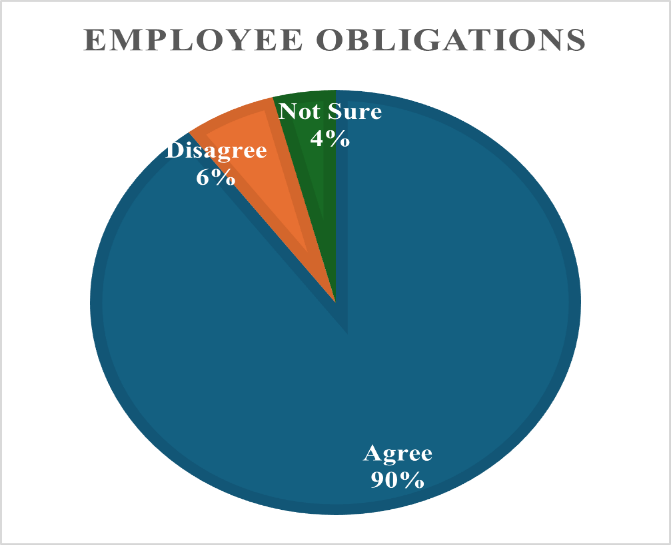
As shown in Figure 1, the majority of the respondents (90%) accounted for the agree category, with 6% accounting for the disagree category, with a relatively high mean of M=4.27, standard deviation=0.34, and variance=0.12. The high level of endorsement of agreement suggests a strong sense of duty and personal accountability. The MLPs perceived themselves as fulfilling their end of the bargain from a psychological contract perspective, reflecting a balanced contract. In their study, Lijo and Lyngdoh (2016) indicate a significant correlation between psychological contract dimensions (employee obligation, employer obligation, and psychological contract fulfillment) and job satisfaction among HR professionals in Start-up service sectors, deviating from the current study findings.
Descriptive Statistics on Employee Entitlements
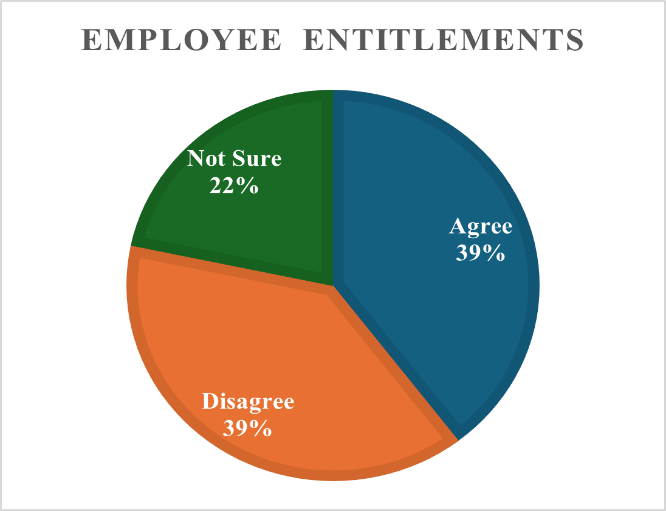
The findings in Figure 2 revealed an even split between agreement and disagreement responses, with both response categories accounting for 39/%, with a high number (22%) not taking sides. The mean was M=2.90, standard deviation, SD=0.65, and variance=0.43. This suggested an imbalance in expectations, which may point to an unbalanced psychological contract, especially if expectations are unmet. According to Wanous et al. (1992), there is a strong association between unmet expectations and decreased job satisfaction as well as commitment.
The study's finding that entitlements may generate positive outcomes for the organization, like the employees' job satisfaction, agrees with several other previous studies (Langerud & Jordan, 2020; O'Leary-Kelly et al., 2017; Schwarz et al., 2023; Tomlinson, 2013). Conversely, studies found a strong association between employee entitlements and reduced job satisfaction, increased conflict with supervisors, and increased turnover intent and the resultant negative workplace attitudes and behaviours (Brummel & Parker, 2015; Harvey & Harris, 2010; Harvey & Martinko, 2009; Lee et al., 2019).
Descriptive Statistics on Employer Obligations
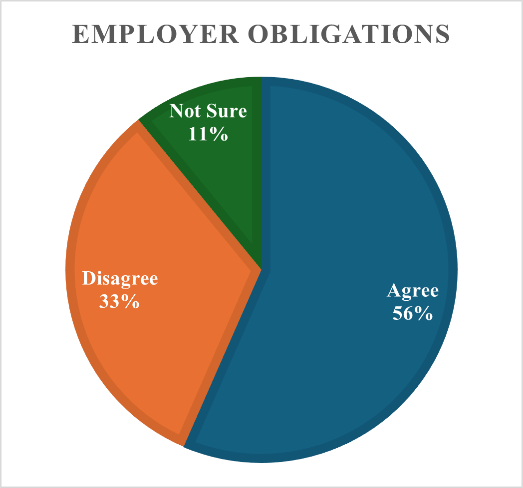
More than half of the respondents (56%) agreed that the employer fulfilled its obligations, though a significant minority (33%) disagreed. This disparity implies a partially balanced psychological contract. The total mean for the variable responses was M=2.97, standard deviation, SD=0.41, and variance=0.17. While a majority viewed the organization as upholding its promises, the relatively high level of disagreement flags a potential breach or inconsistency in employer behaviour that could affect trust and commitment among employees. Job insecurity negatively impacts employment relationships since it is strongly correlated with contract breaches, aligning with the present study findings (Costa & Neves, 2017; Shoss et al., 2018). Diverging from these findings is a study by Akroyd et al. (1994), who found job satisfaction among nurses to be largely unrelated to compensation and job security.
Descriptive Statistics on Delegation
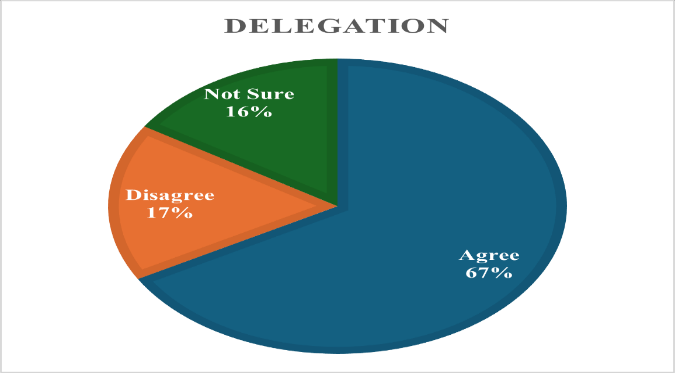
As shown in Figure 4, delegation was perceived positively by most respondents, with 67% agreeing that responsibilities were effectively delegated, which supports a view of shared responsibility and empowerment, hallmarks of a balanced psychological contract. However, with 17% disagreeing, it is important to consider whether delegation practices are uneven across roles or departments. The mean was M=3.70, standard deviation SD=0.46, and variance=0.22. Ferrari's (2014) findings agreed with those of the present study in that delegation is influenced by decision-making processes, organizational structures, and authority transfer.
Descriptive Statistics on Job Satisfaction
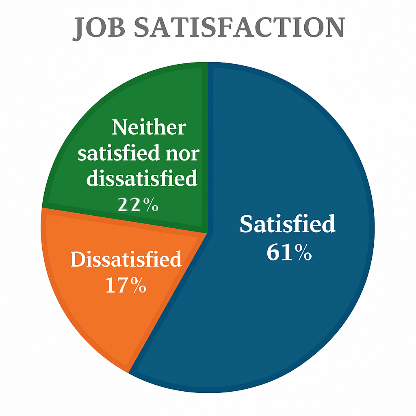
As shown in Figure 5, overall results on job satisfaction revealed that satisfied respondents accounted for 61% with 22% reporting that they were neither satisfied nor dissatisfied, with a mean response of M=3.55, standard deviation, SD=0.59, and variance=0.35. This suggests a generally positive outlook on job satisfaction among respondents. Job satisfaction was measured by two dimensions, intrinsic job satisfaction and extrinsic job satisfaction. The majority of the respondents (65%) reported being satisfied with the intrinsic aspects of their jobs, with 21% neither satisfied nor dissatisfied, and a significant minority (14%) dissatisfied with a mean of M=3.65, standard deviation, SD=0.63, and variance=0.40. The results indicated higher satisfaction with intrinsic rather than extrinsic aspects, which is consistent with previous research indicating that employees often derive more consistent fulfillment from the nature of their work than from external rewards (Herzberg et al., 1959). On the other hand, satisfaction derived from the extrinsic aspects of the job was 58%, slightly lower than the intrinsic satisfaction score, with 21% dissatisfied and a similar proportion (21%) neither satisfied nor dissatisfied with a mean of M=3.45, standard deviation, SD=0.65, and variance=0.43.
Correlation Analysis Results and Regression Results:
Correlation Analysis Results
Pearson's correlation coefficient was utilized to determine the association between variables and job satisfaction. The results are shown in Table 2.
Table 2 Pearson's Correlation Matrix for Independent and Dependent Variables
EEO | EEE | ERO | D | IJS | EJS | JS | |||
| Pearson's r | EEO | R | 1.000 | ||||||
| p-value | . | ||||||||
| N | 98 | ||||||||
EEE | R | .460** | 1.000 | ||||||
| p-value | ˂.001 | . | |||||||
| N | 98 | 98 | |||||||
ERO | R | .535** | .412** | 1.000 | |||||
| p-value | ˂.001 | ˂.001 | . | ||||||
| N | 98 | 98 | 98 | ||||||
D | R | .446** | .656** | .335** | 1.000 | ||||
| p-value | ˂.001 | ˂.001 | .001 | . | |||||
| N | 98 | 98 | 98 | 98 | |||||
IJS | R | .335** | .521** | .372** | .521** | 1.000 | |||
| p-value | .001 | ˂.001 | ˂.001 | ˂.001 | . | ||||
| N | 98 | 98 | 98 | 98 | 98 | ||||
EJS | R | .415** | .711** | .535** | .684** | .699** | 1.000 | ||
| p-value | ˂.001 | ˂.001 | ˂.001 | ˂.001 | ˂.001 | . | |||
| N | 98 | 98 | 98 | 98 | 98 | 98 | |||
JS | R | .410** | .670** | .493** | .655** | .919** | .925** | 1.000 | |
| p-value | ˂.001 | ˂.001 | ˂.001 | ˂.001 | ˂.001 | ˂.001 | . | ||
| N | 98 | 98 | 98 | 98 | 98 | 98 | 98 |
** . Correlation is significant at the 0.01 level (2-tailed).
*. Correlation is significant at the 0.05 level (2-tailed).
Source: Research Findings (2025)
Table 2 shows a moderate positive association (r=0.410) between employee obligations and job satisfaction, with a p-value ˂.001. This means that when employees perceive a greater sense of duty or responsibility toward the organization, they tend to report higher job satisfaction. The findings are consistent with those of Restubog et al. (2007), who found that psychological contract fulfillment by employees positively impacts job attitudes. When employees feel that they are contributing meaningfully, their engagement and satisfaction increase and may reflect a reciprocal exchange. However, the moderate strength also may suggest that other factors mediate or moderate this relationship.
Employee entitlements and job satisfaction had a strong positive correlation (r=0.670, p-value ˂.001). The strong positive correlation indicates that employees who feel entitled to certain organizational provisions tend to report higher levels of job satisfaction. Besides entitlement, often carrying a negative connotation in the context of psychological contracts, the finding suggests that when employees believe their expectations are legitimate and consistently met, their satisfaction increases significantly. The results agree with the findings, which argue that perceived contract fulfillment, particularly of promised benefits, enhances satisfaction and performance (Bal et al., 2011; Rousseau, 1995).
The results indicate that the relationship between employer obligations and job satisfaction was a moderate to strong positive correlation, r=0.493, p-value ˂.001. The finding suggests that the perception of the employer upholding their end of the psychological contract has a moderately strong association with job satisfaction. A previous study by Turnley and Feldman (1999) indicated that unmet employer obligations can be a major source of dissatisfaction, hence consistent with these results. The correlation, although slightly lower than that for employee entitlements, reinforces the role of perceived organizational justice and fairness in shaping satisfaction.
Delegation and job satisfaction had a strong positive correlation (r=0.655, p-value ˂.001). This means that any positive change in delegation leads to increased job satisfaction. Employees who feel trusted with decision-making responsibilities are more likely to be satisfied in their jobs. This is in line with the Job Characteristics Model, which posits autonomy as a core dimension of job satisfaction and Self Determination Theory, which supports the finding that autonomy contributes significantly to intrinsic motivation and well-being at work (Deci & Ryan, 2000; Hackman et al., 2015). The results agree with those of previous studies, whose findings suggest a strong positive association between psychological empowerment, a dimension of delegation, and between delegation itself and job satisfaction (Joiner et al., 2006; Mathew & Nair, 2021; Morrison et al., 1997; Shah & Kazmi, 2020). Leana (1986) found no significant correlation between delegation and subordinate job satisfaction.
The extremely high positive correlation between intrinsic job satisfaction and overall job satisfaction highlights the crucial role of meaningful and engaging work. These results strongly echo Herzberg's Two-Factor Theory (1959), which identifies intrinsic motivators as key drivers of satisfaction but also contrasts with his proposition. This study demonstrates that extrinsic satisfaction is just as critical as intrinsic factors in shaping overall satisfaction. It is evident that internal fulfillment plays a dominant role in shaping how employees evaluate their job experience.
In the same vein, extrinsic job satisfaction also shows an exceptionally strong positive correlation with overall job satisfaction. Consistent with this finding is Judge et al. (2000), who emphasized that while intrinsic rewards are powerful, extrinsic rewards cannot be underestimated. The nearly equal strength of both dimensions in this study emphasizes the simultaneous importance of improving job content and guaranteeing fair extrinsic rewards. This study suggested that a more integrated model may be more appropriate for contemporary work environments (Ajmal et al., 2015).
The findings highlight the significant role of psychological contract elements (obligations and entitlements) and structural elements (delegation) in determining job satisfaction. Furthermore, the dual importance of intrinsic and extrinsic satisfaction supports a holistic approach to job design and human resource management. Finally, strong correlations across variables validate the integration of both relational and transactional components of the psychological contract in understanding employee attitudes.
Regression Results
Regression Results
Multiple regression analysis was utilized to determine the influence of psychological contract on job satisfaction as well as the job satisfaction's dimensions among Medical Laboratory Professionals in selected public health sector institutions at the National Government, Kenya. The results are shown in Tables 3, 4, and 5.
Table 3 Multiple Regression Model Summary
1. Job satisfaction, 2. Intrinsic job satisfaction, and 3. Extrinsic job satisfaction
| Model | R | R Square | Adjusted R Square | Std. Error of the Estimate | |
| 1 | .760a | .577 | .559 | .3922 | |
| 2 | .592a | .350 | .322 | .5174 | |
| 3 | .807a | .651 | .636 | .3941 | |
Predictors: (constant), employee obligations, employee entitlements, employer obligations, delegation
As indicated in Table 3, when all other factors are held constant, employee obligations, employee entitlements, employer obligations, and delegation would account for approximately 57.7% variation in job satisfaction among Medical Laboratory Professionals at the National Government. Whereas the four predictors combined would account for approximately 35% variation in intrinsic job satisfaction, they would, however, account for approximately 65.1% variation in extrinsic job satisfaction among Medical Laboratory Professionals at the National Government.
Table 4 Analysis of Variance
Model | Sum of Squares | Df | Mean Square | F | Sig. |
Regression | 19.502 | 4 | 4.876 | 31.700 | <.001b |
Residual | 14.304 | 93 | .154 | ||
Total | 33.806 | 97 |
For the F-test as to whether the predictors, taken together, significantly explained variation in the dependent variable, showed that the overall regression model was statistically significant, F (4,93) =31.70, P-value<0.001. The model was found to suit the data satisfactorily. The variation in the job satisfaction dimensions reflected in the model summary was also found to be statistically significant.
Table 5 Relationship between the Individual Independent Variable and to Dependent Variable
Model | Unstandardized Coefficients | Standardized Coefficients | t | Sig. | ||
B | Std. Error | Beta | ||||
1 | (Constant) | .183 | .529 | .345 | .731 | |
Employee Obligations (EEO) | -.082 | .147 | -.048 | -.558 | .578 | |
Employee Entitlements (EEE) | .317 | .085 | .351 | 3.741 | <.001 | |
Employer Obligations (ERO) | .367 | .119 | .253 | 3.088 | .003 | |
Delegation (D) | .461 | .117 | .362 | 3.953 | <.001 | |
Dependent Variable: Job Satisfaction (JS)
The regression equation for overall job satisfaction was:
Y = B0 + B1EEO + B2EEE + B3ERO + B4D + ε
Y(JS) = .183 + (-.82) *EEO + (.317) *EEE + (.367) *ERO + (.461) *D + ε
In Table 5, employee obligations were not a significant predictor of the dependent variable, β = -0.048, t (93) = -0.558, p-value .578, which is greater than α= .05, indicating a very weak and nonsignificant negative relationship. Thus, we failed to reject the null hypothesis, meaning there was no statistically significant association between employee obligations and job satisfaction. This suggests that while the Medical Laboratory Professionals generally felt obligated to their roles, such obligations may not have meaningfully influenced how satisfied they felt in their jobs when other factors were considered. Therefore, employee obligations did not strongly or uniquely boost how satisfied the Medical Laboratory Professionals felt in their jobs.
Employee Entitlements were a significant predictor (β= 0.351, t (93) = 3.741, p-value ˂ .001, which is less than α=.05), indicating a moderate positive association with the dependent variable. The null hypothesis was rejected, supporting the alternative hypothesis. This suggests that as perceptions of entitlements were consistently met, there was a corresponding increase in the level of job satisfaction among the MLPs. The statistical evidence strongly supported the alternative hypothesis, confirming that employee entitlements played a meaningful role in shaping satisfaction among this workforce.
Employer obligations were a significant predictor (β= 0.253, t (93) = 3.088, p-value .003, which is less than α=.05, suggesting a moderate positive association with the dependent variable. The null hypothesis was rejected, supporting the alternative hypothesis. Statistical evidence justified rejecting the null hypothesis and lends strong support to the alternative hypothesis that employer obligations indeed influenced job satisfaction among the MLPs. Though a moderate relationship was still noteworthy, it highlighted the importance of the employer's role in shaping the work environment. This suggests that when employers fulfilled their obligations, the MLPs were more likely to report higher levels of job satisfaction. These findings reinforced the idea that employee satisfaction was not only shaped by what they received (entitlements) but also by how they were treated and supported by their organizations.
Similarly, delegation was a significant predictor (β= 0.362, t (93) = 3.953, p-value ˂ .001, which is less than α=.05), indicating a moderate positive association with the dependent variable, slightly stronger than β= 0.351 and β= 0.253. The results provided strong statistical evidence that delegation was not only relevant but also played a substantial role in shaping how satisfied MLPs felt in their jobs. The null hypothesis was rejected, supporting the alternative hypothesis, confirming that delegation practices meaningfully impacted job satisfaction among these professionals. This highlighted the importance of empowering MLPs through the distribution of responsibilities, involving them in decision-making, and trusting them to carry out tasks independently.
While predictors with β values (0.362 and 0.351) had a moderate positive effect on job satisfaction, as indicated by the direction and strength of the regression coefficients in the findings in Table 4.14, delegation (β=0.362) had the strongest influence on job satisfaction. Therefore, with delegation (β=0.362), employee entitlements (β=0.351), and employer obligations (β=0.253) considered the most important predictors in the regression model in that order, employee obligations (β=-0.048) had little or no practical influence on job satisfaction. This underscores the reason for addressing the association of each predictor variable with the outcome variable, since the overall goal of the current study was to establish the factors that impact job satisfaction among the MLPs in the public health sector at the National Government.
Conclusions and Implications for Policy
The findings of this study revealed that employee obligations, employee entitlements, employer obligations, and delegation had all moderate to strong positive associations with job satisfaction, according to the study, as revealed by Pearson's correlation coefficient. Based on the results and the subsequent discussion, at a combined set-up including all the variables, it was established that employee entitlements, employer obligations, and delegation had a significant influence on job satisfaction. However, employee obligations were found not to significantly predict job satisfaction among Medical Laboratory Professionals (MLPs) at the National Government. Additionally, in a combined set-up, delegation was found to be the most important predictor of job satisfaction, followed by employee entitlements. These findings underscore the critical role of balanced expectations and managerial practices in shaping employee experiences. The study concludes that employment is a relationship in which the mutual obligations of employees and employers may be ambiguous but must be respected. Failure to meet expectations may result in major consequences for both the relationship and the organization in general.
References
- Ajmal, A., Bashir, M., Abrar, M., Khan, M. M., & Saqib, S. (2015). The effects of intrinsic and extrinsic rewards on employee attitudes: Mediating role of perceived organizational support. Journal of Service Science and Management, 08(04), 461–470. https://doi.org/10.4236/jssm.2015.84047
- Akroyd, D., Wilson, S., Painter, J., & Figuers, C. (1994). Intrinsic and extrinsic predictors of work satisfaction in ambulatory care and hospital settings. Journal of Allied Health, 23(3), 155–164.
- ASCLS. (2023). Critical Laboratory Personnel Shortage. https://ascls.org/workforce
- Association of Public Health Laboratories. (2020). Kenya Laboratory Capacity Mapping Report.
- Bal, P. M., Chiaburu, D. S., & Diaz, I. (2011). Does psychological contract breach decrease proactive behaviors? The moderating effect of emotion regulation. Group & Organization Management, 36(6), 722–758. https://doi.org/10.1177/1059601111423532
- Blaauw, D., Ditlopo, P., Maseko, F., Chirwa, M., Mwisongo, A., Bidwell, P., Thomas, S., & Normand, C. (2013). Comparing the job satisfaction and intention to leave of different categories of health workers in Tanzania, Malawi, and South Africa. Global Health Action, 6(1), 19287. https://doi.org/10.3402/gha.v6i0.19287
- Brummel, B. J., & Parker, K. N. (2013). Obligation and entitlement in society and the workplace. Applied Psychology, 64(1), 127–160. https://doi.org/10.1111/apps.12023
- Costa, S., & Neves, P. (2017). Job insecurity and work outcomes: The role of psychological contract breach and positive psychological capital. Work & Stress, 31(4), 375–394. https://doi.org/10.1080/02678373.2017.1330781
- Deci, E. L., & Ryan, R. M. (2000). The “What” and “Why” of goal pursuits: human needs and the Self-Determination of behavior. Psychological Inquiry, 11(4), 227–268. https://doi.org/10.1207/s15327965pli1104_01
- Dignos, P. N., Khan, A., Gardiner-Davis, M., Papadopoulos, A., Nowrouzi-Kia, B., Sivanthan, M., & Gohar, B. (2023). Hidden and Understaffed: Exploring Canadian medical laboratory technologists’ pandemic stressors and lessons learned. Healthcare, 11(20), 2736. https://doi.org/10.3390/healthcare11202736
- Ferrari, F. (2014). Delegation, accountability, and organizational reliability. Coordination mechanisms and training models for contingency management. Procedia - Social and Behavioral Sciences, 150, 937–943. https://doi.org/10.1016/j.sbspro.2014.09.105
- Gohar, B., & Nowrouzi-Kia, B. (2022). The Forgotten (Invisible) Healthcare Heroes: Experiences of Canadian medical laboratory employees working during the pandemic. Frontiers in Psychiatry, 13. https://doi.org/10.3389/fpsyt.2022.854507
- Hackman, R., Lawler, E., & Oldham, G. (2015). Job characteristics theory. In Organizational Behaviour 1 (pp. 75–93). Routledge.
- Harvey, P., & Harris, K. J. (2010). Frustration-based outcomes of entitlement and the influence of supervisor communication. Human Relations, 63(11), 1639–1660. https://doi.org/10.1177/0018726710362923
- Harvey, P., & Martinko, M. J. (2008). An empirical examination of the role of attributions in psychological entitlement and its outcomes. Journal of Organizational Behavior, 30(4), 459–476. https://doi.org/10.1002/job.549
- Herzberg, F., Mausner, B., & Snyderman, B. (1959). The motivation to work (2nd ed.). John Wiley.
- Howsepian, A. A. (1998). Correspondence. General Hospital Psychiatry, 20(2), 123–124. https://doi.org/10.1016/s0163-8343(97)00118-7
- Joiner, T., Bakalis, S., & Choy, J. (2006). Delegation, job satisfaction, and subordinate performance: The mediating effect of leader-member exchange. https://api.semanticscholar.org/CorpusID:54978741
- Judge, T. A., Bono, J. E., & Locke, E. A. (2000). Personality and job satisfaction: The mediating role of job characteristics. Journal of Applied Psychology, 85(2), 237–249. https://doi.org/10.1037/0021-9010.85.2.237
- Kanyina, E. W., Boru, W. G., Mucheru, G. M., Amwayi, S. A., & Galgalo, T. (2017). Tuberculosis infection among health care workers: a case series in two district hospitals, Kenya, August 2013. Pan African Medical Journal, 28. https://doi.org/10.11604/pamj.supp.2017.28.1.8222
- Karan, A., Negandhi, H., Hussain, S., Zapata, T., Mairembam, D., De Graeve, H., Buchan, J., & Zodpey, S. (2021). Size, composition, and distribution of health workforce in India: why, and where to invest? Human Resources for Health, 19(1). https://doi.org/10.1186/s12960-021-00575-2
- Kim, M. K., Arsenault, C., Atuyambe, L. M., & Kruk, M. E. (2021). Predictors of job satisfaction and intention to stay in the job among health-care providers in Uganda and Zambia. International Journal for Quality in Health Care, 33(3). https://doi.org/10.1093/intqhc/mzab128
- Koomson, S., Mensah, A. O., & Koomson, E. (2022). Unmet expectations and job involvement among doctors: Does individual conscientiousness play a mitigating role? British Journal of Healthcare Management, 28(12), 1–7. https://doi.org/10.12968/bjhc.2020.0026
- Langerud, D. H., & Jordan, P. J. (2018). Entitlement at work: Linking positive behaviors to employee entitlement. Journal of Management & Organization, 26(1), 75–94. https://doi.org/10.1017/jmo.2018.33
- Leana, C. R. (1986). Predictors and consequences of delegation. Academy of Management Journal, 29(4), 754–774. https://doi.org/10.5465/255943
- Lee, A., Schwarz, G., Newman, A., & Legood, A. (2017). Investigating when and why psychological entitlement predicts unethical pro-organizational behavior. Journal of Business Ethics, 154(1), 109–126. https://doi.org/10.1007/s10551-017-3456-z
- Lijo, K. J., & Lyngdoh, W. S. (2016). Psychological Contract and Job Satisfaction among HR Professionals in Start-up Service Sector. International Journal of Indian Psychology, 3(2). https://doi.org/10.25215/0302.032
- Mannocci, A., De Carli, G., Di Bari, V., Saulle, R., Unim, B., Nicolotti, N., Carbonari, L., Puro, V., & La Torre, G. (2016). How Much Do Needlestick Injuries Cost? A Systematic Review of the Economic Evaluations of Needlestick and Sharps Injuries Among Healthcare Personnel. Infection Control and Hospital Epidemiology, 37(6), 635–646. https://doi.org/10.1017/ice.2016.48
- Mathew, J., & Nair, S. (2021). Psychological Empowerment and Job Satisfaction: A Meta-analytic Review. Vision: The Journal of Business Perspective, 26(4), 431–440. https://doi.org/10.1177/0972262921994350
- Mathulu, A. W., & Mbithi, B. W. (2016). Job Satisfaction among the Nurses of Makueni District Hospital, Kenya. International Journal of Public Health Science (IJPHS), 5(4), 450. https://doi.org/10.11591/.v5i4.4850
- Morrison, R. S., Jones, L., & Fuller, B. (1997). The relation between leadership style and empowerment on job satisfaction of nurses. JONA, the Journal of Nursing Administration, 27(5), 27–34. https://doi.org/10.1097/00005110-199705000-00007
- Mossburg, S., Agore, A., Nkimbeng, M., & Commodore-Mensah, Y. (2019). Occupational Hazards among Healthcare Workers in Africa: A Systematic Review. Annals of Global Health, 85(1). https://doi.org/10.5334/aogh.2434
- Najjuma, S. S., Okiria, J. C., & Nanyonga, R. C. (2016). The role of the psychological contract on health care workers' commitment in the public health sector in Uganda: A case study of medical doctors in Mulago National Referral Hospital (MNRH). International Journal of Science and Research, 5(4), 2319–7064. https://www.ijsr.net/archive/v5i4/NOV163033.pdf
- Nkengasong, J. N., Mbopi-Keou, F., Peeling, R. W., Yao, K., Zeh, C. E., Schneidman, M., Gadde, R., Abimiku, A., Onyebujoh, P., Birx, D., & Hader, S. (2018). Laboratory medicine in Africa since 2008: then, now, and the future. The Lancet Infectious Diseases, 18(11), e362–e367. https://doi.org/10.1016/s1473-3099(18)30120-8
- O’Leary-Kelly, A., Rosen, C. C., & Hochwarter, W. A. (2016). Who is deserving and who decides: Entitlement as a Work-Situated phenomenon. Academy of Management Review, 42(3), 417–436. https://doi.org/10.5465/amr.2014.0128
- Plebani, M., Aita, A., & Sciacovelli, L. (2020). Patient safety in laboratory medicine. In Springer eBooks (pp. 325–338). https://doi.org/10.1007/978-3-030-59403-9_24
- Prüss-Üstün, A., Rapiti, E., & Hutin, Y. (2003). Sharps injuries. In Global burden of disease from sharps injuries to health care workers (WHO Environmental Burden of Disease Series, No. 3). World Health Organization.
- Restubog, S. L. D., Bordia, P., & Tang, R. L. (2007). Behavioural Outcomes of Psychological contract breach in a Non‐Western culture: the moderating role of equity sensitivity*. British Journal of Management, 18(4), 376–386. https://doi.org/10.1111/j.1467-8551.2007.00531.x
- Rousseau, D. (1995). Psychological Contracts in Organizations: Understanding written and unwritten agreements. https://doi.org/10.4135/9781452231594
- Schwarz, G., Newman, A., Yu, J., & Michaels, V. (2021). Psychological entitlement and organizational citizenship behaviors: the roles of employee involvement climate and affective organizational commitment. The International Journal of Human Resource Management, 34(1), 197–222. https://doi.org/10.1080/09585192.2021.1962388
- Shah, S. G. M., & Kazmi, A. B. (2020). The impact of delegation of Authority on job satisfaction, job performance, and organizational growth at higher educational institutions in Sindh. Global Social Sciences Review, V(III), 32–45. https://doi.org/10.31703/gssr.2020(v-iii).04
- Shoss, M. K., Jiang, L., & Probst, T. M. (2016). Bending without breaking: A two-study examination of employee resilience in the face of job insecurity. Journal of Occupational Health Psychology, 23(1), 112–126. https://doi.org/10.1037/ocp0000060
- Spindler, G. S. (1994). Psychological contracts in the workplace—a lawyer’s view. Human Resource Management, 33(3), 325–333. https://doi.org/10.1002/hrm.3930330303
- SRC 2011-2017. (n.d.). Salaries and Remuneration Commission Report. https://www.src.go.ke
- Stone, J. (2022, April 28). We’re facing a critical shortage of medical laboratory professionals. Forbes. https://www.forbes.com/sites/judystone/2022/04/28/were-facing-a-critical-shortage-of-medical-laboratory-professionals/?sh=56679e39260c
- Tengah, S. A. (2019). Factors Influencing Job Satisfaction among Nurses in Public Health Facilities in Mombasa, Kwale, and Kilifi Counties, Kenya. Advances in Social Sciences Research Journal, 6(5). https://doi.org/10.14738/assrj.65.6389
- Tomlinson, E. C. (2012). An integrative model of entitlement beliefs. Employee Responsibilities and Rights Journal, 25(2), 67–87. https://doi.org/10.1007/s10672-012-9208-4
- Tony, O. K. (2018). Job Satisfaction Among Clinicians at Homa Bay County Teaching and Referral Hospital. East African Medical Journal, 95(12).
- Turnley, W. H., & Feldman, D. C. (1999). A discrepancy model of psychological contract violations. Human Resource Management Review, 9(3), 367–386. https://doi.org/10.1016/s1053-4822(99)00025-x
- Waheed, U., Ahmad, M., Wazeer, A., Saeed, M., Saba, N., & Rasheed, F. (2023). Medical Laboratory Science Education: Shaping Competent and Skilled Healthcare Professionals. Mirpur Journal of Medical Sciences, 1(1), 58–63.
- Wanous, J. P., Poland, T. D., Premack, S. L., & Davis, K. S. (1992). The effects of met expectations on newcomer attitudes and behaviors: A review and meta-analysis. Journal of Applied Psychology, 77(3), 288–297. https://doi.org/10.1037/0021-9010.77.3.288
- World Health Organization. (2002). Reducing risks, promoting a healthy life. World Health Report 2002. World Health Organization.
- World Health Organization. (2007). Everybody’s business: Strengthening health systems to improve health outcomes: WHO’s framework for action. World Health Organization.
- Worthington, M. G., Ross, J. J., & Bergeron, E. K. (2006). Posttraumatic Stress Disorder after Occupational HIV Exposure: Two cases and a literature review. Infection Control and Hospital Epidemiology, 27(2), 215–217. https://doi.org/10.1086/501155
- Yamane, T. (1973). Population Sample Formula for Finite Population (3rd ed.). Harper and Row.
- I am Peninna Mwongeli Nzoka, a Master’s of Science student in the Department of Health Systems Management and Medical Education at Kenya Methodist University. I hold a Bachelor of Arts degree from Kenyatta University. My research focuses on health systems strengthening, particularly anchored on the Human Resources for Health pillar. I am passionate about maintaining scientific rigor in health systems research publishing, and look forward to contributing actively to mentorship.
Cite this article
-
APA : Nzoka, P. M., Njoroge, K., & Kyalo, C. K. (2025). The Influence of Psychological Contract on Job Satisfaction Among Medical Laboratory Professionals in Selected Public Health Sector Institutions at the National Government, Kenya. Global Social Sciences Review, X(II), 247-263. https://doi.org/10.31703/gssr.2025(X-II).20
-
CHICAGO : Nzoka, Peninna Mwongeli, Kezia Njoroge, and Carol Kawila Kyalo. 2025. "The Influence of Psychological Contract on Job Satisfaction Among Medical Laboratory Professionals in Selected Public Health Sector Institutions at the National Government, Kenya." Global Social Sciences Review, X (II): 247-263 doi: 10.31703/gssr.2025(X-II).20
-
HARVARD : NZOKA, P. M., NJOROGE, K. & KYALO, C. K. 2025. The Influence of Psychological Contract on Job Satisfaction Among Medical Laboratory Professionals in Selected Public Health Sector Institutions at the National Government, Kenya. Global Social Sciences Review, X, 247-263.
-
MHRA : Nzoka, Peninna Mwongeli, Kezia Njoroge, and Carol Kawila Kyalo. 2025. "The Influence of Psychological Contract on Job Satisfaction Among Medical Laboratory Professionals in Selected Public Health Sector Institutions at the National Government, Kenya." Global Social Sciences Review, X: 247-263
-
MLA : Nzoka, Peninna Mwongeli, Kezia Njoroge, and Carol Kawila Kyalo. "The Influence of Psychological Contract on Job Satisfaction Among Medical Laboratory Professionals in Selected Public Health Sector Institutions at the National Government, Kenya." Global Social Sciences Review, X.II (2025): 247-263 Print.
-
OXFORD : Nzoka, Peninna Mwongeli, Njoroge, Kezia, and Kyalo, Carol Kawila (2025), "The Influence of Psychological Contract on Job Satisfaction Among Medical Laboratory Professionals in Selected Public Health Sector Institutions at the National Government, Kenya", Global Social Sciences Review, X (II), 247-263
-
TURABIAN : Nzoka, Peninna Mwongeli, Kezia Njoroge, and Carol Kawila Kyalo. "The Influence of Psychological Contract on Job Satisfaction Among Medical Laboratory Professionals in Selected Public Health Sector Institutions at the National Government, Kenya." Global Social Sciences Review X, no. II (2025): 247-263. https://doi.org/10.31703/gssr.2025(X-II).20