
01 Pages : 1-12
- How does the education of women impact gender role change in Basti Rasoolpur?
- How does education impact women’s participation in family decision-making?
- How does women’s education promote sustainable rural development?
- What are the cultural shifts that are occurring in relation to girl education and women’s mobility in the village?
Abstract
Education of women has come under focus as a means to transform gender and contribute to sustainable rural development in Pakistan. The aim of this ethnographic research is to explore the role of education in changing gender roles of Basti Rasoolpur, a rural community in south of Punjab. Research is conducted using qualitative approaches such as in-depth interview, participant observation, focus group discussion and informal interaction, examining women's involvement in household decision making, mobility, community involvement and economic life. Results show that education increases women's confidence, autonomy and ability to make a difference in their family's wellbeing, health, money matters and child education. The study reveals evolving attitudes, including greater acceptance of women's mobility and public participation, while maintaining social legitimacy and respectability. The findings show that women’s education strengthens social inclusion, economic resilience, and community development. These outcomes support sustainable rural development and future prosperity.
Keywords
Women’s Education, Gender Roles, Sustainable Development, Ethnography, South Punjab, Rural Pakistan, Women Empowerment
Introduction
Sustainable development has emerged as a key issue in the present development discourse. It focuses on economic development, social justice and environmental protection to benefit current and future generations. Women education plays a crucial role among the key factors affecting sustainable development, which in turn affects family welfare, poverty alleviation, awareness about health care, social participation, and others.
Around the world, scientists and policy makers know that investing in women’s education brings benefits to women and their community. (Bayeh, 2016; Momsen, 2019) Educated women are more likely to engage in economic activities, exercise choices, and promote future generations of education. Hence, there is a strong connection between women education and achievement of Sustainable Development Goals (SDGs) including SDG 4 (Quality Education) and SDG 5 (Gender Equality). (OECD, 2020; UN Women, 2022)
Women encounter restricted educational opportunities in Pakistan, particularly in rural areas like in South Punjab, primarily because of poverty, a patriarchal system, cultural limitations, and poor education infrastructure. (Ali, 2004; Chaudary, 2004) Traditional gender roles often restrict women’s access to public life and their involvement in public affairs. Yet, in some rural communities, there has been some progress in changing the social attitude towards women education.
Basti Rasoolpur is one such village where the inclusion of women in education is growing and is beginning to transform gender relations. Women in the village are not only educated, they are also more involved in decision making within the household, social life, and economic life. The changes experienced by the village are important lessons in the connection between women’s education and sustainable rural development.
Women education is studied in this paper towards changing the gender role and sustainable development in Basti Rasoolpur. The study is targeted to the empowerment, mobility, involvement of women in decision making and perception of the community on women education.
Research Questions
Theoretical Framework
This research is based on Feminist Institutionalism and Social Reproduction Theory.
Feminist Institutionalism provides an analytical tool for examining how social norms, culture, and institutions affect women’s access to education and their involvement in decision-making processes. This theory assists the researcher in analyzing the impact of changing attitudes towards women’s education on gender relations within the village.
Social Reproduction Theory focuses on the significance of the reproductive role played by women within families and communities. This theory assists the researcher in understanding how education impacts the reproductive role of women and contributes to increased social and economic activity.
These theories provide a theoretical basis for the study.
Literature Review
Women’s Education and Sustainable Development
There is a general consensus on the significance of women education in achieving sustainable development. The educated woman is an important factor in social development, economic efficiency and family happiness, say scholars. (Boserup, 1970; Leach et al., 2016) Improved literacy among women leads to better health practices, child nutrition, and educational outcomes, as well as better household management.
Studies in developing countries prove that women’s education has a positive impact on poverty alleviation and economic development through higher labour force participation and productivity. (UNDP, 2020; Naz & Chaudri, 2012) The share of women in community groups and decision-making positions is also higher for those with higher levels of education.
Gender roles in the rural areas of Pakistan
In rural Pakistan, the social system is mostly patriarchal, where men have traditionally greater influence in decision making than women, and women traditionally engage in unpaid domestic and agricultural work. (Shahla, 2002; Chaudary, 2004) Women’s mobility, education and involvement in public life is shaped by cultural norms, kinship systems and gender expectations.
Women in South Punjab are often limited by poverty, early marriage, less opportunities for education and social limitations. (Butt, 2010) But with changing economic conditions and growing awareness on education, gender relations in some rural communities are slowly changing. (Khan, 2021)
Education as a source of empowerment
Education can build the confidence, awareness and capacity of women and improve their role participation in social and economic activities. (Kabeer, 2005) More educated women have greater access to health care, more involvement in their children’s education, and greater involvement in household income.
In addition, the researchers assert education for women challenges the traditional gender stereotype by making women more involved in making decisions in society and the family. (Agarwal, 2010) Education can be the catalyst for social change in rural communities.
Feminist perspectives on education and development
Feminist scholars stress that education can help to remove gender inequities, as it can break away from the norms of patriarchy and increase the possibilities for women. (Bayeh, 2016) Feminist Institutionalism discusses the role of formal and informal institutions on women’s access to education and their involvement in social life.
Another important aspect of women’s unpaid work in the home is the social role of household production in social reproduction (SRT). (Rao, 2012) Women have opportunities to negotiate traditional gender expectations through education, and to engage in social change.
Materials and Methods:
Research Design
This study is qualitative research with ethnographic approach. Ethnography is well suited to the goals of this project as it will allow the researcher to explore lived experience, social meaning, and cultural practices as they occur in a particular community. The ethnographic approach does not impose categories on the data, but rather allows for an interpretive understanding of how women in Basti Rasoolpur conceptualize and express the importance of education in their daily life, relationship, and social involvement. The study is exploratory in nature given that prior ethnographic study on the topic of gender and sustainable development in rural South Punjab is not extensive. The methodological approach is thus inductive, that is, means that themes and patterns were developed from the data, not imposed on it.
Study Area
The study was carried out in Basti Rasoolpur village, which is a rural area of Tehsil Jampur, District Rajanpur of South Punjab, Pakistan. The total population of the village is 5,549 (250 registered households) and is located around 59.5 kilometres north of Rajanpur along the Indus Highway (Pakistan Bureau of Statistics, 2017). It has an economy that is mainly based on agriculture (wheat and cotton production), animal husbandry, and a variety of jobs in the public and private sector. Unlike many other similar rural communities in the area, Basti Rasoolpur has a high rate of literacy – 76.94 per cent for males and 62.79 per cent for females – and the community has established its own development body, the Rasoolpur Development Society, which is actively promoting education across generations. Given that this village had a high level of education, while being one of the most transformative across time, it was a theoretically promising and historically relevant place to explore the link between women's education and evolving gender relationships.
Sampling and Participants
A purposive sampling was used to recruit participants that could communicate with the research question in a meaningful and experiential manner. Analytical relevance was more important than statistical representativeness due to the interpretive and exploratory nature of the study. The participants were chosen to represent a diversity of social status, age and experience of engagement with education and gender norms in their community. The final sample consisted of 35 people, married female, unmarried female, male household head, schoolteachers, elderly male and female. The diversity was intentional, in order to represent the voices of both women and men, youth and the elderly, and to capture the wide range of social attitudes and shifts at community level that inform and are affected by individual experiences of educational change.
Data Collection
In the field work of 2025, individual in depth interviews were used to collect data in Basti Rasoolpur. The in-depth interview was chosen to be the main instrument as it provides depth, flexibility and relationship quality that allows for the capturing of the subjective meanings attached by participants to education, gender and social change, which other instruments such as structured surveys or group based formats cannot capture. Interviews were conducted using a semi-structured interview guide which was designed with the research supervisor and subject experts and was piloted in a neighbouring village before actual data collection to fine-tune question wording and sequencing. Different guides were created for women and men, both of which were in similar thematic formats. The guides were structured into seven sections, starting with rapport building and biographical background, moving up to daily life and division of labour by gender, their views on sustainable development, their traditional ecological knowledge, decision making and their challenges to participation, their hopes for the future and a final one for them to reflect on or give any other suggestions. Interviews were conducted in Urdu/Saraiki as per the respondent's choice and recorded with their consent on an audio recorder that was then transcribed. Every effort was made to ensure the comfort and privacy of women participants, such as the use of culturally appropriate and private interview locations for women. The researcher spent a long time in the study area, thus building trust with the people and increasing the honesty and depth of the answers he could obtain during his interviews.
Data Analysis
Thematic analysis was employed to analyze the interview data through repeated reading, open coding and gradually grouping of codes into larger themes. All interview data was analyzed manually; transcripts of interviews were read in the original language so as to minimize the potential for interpretation loss during translation. Early codes included statements and observations about education, mobility, decision making, social participation and community attitudes. These were then subsequently grouped into larger themes based on the study's theoretical frame, Feminist Institutionalism and Social Reproduction Theory and also based on the patterns that arose inductively from the data. This manual coding scheme was then transferred to RStudio and quantitative summaries of code and sub-code frequencies were computed and then plotted. To illustrate the relative weight of each thematic cluster, treemaps were created using the treemapify package, and frequency tables were generated using kableExtra to clearly and reproducibly report the coding structure. Combined with manual qualitative coding using a computer program, these computational visualization tools in the RStudio environment enabled more analytical clarity without sacrificing the interpretative depth that is part of the ethnographic approach. Reflexivity was also maintained as the researcher kept herself conscious of being an educated woman conducting research in a traditional rural community and how this may have influenced the responses and interpretation of the participants throughout the process of analysis.
Ethical Considerations
This was followed by fully informing all the participants about the purpose and nature of the research and asking for their verbal informed consent before data collection was conducted. The participation was voluntary, and participants were informed of their right to drop out even if it happened to be the middle of the course. Confidentiality was respected during the conduct of the research and no identifying information is given in the reporting of the findings. Special care was taken in handling interviews and selecting not to have photos of participants from the field work part of the published study, especially when it came to the female participants. Photographic documentation was done in the context of fieldwork and for the purpose of documenting and contextualising the fieldwork, and no images of community members were taken without explicit prior consent.
Findings
Through the thematic analysis of the interview data from Basti Rasoolpur, ten major themes were drawn in which there are 113 coded references with thirty sub-themes. The five most common themes were: Intergenerational Perspectives and Family Support (18 mentions); Changing Gender Roles and Decision-Making (13); Cultural Norms and Resistance (15); Education as Empowerment (13); and Economic and Livelihood Dimensions (11). There was a common thread running through all of the ten themes; the education that women received was not an abstract right but a lived, cumulative resource that changed how women related to their households, communities and themselves. The results are summarized in the paragraphs below, grouped according to their themes.
Table 1
Frequency of Parent Themes in Coded Interview Data (N = 113 References)
| Theme | n |
| 5. Intergenerational Perspectives and Family Support | 18 |
| 4. Cultural Norms and Resistance | 15 |
| 1. Changing Gender Roles and Decision-Making | 13 |
| 2. Education as Empowerment | 13 |
| 3. Economic and Livelihood Dimensions | 11 |
| 10. Motivation and the Value of Girls’ Education | 9 |
| 6. Community Participation and Development | 9 |
| 7. Self-Transformation and Identity | 8 |
| 8. Mobility and Access | 8 |
| 9. Education and Health | 6 |
Note: Frequencies derived from manual thematic coding of 10 in-depth interviews conducted in Basti Rasoolpur (2025), analyzed in RStudio. Themes are ordered by frequency. Eleven themes were coded in total; Theme 11 (Diverging Paths and the Cost of Educational Discontinuation, n = 3) is excluded from this summary table.
Table 2
Top 10 Sub-themes by Frequency Across All Coded References
| Parent theme | Sub-theme | n |
| 1. Changing Gender Roles | 1.1 Women’s participation in household decisions | 5 |
| 1. Changing Gender Roles | 1.2 Men’s recognition of women’s changed roles | 5 |
| 2. Education as Empowerment | 2.1 Self-reliance and autonomy | 5 |
| 4. Cultural Norms and Resistance | 4.4 Balancing change with cultural continuity | 5 |
| 5. Intergenerational Perspectives | 5.2 Fathers and husbands as advocates or converts | 5 |
| 5. Intergenerational Perspectives | 5.4 Generational contrast, regret, and honest reflection | 5 |
| 2. Education as Empowerment | 2.2 Voice, confidence, and critical thinking | 4 |
| 2. Education as Empowerment | 2.3 Overcoming the feeling of “smallness” | 4 |
| 3. Economic and Livelihood Dimensions | 3.1 Education leading to income and job prospects | 4 |
| 3. Economic and Livelihood Dimensions | 3.2 Household financial management and investment in education | 4 |
Note: Sub-themes are listed in descending frequency order. Where multiple sub-themes share the same count, ordering follows the parent theme frequency. Sub-theme labels are abbreviated from the original codebook where necessary for readability.
Hierarchical Treemap of Thematic Codes and Sub-codes, Weighted by Number of References
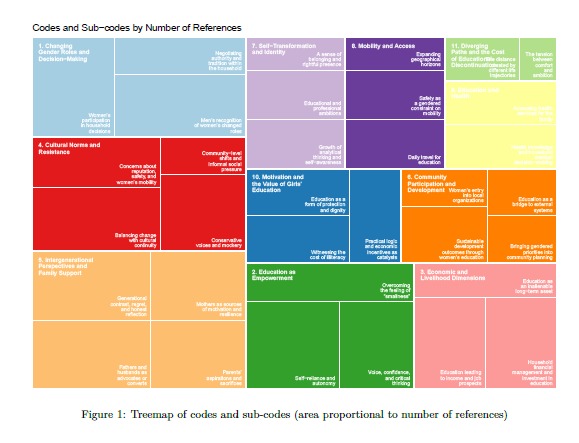
Note: Each rectangle represents a sub-theme; area is proportional to the number of coded references. Colour groupings denote parent themes. Generated in RStudio using the treemapify package.
Changing Gender Roles and Decision-Making
Gender roles formed one of the most salient themes identified in the data with 13 coded references. Participants explained how literacy was used in real-world contexts dispensing prescriptions, reading government announcements, keeping accounts of production and sales, or working out market prices. In both cases, the competence that was acquired through schooling brought forth moments of inversion, which were narrated in a low-key way, not ideologically. One respondent described the time when her husband recognized her capabilities, during a medical emergency: “He said to me afterwards, thank God you were educated, that moment — it said a lot” (Interview 1). One of her spokes made this claim even about her position within her mother-in-law's house in an interpretive role, when she didn't understand something, a notice or a bill: “She comes to me when there is something she does not understand, a notice or a bill. In that moment I become the one who is needed” (Interview 6).
A sub-theme of the men's recognition of women's changed role arose. Male respondents, farmers and teachers, recognized the qualitative nature of the social position held by educated women, which was a kind of informal respect. A male teacher noted that boys who have educated sisters “are more accepting of a woman teacher, more used to a woman knowing something that they don't” (Interview 5). These accounts share Feminist Institutionalism's focus on changes to informal norms that occurs through incremental changes brought about by the observed competence of those around them, not through formal rules or policies.
Education as Empowerment
Education as Empowerment yielded 13 references, the most frequent being in relation to three sub-themes: self-reliance and autonomy, voice and critical thinking and overcoming the “smallness” feeling. The overall theme of this paper is a process of inward transformation, which preceded and facilitated the process of outward transformation (social change). The experience of respondents was expressed in terms of their capability, not credentials their ability to handle institutions, to read prescriptions, to negotiate prices in the market, to read a legal document without a man in between. One commented with great specificity: “It feels good, it feels like I have something of my own that they can't take if all of this is uncertain, the harvest, the price of cotton, this I have” (Interview 6).
One of the sub-themes that arose from the data was the struggle to overcome the feeling of being “small.” It was called upon to explain what it meant to be "functionally illiterate" a condition that was neither functional nor a comfortable one, but was only socially degrading. The material implications of illiteracy were vividly felt by an old woman who spoke of waiting for someone to read the letter to her: “If there was a letter, we waited for a man to come and read it to us. Sometimes they would write about someone dying and we wouldn't even know until someone came” (Interview 4). This testimony refers to a form of structural exclusion that is illuminated by Social Reproduction Theory: women's reproductive labour in the home was overlapped by an informational dependency, the disruption of which is achieved by entering into education.
Economic and Livelihood Dimensions
Economic and livelihood dimensions (11) were mostly aligned with education as a livelihood generating option and with household management of finances to ensure continuity of education. Throughout, the emphasis was on education as instrument: an appointment in the school would mean a monthly salary, and a girl's social status and economic prospects would be altered because of her education. A respondent stated, “When they see that an educated daughter brings salary, then they recalculate (Interview 5). A second father spoke about his own efforts to keep his daughters in school during lean harvest periods: “In the lean periods of harvest, I would rather take something like a wedding away or take something like a feast, but I have never pulled a daughter out of school for money” (Interview 3).
The logic of educational investment, which has been documented more broadly in South Asia by scholars (Klasen 2018; Kabeer 2005), is repeated in these essays: educated women invest their income in their children's education, their health and wellbeing, and agricultural inputs, and reap returns that extend beyond the individual. This was an inalienable long-term asset theme that was especially prominent here they contrasted education with land or livestock because it was inalienable and could not be divided or taken away. The framing here indicates that education is not just human capital, but also a social insurance, in the more precarious of farming circumstances.
Cultural Norms and Resistance
The second most common theme coded was cultural norms and resistance (15 references). This cluster reflects a number of tensions between aspirations to education and the social constraints that remain a problem in Basti Rasoolpur, concerns about reputation, conservative mockery, and restrictions on the mobility of girls. Within this cluster, the sub-theme of balancing change with cultural continuity received the greatest number of references (5), indicating that participants did not position educational progress as something that was contrary to community values, but instead something that was negotiated with community values. This was expressed in the most direct way by one of the respondents: “Change happens in a place like this not all at once, but little by little, like water trickling through stone” (Interview 1).
The concerns related to reputation, safety and mobility of the sub-theme (4 references) referred to the practical difficulties that many girls face when deciding on the educational path they can take. Secondary education was further out of reach for many families, and the absence of safe, affordable transportation led many families to consider the educational value versus social risk a consideration in determining whether to send their daughters to secondary school. Also in the data were conservative reactions, in the form of neighbours' mockery and kin networks' pressure. What the findings show, however, is that this resistance is becoming more and more an exception rather than the rule, and is consistent with the attitudinal shifts, down to the community level, that Feminist Institutionalism has identified as the prerequisite for lasting institutional change.
Intergenerational Perspectives and Family Support
One of the most common themes coded in the data, intergenerational perspectives and family support (18 references) shed light on how education changes is passed on and cemented from one generation to another. The two sub-themes with a highest number of references were fathers/husbands as advocates or converts (5) and generational contrast, regret, honest reflection (5). These together imply that male support, on a pragmatic basis, and sometimes for ideological reasons, is an important factor in ensuring the educational continuity of girls. Following the economic benefits he saw for a neighbour's daughter's education, one respondent explained how his own doubts were replaced by strong advocacy: “He figured and he found another result it wasn't the ideological; it was the practical door” (Interview 7).
The sub-theme of generational contrast, regret and honest reflection captured the emotional burden of the older women who were denied access to education. These testimonies were some of the most emotionally moving within the data set. In one interview (Interview 4), one older respondent described it very clearly: “Every day of my young life I wanted it. I wasn't a stupid girl I knew things I could see what was going on in my life but I couldn't do anything about it.” In the case of the withdrawal of children from school, another older male respondent commented: “No. I am not a cruel man, I was afraid. Fear and cruelty are the same sometimes, but not all the time” (Interview 9). Such testimonies are not only personal narratives, but intergenerational evidence of the cost of educational exclusion, which is now widely, if discreetly known, within the community.
Discussion
Education, Gender, and Institutional Change
The results of Basti Rasoolpur support and complement the previous study on the education of women and gender change in rural Pakistan. Participants were not pressing for both education as a right and the right to education but rather using education as a tool whose impact on their lives was visible, in the ways their households were already aware of – health, financial management, institutional navigation, and income. This pragmatic approach is in line with Khan's (2021) observation that norm change in rural communities of Pakistan is likely to follow rather than precede the observed utility.
Basti Rasoolpur, then, is a Basti that has undergone informal institutional change ahead of formal policy change, from the view of Feminist Institutionalism. The Rasoolpur Development Society has developed a village or community-level infrastructure that normalizes educational investment for girls and maintains a culture of aspiration in the community that is relatively distinct from the conservative culture in other similar villages of South Punjab. Now that conservative resistance is perceived as isolated and not as a social norm, there has been a fundamental change in the informal rules of the game, as identified by Feminist Institutionalism as the main arena of gender-based exclusion. This does not imply that the problem of exclusion has been resolved; issues of mobility, safety and reputation are still present and operational barriers, especially for those families furthest from the secondary schools. Yet it does indicate that there has been a shift in the norm of social acceptability of girls' education, and as educated women are now visible in the community, they reinforce the shift.
Social Reproduction and the Negotiation of Domestic Roles
The findings reveal a dimension of the findings which are not captured by a purely economic analysis, which is highlighted by Social Reproduction Theory. Education has not reduced the reproductive work women are required to do, such as child care, making sure they are well, and negotiating with outside agencies on behalf of the family. The nature and availability of their labour has changed, however. An educated woman who is making her way through an appointment at the hospital, reading a government subsidy notice or is instructing a neighbour's children is doing domestic labour; but in a way that gives her knowledge, skill, and social power, which reconfigures her standing in the family hierarchy. The data reflect this re-positioning as something that is acknowledged and sometimes accepted, not as a surrender to the Patriarchal right to the power, but rather as an increase in the household's ability. It is important to highlight that the changes recorded in Basti Rasoolpur do not stem from the feminist challenge of the patriarchal norms, but are a result of an incremental and negotiated reconfiguration of roles in which continuity of community values remains.
Implications for Sustainable Rural Development
The results have a number of consequences for sustainable development policy and programming in South Punjab's rural areas. They first strengthen the argument for direct investment in girls' secondary education which seeks to tackle the mobility issues as identified by the participants: safe transport, female hostels and locally based educational facilities. The findings indicated that attitudinal barriers to secondary level educational continuity in Basti Rasoolpur is not the main constraint rather it is logistical, which is similar to the findings of FAO (2023) in rural women's access to services in Pakistan. These logistical obstacles will likely be reflected in the attitudinal gains that will be realized quickly in the relatively positive normative environment that already exists in the community.
Second, the intergenerational aspects of the results highlight the need for male participation in educational outreach, especially for the role of fathers and husbands. The results show that the economic demonstration effects can more effectively induce male conversion into educational advocacy than the normative persuasion. Development programmes that are designed to show the economic benefits of girls' education at the household level, such as income generation success stories, mentorship programmes (in which educated women are introduced to prospective families) and conditional transfer programmes, will likely work better than programmes based solely on the girls' rights messaging. Third, the importance of the community institutions such as Rasoolpur Development Society for maintaining an educational aspiration culture has to be recognised in policy. Informal institutional change is the result of locally embedded civil society organizations that, over time, normalise the investment in education.Informal institutional change is created by locally embedded civil society organisations, which over time, normalise the investment into education. The replication and support of such organisations in similar rural settlements in South Punjab is regarded as a low cost, high leverage gender transformative rural development.
Conclusion
This study aimed to explore the linkage between women education and the gender change in a rural community Basti Rasoolpur, which has comparatively higher literacy rate and is a study case as well as a cautionary example for the rural population of South Punjab. In-depth interviews with 35 participants were conducted to gather ethnographic evidence for the study that was themed coded and visualized using RStudio, which depicts a clear and gradual shift in gender in the community. Education has been able to increase women's functional skills, enhance their voice in households, broaden their economic choices and, importantly, has done so without antagonism or opposition from the social fabric. The changes in Basti Rasoolpur is not revolutionary, rather cumulative, negotiated and more or less male sanctioned. This is not the limitation of the findings but rather an indicator of the strength of gender change in an agrarian traditional and interdependent community. The study adds to the growing ethnographic literature on gender and education in rural Pakistan and provides an empirical base to think through policy interventions that are sensitive to the logistical, economic and social processes by which educational change takes place at the community level.
References
Cite this article
-
APA : Khan, A., & Rafiq, N. (2026). Women's Education and Changing Gender Roles in Basti Rasoolpur: An Ethnographic Perspective on Sustainable Rural Development. Global Social Sciences Review, XI(II), 1-12. https://doi.org/10.31703/gssr.2026(XI-II).01
-
CHICAGO : Khan, Azka, and Nazia Rafiq. 2026. "Women's Education and Changing Gender Roles in Basti Rasoolpur: An Ethnographic Perspective on Sustainable Rural Development." Global Social Sciences Review, XI (II): 1-12 doi: 10.31703/gssr.2026(XI-II).01
-
HARVARD : KHAN, A. & RAFIQ, N. 2026. Women's Education and Changing Gender Roles in Basti Rasoolpur: An Ethnographic Perspective on Sustainable Rural Development. Global Social Sciences Review, XI, 1-12.
-
MHRA : Khan, Azka, and Nazia Rafiq. 2026. "Women's Education and Changing Gender Roles in Basti Rasoolpur: An Ethnographic Perspective on Sustainable Rural Development." Global Social Sciences Review, XI: 1-12
-
MLA : Khan, Azka, and Nazia Rafiq. "Women's Education and Changing Gender Roles in Basti Rasoolpur: An Ethnographic Perspective on Sustainable Rural Development." Global Social Sciences Review, XI.II (2026): 1-12 Print.
-
OXFORD : Khan, Azka and Rafiq, Nazia (2026), "Women's Education and Changing Gender Roles in Basti Rasoolpur: An Ethnographic Perspective on Sustainable Rural Development", Global Social Sciences Review, XI (II), 1-12
-
TURABIAN : Khan, Azka, and Nazia Rafiq. "Women's Education and Changing Gender Roles in Basti Rasoolpur: An Ethnographic Perspective on Sustainable Rural Development." Global Social Sciences Review XI, no. II (2026): 1-12. https://doi.org/10.31703/gssr.2026(XI-II).01