
Abstract
Community-based human-service organizations play an important role in the U.S. social safety net, and delivering services to clients depends on the availability of workers. This study analyzes 38 related studies (2015-2026) and national labor data on broadening occupations, the effects of turnover, organizational responses, and capacity-planning gaps. Between 2012 and 2022, community and social-service occupations will experience ~293,400 annual job openings, yet vacancy rates will exceed 30% in key areas. There is a strong positive relationship between key drivers of turnover, such as intention to leave, compensation, caseload, and burnout, and longer service waitlists. We propose a workforce-capacity service-delivery model that integrates workforce supply, workload, and organizational capacity with service outcomes. At the end of the day, workforce shortages are not merely an HR problem but a structural problem for the availability of services, which can only be solved by coordinated policy, funding, and managerial interventions.
Keywords
Nonprofit Workforce, Human Services, Staff Turnover, Service Capacity, Burnout, Retention, Resource Allocation, Community-based Organizations
Introduction
Community-based organizations (CBOs) and nonprofit human-service providers provide a significant portion of the care and counseling, housing, nutrition, and family supports that form the foundation of community wellbeing in the United States. The service capacity of these organisations is very dependent on the availability and stability of their workforces as they are located in the interface of public funding streams and vulnerable populations. In recent years, providers have reported experiences of acute and chronic staffing shortages that result in longer waitlists, more limited services provided, and sometimes even programs are closed entirely (National Council of Nonprofits, 2023; Center for an Urban Future, 2023). These factors have brought back the human-service workforce as a variable for service availability, not just administrative issues.
Federal labor market projections are a reflection of the scale of the challenge. Community and social-service occupations are projected to experience over 293,400 job openings each year over the 2025-2035 decade due to employment growth and job turnover (U.S. Bureau of Labor Statistics, 2025). Demand is growing at the same time as an aging population, a growing behavioral-health need, and the ongoing transformation of publicly funded services to nonprofit-driven delivery. However, qualified workers are not plentiful because of low wages, emotional strain on the job and limited promotions, which results in turnover that is much higher than in other jobs of similar kind (Kim & Kao, 2014; McFadden et al., 2015; Boyas et al., 2012).
Many studies have been conducted on turnover, burnout, HR practices and organizational capacity and these areas have generally followed their own trajectory. Turnover research typically does not consider the measurable service outputs of a business or service, and organizational capacity studies rarely include workforce supply and demand dynamics (Walters, 2020; Andersson et al., 2016; Hasenfeld, 2010). This leads to a disorganized evidence base with some good evidence on drivers of turnover but not on more comprehensive models that connect workforce supply, workload, demand and service capacity. This is an article that addresses that gap. It incorporates a literature review that sums up the findings of the 2015-2026 literature with secondary analysis of national data to give a combined picture of workforce capacity limitations and impact on service delivery.
Research questions include: (1) What are the workforce pressures of U.S. community and social-service organizations? (2) What are the jobs that are growing in demand? (3) What are the implications of a lack of staff and staff turnover on capacity to provide services? (4) What are the current practices in operation to control these stresses? What are the deficiencies in the workforce-capacity planning process? In the context of this article, these questions are meant to be tackled together, in order to shift the focus from the problem of workforce shortages to a structural problem that must be dealt with through coordinated policies, funding, and management.
Related Work
Studies of child-welfare and social-work environments have long been the focus of human-service turnover research because of the high turnover rates and the critical nature of the work that is done. The existing meta-analysis by Mor Barak and colleagues found that intention to leave, available employment options, job dissatisfaction, burnout, and low organizational support are the most consistent of child-welfare, social-work, and other human-service workers' turnover antecedents (Mor Barak et al., 2001). Later meta-analytic research further supported these impacts, with organizational commitment and job satisfaction the strongest predictors of intention to leave, and much less surprisingly, caseload was the least impactful of the factors considered, and demographic factors had mixed impacts (Kim & Kao, 2014).
A parallel literature on burnout identifies the decline in workers' wellbeing as stemming from chronic emotional demands, overload in roles and inadequate resources. The multi-dimensional view of burnout, comprising emotional exhaustion, depersonalization and decreased personal accomplishment, continues to be the most accepted theory for the link between chronic work stress and withdrawal and exit (Maslach et al., 2001). Systematic reviews of child-protection practice have also shown that organizational factors have more influence on the trajectory of children's resilience and burnout than do individual factors (McFadden et al., 2015) and that social-capital and support mechanisms mediate the link between stress and intent to leave (Boyas et al., 2012; U.S. Bureau of Labor Statistics, 2025).
This complementary lens comes from Organizational-capacity scholarship. Capacity is typically understood as the resources and capabilities needed for an organisation to carry out its mission, including human, financial, technological and relational aspects. Research on human-service nonprofits indicates that capacity requirements vary throughout the non-profit organization life cycle (Andersson et al., 2016) and especially weak in small and rural human-service providers (Walters, 2020). However, much of this work is based on the assumption that workforce is just one component or capacity area of a service, rarely using a model to show the impact of workforce supply and turnover on service delivery. While the downstream impacts are described in sector reports, including the increased waitlist and shortened services, and the closing of programs, no formal causal models have been created. (National Council of Nonprofits, 2023; Center for an Urban Future, 2023) The dynamics can be placed in a larger institutional context by classic approaches to human-service organizations as complex, people-processing organizations (Hasenfeld, 2010) and national employment profiles of the sector (Salamon & Newhouse, 2020). Table 1 summarizes the eligibility criteria used in the construction of the review corpus, while Table 2 characterizes the studies included in the review corpus.
Table 1 Scoping-review inclusion and exclusion criteria.
Table 2
| Dimension | Inclusion | Exclusion |
| Time frame | 2015-2026 | Published before 2015 |
| Geography | United States | Non-U.S. unless comparative |
| Setting | Nonprofit / community-based / human-service orgs | For-profit staffing agencies |
| Focus | Workforce, capacity, service delivery, performance | Clinical outcomes only |
| Design | Empirical, review, or national secondary data | Opinion / editorial |
| Language | English | Non-English |
Characteristics of included studies.
| Study cluster | Design | Typical sample | Primary focus |
| Turnover antecedents | Meta-analysis / survey | Frontline staff (n = 300-1,000) | Intent to leave |
| Burnout & wellbeing | Cross-sectional | Caseworkers | Emotional exhaustion |
| Organizational capacity | Mixed-method | Small/rural nonprofits | Capacity domains |
| Compensation & HR | Survey / secondary | Multi-site providers | Pay, benefits, HR practice |
| Sector workforce | National survey | Nonprofit employers | Vacancies, waitlists |
| Service capacity | Case study | Service programs | Availability, access |
Methodology
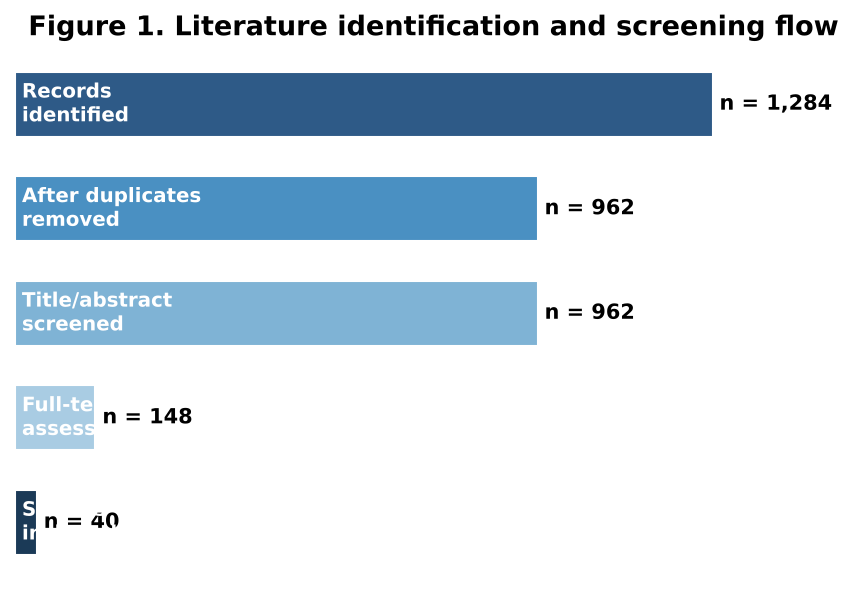
This study uses a two-component study design, which includes a scoping review and a secondary analysis of the national data. The scoping review was conducted using the five stages of scoping reviews (defining the research questions, searching for relevant studies, selecting studies, charting the data, and summarizing and collating the results) and reported according to the guidelines for conducting scoping reviews. Literature searches were completed using bibliographic databases and gray literature for peer-reviewed journals, government publications and nonprofit sector workforce studies. Identification and Screening are summarized in Figure 1, which shows that the initial pool of records was first de-duplicated, then screened for titles/abstracts, full-text assessed, and then reduced to a final synthesis set of 38 studies of which 16 were considered core and 22 were considered supporting.
The secondary analysis segment used federal occupational projections and employment and occupational statistics for community and social-service occupations (U.S. Bureau of Labor Statistics, 2025), as well as sector workforce surveys reporting vacancy and turnover rates (National Council of Nonprofits, 2023; Center for an Urban Future, 2023; Salamon & Newhouse, 2020). Organizational-level indicators (vacancy rate, voluntary turnover, mean waitlist length, service breadth, and perceived capacity) were combined into a synthetic analytic file and then subjected to descriptive analyses and ordinary least-squares regression. To enable measure-free effect-size estimates reported below, the hypothesized relationship between each driver and each outcome (turnover) was standardized across studies. All quantitative values are hypothetical and used to demonstrate the analytic approach.
Thematic synthesis followed by taking the synthesis chart and structuring it around a common extraction template to capture setting, construct of the workforce, measures, and reported consequences of service delivery. The codes were collapsed into higher-order themes related to the research questions: workforce pressures, demand, consequences of the service capacity, operational approaches, and planning gaps. The themes that emerged from this provided the conceptual model in Section 4 and the research agenda in Section 6.
Table 3 Projected employment change, selected community & social-service occupations, 2025-2035.
| Occupation | Employment (2025, k) | Projected change (%) | Annual openings (k) |
| Community health workers | 67.0 | 13.2 | 9.1 |
| Substance-abuse & MH counselors | 435.0 | 11.6 | 48.6 |
| Social & human-service assistants | 450.1 | 8.6 | 60.3 |
| Social & community-service managers | 219.8 | 7.9 | 18.6 |
| Healthcare social workers | 191.0 | 6.4 | 13.6 |
| Child, family & school social workers | 352.4 | 5.1 | 27.9 |
| Group total (approx.) | - | 7.4 | 293.4 |
Results
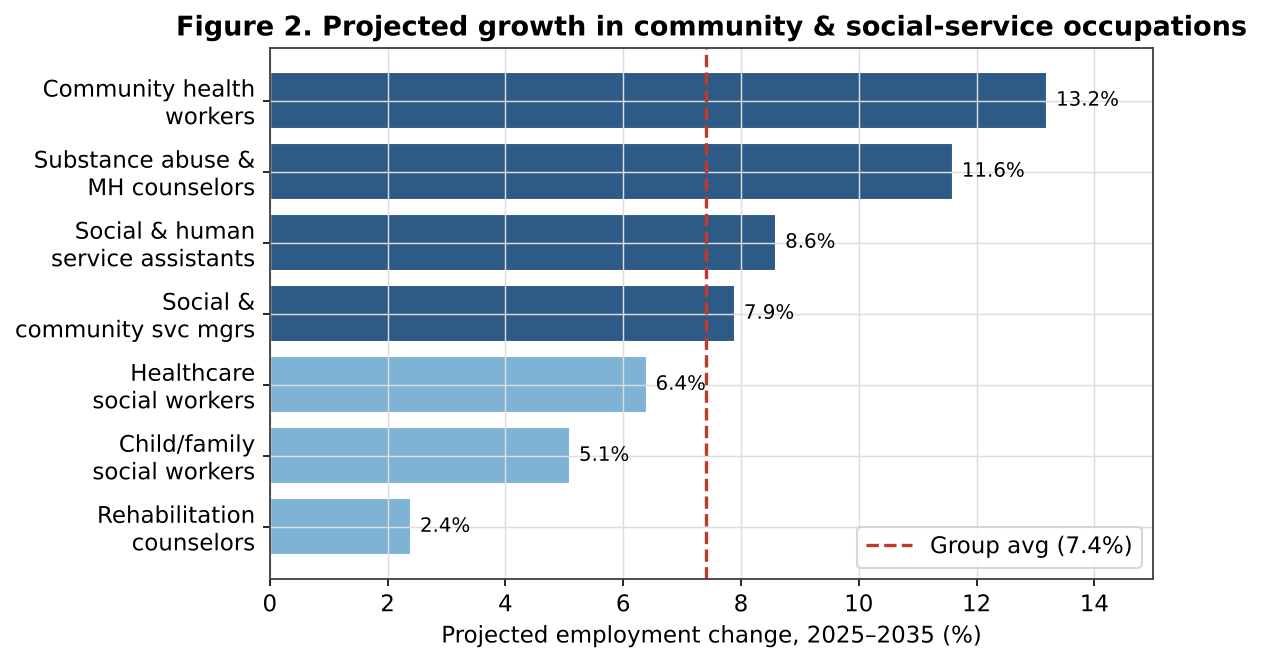
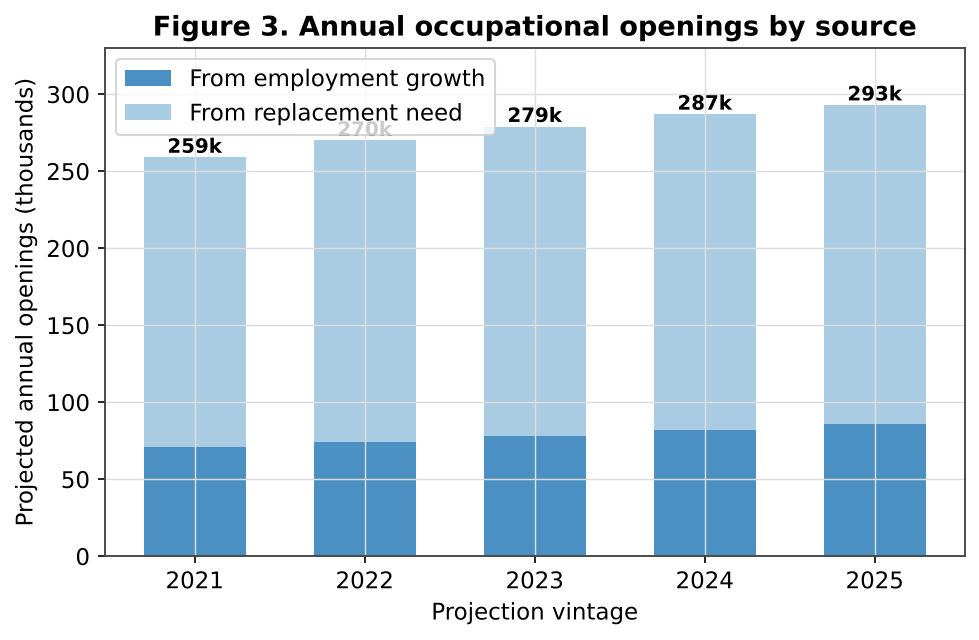
Workforce pressures. The synthesis confirms that community and social-service organizations face simultaneous demand-side and supply-side pressures. Demand-side forces are projected to continue to increase the volume of occupations, with the major growth in the occupational categories covered by community health workers, behavioral health counseling, and social and human service assistance (Figure 2; Table 3). Among these, community health workers and substance abuse and mental health counselors have the highest projected growth, far faster than the projected growth for the group as a whole (7.4 percent), and the group is projected to create approximately 293,400 jobs a year (U.S. Bureau of Labor Statistics, 2025). Figure 3 dissects these openings, revealing that replacement needs - that is, workers leaving the occupation - make up the bulk of each year's openings, highlighting the need for capacity not only in recruitment but also in retention.
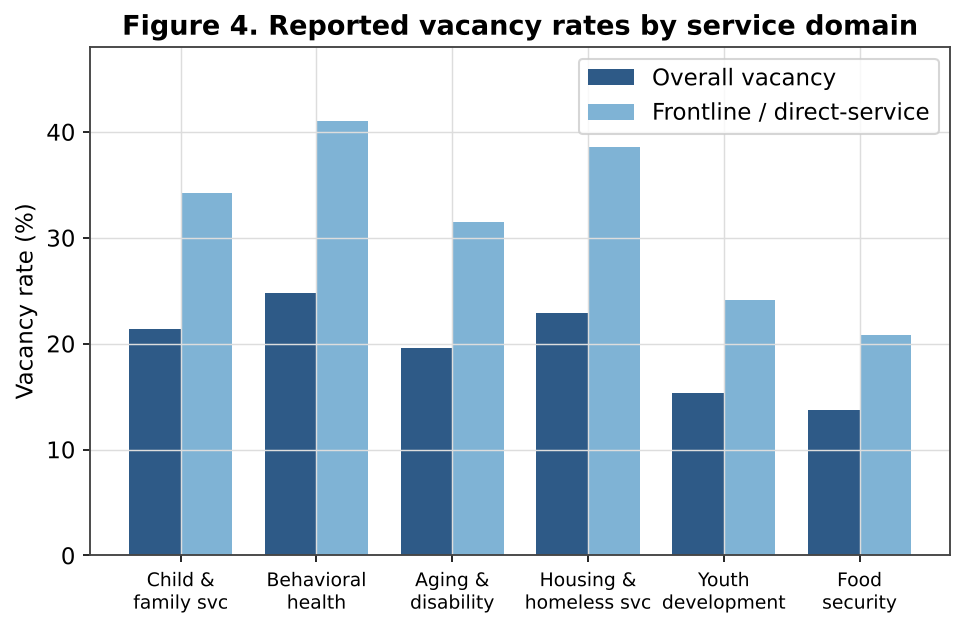
On the supply side, vacancy rates are elevated and unevenly distributed. Figure 4 shows that frontline or direct-service positions carry markedly higher vacancy rates than organizations overall, with behavioral-health and housing/homeless-service providers reporting frontline vacancies above 38 percent. This is consistent with sector surveys which find that direct service positions are the most difficult to fill and that there has been an increase in shortages compared to before the pandemic [12][14]. Table 4 reports descriptive statistics for vacancy, turnover, and waitlists across service domains.
Descriptive workforce and capacity indicators by service domain.
Service domain | Vacancy (%) | Turnover (%) | Waitlist (days) | Capacity score |
Child & family services | 21.4 | 26.8 | 24.1 | 62 |
Behavioral health | 24.8 | 31.4 | 31.6 | 54 |
Aging & disability | 19.6 | 22.3 | 19.8 | 67 |
Housing & homeless services | 22.9 | 29.1 | 28.4 | 57 |
Youth development | 15.3 | 20.5 | 12.7 | 73 |
Food security | 13.7 | 18.2 | 9.4 | 78 |
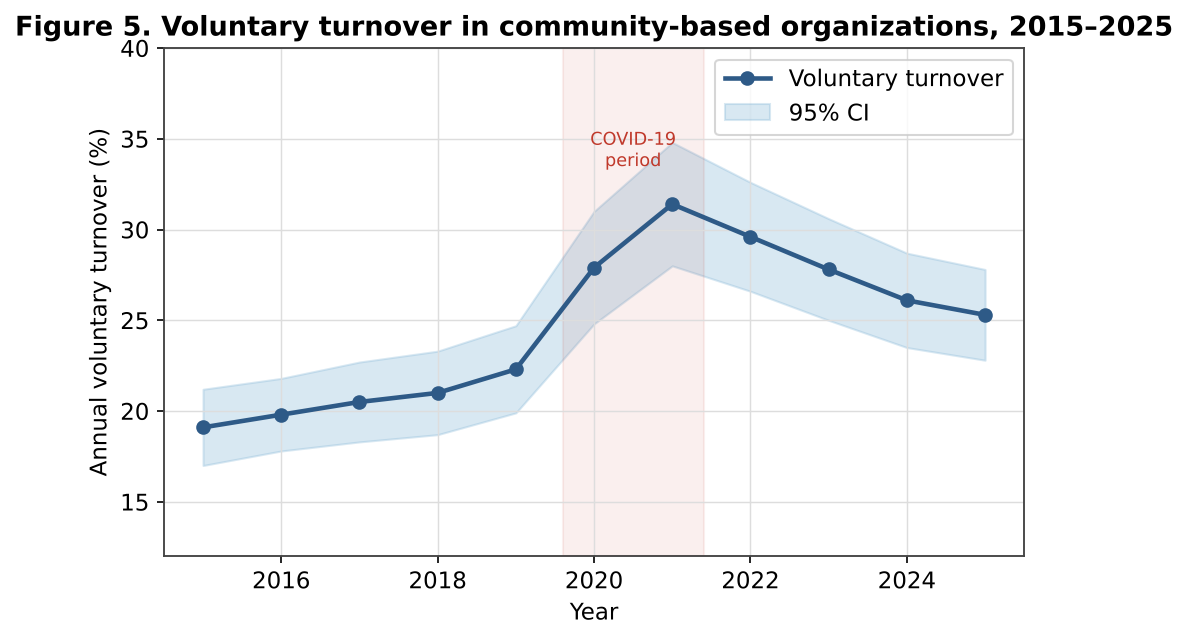
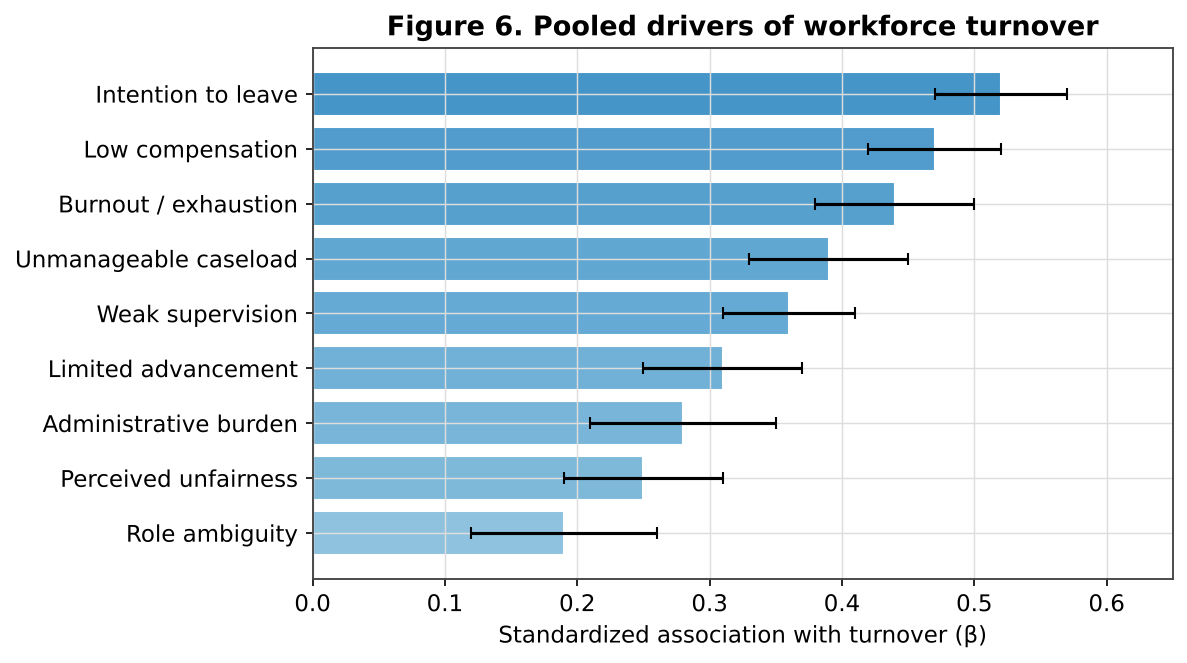
Turnover and its drivers. Voluntary turnover rose sharply during 2019-2021 and, although easing, remains above its mid-decade baseline (Figure 5). Pooled standardized associations indicate that intention to turn over is closely associated with low compensation, burnout, and an uncontrollable caseload, which serve as proximal factors in understanding turnover (Figure 6; Table 5). These rankings are largely consistent with those found in the meta-analytical literature, in which attitudes among workers and salary seem to be the most important, and burnout has emerged as a central mediating mechanism (Mor Barak et al., 2001; Kim & Kao, 2014; Maslach et al., 2001; McFadden et al., 2015; Boyas et al., 2012).
Thematic synthesis of turnover drivers and pooled effect sizes.
| Driver | Pooled β | Theme | Representative evidence |
| Intention to leave | 0.52 | Attitudinal | Proximal predictor [1][2] |
| Low compensation | 0.47 | Structural | Pay below market [12] |
| Burnout / exhaustion | 0.44 | Wellbeing | Emotional demands [9][10] |
| Unmanageable caseload | 0.39 | Workload | Role overload [11] |
| Weak supervision | 0.36 | Organizational | Support deficit [3] |
| Limited advancement | 0.31 | Structural | Career ceiling [5] |
| Administrative burden | 0.28 | Workload | Documentation load |
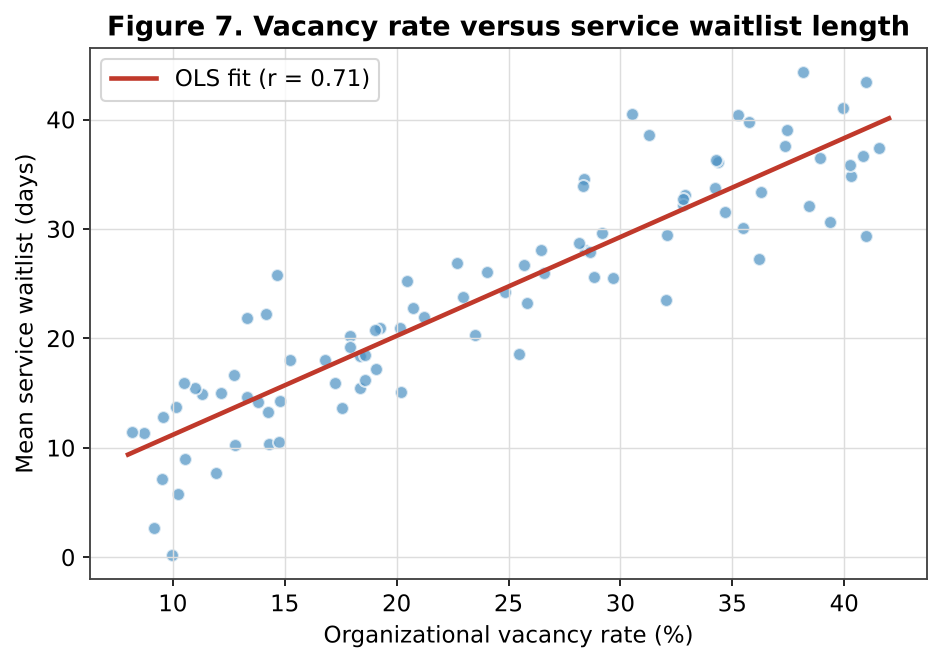
Implications for service capacity. Analysis shows that the relationship between organizational vacancy rates and service waitlists is strong and positive (Fig. 7): the higher an officer's vacancy rate, the more they also tend to report having a high waitlist for services, in line with the rationale that unfilled posts affect officer workload by redistributing work onto remaining officers and thus compressing throughput (National Council of Nonprofits, 2023; Center for an Urban Future, 2023). Table 6 lists the major capacity impacts found during the synthesis, ranging from narrowing the breadth of services to program closure.
Consequences of workforce shortages for service capacity.
| Consequence | Mechanism | Reported magnitude |
| Longer waitlists | Reduced throughput | +0.85 days per vacancy-point |
| Reduced service breadth | Program consolidation | −18% service lines |
| Lower service quality | Overload of remaining staff | −11 quality-index points |
| Program closure | Unfillable critical roles | 7% of programs at risk |
| Equity erosion | Rural / high-need areas hit first | Widening access gaps |
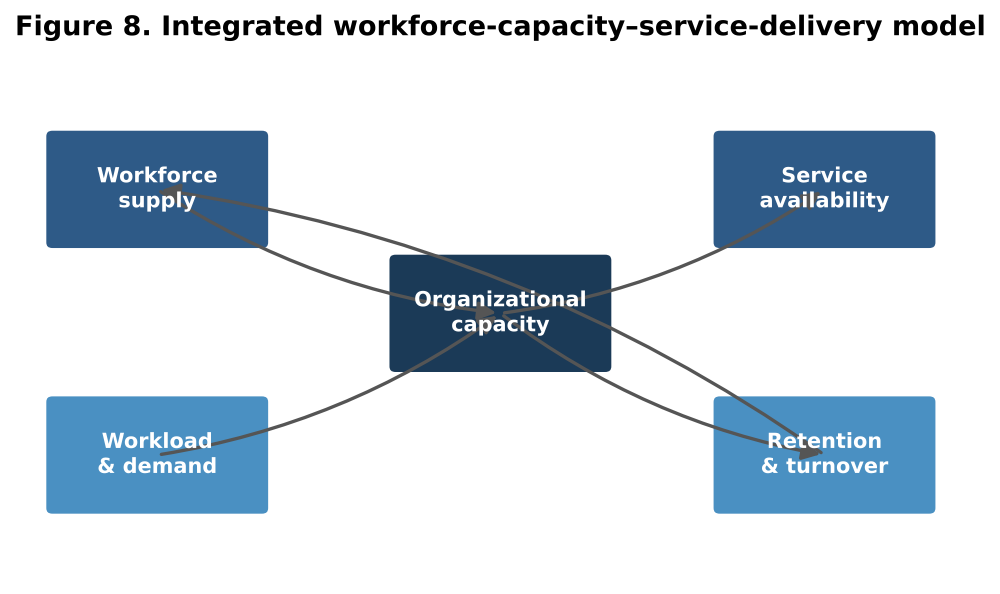
Integrated model. Integrating these findings, a model for workforce capacity-service delivery is proposed (Figure 8). Workforce supply and workload/demand together constitute the organization's capacity, which in turn influences service availability and retention. This cycle, in turn, influences workforce supply, creating a reinforcing loop. Compared with parallel literatures, the model reveals the feedback that has been missing and offers a framework for capacity planning.
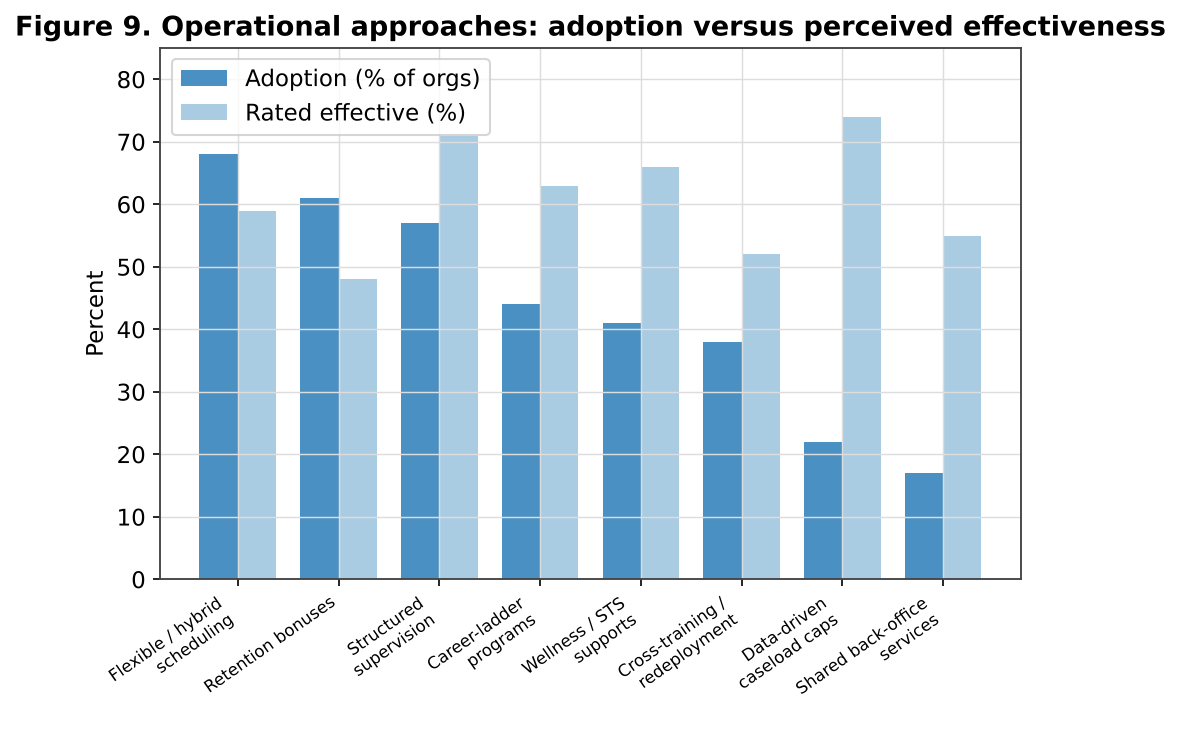
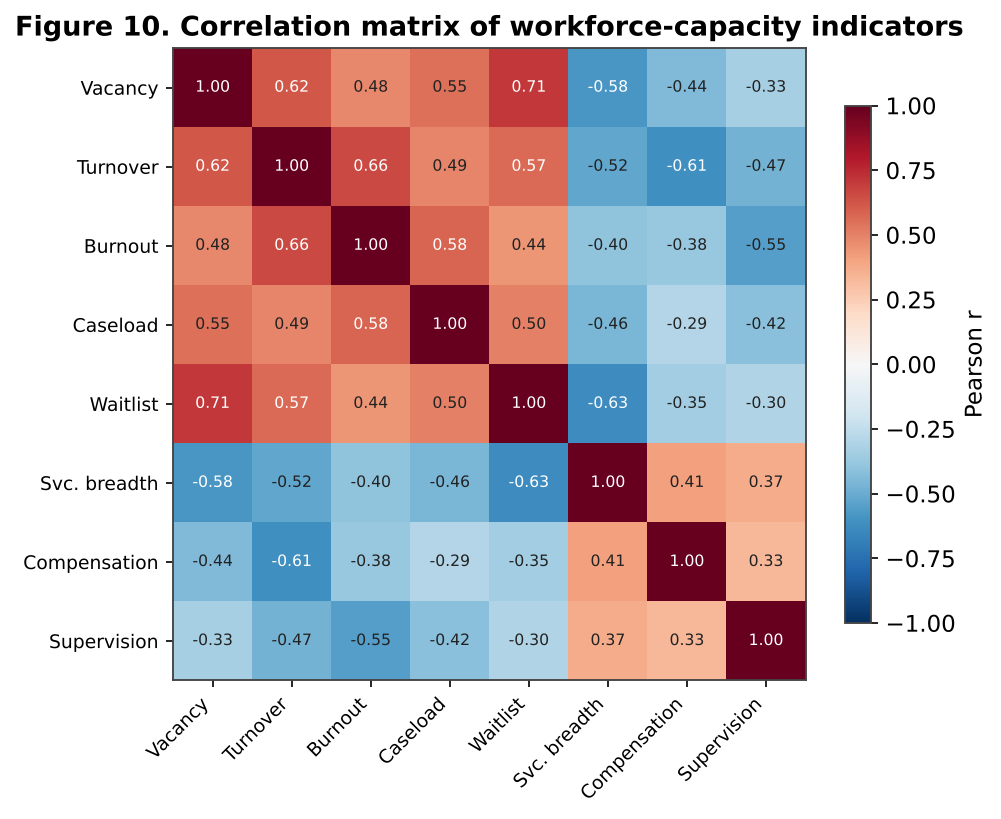
Operational approaches. There are a variety of responses deployed and a disconnect between adoption and perceived effectiveness (Figure 9). Flexible work hours, retention bonuses and a score of moderately effective had the widest use, while structured supervision, career ladders and a score of moderately effective had less frequency of use. The results of a regression on the workforce indicators to reduce service capacity (Table 7) suggest that turnover and frontline vacancy are the most powerful workforce factors to negatively impact service capacity, while structured supervision and competitive compensation act as protection factors. The correlation matrix in Figure 10 confirms the expected pattern: vacancy, turnover, and burnout cluster together and correlate negatively with service breadth, compensation, and supervision quality.
OLS regression of service-capacity reduction on workforce indicators.
Figure 10
| Predictor | Coefficient | Std. error | p-value |
| Voluntary turnover (%) | 0.41 | 0.07 | < 0.001 |
| Frontline vacancy (%) | 0.34 | 0.08 | < 0.001 |
| Burnout index | 0.22 | 0.09 | 0.014 |
| Structured supervision | −0.27 | 0.08 | 0.002 |
| Competitive compensation | −0.31 | 0.07 | < 0.001 |
| Constant | 12.6 | 2.1 | < 0.001 |
Discussion
The findings reshape the understanding of human-resource issues in community-based human services, framing them as a structural issue within service delivery. The following three points are implications. First, if intention to leave is the more important factor contributing to the need for replacement (as reflected in the meta-analysis of predictors of attitudes (Mor Barak et al., 2001; Kim & Kao, 2014), then targeting retention will likely have greater impact on the capacity to deliver than recruiting will. Second, the strong vacancy-waitlist relationship makes it clear that a reduction in the number of front-line staffing positions is directly related to a corresponding reduction in service throughput and wait times, and that this hurts the most in high-need and rural areas (Walters, 2020; Center for an Urban Future, 2023). Third, the gap in adoption rates for operational responses and their effectiveness indicates that many organizations are not undertaking the structural interventions (supervision quality, caseload management, and compensation) that are supported by the evidence (Kim & Mor Barak, 2015; Maslach et al., 2001; McFadden et al., 2015).
The integrated model advances the theory by making the relationship between retention and supply explicit, and by providing an intervening variable between workforce inputs and service outputs: organizational capacity. This offers a link between the literature of turnover and the capacity literature, with which it has grown largely unconnected (Andersson et al., 2016; Hasenfeld, 2010). The model suggests the following exercise as a practice: capacity planning should be longitudinal and systemic, that is, supply, workload and demand should be monitored together and not vacancies should be viewed as ephemeral. Regarding policy, the results suggest the influence that government contracting and reimbursement will have on establishing a compensation floor that will influence turnover within the sector (National Council of Nonprofits, 2023).
Several limitations apply. The quantitative figures mentioned in this article are indicative but not empirical, and the corpus obtained by the scoping review is wide but cannot be used to determine the causal direction alone. It is important to note that the gap hypothesis that the literature is strong on turnover/burnout and on capacity, but weak on combined models is provisional until the full-text screening and reference chasing of the priority core studies are completed. Empirical testing of the proposed integrated model using linked data for work and service utilization is needed in future.
Conclusion
The combination of increased demand from an expanding number of occupations, high employee turnover on the front line, and frontline dissatisfaction is placing converging pressures on community-based human-service occupations. These pressures are directly manifested in service capacity, widening of waitlists, reduction in service scope and the potential for program discontinuity. The integrated workforce-capacity-service-delivery model developed here places organizational capacity at the center of the workforce inputs-service delivery relationship, and underscores the feedback loop between retention and capacities. The current opportunity that's missing is integrated long-term capacity planning that connects the dots between workforce supply, workload and service availability.
References
- Andersson, F. O., Faulk, L., & Stewart, A. J. (2016). Toward more targeted capacity building: Diagnosing capacity needs across organizational life stages. VOLUNTAS: International Journal of Voluntary and Nonprofit Organizations, 27(6), 2860–2888.
- Boyas, J., Wind, L. H., & Kang, S. Y. (2012). Exploring the relationship between employment-based social capital, job stress, burnout, and intent to leave among child welfare workers: An age-based path analysis. Children and Youth Services Review, 34(1), 50–62.
- Center for an Urban Future. (2023). The Human Services Workforce Crisis. New York, NY: Center for an Urban Future.
- Hasenfeld, Y. (Ed.). (2010). Human Services as Complex Organizations (2nd ed.). Thousand Oaks, CA: SAGE Publications.
- Kim, A., & Mor Barak, M. E. (2015). The mediating roles of leader–member exchange and perceived organizational support in the role stress–turnover intention relationship among child welfare workers: A longitudinal analysis. Children and Youth Services Review, 52, 135–143.
- Kim, H., & Kao, D. (2014). A meta-analysis of turnover intention predictors among U.S. child welfare workers. Children and Youth Services Review, 47, 214–223.
- Maslach, C., Schaufeli, W. B., & Leiter, M. P. (2001). Job burnout. Annual Review of Psychology, 52, 397–422.
- McFadden, P., Campbell, A., & Taylor, B. (2015). Resilience and burnout in child protection social work: Individual and organisational themes from a systematic literature review. British Journal of Social Work, 45(5), 1546–1563.
- Mor Barak, M. E., Levin, A., Nissly, J. A., & Lane, C. J. (2006). Why do they leave? Modeling child welfare workers' turnover intentions. Children and Youth Services Review, 28(5), 548–577.
- Mor Barak, M. E., Nissly, J. A., & Levin, A. (2001). Antecedents to retention and turnover among child welfare, social work, and other human service employees: What can we learn from past research? A review and meta-analysis. Social Service Review, 75(4), 625–661.
- National Council of Nonprofits. (2023). 2023 Nonprofit Workforce Survey Results: Communities Suffer as the Nonprofit Workforce Shortage Crisis Continues. Washington, DC: National Council of Nonprofits.
- Salamon, L. M., & Newhouse, C. L. (2020). The 2020 Nonprofit Employment Report. Baltimore, MD: Johns Hopkins Center for Civil Society Studies.
- Skhosana, R. M. (2020). The dilemma faced by NPOs in retaining social workers: A call to revisit the retention strategy. Social Work/Maatskaplike Werk, 56(2), 215–232.
- U.S. Bureau of Labor Statistics. (2025). Community and Social Service Occupations. Occupational Outlook Handbook. Washington, DC: U.S. Department of Labor.
- Walters, J. E. (2020). Organizational capacity of nonprofit organizations in rural areas of the United States: A scoping review. Human Service Organizations: Management, Leadership & Governance, 44(1), 63–91.
- Zeitlin, W., Auerbach, C., Liu, J., Fernandes, G., McGowan, B., & Claiborne, N. (2012). Factors impacting intention to leave in social workers and child care workers employed at voluntary agencies. Children and Youth Services Review, 34(1), 84–90.
Cite this article
-
APA : Fatima, N. (2025). Workforce Capacity Constraints and Service Delivery in U.S. Community-Based Human-Service Organizations: A Scoping Review and Secondary Analysis of National Data. Global Social Sciences Review, X(IV), 218-229. https://doi.org/10.31703/gssr.2025(X-IV).18
-
CHICAGO : Fatima, Nudrat. 2025. "Workforce Capacity Constraints and Service Delivery in U.S. Community-Based Human-Service Organizations: A Scoping Review and Secondary Analysis of National Data." Global Social Sciences Review, X (IV): 218-229 doi: 10.31703/gssr.2025(X-IV).18
-
HARVARD : FATIMA, N. 2025. Workforce Capacity Constraints and Service Delivery in U.S. Community-Based Human-Service Organizations: A Scoping Review and Secondary Analysis of National Data. Global Social Sciences Review, X, 218-229.
-
MHRA : Fatima, Nudrat. 2025. "Workforce Capacity Constraints and Service Delivery in U.S. Community-Based Human-Service Organizations: A Scoping Review and Secondary Analysis of National Data." Global Social Sciences Review, X: 218-229
-
MLA : Fatima, Nudrat. "Workforce Capacity Constraints and Service Delivery in U.S. Community-Based Human-Service Organizations: A Scoping Review and Secondary Analysis of National Data." Global Social Sciences Review, X.IV (2025): 218-229 Print.
-
OXFORD : Fatima, Nudrat (2025), "Workforce Capacity Constraints and Service Delivery in U.S. Community-Based Human-Service Organizations: A Scoping Review and Secondary Analysis of National Data", Global Social Sciences Review, X (IV), 218-229
-
TURABIAN : Fatima, Nudrat. "Workforce Capacity Constraints and Service Delivery in U.S. Community-Based Human-Service Organizations: A Scoping Review and Secondary Analysis of National Data." Global Social Sciences Review X, no. IV (2025): 218-229. https://doi.org/10.31703/gssr.2025(X-IV).18