
- To frame youth involvement and engagement in research into guidance agencies and a structural approach
- To explore through peer-reviewed research the pros of youth engagement in sociological and psychological research
- To create a link between the existing body of research on barriers to youth engagement in research and Pakistan's context
- To suggest dimensions for future research regarding youth engagement in sociological and psychological research
- Youth engagement and sociological research
- Youth engagement and psychological research
- Youth engagement and barriers and sociological and psychological research
Abstract
As review-based research, this study uses Anthony Giddens's agency and structure approach to highlight youth engagement in sociological and psychological research in Pakistan. 22 research papers were sampled through keyword search, while the data were analyzed with the reflexive thematic analysis by Braun and Clark(2019). The researcher's bias has been reduced through reflexivity and independent review by PhD-level reviewers. Findings show that multifaceted barriers, such as lack of funding, lack of interest of stakeholders, lack of culture of engaging youth in research, and ethical dilemmas, work as barriers to youth engagement in sociological and psychological research in Pakistan. The benefits of engaging youth in sociological and psychological research in Pakistan include developing leadership skills, understanding of local social problems, and developing a knowledge-based system for sociological and psychological knowledge. Finally, stakeholders, NGOs, and governmental organizations can play an important role in engaging youth in sociological and psychological research in Pakistan.
Keywords
Youth Engagement, Psychological, Sociological, Barriers, Benefits
Introduction
Background of Study
Trends are very important in research, whereby the target population constitutes a significant dimension of any research activity. Researchers target different demographic components of the population, including children, youth, middle-aged populations, and elderly populations. Different features and characteristics of different segments of populations are explored by researchers. Due to many reasons, youth are ignored as a target population in the research activity, but most importantly, their involvement in the research activity (Berkens, 2013). Malcolm et al. (2020) assert that research relevant to youth is usually about education, economic planning, civic engagement, and changing trends in social life.
One of the dimensions of research considering youth is the participation, involvement, and engagement of the young people in research. There are two broader dimensions of this discussion: first, researching young people; and secondly, involvement and engaging young people in the research process. Research on young people is a relatively common trend, whereas involvement in engaging young people in the research process is a rare phenomenon. Involvement and engagement of youth in the research process are rare due to multifaceted, intertwined factors. These factors include financial aspects, attitude and perception about young people, lack of understanding of the importance of involvement of young people in research, funding-related issues, and significant focus on exploring issues about other segments of populations, such as women, children, and the elderly (McCabe et al., 2023).
Besides the barriers to involvement and engagement of youth in research, there is a need to understand the benefits of involvement and engaging youth in research (Mason & Hood, 2011). The previous debate can be used as a justification for the benefits of involvement in engaging youth in research, for example, youth can be involved in research to understand the issues related to women, children, and the elderly. This is an indication that youth is a resource in the process of researching.
Theoretically, Anthony Giddens's framework can be utilized to understand youth involvement and engagement in research. In this regard, the notion of agency and structure is a guideline framework. Youth is a segment of the population that can be utilized as a source of change through the process of research (Anam, 2025). Considering this debate, it is imperative to explore the purposeful use of youth in the research process to understand different socio-economic, political, and psychological issues related to society.
Objectives of the study
Methodology
This is review-based research, whereby the purpose is to explore the existing body of knowledge regarding youth research specific to sociology and psychology. The current body of knowledge regarding youth engagement in research regarding Pakistan is almost neglected and lacking, which hinders the application of research done on youth engagement and its application to the Pakistani context. For this purpose, Google Scholar was searched to know about the Pakistani context, which showed a lack of research on Pakistan about youth engagement in social and psychological research.
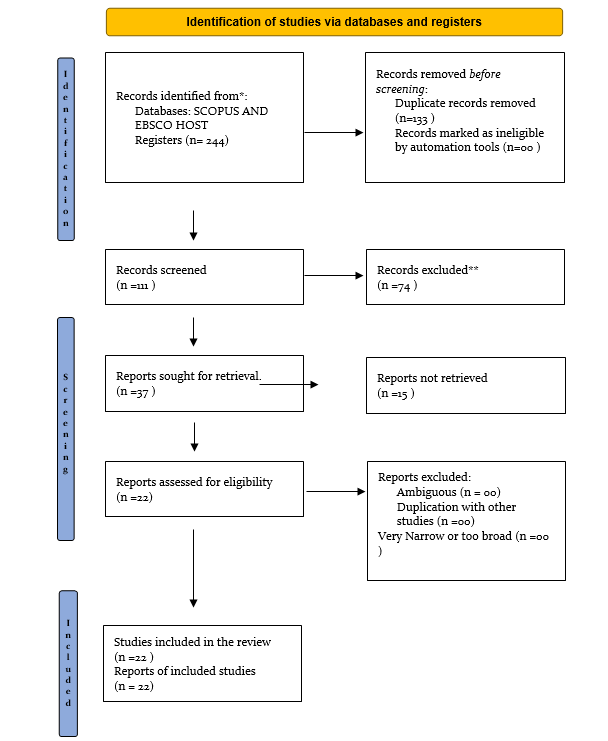
However, globally, there is a strong strand of youth engagement in research, specifically in the Western and African regions. For this purpose, two databases, including Scopus and EBSCOhost, were searched to extract existing peer-reviewed literature regarding youth engagement in sociological and psychological research. The extracted debate has been juxtaposed with Pakistan's context. The databases yielded 244 results. 133 results were duplicated. Among 111 results, 74 were not relevant to social and psychological research. 37 results were screened, whereby 22 were sampled for this study. The keywords included:
The flow chart is as follows:
It is important to consider the biases in selecting the study for review and the extraction of findings. To reduce researchers' bias in selecting papers for youth engagement in sociological and psychological research, a well-known process of peer review for selecting papers was carried out, whereby 2 independent PhD-level colleagues studied the sampled papers and selected and excluded papers for review, which reduced the bias. The colleagues were instructed with the title and scope of the study so that they could identify and retrieve the most relevant papers.
The analysis technique is based on Braun and Clark's (2019) reflexive thematic analysis, which is one of the widely used analysis techniques in qualitative research. Sample research papers were studied so that researchers are familiarized with concepts and issues relevant to youth engagement in sociological and psychological research. Important phrases were coded, and 2nd order concepts were extracted, leading to world-reaching themes. That we're reaching teams was compared and contrasted, and findings were extracted, which are later mentioned in the discussion in this document.
Theoretical Framework
Umar (2019) asserts about planned behavior regarding the involvement of individuals or participants in research. In this regard, the scope of this study is relevant to plans that involve youth in sociological and psychological research. Research is a systematic process, and therefore, planning is an important dimension of human involvement in sociological and psychological research. Another work by Schelbe et al. (2015) is about the strategies for improving youth involvement and engagement in research. This research focused on different regions, but most importantly targeted middle-income and poor regions where research-related practices are not standardized. This provides a good background for writing this discussion paper and provides guidelines.
Anthony Giddens's framework can be utilized to understand youth involvement and engagement in research. In this regard, the notion of agency and structure is a guideline framework. Youth is a segment of the population that can be utilized as a source of change through the process of research (Anam, 2025). Considering this debate, it is imperative to explore the purposeful use of youth in the research process to understand different socio-economic, political, and psychological issues related to society.
Results
Why are Youth not engaged in Research?
The most prominent finding in the studies sampled showed that there are many barriers to youth engagement in sociological and psychological research, specifically in middle-income and poor regions. Hawke et al. (2018) stated that the research practices in middle-income and poor regions are not standardized, and they often lack proper planning. The research is usually a descriptive analysis of a given situation, and the important stakeholders in the process of research are ignored, including youth, as an important stakeholder. Fisher et al. (2013) stated that misperceptions and stereotypes about youth lead to a lack of involvement and engagement in research. For example, Stereotyping youth is inexperienced. Clark (2015) found that youth are underestimated, considering the misperception in stereotyping of youth, leading to a lack of engagement in research. This is particularly true about the usefulness of youth in social and psychological research. The work by Campbell (2008) is also relevant in connection with answering the question of why young people are not engaged in social and psychological research. The answer lies in stereotyping youth for their immaturity, which works as a significant barrier to youth engagement in research.
In Pakistan, funding research is regarded as one of the major challenges in engaging different stakeholders in the research classes, which is also relevant in connection to sociological and psychological research. This is highlighted by many studies at international levels as well, that many funding agencies do not consider the importance of youth as a stakeholder, which is a barrier to youth engagement in sociological and psychological research. In Pakistan, the funded research is already limited; however, the limited research also does not focus on youth engagement as an important component, which can contribute significantly to the development of research and filling knowledge gaps regarding Pakistani society.
Ethical dilemmas are important in connection with youth engagement in research. It is a global barrier to youth engagement and sociological and psychological research. Sociological and psychological research is sensitive in many ways, for example, investigating gender sensitive issues, social and economic dimensions of HIV/AIDS, causes and impacts of terrorism, and even exploring mental health issues and sexuality (Malla et al., 2021). Sociological and psychological research is sensitive in nature, and in many cases, engaging stakeholders may expose them to harm and may violate their rights. Lisa (2015) calls it "risk of coercion". Gatekeepers and key informants, and lack of trust-related issues are also considerable in this regard.
How can Youth Engagement in Sociological and Psychological Research Benefit Society?
The initial answer provided by the existing body of knowledge is very simple, i.e., a better understanding of social and psychological issues resulting in better policy making. A better understanding of social psychological issues in a way to involve youth or simply the community leads to understanding the problems through the lens of cultural and normative theories. This provides a policymaker's approach to a problem from a normative cultural lens, which provides a better acceptance among the community to solve the problem through different approaches and programs.
Making youth skillful is also a key consideration, whereby engagement of youth in the research process leads to improvement in their skills. This is very applicable in the context of educational institutions, whereby students from universities can be involved in exploring social and psychological issues. This offers a skilled youth to work in the same societies in the future, which has numerous benefits (Malcolm et al., 2020). Therefore, youth can learn about the research process to explore different social and psychological problems in their respective societies.
Intervention is another significant dimension to bring improvement in social and psychological metrics in any given society. Research-based intervention provides a better opportunity for policymakers to intervene in the most effective manner. Hawk (2020) explored that the involvement of youth in social and psychological research will lead to a better understanding and more suggestions for more appropriate interventions. Macionis (2014) asserts that local youth can work with international organizations in developing regions to bring improvement through research. This argument also indicates the importance of indigenous knowledge, which can be best achieved through engaging youth in research. There is no doubt that indigenous knowledge is the best way to provide a solution to social problems. This is relatable in connection with social action programs, where social problems are researched and policies are devised as per findings from research on communities. It shows that youth engagement in research can be utilized as a source of positive change in any given community and society.
The theory by Anthony Giddens, such as agency and structure, is also applicable, whereby youth can be an agency for changes in the structures of the community for positive social change. In this regard, youth engagement in research can be considered as a social action whereby the youth is a social actor. Many dimensions of civic engagement, the role of non-governmental organizations, and national and international donor agencies are relevant in this connection. Youth can be engaged in research by considering them as social actors in the process of positive social change, such as understanding local social problems, stakeholders in the intervention process, and preparing them for future ventures (Bakhshi et al., 2023). With this argument, it can also be asserted that youth engagement in research can prepare young people for leadership in the future. By involving all youth in social and psychological research, we'll prepare them for leadership with the qualities of understanding local social problems. Supporting literature in this regard includes a bulk of studies that proved that Youth engagement in research in the developed world is one of the causes of socioeconomic development. These studies include Ennals et al. (2021) and Vivian et al. (2020). Henderson et al. (2018) and Kennan and Dolan (2017).
What is required to Engage Youth in Sociological and Psychological Research in Pakistan?
Identification and exploration of the importance of engagement of youth in sociological and psychological research is the first step towards engaging youth in research in Pakistan. The role of stakeholders is very important, whereby educational institutes, non-governmental organizations, and governmental agencies should play an integral role (Almari et al., 2020). The role of these stakeholders is to consider funding for engaging young people in sociological and psychological research. These stakeholders must inculcate the culture of engaging youth in sociological and psychological research. Appraised approach in terms of age prevails in engaging different age groups in research, such as children and the elderly, whereas youth is usually ignored, whereby the need is to focus on future leadership and enhanced capabilities of managing social problems in the community and society. This suggestion doesn't mean that children, the elderly, and women should be ignored in terms of engagement in research. These suggestions are supported by the Pakistan Institute for Peace Studies (2019).
Areas for Engaging Youth in Sociological and Psychological Research in Pakistan
In Pakistan, there is a lack of focus on a knowledge-based approach towards social and psychological issues in the community and society (Mahmood et al., 2025). The key area of social psychological research to engage youth in Pakistan includes social aspects of physical illnesses and mental illnesses, exploring social problems such as low income and poverty, terrorism and political instability, migration and psychology behind migration, changes in social demographic indicators considering social factors and psychological factors, etc.
Future Research
Reviewing this article provides some useful insights regarding future research in the context of youth engagement in sociological and psychological research in Pakistan. First, there is a need for qualitative explorations, such as phenomenological inquiries into the approach of youth in their engagement in research. Secondly, there is a need for large-scale surveys to understand the patterns of engagement of youth research in Pakistan, bringing sociological and psychological dimensions. Thirdly, the alignment of sociological and psychological aspects of research can be explored, considering the importance of youth engagement.
References
- Anam, R. (2025). Anthony Giddens's Structuration Theory And Relevance With Sociology Of Knowledge. SSRN Electronic Journal. https://doi.org/10.2139/ssrn.5151645
- Bakhshi, S.K., Abdul Rahim, K., Merchant, A. A.H., et al. (2023). Barriers to research productivity amongst postgraduate trainees: results from a survey of 333 medical and surgical residents. Postgrad Med Journal, 99:1182–8. https://doi.org/10.1136/postgradmedj-2022-142354
- Braun, V., & Clarke, V. (2019). Reflecting on Reflexive Thematic Analysis. Qualitative Research in Sport, Exercise and Health, 11(4), 589-597. https://doi.org/10.1080/2159676X.2019.1628806
- Campbell, A. (2008). For their own good: recruiting children for research. Childhood, 15(1), 30-49.
- Clark, S. A. (2015). “Child’s rights perspective”: the “right” of children and young people to participate in health care research. Issues Compr Pediatr Nurs, 38(3), 161-180.
- Fisher, C. B., Brunnquell, D. J., Hughes, D. L., & al., e. (2013). Preserving and enhancing the responsible conduct of research involving children and youth: A response to proposed changes in federal regulations. Social Policy Report, 27, 1-23.
- Hawke, L. D., Darnay, K., Relihan, J., & al, e. (2020). Enhancing researcher capacity to engage youth in research: Researchers’ engagement experiences, barriers and capacity development priorities. Health Expect, 23, 584– 592.
- Hawke, L. D., Relihan, J., Miller, J., McCann, E., Rong, J., Darnay, K., Docherty, S., Chaim, G., & Henderson, J. L. (2018). Engaging youth in research planning, design and execution: Practical recommendations for researchers. Health expectations: an international journal of public participation in health care and health policy, 21(6), 944–949. https://doi.org/10.1111/hex.12795
- Kennan, D., & Dolan, P. (2017). Justifying children and youth people’s involvement in social research: Assessing harm and benefit. Irish Journal of Sociology. Irish Journal of Sociology, 25(3), 297-314.
- Mahmood, A., Rehman, N., Huang, X. & Riaz, I. (2025). Barriers to undergraduate medical students’ research engagement in Pakistan: a qualitative exploration. BMC Med Educ 25, 592. https://doi.org/10.1186/s12909-025-07185-9
- Malcolm, J., Brennan, M., Webster, N., & D., P. (2020). Beyond Participation: A Case Study of Youth As Researchers and Community Development in North Philadelphia. Community Development, 51(5), 703-720.
- Malla, A., Boksa, P., Joober, R. (2021). The new wave of youth mental health services: time for reflection and caution. Can J Psychiatry, 66(7):616‐620. https://doi.org/10.1177/0706743720984382
- Mason, J., & Hood, S. (2011). Exploring issues of children as actors in social research. Children and Youth Services Review, 33, 490-495.
- McCabe, E., Amarbayan, M. M., Rabi, S., Mendoza, J., Naqvi, S. F., Thapa Bajgain, K., Zwicker, J. D., & Santana, M. (2023). Youth engagement in mental health research: A systematic review. Health expectations: an international journal of public participation in health care and health policy, 26(1), 30–50. https://doi.org/10.1111/hex.13650
- Schelbe, L., Chanmugam, A., Moses, T., Williams, L. R., Saltzburg, S., & Letendra, J. (2015). Youth Participation in Qualitative Research: Challenges and Possibilities. Qualitative Social Work, 14, 504-521.
- Umar, S. (2019). Developing a research framework for youth engagement in agripreneurship: application of the theory of planned behaviour. 19. 24-33.
- Vivian, W. L., Tsang, S. F., Charles, T., & S, S. (2020). A novel way to engage youth in research: evaluation of a participatory health research project by the International Children's Advisory Network Youth Council. International Journal of adolescence and youth, 25(1), 676-686. https://doi.org/10.1080/02673843.2020.1716817
- Wattar, L., Fanous, S., & Berliner, P. (2012). Challenges of youth participation in participatory action research: methodological considerations of the Paamiut Youth Voice research project. International Journal of Action Research, 8(2), 185-212.
Cite this article
-
APA : Khan, N., & Usra. (2024). Youth Engagement and Participation in Socio-Psychological Research: Suggestions for Research in Pakistan. Global Social Sciences Review, IX(II), 134-141. https://doi.org/10.31703/gssr.2024(IX-II).14
-
CHICAGO : Khan, Nasar, and Usra. 2024. "Youth Engagement and Participation in Socio-Psychological Research: Suggestions for Research in Pakistan." Global Social Sciences Review, IX (II): 134-141 doi: 10.31703/gssr.2024(IX-II).14
-
HARVARD : KHAN, N. & USRA. 2024. Youth Engagement and Participation in Socio-Psychological Research: Suggestions for Research in Pakistan. Global Social Sciences Review, IX, 134-141.
-
MHRA : Khan, Nasar, and Usra. 2024. "Youth Engagement and Participation in Socio-Psychological Research: Suggestions for Research in Pakistan." Global Social Sciences Review, IX: 134-141
-
MLA : Khan, Nasar, and Usra. "Youth Engagement and Participation in Socio-Psychological Research: Suggestions for Research in Pakistan." Global Social Sciences Review, IX.II (2024): 134-141 Print.
-
OXFORD : Khan, Nasar and Usra, (2024), "Youth Engagement and Participation in Socio-Psychological Research: Suggestions for Research in Pakistan", Global Social Sciences Review, IX (II), 134-141
-
TURABIAN : Khan, Nasar, and Usra. "Youth Engagement and Participation in Socio-Psychological Research: Suggestions for Research in Pakistan." Global Social Sciences Review IX, no. II (2024): 134-141. https://doi.org/10.31703/gssr.2024(IX-II).14