
- All blocks or buildings are considered as part of the CBD those who had a CBHI of 1 or more and a CBII of 50 percent or more.
- The block or building must be part of contiguous group surrounding the peak land value intersection. Even though a block touches the others, only at one corner it is considered contiguous.
- A block that does not reach the required index values, but is surrounded by blocks that did is considered part of the CBD.
- A block completely occupied by the building and ground of a city hall or other municipal office building, a municipal auditorium, city police or fire department headquarters, or a central post office is included within the CBD if it is adjacent to (or contiguous with) blocks meeting the standard requirements.
- If the structures mentioned in rule 4 occupy only part of a block, which is contiguous with other CBD blocks, and if the inclusion of these establishments as central business would bring the two indices of the block to the required totals, then the block is considered part of the CBD.
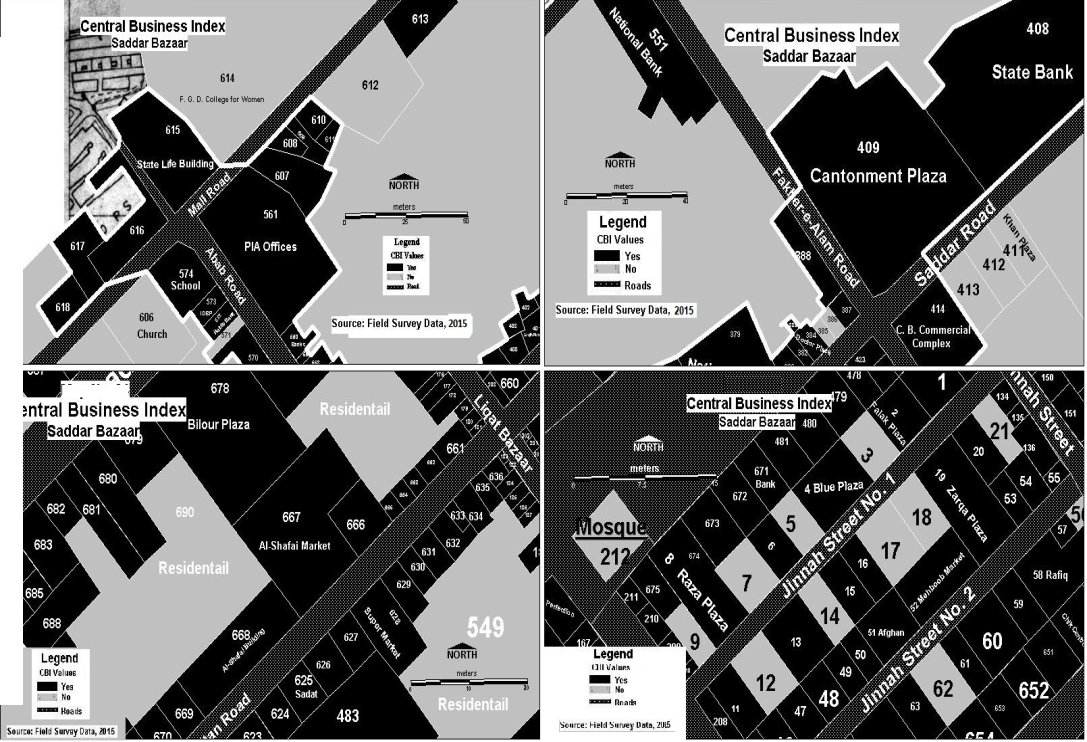
- On Mall road the State life plaza and its surrounding area included while the isolated cluster of block No. 613 on other side are not included in the CBD.
- On Fakher-e-Alam road the contiguous blocks are included in CBD while isolated blocks like national bank (Block No. 551) etc. are not included in the CBD.
- The Kabari bazaar and its surroundings (Blocks No. 94, 96, 98, 110, 111, 112, and 114) have CBI values "No", but these blocks are included in the CBDbecause it is surrounded by CB uses from all sides as under rule 3.
- In front of Shafi market, the inner portion of the main block (Block No. 690) is used for residential but almost surrounded from all side by CB uses so it is included in the CBD under rule 3.
- Dean's plaza (Block No. 410) and its surrounding are not included in the CBD as under rule 1 and 4.
- Sunehri mosque road has most complex structure but majority blocks are not included in the CBD because of its accessibility nature. The hospital mosque, schools and police station are not included under rule 4. The Peshawar shopping plaza and surrounding of Nothia road are included in the CBD as specified in rule 1 & 2.
- In Hali Street and Faizul Ullah Khan Street the blocksNo. 27, 29, 37, 38, 40, and 41 are attached with Saddar road and Fawara chowk have CBI value "Yes" while the remaining portion is in residential use. Under rule 2only contiguous parts are included in the CBD.
- In Jinnah streets blocks No. 3, 5, 7, 9, 12, 14, 17, and 18 have CBHI value one or greater than one but CBII values are lesser than 50% so their CBI values are "No". Under rule 3 all these blocks areconsidered as part of CBD because they are surrounded by blocks that are part of the CBD.
- Blocks in surroundings of Stadium Chowk have CBI value "Yes" and contiguous part the CBDso these blocks are included in the CBD. The isolated block of No. 604has CBI value "Yes" but it is not included in the CBD under rule 2.
- Blocks of No. 549, 189, 191, and 690 on Saddar road, Tipu Sultan road, and Liaqat bazaar have CBI values "No" but are included in the CBDbecause these blocks fulfil the requirement of rule 2 or 4.
Abstract
The present study identifies the limits and pattern of commercial activities within CBD of Peshawar. Retailing is topmost paying commercial activity and occupies the highest bid-rent location in the city. The Central Business District (CBD) is the retail heart of the city. The spatial arrangement of commercial activities happens to be very complex and their limits are dynamic in the CBD of Peshawar. The land value, rent values, taxation system, commuter behaviour, nature & transformation of commercial activities are directly dependent on this spatial arrangement and delimitation of CBD. The methodology adopted for this study is the combination of traditional rules/methods with modern tool of GIS. The results for spatial arrangement of commercial activities and delimitation of CBD are more precise which can enable the city planners and investors to achieve better sustainable development in city and regional context.
Keywords
Central Business District (CBD), Commercial Activities Retailing, Central Business Uses; non-Central Business Uses, Geo-spatial
Introduction
Saddar Bazaar is the Central Business District (CBD) of Peshawar which is retail heart of the city. This is the area where retailing, office, and services activities are in greater number; the highest land values, rent values, pedestrian flow, and vehicular flow are observed (Ali, 2005). CBD is the centre of employment, investment, and focus of city transportation network. Development in technology changes the means of transportation and mode of utility services due to which new commercial centres are developed (Osoba, 2012; Raymond & Vance, 1954). The location of any activity or practising land use in any area is directly dependent on land values and ultimately on accessibility, which is the basic theme of urban land economics. The commercial activities in a city are primarily important because of the city structure and economics are directly under its influence (Alonso, 1994; Proudfoot, 1937; Kachenje, Kihila, & Nguluma, 2010). The commercial land use in CBD is different from city to city in type but not in nature and there is predominantly retailing, office, financial, and services activities (Briggs, 1974; Ratcliff, 1949; Tali, Entehani, Krishna, & Nagendra, 2012). The Saddar Bazaar was developed as commercial centre newly to cater for the needs of Britishers. The Saddar Bazaar is situated in Cantonment area. Easy accessibility, space, and growth potential make this region highly attractive for investor. Here growth occurs in all directions, both vertically and horizontally (Dani, 1995; Government of Pakistan [GOP], 1999). The importance of CBD is greater than the limited extended of its area because it is the most concentrated centre of employment, inter and intra city transportation network with which other land uses are closely related (Harris & Ullman, 1945; Kachenje, Kihila, & Nguluma, 2010). The delimitation of CBD of Peshawar provides the basic information about trading area potential& growth, business interception, site economics and accessibility to central area. The study has major attention for city planners (Briggs, 1974; Klotz, 2012). It will provide help for those who study the nature of urban function, form, structure, and morphology of the city. The size, structure and nature of CBD is important for the study of urban hierarchy, also. The limit of the Saddar Bazaar in constant flux because of new developments and convergence of residential blocks into commercial (Harris & Ullman, 1945; Mitchell, 2001; Carter & Rowley, 1966).
R.E. Murphy and J.E. Vance Jr. studied the CBD of nine American cities and produced a uniform method for the delimitation of CBDs, which could replace the fixing of boundaries, by arbitrary procedures. They mapped each plot and building of CBD under defined criteria for CB uses and non-CB uses and calculating the CB Index value for each building (Raymond & Vance, 1954). In 1958, R.L. Nelson put forward eight principles operative in the selection of retail site i.e. trading area potential, accessibility to trading area, growth potential, business interception, cumulative attraction, compatibility, the minimizing of comparative hazard, and site economics (Nelson, 1958). In 1965, the D.H. Davies studied the detail structure of the CBD in Cape Town and identified the centre of gravity of CBD through cluster analysis method (Davies, 1959 & 1960). In 1967, B. Thorngren (1967) studied the external economics of the urban core and took sample of 373 establishments in Worcester, Mass. He used seven basic functions in centre core and ranked it according to their number, space sized, and number of employees. Thus, provide the internal structure of centre core and their external economic connection with city. Goddard (1967) studied the internal structure of London's central area on the bases of six basic land uses and analysed location pattern of the offices. Valey (1968) ranked thirty lands uses and followed the cluster analysis method for identification of centre of gravity. Dittmann (1994) classified the activities in Gilgit city. On the bases of activities, bazaars were classified and their role was identified. The recent induction of modern technologies e. g. Remote Sensing (RS) and Geographic Information System (GIS) in geo-spatial analysis provides new techniques and methods for more accurate and precise analysis (Yu, Ai, & Shao, 2015; Klotz, 2012).
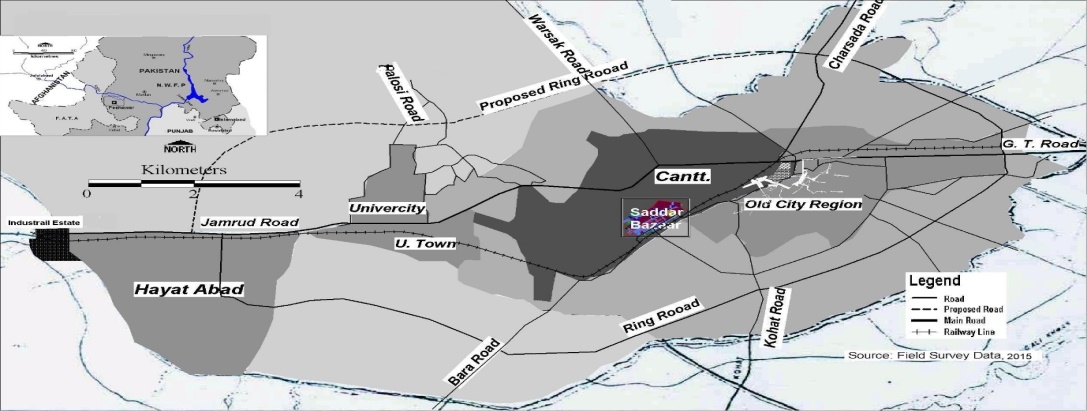
The present is an attempt to delimit the CBD of Peshawar using the land use method of CBI of Murphy and Vance Jr. with GIS. The basic theme of the study is to upgrade the traditional method with more precise and accurate results. Peshawar is an historic city with colonial background (Hart, 1985; Heston & Nasir, 1988; Rittenberg, 1988). The limits of the city extended from 33o 43/ 22.70// to 34o 11/ 45.46// North latitude and 71o 21/ 54.39// to 71o 49/ 29.34// East longitude (Figure 1). The population of the city is 1,970,042persons with 3.72 % annual growth rate (GoP, 2017). According to land valuation table of Peshawar, the cantonment area particularly the Saddar Bazaar has occupied the top most positions among all commercial areas of the city (GoP, 2016). This study focuses on the delimitation of the CBD of Peshawarwhich shows preciously retailing limits of the heart of city. The land use pattern, transitional zone, shifting of commercial activities, parking and other land use problems data are associated with this study. The present study will not only improve the methodology for delimitation of CBD but also provide information to planner and economic investors to understand the dynamic structure of the CBD and enhance their capacity to guide & control the commercial development in more sustainable manner. Certainly, this new method of geo-spatial analysis will open an avenue for research and general application to other studies of CBDs.
Methodology
The present innovative methodology of delimitation of CBD of Peshawar is a combination of traditional methods and/or rules of CBI and modern tool of Geographic Information System (GIS). The data collection and recording are carried out on traditional profile method. The land use and CBI data are stored in GIS platform and Geo-spatial analysis is carried out for delimitation of CBD. The intensive land use survey is carried out in which each plot land use data was collected and mapped through profile method. The base map scale was R.F. 1: 2400. This base map was geo-referred in GIS and thus provides accurate data of blocks' sizes. Open spaces, residential blocks, manufacturing blocks, and organizational institutions were mapped directly on base map while basic information of a building area, number of shops, and floor numbers of a building are recorded also on base map. Each floor of buildings is mapped separately and most uncommon situation of land uses of CB or Non-CB uses are mapped. In most cases, the structure of building floors was different from each other so the area recorded land use is subtracted from the total floor area and thus the predominant land use area is calculated. The size of shops is different in the study area but reduced to three basic types: the small shops with the area of 50 sq. feet, the medium size shops with the area of 100 sq. feet, and the large shops with the area of 150 sq. feet. These sizes of each blocks are further checked with the area calculation in GIS. The CB uses of retailing, offices, services, and special categories were mapped as "C" and the non-CB uses of wholesaling, residential, manufacturing, open spaces, and organizational institutions were mapped as "X". In GIS platform, the contiguous "C" and "X" blocks are converted into regions and then regions into singular region. The major command routes in Pro MapInfo - 15 are: registration of a raster map; geocoding of vector regions through matching to region; defining the regions by Structured Query Language (SQL) data sources dialog box and quarries; converting polygons into regions; combining the regions; and drawing/changing the boundary line of a region.
Based on literature review, retailing, office, services, and some special activities land uses are classified as CB uses while wholesaling, residential, manufacturing, open spaces, and organizational institutions are classified as non-CB uses. The principles for differentiating the central business and non-central business uses are: all sort of retail activities and services are included in CB uses; establishments, which perform financial, and office function are included in CB uses; wholesaling, permanent residence, manufacturing, vacant lots and buildings are not included in CB uses; establishment which perform function as government, public, and organizational institution are not included in CB uses; and activities & services which are in dual in nature are included in special cases.
The secondary data about land values, population, and land uses are collected from Census Deptt; Revenue office, Revenue Registrar Office, Cantonment Board of Peshawar, Topographic sheet, and land use maps. The primary and secondary data collected from field survey is analysed by applying statistical and cartographic techniques. The CBI table is tabulated in which complex and compound statistics are given in simplified table form (Table 1). The CB Indices values of different ratios i.e. HI, CBHI, CBII, and finally CBI values are calculated which details are given in following:
Total Height Index (HI)
This is value which gives a quick picture of a total numbers of floors in a building or block. The total area of a building and block are divided on ground floor area and HI value was calculated. In some blocks this value is in fraction which means that in upper floors there is some uncompleted portions.
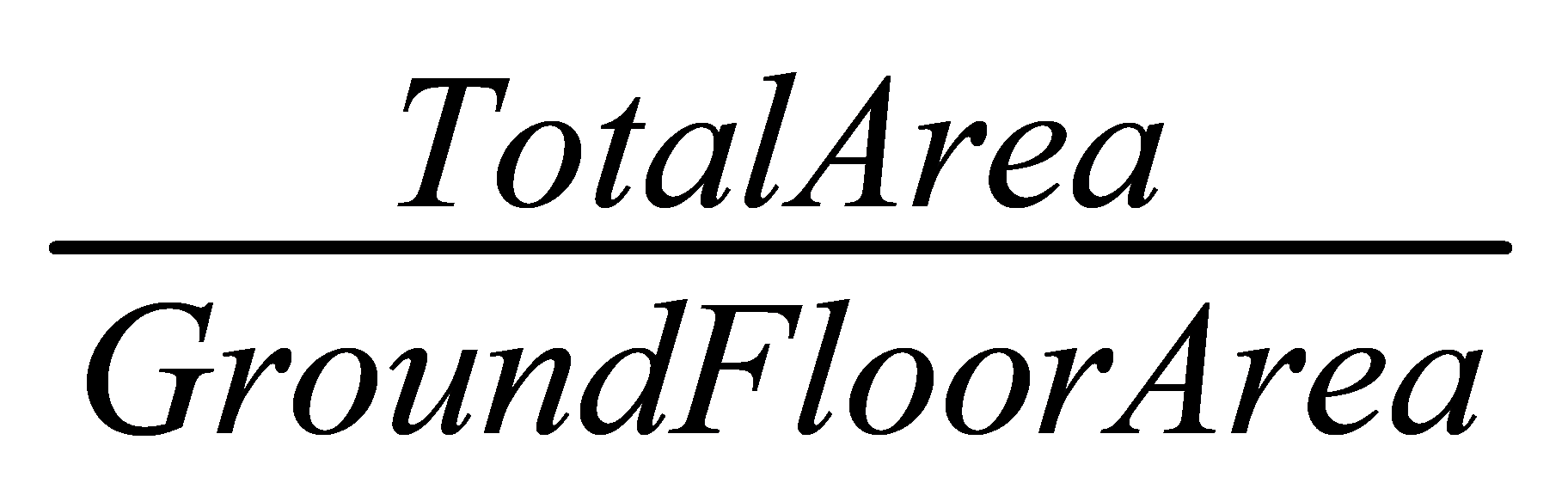
The HI Index shows value 1 for one story building and also for vacant lots. The change in ground floor area and its upper floor is also justified at this stage (Table 1).
Central Business Height Index (CBHI)
This is the first indices value which is directly concerned with delimitation of CBD of Peshawar. In first step total area of CB use in each floor is calculated and then added all the floors areas of CB use and calculated the total CB use area of a building or block. In second step, the total CB use area is divided on ground floor area and calculated the CBHI values. It may be whole number or in fraction which gave the first picture of CB use in that particular building or block.
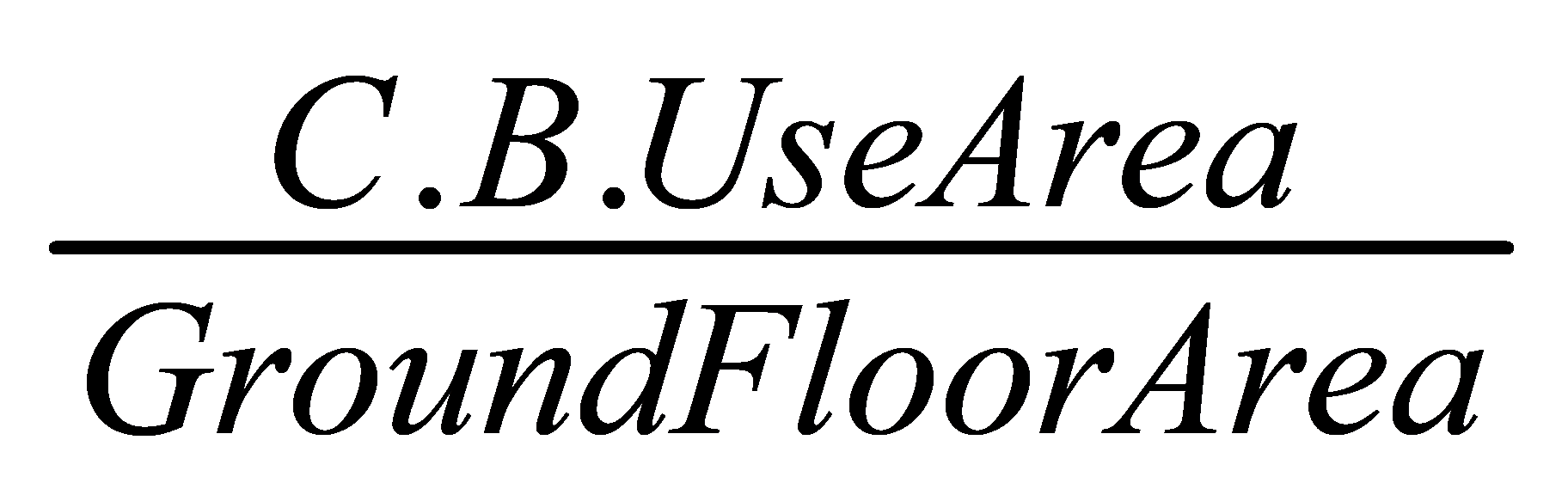
The blocks use for single CB activity is marked as CB uses, for example banks, state banks, offices and G.P.O. etc. In blocks where, mixed activities are practised the lesser dominant activity is marked on profile and remaining all area is included in dominant uses. Similarly, the streets area within a block is included in area of dominant uses. These conditions are present on Saddar road where big plazas are present. The interesting point about the CBHI value is this, that all blocks where central business uses are present their value is one are more than one, there is no single blocks that if its CBHI value is lesser than one and CBII value is greater than 50%. The CBHI value of all blocks is given in Table 1.
Central Business Intensity Index (CBII)
This is the second important index value for delimitation of CBD of Peshawar in which the limitation of first value that ignore the total floor area and greater floor numbers directly influence the whole value. It is percentage CB use and calculated by dividing the total CB use on total floor area and multiplying with 100.
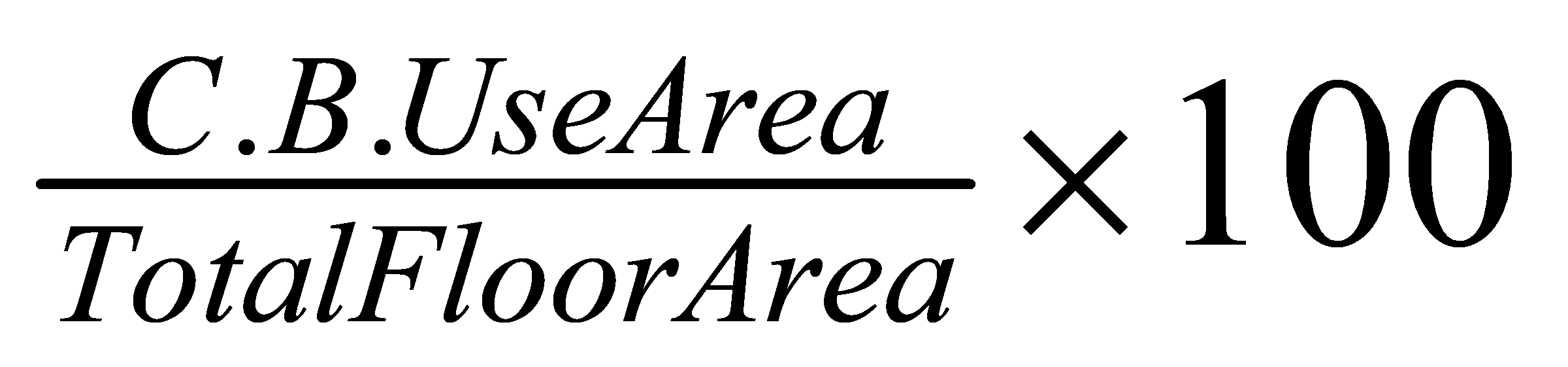
The blocks in Jinnah streets, Tipu Sultan road, and Sunehri Mosque road are in dual uses. These blocks use their ground floor for shops and upper portion for residential. The CBII values clarify the block uses for CB or non-CB uses. The Index value give clear picture of Saddar bazaar that the plaza on Saddar road are dominantly used for CB activities. Number of blocks on Tipu sultan road, Sunehri Mosque road, and Jinnah Street has CBII value lesser than 50%. The CBII value is calculated for all blocks and tabulated in Table 1.
Central Business Index (CBI)
It is a value that incorporated the results of CBHI and CBII. All those blocks or buildings which CBHI value is greater than one and CBII value is fifty percent or greater is included in CBD area and if any value is lesser than required criteria the area is not included in CBD area. The result of CBI is very simple because if it qualifies the criteria than block or building is marked as "Yes" and if not do so it is marked as "No".
CBI = CBHI of 1 plus CBII of 50% ... (4)
The calculated CBI values are applied to whole area and represented on a map. The problems of inclusion of a block or building those whose CBI values is "No" but surrounded by CB uses or those whose CBI value is "Yes" but surrounded by non-CB uses and transitional zone problems are solved by adopting the following rules:
S. No. | Block Name | GFA (sq.ft.) | TA (sq. ft.) | CBU (sq. ft.) | HI | CBHI | CBII | CBI |
1 | 960.00 | 960.00 | 960.00 | 1.00 | 1.00 | 100.00 | Yes | |
2 | Falak Plaza | 480.00 | 2400.00 | 1440.00 | 5.00 | 3.00 | 60.00 | Yes |
3 | Residential | Whole Block Non C.B. Use | No | |||||
4 | Blue Plaza | 1200.00 | 6000.00 | 3600.00 | 5.00 | 3.00 | 60.00 | Yes |
5 | Residential | Whole Block Non C.B. Use | No | |||||
6 | Qayum Manzil | 480.00 | 1440.00 | 720.00 | 3.00 | 1.50 | 50.00 | Yes |
7 | Open Space | Whole Block Non C.B. Use | No | |||||
8 | Raza Market | 1920.00 | 3840.00 | 3840.00 | 2.00 | 2.00 | 100.00 | Yes |
9 | 240.00 | 1200.00 | 480.00 | 5.00 | 2.00 | 40.00 | No | |
10 | 240.00 | 480.00 | 240.00 | 2.00 | 1.00 | 50.00 | Yes | |
... | ||||||||
692 | Sddiqi Plaza | 1920.00 | 7680.00 | 3960.00 | 4.00 | 2.06 | 51.56 | Yes |
693 | School and Colleges | Whole Block Non C.B. Use | No | |||||
694 | Landa Market | Whole Block C.B. Use | Yes | |||||
695 | Shahje Market | Whole Block C.B. Use | Yes | |||||
696 | 360.00 | 1080.00 | 720.00 | 3.00 | 2.00 | 66.67 | Yes | |
697 | 720.00 | 1440.00 | 960.00 | 2.00 | 1.33 | 66.67 | Yes | |
698 | Police Station | Whole Block Non C.B. Use | No | |||||
699 | Hospital | Whole Block Non C.B. Use | No | |||||
700 | Landa Market | Whole Block C.B. Use | Yes | |||||
Source: Field Data 2015
Central Business Uses
The primary CB uses functions are to be retailing of goods and services for a profit and performing of various financial, and office functions. Stores of all sorts that retail merchandise, shops that offer services, banks, and the whole miscellany offices so often found near the centre of the city are considered characteristics central business uses. Similar establishments occur elsewhere in the city, but their area of maximum concentration is the central business district, where they are oriented around the peak land value intersection and where they tend to serve the city as a whole rather than any one section or any one group of people. These establishments are the ones upon which delimitation of the district is based in the central business index method. Following are the main categories of central business uses in Peshawar:
Retail Uses
Retailing is the basic function of CBD. It not only occupied the major share of land use but also in its economic share. The highest vehicular and pedestrian flow in CBD is mainly due to this activity. Retailing is the most prior activity for any high bed rent in a location. It has been performed in many shape and form in CBD. The fashion commodities occupied main front of a building or a two face-side corner, which is most accessible location in CBD particularly for vehicles. Its important typesare Perfume, Gift, Cosmetics, Kids, Barber, Beauty parlour, and mixed functional shops.Jewellery shops are one of the most important activities of CBD which remain on top for its importance, occupancy, location, and number. It grows as CBD grows and change it shape, size, and location with time. In the study area, this activity is growing rapidly particularly in Liaqat bazaar. It can be subdivided in three major groups i.e. goldsmith shops, ornamental shops, and small shops of jewellery.
Some of the retailing activity has converted in more specialised form than the others; shoes shops are one of this. It has different kinds i.e. company shops, super shoes shops, mixed shops, cobbler, and plastic commodities shops. Cloths and related items shops have greatest number and volume of sales in CBD. These shops are located everywhere in CBD but big shops are located on main vehicles flow channels while medium and small shops are clustering in a region making a huge bazaar consisting on number of streets, plazas, and buildings. It can be broadly divided into three sub types' i.e. big shops, market shops and individual stalls. In the Saddar bazaar, the Shafi market is famous bazaar in whole city for different items of cloths.A huge variety of food shops are found in CBD. It not only serves the CBD population but people come from outside to enjoy food and glamour of the CBD of Peshawar. A new category of retail business developed very rapidly in recent years. Due to its large applicability the attraction in this activity for CBD has been increased with time. Now it is one of the basic retailing activities in the CBD. It has different kinds of land uses like mobile phones, mobile & Internet cards, computers, CDs, dish & cables, and other electronic appliances shops. There are huge number of variety shops that are not mentioned under any headings because retailing is very dynamic activity and has different shapes and form, which depends on local circumstances and activity nature. Some of important activities are; super general stores, general retail stores, books and stationary shops, low-price shops, medicine, antique, household-wares, and mixed activity shops. These activities are found in random in all bid-rent areas.
Services
CBD perform various types of functions in which providing services to local and surrounding area is one of the fundamental function. The range of these services varies from local to regional. These services have different kinds and mode of performance. The locations of these services are based on their nature, structure, and mode of performance. But large numbers of these services are situated on main traffic flow channels; few are situated in congested and rush area of the CBD. Some common types of services are; hotels, GPO, banks, photo-labs, parking, travelling agencies, courier services, automobiles, electronic companies' representative shops, watch-makers, lock-makers, electronic appliances repair shops, property dealers, internet cafes, cables, computers repair, artists, architects, map-makers, and cobblers' shops.
Offices
In recent times gaining more importance than any other activity in the CBD of Peshawar. The CBD is highly accessible and fashionable area of the city so all those offices who can afford the locational competence has the most favourable choice. The construction of huge plazas makes things more compatible for office activity because higher portion are less important for retail activity. The office activity is growing rapidly with time because here office not only performed their routine office work but things are more derisible due to their location and people interaction. The huge number of offices are present in CBD but some important types are: professionals, multi-national companies, community & government, private companies, and financials activities offices.
Special Categories
Some activities at first glance are looked as non-central but they are included in central business uses due to their customer dealings or their specified function nature at that location. These categories can be easily distinguishable from other non-CB uses due to their location, which is comparatively in high bid-rent area and nature of function, which these activities perform in CBD economy. The newspapers at their printing sites are manufacturing in nature and at offices these can be included in whole sailing but due to their customer nature it is absolute retailing and included in central business uses. The shops of furniture in CBD of Peshawar are mainly considered with retailing and not with manufacturing. Although there is work of repairing and manufacturing of small items but over all these shops are involved in retailing. These shops can further have specified by their location. The tailors are professionally manufactures but the business is absolutely retailing. The shops and stores, which are involved in retailing, are included in CB uses and those shops and stores, which do only manufacturing activity, are not included in CB uses. Money changing activity is regional based and dual nature. By their customers dealing it is almost retailing but overall the capital movement and other related activities performed by these shops are whole sailing in nature. Due to their nature of capital movement and other dealings it does not included in CB uses but those shops which are only involved in individual customers dealing of money changing are included in CB uses.
Non-Central Business Uses
All that activities and uses which are performing non-profitable functions are included in non-CB uses. The wholesaling& commercial storage, manufacturing, residential, government, public, industrial, railroad-track, vacant lots and buildings etc. are non-CB uses. Although some activities are profitable like whole sailing, manufacturing, and industrial uses but these are low paying activities in any bid-rent system. These uses are present due to local needs, old occupancies, community or individual desire, under development process areas, dual uses for tax saving, and at the edge of CBD.
Delimitation of CBD
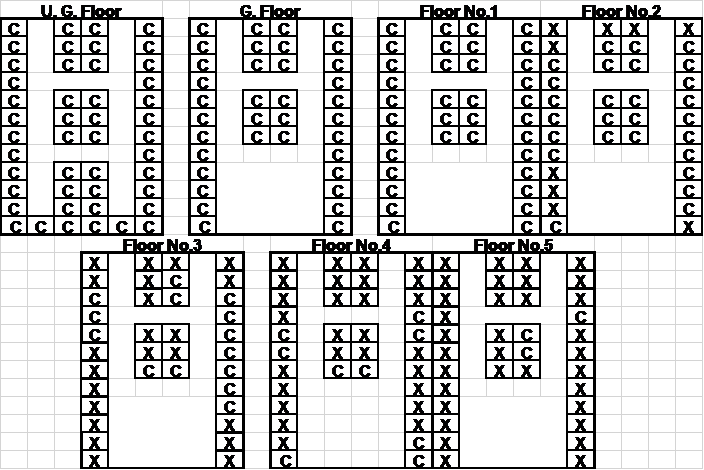
All blocks in the Saddar bazaar area are geo-spatial coded from 1 to 700 on a base map. For example, the Bilour Plaza details are given (. In first step, the shops size is identified as large size (150 sq. feet) and then the whole block ground area is calculated using the shop size, which is 72 units. Upper floor size of total area is smaller than ground floor area due to some open space in front of building. This difference is neglected because of small difference and for easy calculations. The ground floor area is almost same as on map. The activity in small proportion is marked in profile and remaining area is considered for dominant function. In underground, ground, first, and second floor is dominantly in CB used. Non-CB uses are marked as "X", and all remaining area is included in "C". In remaining floors only, particular unit area is included in "C" where dominant use is "X". Total ground floor, CB uses in ground floor, total block, and total CB use area is calculated for HI, CBHI, CBII, and CBI indices. The HI index value is 7, CBHI index value is 4.2, and CBII index value is 60.23%. According to CBI index the block is considered in CB uses because the CBHI value is greater than 1 and CBII value is greater than 50% (Table 2 &Figure 2).
Unit Size | Large (150 Sq. Feet) |
Total Unit | 72 |
Total Unit Area | 72 × 150 = 10800 Sq. Feet |
Area on Map | 10760 Sq. Feet |
Total G.F. Area | 10800 Sq. Feet |
Total Block Area | 10800 × 7 = 75600 Sq. Feet |
U. G. Floor C. B. Uses | 10800 Sq. Feet |
G. Floor C. B. Uses | 10800 Sq. Feet |
First Floor C. B. Uses | 10800 Sq. Feet |
Second Floor C. B. Uses | 63 × 150 = 9450 Sq. Feet |
Third Floor C. B. Uses | 14 × 150 = 2100 Sq. Feet |
Fourth Floor C. B. Uses | 8 × 150 = 1200 Sq. Feet |
Fifth Floor C. B. Uses | 3 × 150 = 450 Sq. Feet |
Total C. B. Uses | 45600 Sq. Feet |
HI Index | 7 |
CBHI Index | 4.22 |
CBII Index | 60.32% |
CBI Index | Block in C. B. Use |
Transitional Zone
The transitional zone of the CBD of Peshawar has no uniformity in their land use. The zone comprises of different land uses, residential is the most common land use. Govt institutions are also present in good number. But manufacturing is not present in transitional zone area. The land use structure is simple on Northern and Eastern side, and much complex on southern and western side. Much complication is present particularly on south-western edge of transitional zone of the CBD of Peshawar. The residential is predominant activity in transitional zone that is observed in the Hali street area, Sunehri mosque road, Fakher-e-Alam road, and on Mall road. Here convergences of residential blocks to commercial are also most common phenomena. The public parks are present on the edge of the CBD as cantonment Park on Sunehri mosque road, Stadium on Stadium road and children parks on Mall road. The public institution like school, colleges, hospitals, mosques, mandar, church and hujra are also present in good number as in Shafi market, Sunehri mosque road, Saddar road, Arbab road and on Mall road. These three types of land use i.e. residential, public parks, and public institution provides natural limits for the CBD of Peshawar because they are considered as non-CB uses. The furniture shops are present on Sunehri mosque road, automobile parts and Services shops are clustering toward South-eastern corner of CBD on Sunehri mosque and Fakher-e-Alam road. The isolated clusters of CB uses are found in Hali Street, surroundings of Dean's plaza, Fakher-e-Alam road and Sunehri mosque road on southern side.These areas are studiedand blocks decisions of inclusion or exclusion in the CBD are made under the rules mentioned in research methodology.
Application of Ratios (Indices)
The indices values of all 700 blocks are calculated and presented on a map, which provide the commercial pattern of CBD of Peshawar. The similar small blocks are combined into large one and presented on map as a one large block. Due to similar CBI values the Saddar road contiguous blocks are combined and show as one block on each road side. The Jinnah streets, Sunehri Mosque road, Fakher-e-Alam road and Mall road shows dissimilar value of CBI for some contiguous blocks. The Dil Jan plaza and its surroundings is predominantly CBI values of "Yes" and this make a big isolated cluster in CBD of Peshawar. It is separated from main region by Cantonment Park in west and Wapda house with residential blocks in north. There is isolated cluster of CB uses in main residential blocks of Hali Street, Kabari and Kalibari areas. The CBI values application has identified that Saddar road, Liaqat bazaar, Tipu Sultan road, Arbab road and Shafi market area are part of CBD of Peshawar.The mixed values area and blocks at edges of CBD is further studied. In zone of transition the circumstances are different and different problems are existing so these values are applied in second stage with certain rules. The following cases of block or building inclusion or exclusion have been studied and the block decision about its inclusion or decision is made under the rules (Figure 3).
Figure: Examples of CBI on Survey Map
Drawing the Boundary
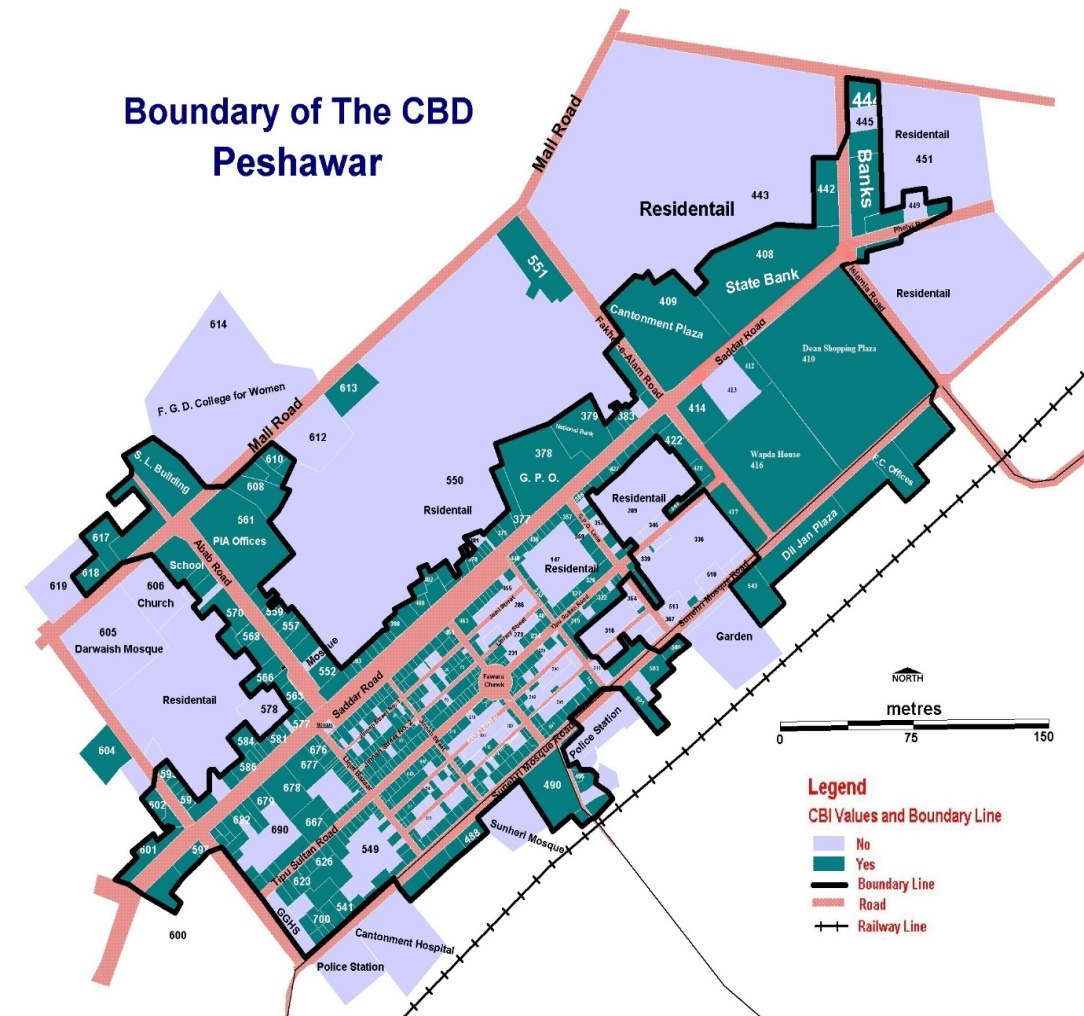
The boundary line of the CBD of Peshawar is non-breaking line. The CBI value map is used as a base map for delimitation of the CBD. It only includes that area, which are contiguous and fulfil the requirement of all five rules forwarded by Murphy and Vance. The boundary line is started from State Life building (Block No. 615) toward eastern side on Mall road. The F. G. D. College for Women (Block No. 615) and residential blocks No. 612 and 660 on each side of Mall road are eastern limits of the boundary line. The line is angled toward Arbab road and goes behind the buildings and reached to Apwa plaza (Block No. 390) on Saddar road. From here, behind the buildings the line is turned on right angle toward Fakher-e-Alam road on Saddar road and reached to block No. 386. On Fakher-e-Alam road the residential Blocks provides limit for the line and turned toward other side of the road where it goes behind the Cantonment plaza (Block No. 409) on Saddar road and reached to Jan's Shopping Centre (Block No. 442) on Islamia road.
On Islamia road due to residential blocks the line is turned towards other side of the road where it reached to Mall road. Due to residential blocks the line is turned back behind the banks' buildings (Blocks No. 444, 446-448) and reached to Phelvi road. On Phelvi road the line is turned around Jan's Bakers building (Block No. 450) because on both side of the road residential blocks are present. The line goes parallel to Dean's Shopping plaza (Block No. 410) and crossed the Sunehri mosque road toward Dil Jan Plaza. Due to public garden the line is back across the road and reached to C. B. Commercial Complex (Block No. 414). Around C. B. Commercial Complex, the line is turned toward Fakher-e-Alam road and reached to Tipu Sultan road where it is turned back to Fakher-e-Alam road because of residential blocks all around. From Fakher-e-Alam road the line reached to G. P. O. Lane Street on backward side of Saddar road buildings. On backward side of buildings of G. P. O. Lane Street, the line crossed the Tipu Sultan road and almost reached to Sunheri Mosque road from where it is turned back to Tipu Sultan road because of residential blocks all around there. On backward side of buildings of Tipu Sultan road the line reached to block No. 318 where the line is turned at right angle toward Sunheri Mosque road. On Sunheri Mosque road the line is turned back behind building of block No. 515 and crossed the road to other side. Here the line goes on backward side of buildings of blocks No. 501 - 505 and then crossed the road toward other side. Here from Paradise Hotel (Block No. 308) the line reached to Khan's Hotel (Block No. 501) and again crossed the road toward Nothia road. On Nothia road the line reached to Railway Line from where it turned back toward Sunheri Mosque road on backward side of Peshawar Trade Centre (Block No. 490).
On Sunheri Mosque road crossing the Sunheri Mosque the line goes on backward side of buildings (Block No. 485 - 488) and then crossed the road toward other side. From here the line goes straight and turned with Sunheri Mosque road. On other side of the road there are residential blocks. When the line is almost reached to Saddar road it crossed the road toward Stadium Chowk. Behind the blocks of No. 597, 698, 599, and 601 the line turned and reached to bus stop. After next block the line crossed the road to other side because of residential blocks. Here the line turned toward Saddar road behind the block No.595 and then reached to Arbab road Novelty Stores (Block No. 575), behind the buildings on Saddar road. On Arbab road, behind the buildings the line reached to Mall road where it crossed the road to other side because of Church and Mosque present on this side. On Mall road behind the blocks No. 616, 617, and 618 the line reached to State Life Building which is starting point and thus completed the non-breaking line to delimit the CBD of Peshawar (Figure 4). This polyline is converted to polygon. This polygon boundary line is crossed checked with the boundary line of region "X", which are the same.
Findings and Conclusion
The rapid development in technology has changed the needs and mode of life. Withpassage of time, the basic amenities of life and their mode of services are changed which has directly affected the city structure and their spatial arrangement. Accessibility is vital factor in city spatial arrangement of different land uses. Many areas are rapidly developing which are easily accessible. The Saddar bazaar is the CBD of Peshawar. The Saddar bazaar is easily accessible for the whole city. Its retail activities, pedestrian and vehicular flow are higher in their density and intensity than any part of the city. It is the area of first priority of any businessman for investment because of its commercial structure and rapid developments in this area. New commercial structure and centre are developed along the transportation routes. However, the CBD never lost its importance in city commercial structure as the number of commuters and profile of activities are increased. Here development happened in both direction i.e. vertical and horizontally. Certainly, the nature of activities and their spatial arrangement are changing. The delimitation of CBD not only encompasses the issue of development but also provide opportunity to understand the nature, spatial arrangement and dynamic evolves in commercial activities in the CBD.
The CBD of Peshawar is delimited by CBI method with geospatial analysis in GIS. In this method the intensive land use survey is carried out through profile method in which each block is mapped and all its floor land uses are recoded. After survey this data is studied through CB indices i.e. CBHI, CBII, and finally the CBI values are calculated. These indices values are applied to all blocks with certain rules and following these rules decision about each block for its inclusion or exclusion is made. All the data of 700 blocks are geo-spatial coded with their retributes data of CBI.The blocks were converted into regions. Similar, regions were converted into single region of the same value of CBI.After studying the transitional zone, the line is drawn for the limits of the CBD of Peshawar which was verified through drawing the regional boundary.
The CBD is growing very rapidly in both directions i.e. vertically and horizontally. But this growth is un-planned and cause of different problems. The development depends on investor capital and his desire; his prior aim is commercial earnings and saving of costs, which directly creates land use and sometimes environmental problems. The vertical growth in shape of big plazas construction is predominant on Saddar road area, Liaqat bazaar, and all over where commercial activity is growing. The vertical height of a building is defined by available area and not by its surroundings or location. The high buildings with small construction in its surroundings are common on Saddar road, Sunheri mosque road, and Fakher-e-Alam road, which is typical example of un-planned vertical growth in area. The horizontal growth is observed in State life building surroundings, around Sunheri mosque, in Dean's hotel area, and Fakher-e-Alam road. The old buildings that are in worse condition are found on different site in CBD. These building are made of bricks and wood which are with time eroded and converted into rough structure that are danger for property and life. Similarly the new constructions that are made of loose material or bad designed are also danger for propertyand life. The Tarpal shops are most serious condition of bad structure present in CBD of Peshawar. The old structures are common around residential blocks while the last two are in main retailing area, for example of Shafi market and on Tipu Sultan road. The buildings on Tipu Sultan road are good example of small size and big height. Similarly, on the Saddar road in between two large plazas there are buildings of small size. These building not only dangerous for life and property but also create serious problems of light and air for surrounding buildings. The large building extends in backward that close or decrease the frontage of other buildings as on Saddar Road big plaza cover the front area and make less accessible backward areas. The second type of extension is illegal extension in which the building extended towards road side. This type of extension is more common on Jinnah streets and other small bazaar streets. Similarly, the balconies of buildings extended towards road and streets sides.
In Saddar bazaar, parking of vehicles was a major problem in peak hours. Private parking services have been started, which has decreased the pressure on available roadside parking area to some extent for commercial tax exemption buildings were in dual use in Saddar area. Liaqat bazaar and Jinnah streets are sharing examples of the dual uses of buildings, which was the root cause of the existing of different land uses together leading to many social problems. Buildings are used for residential and commercial purposes. In some areas residential blocks were predominantly used for light manufacturing as in Kalibari area and Kabari bazaar area. It has been observed that agglomeration and re-structuring of activities is started in CBD. The jewellery activity was agglomerating in Saddar road and Liaqat bazaar areas. Fashion commodities activity was re-structuring in Arbab road area. Clothes merchants' trade was agglomerating in Shafi market and its surroundings. Bilour plaza which has been emerged as centre of electronic commodities. High value activities of retailing and office were shifted towards Central Business District area. The big merchants of jewellery business were shifted from Ander Sher area to Saddar road and Liaqat bazaar area because of accessibility problem in Ander Sher and high number of customers in Saddar Bazaar as part of the CBD. Similarly, expensive fashion commodities shops and offices of the national and multinational companies were shifted towards Saddar road and Fakher-e-Alam road. It was found that there was a gradual change in nature of activities taking placein the transitional zone. Residential blocks were converting to commercial buildings. The nearest areas to main bazaars were in strong influence of this change. For example, the Sunehri mosque area was in constant change and where new buildings were constructed. Similarly, the Dean's hotel has been converted to shopping plaza. On Mall road new offices and shopping plazas have emerged in this zone.
References
- Ali, A. (2005). The Delimitation of Central Business District of Peshawar. Peshawar: Unpublished M. Phil. Report.
- Alonso, W. (1994). Location and Land Use. Cambridge: Harvard University Press.
- Briggs, R. (1974). A Model to Relate the Size of the Central Business District to the Population of a City. Geographical Analysis, 6(3), 265-279.
- Carter, H., & Rowley, G. (1966). The Morphology of the Central Business District of Cardiff. Transactions of the Institute of British Geographers, 38, 199-134.
- Dani, A. H. (1995). Peshawar: Historic city of the Frontier. Sang-E-Meel Publication.
- Davies, D. H. (1959). Boundary Study as a Tool in CBD Analysis: An Interpretation of Certain Aspects of the Boundary of Cape Town's Central Business District. Economic Geography, 35(4), 322-345. Retrieved 08 28, 2017
- Davies, D. H. (1960). The Hard Core of Cape Town's Central Business District: An Attempt at Delimitation. Economic Geography, 36(1), 53-69. Retrieved 08 28, 2017
- Dittmann, A. (1994). Research on Central Place System of the karakuram Mountains in Northern Pakistan: Gilgit as a model of urban Development. Pakistan Journal of Geography, 4(1&2).
- Goddard, J. (1967). Goddard, J. (1967). The internal structure of London’s central area. Urban core and inner city, 118-140.
- Government of Pakistan [GOP]. (1999). District Census Report of Peshawar. Islamabad, Pakistan: Statistic Division Population Census Organization, Printing Press, Islamabad, Pakistan.
- Government of Pakistan [GOP]. (2016, August 02). Rates of valuation of immovable properties in Peshawar. Retrieved from The Federal Board of Revenue (FBR): download1.fbr.gov.pk/SROs/2016821785237742Peshawar.pdf
- Government of Pakistan [GoP]. (2017, October 10). Provisional Province Wise Population by Sex & Rural/Urban. Retrieved from Pakistan Bureau of Statistics: http://www.pbscensus.gov.pk/sites/default/files/DISTRICT_WISE_CENSUS_RESULTS_CENSUS_2017.pdf
- Harris, C. D., & Ullman, E. L. (1945). The Nature of Cities. The Annals of the American Academy of Political and Social Science, 242, 7-17.
- Hart, D. M. (1985). Guardians of the Khaibar Pass: The Social Organisation and History of the Afridis of Pakistan. Vanguard Books.
- Heston, W. L., & Nasir, M. (1988). THe Bazaar of the Storytellers. Lok Virsa Publication House.
- Kachenje, Y., Kihila, J., & Nguluma, H. (2010). Assessing Urban Fire Risk in the Central Business District of Dar es Salaam, Tanzania. JAMBA: Journal of Disaster Risk Studies, 3(1), 321-334.
- Klotz, M. (2012, June 02). Delimiting the Central Business District- A physical analysis using Remote Sensing. Retrieved 02 25, 2018, from Publications of the DLR: http://elib.dlr.de/82418/1/MSc_Disseration_MartinKlotz_1162118_28082012_EMMM.pdf
- Mitchell, J. (2001). Business Improvement Districts and the “New” Revitalization of Downtown. Economic Development Quarterly, 15(2), 115-123.
- Nelson, R. L. (1958). Retail location theory: The legacy of Harold Hotelling. In S. Brown, & A. M. SPARKS (Ed.). Newyork: NY: Dodge.
- Osoba, S. B. (2012). Appraisal of Parking Problems and Traffic Management Measures in Central Business District in Lagos, Nigeria. Journal of Sustainable Development, 5(8), 105-115.
- Proudfoot, M. J. (1937). City Retail Structure. Economic Geography, 13(4), 425-428.
- Ratcliff, R. U. (1949). Internal Arrangement of Land Uses. Urban Land Economics. Newyork: Mc Graw hill Book Co.
- Raymond, E. M., & Vance, J. V. (1954). Delimiting the CBD. Economic Geography, 30, 89-222.
- Rittenberg, S. A. (1988). Ethnicity, Nationalism, and the Pakhtuns: The Independence Movement in India's North-West Frontier Province. Carolina Academic Press.
- Tali, J. A., Entehani, M. R., Krishna, M., & Nagendra, H. N. (2012). Future Threats to CBD: A Case Study of Bangalore CBD. New York Science Journal, 5(1), 22-27.
- Thorngren, B. (1967). External Economies of the Urban Core. Brill, 413-422.
- Varley, R. A. (1968). Landuse Analysis in the City Centre, with Special Reference to Manchester. Doctoral dissertation, University of Wales. Retrieved 01 28, 2018
- Yu, W., Ai, T., & Shao, S. (2015). The analysis and delimitation of Central Business District using network kernel density estimation. Journal of Transport Geography, 45, 32-47. Retrieved 11 10, 2017
Cite this article
-
APA : Ali, A., Malik, S. M., & Jan, M. A. (2018). Delimitation of the Central Business District Peshawar (Pakistan). Global Social Sciences Review, III(I), 194-214. https://doi.org/10.31703/gssr.2018(III-I).13
-
CHICAGO : Ali, Amjad, Sher Muhammad Malik, and Mushtaq Ahmad Jan. 2018. "Delimitation of the Central Business District Peshawar (Pakistan)." Global Social Sciences Review, III (I): 194-214 doi: 10.31703/gssr.2018(III-I).13
-
HARVARD : ALI, A., MALIK, S. M. & JAN, M. A. 2018. Delimitation of the Central Business District Peshawar (Pakistan). Global Social Sciences Review, III, 194-214.
-
MHRA : Ali, Amjad, Sher Muhammad Malik, and Mushtaq Ahmad Jan. 2018. "Delimitation of the Central Business District Peshawar (Pakistan)." Global Social Sciences Review, III: 194-214
-
MLA : Ali, Amjad, Sher Muhammad Malik, and Mushtaq Ahmad Jan. "Delimitation of the Central Business District Peshawar (Pakistan)." Global Social Sciences Review, III.I (2018): 194-214 Print.
-
OXFORD : Ali, Amjad, Malik, Sher Muhammad, and Jan, Mushtaq Ahmad (2018), "Delimitation of the Central Business District Peshawar (Pakistan)", Global Social Sciences Review, III (I), 194-214
-
TURABIAN : Ali, Amjad, Sher Muhammad Malik, and Mushtaq Ahmad Jan. "Delimitation of the Central Business District Peshawar (Pakistan)." Global Social Sciences Review III, no. I (2018): 194-214. https://doi.org/10.31703/gssr.2018(III-I).13