
Abstract
Higher education institutions, in the knowledge economy, have a significant role in encouraging innovation and ultimately accelerating economic growth by the creation and transfer of knowledge. This study concentrates on the construct of knowledge entrepreneurship in higher education institutions of the public and private sectors in Pakistan. It highlights the competencies required to enhance knowledge entrepreneurship in presence of an encouraging organizational climate. Using the dynamic capability theory, this study theorizes the essential role of Personal, Professional and social competencies of faculty members in Higher education institutions in creating and disseminating various forms of knowledge while the organization maintains support, encouragement, leadership and the vision to accomplish the same. Implications and areas for future research are highlighted for further expansion in literature.
Keywords
Knowledge Entrepreneurship, Personal Competency, Professional Competency, Social Competency, Organizational Climate, Higher Education Institutions.
Introduction
Research about knowledge and its management has become a potential area of development as it is known to contribute towards the success of organizations and particularly higher education institutions (Obeidat et al., 2017). As a global phenomenon, the role of higher education institutes in transforming societies and enhancing economies is being given significant consideration (Al-Mansoori & Koc, 2019).As the countries are leaping at becoming knowledge economies, higher education institutions must work towards developing the capabilities that can help create, attain and disseminate knowledge which in turn supports new technology and innovation (Abdulwahed & Hasna, 2014).
Knowledge-based competition and success in emerging economies of higher education institutions have the potential to facilitate economic growth (Adepoju & Abosede, 2018). The convergence of knowledge and entrepreneurship is a major driver of the economic and social development of societies along with having significant implications for public policymaking. To illustrate the strengthening of the economy, the literature on knowledge-intensive entrepreneurship in organizations has emerged (Venkataraman et al., 2012). Various empirical studies have examined the concept of entrepreneurial universities (Brennan & McGowan, 2006; Bernasconi,2005 and Zhao,2004). Universities today have a considerable impact on the entrepreneurial attitudes and activities (Walter & Block, 2016) along with the support that is available at the universities for entrepreneurial activities(Bergmann et al.,2018).
Higher education institutions today are recognized as a significant source for promoting innovation in society. It includes the ever-increasing trend of academicians participating in academic knowledge entrepreneurship as stated by Chang et al., (2016) and Schmitz et al., (2017). Entrepreneurship in higher education can help protect intellectual property, provide a platform for novel scholarly activities, promotion, and integration of new ideas and businesses through incubation. This leads to the promotion of multidisciplinary research and teaching, which is an avenue for social, economic and regional development (Gibb, Haskins, & Robertson, 2013). Researches such as Seigel and Wright (2015) and Balven et al.,(2018), have also suggested that the realization of academic knowledge entrepreneurship signifies the success and accomplishments of developing economies. Research on the management of knowledge in developing economies is still considered unique and requires attention (Asrar-ul-Haq & Anwar, 2016). Knowledge entrepreneurship: that advocates creation and utilization of knowledge may be given due consideration to reap significant benefits. The outcomes of individual Competencies of individuals must also be studied in Higher education Institutions as suggested by (Naim & Lenka, 2017). While other researchers such as Al-kurdi, Elhaddadeh, and Eldabi (2018) have proposed the empirical investigation through data from leaders in organizations, administrators and other members in the population to generalize results. Literature is scarce on factors that enhance entrepreneurship in higher education (Marzban, Moghimi & Ramezan, 2013). Hence, this study puts forward the importance to examine the capabilities of individuals and organizational climate that higher education institutions have considering the dynamic capability theory to generate knowledge entrepreneurship.
Literature Review
Knowledge Entrepreneurship
Sustainable development of economies and entrepreneurship cannot be considered exclusive, and go hand in hand (Criado-Gomis, Cervera-Taulet & Iniesta-Bonillo, 2017). Knowledge entrepreneurship can be referred to as the activity of an organization to identify and capitalize on existing knowledge as a potential source of innovation in the organization. This may be classified as a significant contributor to the long term sustainability of the economy (Bandera et al., 2017). Researchers have suggested the study of antecedents that lead to the knowledge entrepreneurship process by fostering a supporting climate (De Geus 1988; Day 1994; Sinkula 1994; Huber 1991). Knowledge entrepreneurship commonly is also referred to the academic entrepreneurship. Academic knowledge entrepreneurship refers to the creation of new scientific inventions, researches and introduction of new processes and systems in the university (Morris & Kuratko,2002; Jacob et al., 2003). This also includes transference and commercialization of technology and new knowledge for socio-economic development (Brennan et. al., 2005; Jacob et al., 2003 and Morris& Kuratko, 2002).
Brennan and McGowan (2006) and Powers and McDougall (2005) have suggested that knowledge entrepreneurship or knowledge creation within the universities can also be considered as new venturing in context of incubating businesses, start-ups, alliances, and joint venturing. Universities transforming from old systems to new systems and resources also reflect on entrepreneurial behavior ( Etzkowitz et al., 2000 and Hitt et al., 2001). Byrne and Sheperd (2015) suggest that many universities also hold incubation facilities to encourage faculty and students with ideas to pursue their entrepreneurial initiatives.
Competencies
Competencies are defined as the ability of individuals (Boyatzis & Boyatzis 2008). These competencies can also be seen as the underlying characteristics of individuals that help enhance output in certain job situations (Spencer & Spencer,1993). While competencies enhance job output, they can also be seen as a factor that differentiates the superior and mediocre performers (Cardy & Selvarajan, 2006). The talent of the individual is defined by his or her philosophy, vision, values, knowledge and competencies. The job requirements relate to the tasks and the responsibilities that need to be undertaken. Many researchers as Naim and Lenka (2017), have classified these competencies to be of personal, professional and social nature.
The personal competencies encompass responsibility, motivation, decision-making skills and the ability to seek innovation and creativity at the workplace as suggested by Muller-Muller-Frommeyer et al.,(2017); Kreimeier et al., (2014) and Tisch et al., (2013) and Abele and Reinhart (2011). The professional competencies are a permutation of abilities and attributes that help individuals outperform others at the organization (Kuijpers & Scheerens, 2006). These attributes include having professional knowledge and skills involving the management of projects effectively (Muller-Frommeyer et al.,2017). Along with the essential personal and professional competencies, individuals must have social competencies, which is a cognitive function (Schumaker & Hazel, 1984). It helps them interact with others at the workplace, solving problems, networking, communicating and most importantly working with diverse people in various functional teams (Wagnenaar,2014; Tisch et al., 2013).
Organizations should consider the relationship between individual competencies and knowledge entrepreneurship to encourage the creation and exploitation of knowledge. Researchers have suggested that these competencies help individuals use their abilities for the creation of knowledge, new ideas, and solutions (Rojas, Perez & Sanchez, 2017).
Organizational Climate
Organizational climate is usually referred to as how individuals in an organization identify and explain their surrounding environment (Schneider et al., 2013). Individual perceptions about climate may also include the organization's procedures, policies, and practices as suggested by Schneider et al., (2017). Research regarding organizational climate includes service as a part of climate(Wu, et al., 2008), justice in the organization( Walumbwa et al.,2008) innovativeness (Lee et al.,2011) and aspects of organizational safety (Wu et al.,2007; Zohar & Luria, 2005).
Researchers have considered the organization climate as an enabler of understanding the behavioral outcomes of individuals in an organization (Riordan et al., 2005). Researchers such as Bregmann et al., (2018) have advocated the need for research on the construct of organizational climate specifically in the context of universities, especially for entrepreneurial activities. The organizational climate encourages individuals to participate in the process of exploring, exploiting and creating knowledge (Jonsson et al., 2015).
An organizational climate that enables individuals to perform their best involves employee involvement aspects, autonomous decision making, provision of access to information and the encouragement to carry out tasks that are necessary to accomplish organizational goals (Riordan et al., 2005). Organization climate and knowledge-based entrepreneurial activities link as the organizational climate helps individuals be involved in knowledge-based activities in the organization and helps them seek new opportunities that they can capitalize on, in the presence of information and necessary resources (Wallace et al., 2016). Despite the acknowledgment that universities are hubs of knowledge-based activities, a limited amount of research is done to examine climate that enables knowledge creation and dissemination in higher education institutions making it is a critical challenge that universities face today (Al-Kurdi, El-Haddadeh & Eldabi, 2020).
All the constructs of this study and their relationship have been viewed in the light of the Dynamic capability Theory in organizations that advocates that organizations build, integrate and reorganize their external and internal specific competencies into new competencies to manage change in the environment (Teece, Pisano & Shuen, 1997). The presence of these capabilities enhances the ability of the organization to perform certain tasks as suggested by Helfat and Peteraf (2009). The dynamic capability theory tends to incorporate the Schumpeterian view (Antonelli, 2017), that incorporates the sustainable competitive advantage for organizations, which is also true in the case of universities. Thus this paper aims to examine the role of organizational climate in enabling knowledge entrepreneurship with the help of employees with individual competencies.
Hypotheses:
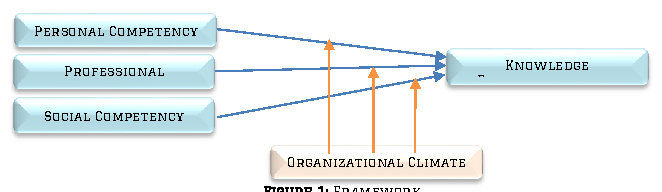
H1: Personal Competencies are positively associated with Knowledge Entrepreneurship in Higher Education Institutions
H2: Professional Competencies are positively associated with Knowledge Entrepreneurship in Higher Education Institutions
H3: Social Competencies are positively associated with Knowledge Entrepreneurship in Higher Education Institutions
H4: In Higher Education Institutions, the association of personal Competencies and Knowledge Entrepreneurship is significantly moderated by organizational climate
H5: In Higher Education Institutions, the association of professional Competencies and Knowledge Entrepreneurship is significantly moderated by organizational climate
H6: In Higher Education Institutions, the association of social Competencies and Knowledge Entrepreneurship is significantly moderated by organizational climate
Theoretical Model
Materials and Methods
Research Design
This correlational study takes a positivist approach and is focused on empirically testing the hypotheses. The research design is cross-sectional and relies mainly on primary data collection in the non-contrived environment.
Population and Sampling
The target population of interest in this study is faculty members of Universities both in the private and public sector institutions of Pakistan. The targeted sample respondents were nominated through the process of non-probability convenience sampling. A total of 305 samples was collected for empirical testing and analysis. A total of 410 questionnaires were floated and a complete response on 305 questionnaires was generated for analysis. Faculty members permanently employed in the private and public higher education institutes are the unit of analysis of the given study.
Instrument and Data Collection Method
Primary data for this research has been collected through Structured questionnaires that have been adopted from prior researches and later adapted to match the context of the study. A five-point Likert scale, ranging from 1-strongly disagree to 5-strongly agree, has been used for all five variables included in the study. The scale of Knowledge entrepreneurship was adapted from McDonald(2002), competencies from Naim and Lenka (2017) and organizational climate from Patterson, War, and West (2004).
Data Analysis
Data analysis was carried out through SPSS 25 software including descriptive statistics, Reliability, Pearson correlations, simple and moderated regression analysis of the data.
Discussion
Descriptive Statistics, Correlation, and Reliability
Table 1: Descriptive Statistics, Correlation and Reliability
Variables | M | SD | I | II | III | IV | V | α | |
I | Knowledge Entrepreneurship | 3.34 | 0.92 | - | 0.89 | ||||
II | Personal Competency | 3.39 | 0.63 | .433** | - | 0.74 | |||
III | Professional Competency | 3.03 | 0.67 | .573** | .216** | - | 0.77 | ||
IV | Social Competency | 3.22 | 0.59 | .341* | .343** | .489** | - | 0.79 | |
V | Organizational Climate | 2.94 | 0.79 | .329** | .339** | .323** | .274** | - | 0.81 |
* p < 0.01
Table 1 above reflects the values for the descriptive statistics including the mean values and standard deviation. It also highlights the correlation of each variable (p-value < 0.01) along with the reliability values for the scale of each variable. The reliability statistics for the instruments included in this study indicate that the scales used are reliable, with alpha values of the scale dimensions ranging from 0.74 to 0.89
Hypotheses Testing-Direct and Moderated Regression Analysis
Table 2: Direct and moderated regression Analysis
Hypothesis | Impacts | β | ∆R2 | Sig | Results |
| Direct Impact | |||||
H1 | Personal Competency | .264 | .27 | .004* | Accepted |
H2 | Professional Competency | .279 | .13 | .012* | Accepted |
H3 | Social Competency | .185 | .10 | .005* | Accepted |
| Moderations (Interaction Terms) | |||||
H4 | Personal Competency* Organizational Climate | .320 | .29 | 0.002* | Accepted |
H5 | Professional Competency* Organizational Climate | .299 | .17 | 0.025* | Accepted |
H6 | Social Competency* Organizational Climate | .258 | .15 | 0.037* | Accepted |
*p<.05, Dependent variable: Knowledge Entrepreneurship
Table 2 above, reflects the multiple regression analysis results used to test the direct and the moderated relationships that were hypothesized.
The personal (β=.264, p=.004), Professional (β=.279, p=.012) and Social competency (β=.185, p=.005) were seen to have a positive association with Knowledge entrepreneurship and thus the direct relational hypotheses were accepted. The Moderated regression including the analysis of the interactional terms with the dependent variable; knowledge entrepreneurship show that the interaction of personal competency with organizational climate (β=.320, p=.002 and R2 = .29), Professional competency with organizational climate (β=.299, p=.025 and R2 = .17), and Social competency with organizational climate (β=.258, p=.037 and R2 = .15) reflect the positive moderation of organizational climate between the competencies and knowledge entrepreneurship, showing that a supportive climate that encourages participation and use of ability along with the vision of leaders is a positive enabler of creating new knowledge.
The study examines how the competencies of individuals working in higher education institutions can be translated into the creation of new knowledge, known as knowledge entrepreneurship. The view of having individual competencies also supported in prior research. They have suggested that these competencies help in the creation of knowledge, new ideas, and solutions (Rojas, Perez & Sanchez, 2017). This study shows that it is also imperative to have a climate in the organization that supports risk-taking, opportunity seizing and lends a vision to its employees to achieve knowledge creation. Researchers such as Bregmann et al., (2018) have also advocated the same in the context of universities, especially for entrepreneurial activities. The organizational climate reassures individuals for participation in the process of exploring, exploiting and creating knowledge (Jonsson et al., 2015).
This, in turn, is essential for the sustenance of the knowledge economy. The results of the study reveal a significantly positive association of the competencies and knowledge entrepreneurship, which is further enhanced by the organizational culture.
Implications and Future Research
This study through the empirical testing of relationships has inferred a significantly positive relation
between the variables. By constructing the association, the generalizable results contribute to the expansion of literature pertinent to the higher education context. It explains the presence of the multidimensional construct known as knowledge entrepreneurship in universities and how individuals through their competencies can contribute towards it. However, the antecedents to competency development have limited literature. Future researches can examine the antecedents of competencies and their development in individuals. The antecedents can help reveal the mediating role of competencies to create knowledge entrepreneurship. Researchers can also examine other moderators that support the creation of knowledge and knowledge entrepreneurship in the higher education sector. The most prominent of them is the presence of entrepreneurial leadership that has the vision, risk-taking ability, is creative and is open to new ideas.
References
- Abdulwahed, M.& Hasna, M.O. (2014). Engineering and Technology Talent for Innovation and Knowledge-Based Economies; Springer: Cham, Switzerland.
- Adepjou, T.L & Abosede, O. C. (2018). Higher Education, Knowledge Economy and Sustainable Development in Nigeria. Higher Education, 9(18).
- Al-Kurdi, O. F., El-Haddadeh, R., & Eldabi, T. (2020). The role of organisational climate in managing knowledge sharing among academics in higher education. International Journal of Information Management, 50, 217-227.
- Al-Kurdi, O. F., El-Haddadeh, R., & Eldabi, T. (2018). Knowledge sharing in higher education institutions: a systematic review. Journal of Enterprise Information Management, 31(2), 226-246.
- Al-Mansoori, R. S., & Koç, M. (2019). Sustainability in Higher Education: The Impact of Transformational Leadership on Followers’ Innovative Outcomes A Framework Proposal. In Sustainability on University Campuses: Learning, Skills Building and Best Practices (pp. 227-243). Springer, Cham.
- Antonelli, C. (2017). Knowledge exhaustibility and Schumpeterian growth. The Journal of Technology Transfer, 1-13.
- Argyris, C., 2005. Actionable knowledge. In: Tsoukas, H., Knudsen, C. (Eds.), The Oxford Handbook of Organization Theory: Meta-Theoretical Perspectives. Oxford University Press, Oxford, UK, pp. 423–425.
- Balven, R., Fenters, V., Siegel, D. S., & Waldman, D. (2018). Academic entrepreneurship: The roles of identity, motivation, championing, education, work-life balance, and organizational justice. Academy of Management Perspectives, 32(1), 21-42.
- Bandera, C., Keshtkar, F., Bartolacci, M. R., Neerudu, S., & Passerini, K. (2017). Knowledge management and the entrepreneur: Insights from Ikujiro Nonaka's Dynamic Knowledge Creation model (SECI). International Journal of Innovation Studies, 1(3), 163-174.
- Bergmann, H., Geissler, M., Hundt, C., & Grave, B. (2018). The climate for entrepreneurship at higher education institutions. Research Policy, 47(4), 700-716.
- Bernasconi, A. (2005). University entrepreneurship in a developing country: The case of the P. Universidad Católica de Chile, 1985–2000. Higher Education, 50(2), 247-274.
- Boyatzis, R. E. (1994). Rendering unto competence the competent things.
- Boyatzis, R. E. (2007). Developing emotional intelligence competencies. Applying emotional intelligence: A practitioner’s guide, 28-52.
- Boyatzis, R., & Boyatzis, R. E. (2008). Competencies in the 21st century. Journal of management development.
- Brennan, M. C., & McGowan, P. (2006). Academic entrepreneurship: An exploratory case study. International Journal of Entrepreneurial Behavior & Research.
- Brennan, M. C., Wall, A. P., & McGowan, P. (2005). Academic entrepreneurship. Journal of Small Business and Enterprise Development.
- Byrne, O., & Shepherd, D. A. (2015). Different strokes for different folks: Entrepreneurial narratives of emotion, cognition, and making sense of business failure. Entrepreneurship Theory and Practice, 39(2), 375-405.
- Cardy, R. L., & Selvarajan, T. T. (2006). Competencies: Alternative frameworks for competitive advantage. Business Horizons, 49(3), 235-245
- Chang, Y. C., Yang, P. Y., Martin, B. R., Chi, H. R., & Tsai-Lin, T. F. (2016). Entrepreneurial universities and research ambidexterity: A multilevel analysis. Technovation, 54, 7-21.
- Criado-Gomis, A., Cervera-Taulet, A., & Iniesta-Bonillo, M. A. (2017). Sustainable entrepreneurial orientation: A business strategic approach for sustainable development. Sustainability, 9(9), 1667.
- Day, G. S. (1994). The capabilities of market-driven organizations. Journal of Marketing, 58(4), 37-52.
- De Geus, A. P. (1988). Planning as learning (pp. 70-74). March/April: Harvard Business Review.
- Etzkowitz, H. (2017). Innovation Lodestar: The entrepreneurial university in a stellar knowledge firmament. Technological Forecasting and Social Change, 123, 122-129.
- Etzkowitz, H., Webster, A., Gebhardt, C., & Terra, B. R. C. (2000). The future of the university and the university of the future: evolution of ivory tower to entrepreneurial paradigm. Research Policy, 29(2), 313-330.
- Gibb, A., Haskins, G., & Robertson, I. (2013). Leading the entrepreneurial university: Meeting the entrepreneurial development needs of higher education institutions. In Universities in change (pp. 9-45). Springer, New York, NY.
- Helfat, C. E., & Peteraf, M. A. (2009). Understanding dynamic capabilities: progress along a developmental path.
- Hitt, M. A., Ireland, R. D., Camp, S. M., & Sexton, D. L. (2001). Strategic entrepreneurship: Entrepreneurial strategies for wealth creation. Strategic management journal, 22(6‐7), 479-491.
- Huber, G. P. (1991). Organizational learning: The contributing processes and the literatures. Organization Science, 2(1), 88-115.
- Jacob, M., Lundqvist, M., & Hellsmark, H. (2003). Entrepreneurial transformations in the Swedish University system: the case of Chalmers University of Technology. Research Policy, 32(9), 1555-1568.
- Jönsson, S., Muhonen, T., Denti, L. and Chen, K. (2015), “Social climate and job control as mediators between empowering leadership and learning from a cross-cultural perspective”, International Journal of Cross Cultural Management, Vol. 15 No. 2, pp. 135-149.
- Kreimeier, D., Morlock, F., Prinz, C., Krückhans, B., Bakir, D. C., & Meier, H. (2014). Holistic learning factories–A concept to train lean management, resource efficiency as well as management and organization improvement skills. Procedia CIRP, 17, 184-188.
- Kuijpers, M. A. C. T., & Scheerens, J. (2006). Career competencies for the modern career. Journal of career development, 32(4), 303-319.
- Marzban, S., Moghimi, S. M., & Ramezan, M. (2013). The effective factors in organizational entrepreneurship climate. Journal of Chinese Entrepreneurship.
- Morris, M. H., & Kuratko, D. F. (2002). Corporate entrepreneurship: Entrepreneurial development within organizations. South-Western Pub.
- Müller-Frommeyer, L. C., Aymans, S. C., Bargmann, C., Kauffeld, S., & Herrmann, C. (2017). Introducing competency models as a tool for holistic competency development in learning factories: Challenges, example and future application. Procedia Manufacturing, 9, 307-314.
- Naim, M. F., & Lenka, U. (2017). Linking knowledge sharing, competency development, and affective commitment: Evidence from Indian Gen Y employees. Journal of Knowledge Management.
- Obeidat, B. Y., Tarhini, A., Masa'deh, R. E., & Aqqad, N. O. (2017). The impact of intellectual capital on innovation via the mediating role of knowledge management: a structural equation modelling approach. International Journal of Knowledge Management Studies, 8(3-4), 273-298.
- Patterson, M.G., West, M., Shackleton, V.J., Dawson, J.F., Lawthom, R., Maitlis, S., Robinson, D.L., Wallace, A.M., 2005. Validating the organizational climate measure: links to managerial practices, productivity and innovation. J. Organ. Behav. 26, 379–408.
- Powers, J. B., & McDougall, P. P. (2005). University start-up formation and technology licensing with firms that go public: a resource-based view of academic entrepreneurship. Journal of business venturing, 20(3), 291-311.
- Riordan, C.M., Vandenberg, R.J., Richardson, H.A., 2005. Employee involvement climate and organizational effectiveness. Hum. Resour. Manage. 44, 471–488.
- Schmitz, A., Urbano, D., Dandolini, G. A., de Souza, J. A., & Guerrero, M. (2017). Innovation and entrepreneurship in the academic setting: a systematic literature review. International Entrepreneurship and Management Journal, 13(2), 369-395.
- Schneider, B., Ehrhart, M. G., & Macey, W. H. (2013). Organizational climate and culture. Annual review of psychology, 64, 361-388.
- Schneider, B., González-Romá, V., Ostroff, C., & West, M. A. (2017). Organizational climate and culture: Reflections on the history of the constructs in the Journal of Applied Psychology. Journal of Applied Psychology, 102(3), 468.
- Schumaker, J. B., & Hazel, J. S. (1984). Social skills assessment and training for the learning disabled: Who's on first and what's on second? Part I. Journal of Learning Disabilities, 17(7), 422-430.
- Siegel, D. S., & Wright, M. (2015). Academic entrepreneurship: time for a rethink?. British Journal of Management, 26(4), 582-595.
- Sinkula, J. M. (1994). Market information processing and organizational learning. Journal of Marketing, 58(1), 35-45.
- Spencer, L. M., & Spencer, S. M. (1993). Competency at work. New York: John Wiely & Sons, 5.
- Teece, D. J., Pisano, G., & Shuen, A. (1997). Dynamic capabilities and strategic management. Strategic management journal, 18(7), 509-533
- Tisch, M., Hertle, C., Abele, E., Metternich, J., & Tenberg, R. (2016). Learning factory design: a competency-oriented approach integrating three design levels. International Journal of Computer Integrated Manufacturing, 29(12), 1355-1375.
- Tisch, M., Hertle, C., Cachay, J., Abele, E., Metternich, J., & Tenberg, R. (2013). A systematic approach on developing action-oriented, competency-based Learning Factories. Procedia CIRP, 7, 580-585
- Venkataraman, S., Sarasvathy, S. D., Dew, N., & Forster, W. R. (2012). Reflections on the 2010 AMR decade award: Whither the promise? Moving forward with entrepreneurship as a science of the artificial. Academy of Management Review, 37(1), 21-33.
- Wagenaar, R. (2014). Competences and learning outcomes: a panacea for understanding the (new) role of Higher Education?. Tuning Journal for Higher Education, 1(2), 279-302.
- Wallace, J.C., Butts, M.M., Johnson, P.D., Stevens, F.G. and Smith, M.B. (2016). A multilevel model of employee innovation understanding the effects of regulatory focus, thriving, and employee involvement climate. Journal of Management, 42(4), pp. 982-1004.
- Walter, S. G., & Block, J. H. (2016). Outcomes of entrepreneurship education: An institutional perspective. Journal of Business Venturing, 31(2), 216-233.
- Walumbwa, F.O., Wu, C., Orwa, B., 2008. Contingent reward transactional leadership, work attitudes, and organizational citizenship behavior: the role of procedural justice climate perceptions and strength.
- Wu, T., Chen, C., Li, C., 2008. A correlation among safety leadership, safety climate and safety performance. J. Loss Prev. Process Ind. 21, 307–318. http://dx.doi.org/10. 1016/j.jlp.2007.11.001.
- Wu, T., Liu, C., Lu, M., 2007. Safety climate in university and college laboratories: impact of organizational and individual factors. J. Saf. Res. 38, 91–102.
- Zhao, F. (2004). Academic entrepreneurship: case study of Australian universities. The International Journal of Entrepreneurship and Innovation, 5(2), 91-97.
- Zohar, D., Luria, G., 2005. A multilevel model of safety climate: cross-level relationships between organization and group-level climates. J. Appl. Psychol. 90, 616–628. http://dx.doi.org/10.1037/0021-9010.90.4.616.
Cite this article
-
APA : Kamal, N., Ali, B., & Samdani, H. (2020). The Competencies and Knowledge Entrepreneurship relationship in Higher Education Institutes: Examining the Moderating Role of Organizational Climate. Global Social Sciences Review, V(I), 390-398. https://doi.org/10.31703/gssr.2020(V-I).40
-
CHICAGO : Kamal, Nida, Bakhtiar Ali, and Hina Samdani. 2020. "The Competencies and Knowledge Entrepreneurship relationship in Higher Education Institutes: Examining the Moderating Role of Organizational Climate." Global Social Sciences Review, V (I): 390-398 doi: 10.31703/gssr.2020(V-I).40
-
HARVARD : KAMAL, N., ALI, B. & SAMDANI, H. 2020. The Competencies and Knowledge Entrepreneurship relationship in Higher Education Institutes: Examining the Moderating Role of Organizational Climate. Global Social Sciences Review, V, 390-398.
-
MHRA : Kamal, Nida, Bakhtiar Ali, and Hina Samdani. 2020. "The Competencies and Knowledge Entrepreneurship relationship in Higher Education Institutes: Examining the Moderating Role of Organizational Climate." Global Social Sciences Review, V: 390-398
-
MLA : Kamal, Nida, Bakhtiar Ali, and Hina Samdani. "The Competencies and Knowledge Entrepreneurship relationship in Higher Education Institutes: Examining the Moderating Role of Organizational Climate." Global Social Sciences Review, V.I (2020): 390-398 Print.
-
OXFORD : Kamal, Nida, Ali, Bakhtiar, and Samdani, Hina (2020), "The Competencies and Knowledge Entrepreneurship relationship in Higher Education Institutes: Examining the Moderating Role of Organizational Climate", Global Social Sciences Review, V (I), 390-398
-
TURABIAN : Kamal, Nida, Bakhtiar Ali, and Hina Samdani. "The Competencies and Knowledge Entrepreneurship relationship in Higher Education Institutes: Examining the Moderating Role of Organizational Climate." Global Social Sciences Review V, no. I (2020): 390-398. https://doi.org/10.31703/gssr.2020(V-I).40