
Abstract
Modern innovation in communication has changed patterns of socializing. Advance forms of communication are paving ways for people to convey their ideologies to others. This study attempts to analyze the role of social media in strengthening democracy in Pakistan and highlights the importance of media in democratic states by an extensive review of the literature. The core concern of the study was to observe how mass media contributes to the socialization of democracy. Quantitative research methodology opted, and research findings concluded that social media advocates the public on general political issues that increase the political efficacy and resulting in more political participation in Pakistan. Web 2.0 platforms such as Twitter and Facebook provide new opportunities to create a political environment in Pakistan. In the presence of these platforms, a bridge is developed between the citizens for strengthening a strong democratic setup.
Key Words
Social Media, Democratization, Political Awareness, Political Efficacy, Political Participation
Introduction
Mass media shaped public decisions. It shapes the political and social ideology of the people. Media advocates political and social awareness among their users. It does not only fulfil the basic requirements of information but also connect the people with the world of knowledge (Anwar & Jan 2010). The citizen’s satisfaction with democracy is an interlinked universal process that develops a true political process (Zhai, 2018). Democracy requires a particular physical place and arrangements for democratic concerts. Certain arrangements make democracy more valuable among citizens (Parkinson, 2012; Buchyn & Mushchenko, 2019; Doorenspleet, 2012). Mainstream media and new media have different dependencies for democratic satisfaction. Good democracies make sure citizens are able to use these rights in voting, organizing and protesting for their interests (Mustapha, Mustapha & Anafi, 2018; Pállinger, 2018; Diamond & Morlino, 2005). Democracy is a system that is considered as the government of the people, by the people, for the people. Citizen’s satisfaction with the democratic process is linked with the appreciation of people for their government and its performances (Canache, Mondak & Seligson, 2001; Linde and Ekman, 2003). A quarter-century ago, liberal democratic citizens were more satisfied with government and institutions. They were proud to live in a democratic state as compare to an authoritarian state (MOUNK, 2018). Social networking sites (SNSs) usage increases political expression and participation in both online and offline activities. People get information through interpersonal communication and Facebook, which encourage them to take part in political protests (Awad & Farghaly, 2018; Tufekci & Wilson, 2012; Dalton, Jou & Shin, 2007; Lu, 2013) and this democratic knowledge provide general citizens with a proper lens to see the valuable advantages of democratization and examine the level of democracy in their respective societies. This advance means of technology allow citizens to criticize and challenge democratic government (Esarey & Qiang, 2011). Diplomatic communication of democracies leads by the actors for the political system. Voters desire to be aware of the political issues, political parties and issues of the democratic state (Meer & Yousaf, 2018; Dick, 2012). Egypt revolution is the best example which was held by the users of social media. President Hosni Mubarak had lost his political worth among his citizens (Habeeb, 2012). Many political movements of the world like Ankara, Cairo, Tripoli, Moscow, Kiev, Athens, Madrid, New York, Ferguson, Missouri, Los Angeles, Hong Kong and Istanbul these political movements utilized Facebook and Twitter to spread their voices with the rest of the area (Jost et al., 2018). Facebook pages and groups work throughout conflicts, and Twitter was used to connect politicians and citizens for
political electoral information (Loxbo, Hinnfors, Hagevi, Blombäck & Demker, 2019; Borah, 2014; Cogburn & Espinoza-Vasquez, 2011; Johnson, 2011; Pole & Xenos, 2011; Ronzhyn,2016). Obama’s Political movement used Facebook for personality upgrading and to engage the followers in a political campaign (Gerodimos & Jakup, 2014). The use of new media expresses destructive estimates for political cynicism (Hanson, Haridakis, Cunningham, Sharma & Ponder, 2010). Valtysson (2013) highlighted the importance of and use of social media usage in revising the Icelandic constitution that ensured the general participation of the public. Citizens who think political and electoral rights are basic requirements of democracy are satisfied with the current democratic system, where social media penetration has a significant relation with democracy. It provides a platform for the participant’s democratic activities (Zhai, 2018; Beetham, 2004; Herrmann, 2016; Jha & Kodila-Tedika, 2019).
Purpose and Rationale of the Study
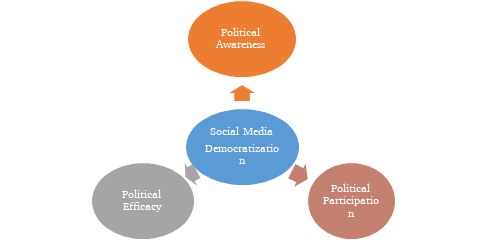
The purpose of the study is to analyze the role of social media in strengthening democracy in Pakistan as to how social media play its role in political awareness, Efficacy and Participation. The study highlights the importance of social media among youth to take part in different political activities and strengthen their internal and external political efficacy. As per the Pakistan Bureau of Statistics, more than half the population of Pakistan based on youth which is (60%). The study is the focus to analyze the youth of Lahore regarded social media (Facebook and Twitter) role for political awareness, efficacy and participation. Today Societies have become more social, and they are globally interlinked through Social Media (Riaz, 2010, Hassan, 2004). For the last few years, media studies actively examine the pros and cons of Facebook and Twitter in different media studies. Democratization is promoted by the use of social media. It is so easy to socialize from region to region and discuss the ongoing political happenings with others. Likewise, today all around the world majority of the political parties, democratic participants communicate with their national and international followers through Facebook and Twitter. Digital technologies and applications are changing the way individuals, governments, and non-governmental organizations are interacting today (Spinner, 2012). Currently, it is debatable that social media is successfully generating a great involvement in political participation among youth for the strengthening of democracy in the world (Siluveru, 2015; Sohl, 2014). The problems and prospects of democracy in Pakistan have been studied by many researchers, but there is very limited researches have been done on social media and its role in democratization, especially the participation of youth. However, this study explores the role of social media in building political awareness, efficacy and participation to explore the contribution of these variables in the Democratization of Pakistan.
Literature Review
Digital Communication and Democratization in Pakistan
In Pakistan, for the last few decades, social media is educating the citizens about their Political democratic rights. The unstable economy and lack of proper literacy ratio create unclear democratic awareness among the rural public of Pakistan. Along with Twitter, social media also has the power to engage people for social movement as well as it can provide the ability for citizens to take part in protest (Prokhorov, 2012). Social Media involve young people in political participation in Pakistan. Most people get all the political information about ongoing issues of the state. Social media is a new and irreplaceable platform to transfer social and political issues with the world. Social media has an essential platform for student activists and their groups to communicate, share personal opinions as well as to express political ideology and issue-based discussion (Ali & Ali, 2014; Enjolras, Steen Johnsen, & Wollebæk, 2012; Valenzuela, Arriagada, & Scherman,2012). Today, It is true that Social media makes its unique identity in Pakistani society. In the initial time, it was difficult for Pakistani people to involve in social media for politics, but now the majority of the youth are using it for political participation that strengthens the democratic process (Zaheer, 2016; haq2010). The emerging platform of new media is widely used for political awareness in Pakistan Karamat & Farooq, 2016; Muzafar, Choudhry & Afzal, 2019; Shaheen, 2008). Facebook is used as the famous socializing app among rather than the other apps like Twitter, Blogs and my space and encourages the participants for online and offline political activities (Eijaz, 2013, Zaheer, 2016; Michaelsen, 2011)
Although democratization is also a part of the Pakistani government setup. Pakistani people actively get political awareness, they take part in political participation, and they have a certain political efficacy about Pakistani democratic setup. No doubt that socializing applications are the greatest option to get information (Abbott, 2014; Auger, 2013; Bulovsky, 2018; Ellison & Hardey, 2014; Prokhorov, 2012; Schulz, 2005). Social media is generating dialogue for democracy and facilitating the citizens for democratic participation (Barber, 1998b; see also Buchstein, 1997; Dahlgren, 2013). It is considered as a network of socializing which allows all participants to get informed, enhance their knowledge and take part in collective actions (Shirky, 2008,2011). The social media is an ideal tool for the democratic process because it allows its citizens to interact, participate and promote democratization (Price,2013).
Internet, Social Media and Political Awareness
It is considered as a process that passes the ongoing political happenings among the people who politically involve and are a part of a particular political system. Social media platforms are the largest forums that disseminate every political information all around the world every second. Facebook and Goggle have a great influence on politics, like elections and political opinion building (Mosco, 2018). The world most famous politicians, political leaders are highly active on Twitter to share their political knowledge with their followers. People move towards the usage of new media innovation to express their political ideology, get political information shared by other users (Glynn, Huge, & Hoffman, 2012; Weeks & Holbert, 2013). The new media has a great and powerful influence among citizens for party-political education and necessary tool to get a political education about political movement (And?, Aytaç & Çarko?lu, 2019; Doris, 2014; Emruli & Ba?a, 2011). Internet leads people towards Political knowledge and provides them with quality content. Likewise, the internet increase users’ level of Politics (Bimber &Davis, 2003; Jennings & Zeitner, 2003; Xenos & Moy, 2007). Facebook and Twitter used by various Politicians for their Political needs. Especially Twitter is the source through different Political events can be discussed. Likewise, digital media firms are the agents that contribute in a political process (Stier, Bleier, Lietz & Strohmaier, 2018; Jungherr, Schoen & Jürgens, 2015; Kreiss, & Mcgregor, 2017).
Modern Technology and Political Efficacy
Technology and media both linked to serving society. Social media is considered as the moderate form of media because it engages the people in various activities like socializing, sharing of contact. Today people are more easily communicate with each other by the use of computer technology (Karamat & Farooq, 2016). The sentiment of efficacy is linked with the political participation of citizens in political activities and their perception of the government and its policies. Peoples’ ideology, mindset and thinking have countless influence in building internal efficacy. Internal efficacy is considered as the self-exposure, self-knowledge to examine the political system and how to involve own self in different political activities (Campbell, Gurin, & Miller, 1954; Holbert, Lambe, Dudo, & Carlton, 2007). External efficacy is importance for political activities (Gil de Zúñiga, Diehl & Ardévol-Abreu, 2017; Zaheer, 2016). It enhances the Political efficacy of people for better relations among others and makes officials more answerable (Kenski & Stroud, 2006). Social media is more progressive and give more attention to political discussion. Through social media, politicians are becoming more and more active (Biswas, Ingle, & Roy, 2014). Social media provides citizens with the most significant information and is strengthening political participation and efficacy (Mc Nair, 2011; Ahmad, Alvi & Ittefaq, 2019; Jiang, 2016).
Role of Social Media for Political Participation
Politically active people are more likely to involve in political participation. World democratic countries like Sweden, Norway, Iceland, New Zealand, Canada, America, Pakistan, and India allow their citizens for equal political participation. Through social media, it is easy for Pakistani citizens to politically socialize with political participants (Khan & Shahbaz, 2015). The active participation of citizens on social media caused tension among politicians to give instant responses to citizens (Doris, 2014). Twitter and Facebook are consuming different communication and informative sources (Velasquez, Wash, Lampe, & Bjornrud, 2014). Technology enhances the social media role in society and gives a chance for citizens to perform collectively (Michaelsen, 2011). Online Political involvement is spreading due to the use of social media (Papagiannidis & Manika, 2016). Social media is an advanced innovation in the field of mass communication, which is also worth as a crucial tool for Political participation (Karamat & Farooq, 2016). It is mobilizing the citizens and inspires them to actively involved in political participation (Siluveru,2015). Media scholars like (Abdulrauf 2016; Abdu, Mohamad & Muda,2017; Bimber & Copeland, 2011) defines the social media relationship with politics and explain the importance of social media in different political participation.
Theoretical Framework
Theory as a set of prepositions describes the systematic view of any phenomena through specifying association among the concepts and convenient in achieving goals (Perry, 2002; Wimmer & Dominick, 2011). This research work has utilized three theories that provide a strong base to research findings. Uses and gratification, which describes that audience actively participate in media content selection and media work as per the need and gratification of the audience. It frames that audience is active to fulfil their needs and receive self-satisfaction (Mc Quail, 2010). Media Richness theory explains that individuals also select the appropriate channel of communication to get riches information about the topic (Brinker, Gastil & Richards, 2015; Daft, Lengel & Trevino, 1987; Dennis, & Kinney, 1998; Sheer & Chen, 2004; Wright, Schwager & Donthu, 2008). Prahalad & Ramaswamy’s (2004) driven model of co-creation to constructs Social Media Engagement theoretical framework is used to know how the social networking sites can facilitate its users for social Interaction and develop an engagement process. (Di Gangi & Wasko, 2016; Jensen & Aanestad, 2007; Kettinger & Lee, 1994; Prahalad & Ramaswamy, 2004; Wixom & Todd, 2005).
Methodology
In this study, a Quantitative research methodology has applied, and a survey has used to collect data among the respondents. The youth of Lahore, Pakistan, was selected as the population for the study because it is considered as the highest populated city of Punjab amongst the 40th largest city in the world. Moreover, It is considered the second largest urban city in Pakistan. Data were collected by random sampling. According to the HEC 2015 university ranking report, Lahore five top public sector universities, Government college university, Punjab University, University of Education, Kinnaird College for women and Lahore college for women university, were selected by random method. In the second level of sampling, youth were selected through the convenience sampling method. The sample involved 700 respondents included male and female consist of 350 each gender. Selected Respondent’s ages were 15 to 29 as per the United Nation Development Programme (UNDP) 2019 Report. The questionnaire was developed by the use of a likert scale (summated rating scale). Whereas, Scale internal consistency was measured through the Cronbach’s Alpha which value was ? =0.935.
Findings
Table 1. Descriptive Analysis
| Mean Value | Std. Deviation Value | N | |
| Usage and Consumption | 3.5379 | 81198 | 700 |
| Political Awareness (PA) | 3.5461 | .80747 | 700 |
| Political Efficacy (PE) | 3.5823 | .77943 | 700 |
| Political Participation (PP) | 3.4683 | .88706 | 700 |
| Valid N | 700 |
Table 1 describes that the mean value of (Usage of social media) is 3.5379, PA (Political Awareness) is 3.5461, PE (Political Efficacy) is 3.5823 while, PP (Political Participation) is 3.4683. Moreover, the standard deviation of (Usage of Social Media) is .81198, PA (Political Awareness) is .80747, PE (Political Efficacy) is .77943. While PP (Political Participation) is .88706.
Table 2. Correlation Among the Variables
| Usage & Consumption | Political Awareness | Efficacy | Participation | |
| Usage & Consumption Pearson Correlation | 1 | .594** | .587** | .588** |
| Sig. (2-tailed) | .000 | .000 | .000 | |
| N | 700 | 700 | 700 | 700 |
| Political (PA) Awareness Pearson Correlation | .594** | 1 | .760** | 662** |
| Sig. (2-tailed) | .000 | .000 | .000 | |
| N | 700 | 700 | 700 | 700 |
| Political Efficacy (PE) Pearson Correlation | .587** | .760** | 1 | .716** |
| Sig. (2-tailed) | .000 | .000 | .000 | |
| N | 700 | 700 | 700 | 700 |
| Political Participation (PP) Pearson Correlation | .588** | .662** | .716** | 1 |
| Sig. (2-tailed) | .000 | .000 | .000 | |
| N | 700 | 700 | 700 | 700 |
Table 2 specifies that Usage of Social Media correlate with Political Awareness at .594, Political Efficacy at .587 and correlate with Political Participation at .588.usage of social media shows Moderate positive association among the Political Awareness, Efficacy and Participation The p significance value is (.000), which indicates that there is the value of p is less than (value of ?, alpha) (p < 0.05).
Figure 1
: Research Results
Discussion and Analysis
Social media has become a part of society and is being used for different purposes of Interaction, and it has also become a part of the political system. It is used as multitasking media during Political activities and playing an important role to strengthen the democratic process (Bulovsky 2018; Carroll & Hackett, 2006; Clark, 2015; Dick, 2012, Doorenspleet, 2012; Wang & Tchernev, 2012) were evaluated that Social Media can play a crucial role in Democratic Participation. Does the youth consume social media for getting political information, opinion building, and participation in political activities? The majority of the respondents were strongly agreed that usage of social media increases their political activities. Facebook & Twitter is widely used for Political updates and information. The findings are supported by literature (Ceron, Curini, Iacus & Porro, 2014; Cacciatore et al., 2018; Doris, 2014; Guess, Munger, Nagler & Tucker, 2018; Hasell & Weeks, 2016; Jarrar & Hammud,2018; Kruikemeier & Shehata, 2016). Does Social Media create Political Awareness (Voting Process, Information about Political Parties, leaders and activities) to the youth of Lahore for strengthening democratization? Results of the study found that youth get information about political parties and their manifestos through Social Media (Facebook & Twitter). Moreover, youth get voting awareness, information regarding political parties and leaders through Social Media (Andersen & Medaglia, 2009; Borah, 2014; Kobayashi & Ichifuji, 2015; Bekmagambetov et al., 2018; Baum & Groeling, 2008; Boulianne, 2011; Gottfried, Hardy, Holbert, Winneg & Jamieson, 2016). Does Social Media construct Political Efficacy (Opinion building, Beliefs, Awareness and decision making) among the youth of Lahore for strengthening democratization? Respondents are strongly agreed that by the use of Social Media (Facebook & Twitter), they have Political opinion and particular point of view about the Politics of Pakistan. Youth strongly agree that usage of Social Media can enhance my decision making power to join a Political party and support Political campaigns, regulate political content. While the majority of the respondents strongly agreed that they know about the political agendas of different political parties, and it strengthens their thoughts about the current political situation.While the majority of the respondents strongly agreed that Social Media is a platform that makes them aware of their Political democratic rights. Facebook pages were used in Political campaigns to change the beliefs of voters for their candidates (Bronstein, 2013).) Social Media political campaigns, messages can play an important role in building the Political knowledge and beliefs of users. The Earlier studies (Abdelzadeh, 2014; Ahmad, Alvi & Ittefaq, 2019; Bimber & Copeland, 2011; Chan, 2015; Chan & Guo ,2013, Graham, Jackson & Broersma, 2014; Kaid McKinney & Tedesco , 2007). Does the youth use Social Media for Political Participation (discussion, debates, like, share and comment on political pages and groups about politics, politicians, rallies, jalsa etc.) to strengthen democratization? Youth take participation in political activities through Social Media. Most of the respondents are strongly agree that Social Media is the best platform to communicate with political representatives. The findings were also supported by literature (Abdu, Mohamad & Muda,2017; Bekafigo & McBride, 2013; Enjolras, Steen-Johnsen & Wollebæk, 2012; Eady, Nagler, Guess, Zilinsky & Tucker, 2019; Delli Carpini, 2000)
Conclusion
Social media is considered a strong functional tool for Political communication all around the world. In Pakistan, it has also changed the way of Political discourse. Social Media applications Facebook, Twitter and YouTube, have provided political personalities with a way to discuss political issues with their community (Golbeck, Grimes & Rogers, 2010; Gueorguieva, 2008; Lassen & Brown, 2011; Papacharissi, 2009). Social media is the best tool to create democracy in a better way (Sunstein, 2018). Moreover, in the last few years, it made Political leaders more accountable in democratic regimes. Social media is now providing a better understanding of the Political system of Pakistan for their youth. The findings of the study supported that Social Media is actively used by users, especially youth. Both male and female youth are actively participating in Social Media for Politics. Moreover, youth are using Social Media for Political awareness related to the voting process, political leaders and Political parties, which make democracy more strengthen in Pakistan. Study findings suggested that majority of the youth use Social Media which make their Political beliefs and opinion even more strong. This study worked under uses and gratification, media richness theory and social engagement theories.
The study concluded that Social Media strengthen democratization in Pakistan, so it extends the existing body of literature available in the domain of social media and democratization (Christensen & Groshek, 2019; Danju, Maasoglu & Maasoglu, 2013; Ellison & Hardey, 2014; Gillespie, 2013; Lemke & Chala, 2016; Mosco, 2018; Mustapha, Mustapha & Anafi,2018). Social media usage develops an engagement among the Youth and Political system, which strengthen the democratic setup in Pakistan. In the light of literature, theories and findings, the study also suggests that positive use of Social Media in the Political system of Pakistan can create a more strong democratic system.
References
- Abbott, J. (2014). Democracy@internet.org Revisited: analyzing the socio-political impact of the internet and new social media in East Asia. Third World Quarterly, 33(2), 333-357.
- Abdelzadeh, A. (2014). The Impact of Political Conviction on the Relation between Winning or Losing and Political Dissatisfaction. SAGE Open, 4(2), 1-13.
- Abdu, S. D., Mohamad, B., & Muda, S. (2017). Youth online political participation: The role of facebook use, interactivity, quality information and political interest. SHS Web of Conferences, 33, 1-10.
- Abdulrauf, A. A. (2016). Congnitive engagement and online political participation on facebook and twitter amoung youths in Nigeria and Malaysia (Doctoral thesis). Universiti Utara Malaysia , Changlun.
- Ahmad, T., Alvi, A., & Ittefaq, M. (2019). The Use of Social Media on Political Participation among University Students: An Analysis of Survey Results from Rural Pakistan. Sage Open, 9(3), 1-9.
- Ali ,A ., & Ali ,H. S. (2014). Role of New Media in Political Discussion and Changing Voting Behavior of University Students. International Research Journal of Social Sciences , 3(7), 4-9.
- Andersen, K. N., & Medaglia, R. (2009). The use of Facebook in national election campaigns: politics as usual. In International conference on Electronic Participation, (pp. 101-111). Berlin,Germany : Springer.
- Andı, S., Aytaç, S.E., & Çarkoğlu, A. (2019). Internet and social media use and political knowledge: Evidence from Turkey. Mediterranean Politics, 1-21.
- Anwar, M., & Jan, M. (2010). Role of media in political socialization: The case of Pakistan.The Dialogue, 5(3),212- 227.
- Auger, G.A. (2013). Fostering democracy through social media: Evaluating diametrically opposed nonprofit advocacy organizations' use of Facebook, Twitter, and YouTube. Public Relations Review, 39,369-376.
- Awad , T , A., & Farghaly, E ,K. (2018). Social Media as Political Participation Tool Among Millennials:An Applied Research on Egyptian Social Media Users. International Journal of Online Marketing ,8(4),15-37.
- Barber, B. (1998). Three Scenarios for the Future of Technology and Strong Democracy. Political Science Quarterly, 113(4), 573-590.
- Baum, M. A., & Groeling, T. (2008). New Media and the Polarization of American Political Discourse. Political Communication, 25(4), 345-365.
- Beetham, D. (2004). Towards a universal framework for democracy assessment. Democratization, 11(2), 1-17.
- Bekafigo, M. A., & McBride, A. (2013). Who Tweets About Politics? Political Participation of Twitter Users during the 2011Gubernatorial Elections. Social Science Computer Review, 31(5), 625-643.
- Bekmagambetov, A., Wagner, K. M., Gainous, J., Sabitov, Z., Rodionov, A., & Gabdulina, B. (2018). Critical social media information flows: political trust and protest behavior among Kazakhstani college students. Central Asian Survey, 1-20.
- Bimber, B. A., & Davis, R. (2003). Campaigning online: The internet in U.S. elections. New York, NY: Oxford University Press
- Biswas, A., Ingle, N., & Roy, M. (2014). Influence of social media on voting behavior. Journal of Power, Politics & Governance, 2(2), 127-155.
- Borah, P. (2014). Political Facebook use in the 2012 presidential campaign : political participation and congruency. Paper presented at the annual meeting of the International communication Association 64th Annual conference, Seattle Sheraton Hotel , Seattle ,WA.
- Boulianne, S. (2011). Stimulating or Reinforcing Political Interest: Using Panel Data to Examine Reciprocal Effects between News Media and Political Interest. Political Communication, 28(2), 147-162.
- Brinker, D. L., Gastil, J., & Richards, R. C. (2015). Inspiring and Informing Citizens Online: A Media Richness Analysis of Varied Civic Education Modalities. Journal of Computer-Mediated Communication, 20(5), 504-519.
- Buchstein, H. (1997). Bytes that Bite: the Internet and deliberative democracy. Constellations, 4(2), 248-263.
- Buchyn, M., & Mushchenko, Y. (2019). ELECTORAL QUALIFICATIONS AS THE ATTRIBUTE OF DEMOCRATIC ELECTIONS. Політичні науки, 5 (1), 1-6.
- Bulovsky, A. (2018). Authoritarian communication on social media: The relationship between democracy and leaders' digital communicative practices. The International Communication Gazette, 81(1), 20-45.
- Cacciatore, M. A., Yeo, S. K., Scheufele, D. A., Xenos, M. A., Brossard, D., & Corley, E. A. (2018). Is Facebook Making Us Dumber? Exploring Social Media Use as a Predictor of Political Knowledge. Journalism & Mass Communication Quarterly,95(2), 404-424.
- Campbell, A., Gurin, G., & Miller, W. E. (1954). The voter decides. Evanston, IL: Row, Peterson.
- Canache, D., Mondak, J. J., & Seligson, M. A. (2001). Meaning and Measurement in Cross-National Research on Satisfaction with Democracy. Public Opinion Quarterly, 65(4), 506-528.
- Carroll, W. K., & Hackett, R. A. (2006). Democratic media activism through the lens of social movement theory. Media, Culture & Society, 28(1), 83-104.
- Ceron, A., Curini, L., Iacus, S. M., & Porro, G. (2013). Every tweet counts? How sentiment analysis of social media can improve our knowledge of citizens' political preferences with an application to Italy and France. New Media & Society, 16(2),340-358.
- Chan, M. (2015). Social media and democratic engagement: exploring Facebook. Paper presented at the International Communication Association Annual Conference, Puerto Rico, Hong Kong
- Chan, M., & Guo, J. (2013). The role of political efficacy on the relationship between Facebook use and participatory behaviors:A comparative study of young American and Chinese adults. Cyberpsychology, Behavior, and Social Networking,16(6),460-463.
- Christensen, B., & Groshek, J. (2019). Emerging media, political protests, and government repression in autocracies and democracies from 1995 to 2012.International Communication Gazette, 1-20.
- Clark, L. S. (2015). Can Social Media be a Space for Democratic Inclusivity? Social media society, 1(1).
- Cogburn, D., & Espinoza-Vasquez, F.K. (2011). From networked nominee to networked nation: Examining the impact of web 2.0 and social media on political participation and civic engagement in the 2008 Obama campaign. Journal of Political Marketing, 10, (1- 2), 189-213.
- Daft, R. L., Lengel, R.H., & Trevino. (1987). Message Equivocality, Media Selection, and Manager Performance: Implications for Information System. MIS Quarterly, 355- 366.
- Dahlgren, P. (2013). The Political Web: Media, Participation and Alternative Democracy. Basingstoke: Palgrave Macmillan.
- Dalton, R.J., Jou, W., & Shin, D.C. (2007). Understanding Democracy: Data from unlikely places. Journal of Democracy,18(4), 142-156.
- Danju, I., Maasoglu, Y., & Maasoglu, N. (2013). From Autocracy to Democracy: The Impact of Social Media on the Transformation Process in North Africa and Middle East.Procedia-Social and Behavioral Sciences, 81,678-681.
- Deibert, R., & Rohozinski, R. (2010). Liberation vs. control: The future of cyberspace. Journal of Democracy, 21(4), 43-57.
- Di Gangi, P. M., & Wasko, M. M. (2016). Social Media Engagement Theory: Exploring the Influence of User Engagement on Social Media Usage.Journal of Organizational and End User Computing (JOEUC), 28(2), 53-73.
- Diamond, L. J., & Morlino, L. (2005). Assessing the Quality of Democracy. Baltimore: Johns Hopkins: University Press.
- Dick, A. L. (2012). Established democracies, Internet censorship and the social media test. Information Development, 28(4), 259-260.
- Doorenspleet, R. (2012). Critical citizens, democratic support and satisfaction in African democracies. International Political Science Review, 33(3), 279-300.
- Doris, G. (2014, Feburary). An assesment of the role of social media in political education and mobalization. Unpublished Master'sThesis, BENUE STATE UNIVERSITY, MAKURDI.
- Eady, G., Nagler, J., Guess, A., Zilinsky, J., & Tucker, J. A. (2019). How Many People Live in Political Bubbles on Social Media? Evidence from Linked Survey and Twitter Data. SAGE Open, 1-21.
- Eijaz, A. (2013). Impact of new media on dynamics of Pakistan politics. Journal of Political Studies ,20,(1), 113- 130.
- Ellison, N., & Hardey, M. (2014). Social Media and Local Government: Citizenship, Consumption and Democracy. Local Government Studies, 40 (1), 21-40.
- Emruli, S., & BaÄa, M. (2011). Internet and political communication - Macedonian case. International Journal of Computer Science ,8 (3), 154-163.
- Enjolras, B., Steen-Johnsen, K., & Wollebæk, D. (2013). Social media and mobilization to offline demonstrations: Transcending participatory divides? New Media & Society, 15(6), 890-908.
- Esarey, A., & Qiang, X. (2011). Digital communication and political change in China. International Journal of Communication, 5, 298-319.
- Gazali, E. (2014). Learning by clicking: An experiment with social media democracy in Indonesia. International Communication Gazette, 76(4-5), 425-439.
- Gerodimos, R., & Justinussen, J. (2014). Obama's 2012 Facebook campaign: political communication in the age of the like button. Journal of Information Technology & Politics,12(1),113-132
- Gibson, R., Römmele, A., & Williamson, A. (2014). Chasing the Digital Wave: International Perspectives on the Growth of Online Campaigning. Journal of Information Technology & Politics, 11(2), 123-129.
- Gil de Zúñiga, H., Diehl, T., & Ardévol-Abreu, A. (2017). Internal, External, and Government Political Efficacy: Effects on News Use, Discussion, and Political Participation. Journal of Broadcasting & Electronic Media, 61(3), 574-596.
- Gillespie, M. (2013). BBC Arabic, Social Media and Citizen Production: An Experiment in Digital Democracy before the Arab Spring. Theory, Culture & Society, 30(4), 92-130.
- Glynn, C. J., Huge, M. E., & Hoffman, L. H. (2012). All the news that's fit to post: A profile of news use on social networking sites. Computers in Human Behavior, 28(1), 113 -119.
- Golbeck, J., Grimes J.M., & Rogers, A. (2010). Twitter use by the U.S. congress. Journal of the American Society for Information Science and Technology 61(8),1612-1621.doi:10.1002/asi.21344
- Gottfried, J. A., Hardy, B. W., Holbert, R. L., Winneg, K. M., & Jamieson, K. H. (2016). The Changing Nature of Political Debate Consumption: Social Media, Multitasking, and Knowledge Acquisition. Political Communication,34(2), 172-199.
- Graham, T., Jackson, D., & Broersma, M. (2014). New platform, old habits? Candidates' use of Twitter during the 2010 British and Dutch general election campaigns. New Media & Society, 18(5), 765-783.
- Gueorguieva, V. (2008). Voters, MySpace, and YouTube: The impact of alternative communication channels on the 2006 election cycle and beyond. Social Science Computer Review, 26(3), 288-300.
- Guess, A., Munger, K., Nagler, J., & Tucker, J. (2018). How Accurate Are Survey Responses on Social Media and Politics? Political Communication,36(2), 241 258.18.
- Habeeb, W. M. (2012). The Middle East in Turmoil: Conflict, Revolution, and Change. USA: Greenwood.
- Hanson, G., Haridakis, P. M., Cunningham, A. W., Sharma, R., & Ponder, J. D. (2010). The 2008 presidential campaign: Political cynicism in the age of Facebook, MySpace, and YouTube. Mass Communication and Society,13(5),584-607
- Haq, N.U. (2010). GOVERNANCE AND DEMOCRACY IN PAKISTAN: WEAKNESSES, STRENGTHS AND PROSPECTS.IPRI Journal, X (1), 1-21.
- Hasell, A., & Weeks, B. E. (2016). Partisan Provocation: The Role of Partisan News Use and Emotional Responses in Political Information Sharing in Social Media. Human Communication Research, 42(4), 641-661.
- Hassan, R. (2004). Media,politics and the network society. UK: Open University Press
- Herrmann, J. D. (2016). Media and subnational democracy: the case of Bahia, Brazil. Democratization, 24(1), 81- 99.
- Holbert, R. L., Lambe, J. L., Dudo, A. D., & Carlton, K. A. (2007). Primacy effects of the daily show and national TV news viewing: Young viewers, political gratifications, and internal political self-efficacy. Journal of Broadcasting & Electronic Media, 51, 20-38.
- Jarrar, A.G., & Hammud, M.A. (2018). The Role of Social Media in Developing Social Responsibility and Political Awareness of Jordanian Youth. Asian Social Science, 14(3), 25-36.
- Jennings, M. K., & Zeitner, V. (2003). Internet Use and Civic Engagement. Public Opinion Quarterly, 67(3), 311- 334.
- Jensen, T. B., & Aanestad, M. (2007). How Healthcare Professionals
- Jha, C. K., & Kodila-Tedika, O. (2019). Does Social Media Promote Democracy? Some Empirical Evidence. Journal of Policy Modeling, 1- 22.
- Jiang, L. (2016, March). The effects of the internet on online and offline political participation among citizens in Australia.Paper presented at the 66th Annual International Conference of British Political Science Association ,Brighton, UK.
- Johnson, D. W. (2011). Campaigning in the twenty-first century: A whole new ballgame? New York, NY: Routledge.
- Jost, J. T., Barberá, P., Bonneau, R., Langer, M., Metzger, M., Nagler, J., Sterling, J., Tucker, J. A. (2018). How Social Media Facilitates Political Protest: Information, Motivation, and Social Networks. Political Psychology, 39, 85-118.
- Jungherr, A., Schoen, H., & Jürgens, P. (2015). The Mediation of Politics through Twitter: An Analysis of Messages posted during the Campaign for the German Federal Election 2013. Journal of ComputerMediated Communication, 21(1), 50-68.
- Kahne, J., & Bowyer, B. (2018). The Political Significance of Social Media Activity and Social Networks. Political Communication, 35(3), 470-493.
- Kaid, L. L., McKinney, M. S., & Tedesco, J. C. (2007). Introduction: Political Information Efficacy and Young Voters. American Behavioral Scientist, 50(9), 1093-1111.
- Karamat, A., & Farooq, A. (2016). Emerging Role of Social Media in Political Activism: perceptions and Practices. A Research Journal of South Asian Studies , 31(1), 381-396.
- Kenski, K., & Stroud, N. J. (2006). Connections between Internet Use and Political Efficacy, Knowledge, and Participation. Journal of Broadcasting & Electronic Media, 50(2), 173-192.
- Kettinger, W. J., & Lee, C. C. (1994). Perceived Service Quality and User Satisfaction with the Information-Services Function. Decision Sciences, 25(5-6), 737-766.
- Khan, M. A., & Shahbaz, M. Y. (2015). Role of social networking media in political socialization of youth of Multan. Pakistan Journal of Social Sciences ,35(1), 437-449.
- Kobayashi, T., & Ichifuji, Y. (2015). Tweets That Matter: Evidence from a Randomized Field Experiment in Japan. Political Communication, 32(4), 574-593.
- Kreiss, D., & Mcgregor, S. C. (2017). Technology Firms Shape Political Communication: The Work of Microsoft, Facebook, Twitter, and Google With Campaigns During the 2016 U.S. Presidential Cycle. Political Communication, 35(2), 155-177.
- Kruikemeier, S., & Shehata, A. (2016). News Media Use and Political Engagement among Adolescents:An Analysis of Virtuous Circles Using Panel Data. Political Communication, 34(2), 221-242.
- Kushin, M. J., & Yamamoto, M. (2010). Did Social Media Really Matter? College Students' Use of Online Media and Political Decision Making in the 2008 Election. Mass Communication and Society, 13(5), 608-630
- Lassen, D. S., & Brown, A. R. (2011). Twitter: The electoral connection? Social Science Computer Review, 29(4), 419-436.
- Lemke, J., & Chala, E. (2016). Tweeting democracy: An ethnographic content analysis of social media use in the differing politics of Senegal and Ethiopia's newspapers. Journal of African Media Studies, 8(2), 167- 185.
- LINDE, J., & EKMAN, J. (2003). Satisfaction with democracy: A note on a frequently used indicator in comparative politics. European Journal of Political Research, 42(3), 391 -408.
- Loxbo, K., Hinnfors, J., Hagevi, M., Blombäck, S., & Demker, M. (2019). The decline of Western European social democracy: Exploring the transformed link between welfare state generosity and the electoral strength of social democratic parties, 1975-2014. Party Politics, 1-12.
- Lu, J. (2013). Democratic Conceptions in East Asian Societies: A contextualized analysis. Taiwan Journal of Democracy, 9(1), 117-145.
- MacKinnon, R. (2011). Networked authoritarianism in China and beyond: Implications for global internet freedom. Journal of Democracy, 22(2), 32-46.
- McNair, B. (2011). An Introduction to Political Communication (5thed.). USA and Canada: Routledge.
- McQuail, D. (2010). Mass communication theory: An introduction (6th ed.). London: Sage Publications.
- Meer, A.S., & Yousaf, Z. (2018). Impact of Political Communication on the Voting Behavior of Youth of Lahore. Social Science Review, 4(1), 29-41.
- Michaelsen, M. (2011). New media vs. old politics the internet, social media, and democratization in Pakistan. Berlin, Germany: fesmedia Asia Friedrich-Ebert-Stiftung.
- Mosco, V. (2018). Social media versus journalism and democracy. Journalism, 20(1), 181- 184.
- MOUNK, Y. (2018). THE PEOPLE VS. DEMOCRACY Why Our Freedom Is in Danger and How to Save It. Cambridge, Massachusetts, UK: Harvard University Press.
- Mustapha, M.L., Mustapha, L.K., &Anafi, A.B. (2018). Analyzing Media Role in Satisfaction with Democracy among Undergraduates in Selected Universities in Kwara State, Nigeria. International Journal of Information Processing and Communication (IJIPC), 6 (1), 202-212.
- Muzafar, M., Chodhry, S., & Afzal, N. (2019). Social Media and Political Awareness in Pakistan: A Case Study of Youth. Pakistan Social Sciences Review, 3(2), 141-153.
- Nielsen, R. K., & Vaccari,C. (2013). Do People
- Pállinger, Z, T. (2018). Direct democracy in an increasingly illiberal setting: the case of the Hungarian national referendum. Contemporary Politics, 25(1), 62-77.
- Papacharissi, Z. (2009). The virtual sphere 2.0: The Internet, the public sphere, and beyond. In A. Chadwick & P. N. Howard (Eds.), The Routledge handbook of Internet politics (pp. 230-245). New York, NY: Routledge.
- Papagiannidis, S., & Manika, D. (2016). Political participation and engagement via different online and offline channels. International Journal of E-Business Research ,12(4),1-22.
- Parkinson, J.R. (2012). Democracy and Public Space the Physical Sites of Democratic Performance. New York, USA: Oxford University Press Inc.
- Perry, D. K. (2002). Theory and research in mass communication :Contexts and Consequences (2nd ed.). Mahwah, NJ: Lawrence Erlbaum Associates.
- Pole, A., & Xenos, M. (2011). Like, comments and retweets: Facebooking and Tweeting on the 2010 Gubernatorial Campaign Trail. Paper Presented at State Politics and Policy Conference. Hanover, NH.
- Prahalad, C. K., & Ramaswamy, V. (2004). The future of competition: Co-creating unique value with customers. Boston, MA: Harvard Business School Press.
- Price, E. (2013). Social media and democracy. Australian Journal of Political Science, 48(4), 519-527.
- Prokhorov, S. (2012). Social Media and Democracy: Facebook as a Tool for the Establishment of Democracy in Egypt. Unpublished master's thesis, Malmo University, Sweden.
- Riaz, S. (2010). Effects of new media technologies on political communication. Journal of Political Studies 1(2), 161-173.
- Ronzhyn, A. (2016). Social Media Activism in Post-Euromaidan Ukrainian Politics and Civil Society. Paper Presented at 2016 Conference for E-Democracy and Open Government (CeDEM), Bilbao, Spain.
- Schulz, W. (2005). Political efficacy and expected political participation among lower and upper secondary students. Paper prepared for the ECPR General Conference, Budapest, Hungary
- Shaheen, M. A. (2008). Use of social networks and information seeking behavior of students during political crises in Pakistan :A case study. The International Information & Library Review ,40, 142-147.
- Sheer, V. C., & Chen, L. (2004). Improving media richness theory: A study of interaction goals, message valence, and task complexity in manager-subordinate communication. Management Communication Quarterly, 11(1), 76-93.
- Shirky, C. (2008). Here Comes Everybody: The Power of Organizing without Organizations. New York: Penguin Press.
- Shirky, C. 2011. The Political Power of Social Media Technology, the Public Sphere, and Political Change. Foreign Affairs, 90(1), 28-41.
- Siluveru, M. (2015). Social and digital media in political communication. International Journal of Scientific Research,4(6), 768-770.
- Sohl, S. (2014). Youth's political efficacy :Sources ,effects and potentials for political equality.Unpublished Doctorial thesis, Orebro University,Sweden.
- Spinner, M. (2012). The Effects of Social Media on Democratization. Unpublished Master's thesis, City College, New York.
- Stier, S., Bleier, A., Lietz, H., & Strohmaier, M. (2018). Election Campaigning on Social Media: Politicians, Audiences, and the Mediation of Political Communication on Facebook and Twitter. Political Communication, 35(1), 50-74.
- Sunstein, C. (2018). IS SOCIAL MEDIA GOOD OR BAD FOR DEMOCRACY? Sur International journal on human rights, 15(27), 83-89.
- Tufekci, Z., & Wilson, C. (2012). Social Media and the Decision to Participate in Political Protest: Observations from Tahrir Square. Journal of Communication, 62(2), 363-379.
- UNDP Development Programme. (2019). Kamyab Jawan: Youth Empowerment Programme 2018-2022.Islamabad, PK.
- Valtysson, B. (2013). Democracy in disguise: the use of social media in reviewing the Icelandic Constitution. Media, Culture & Society, 36(1), 52-68.
- Velasquez, A., Wash, R., Lampe, C., & Bjornrud, T. (2014). Latent Users in an Online User-Generated Content Community. Computer Supported Cooperative Work (CSCW), 23(1), 21-50.
- Wang, Z., & Tchernev, J. M. (2012). The
- Weeks, B. E., & Holbert, R. L. (2013). Predicting dissemination of news content in social media: A focus on reception, friending, and partisanship. Journalism & Mass Communication Quarterly, 90(2), 212-232.
- Wimmer, R. D., & Dominick, J. R. (2011). Mass media research An introduction (9th ed.). Boston ,MA: Wadsworth CENGAGE Learning.
- Wixom, B. H., & Todd, P. A. (2005). A theoretical integration of user satisfaction and technology acceptance. Information Systems Research, 16(1), 85-102.
- Wright, B., Schwager, P.H., & Donthu, N.2008.Application of Media Richness Theory to Data Collection. The Journal of Applied Business Research - First Quarter, 24(1), 137-142.
- Xenos, M., & Moy, P. (2007). Direct and Differential Effects of the Internet on Political and Civic Engagement. Journal of Communication, 57(4), 704-718.
- Zaheer, L. (2016). Use of social media and political participation among university students. Pakistan Vision , 17(1), 278-299.
- Zhai, Y. (2018). Popular conceptions of democracy and democratic satisfaction in China. International Political Science Review, 1-17.
Cite this article
-
APA : Batool, S., Sultana, S., & Momineen, F. -. (2019). Analyzing the Role of Social Media in Strengthening Democracy in Pakistan. Global Social Sciences Review, IV(II), 391-402. https://doi.org/10.31703/gssr.2019(IV-II).51
-
CHICAGO : Batool, Sumera, Saba Sultana, and Farrah -ul- Momineen. 2019. "Analyzing the Role of Social Media in Strengthening Democracy in Pakistan." Global Social Sciences Review, IV (II): 391-402 doi: 10.31703/gssr.2019(IV-II).51
-
HARVARD : BATOOL, S., SULTANA, S. & MOMINEEN, F. -. 2019. Analyzing the Role of Social Media in Strengthening Democracy in Pakistan. Global Social Sciences Review, IV, 391-402.
-
MHRA : Batool, Sumera, Saba Sultana, and Farrah -ul- Momineen. 2019. "Analyzing the Role of Social Media in Strengthening Democracy in Pakistan." Global Social Sciences Review, IV: 391-402
-
MLA : Batool, Sumera, Saba Sultana, and Farrah -ul- Momineen. "Analyzing the Role of Social Media in Strengthening Democracy in Pakistan." Global Social Sciences Review, IV.II (2019): 391-402 Print.
-
OXFORD : Batool, Sumera, Sultana, Saba, and Momineen, Farrah -ul- (2019), "Analyzing the Role of Social Media in Strengthening Democracy in Pakistan", Global Social Sciences Review, IV (II), 391-402
-
TURABIAN : Batool, Sumera, Saba Sultana, and Farrah -ul- Momineen. "Analyzing the Role of Social Media in Strengthening Democracy in Pakistan." Global Social Sciences Review IV, no. II (2019): 391-402. https://doi.org/10.31703/gssr.2019(IV-II).51