
- Surveys and Interviews: The research tool incorporated structured inquiries designed to acquire statistical responses about stakeholders' perceptions of climate change impacts on water security. Survey distribution focused on representatives from different stakeholder groups, which included both decision-makers in water management and specialists, alongside representatives from agricultural fields and the energy sector, along with farmers. Stakeholders from various groups took part in surveys because they develop or encounter existing practices of water management within Pakistan (Hanif, 2021). The assessment of stakeholders relied on questions focused on their understanding of climate change effects and their preparedness against water shortage, alongside existing water management policy evaluation. Semi-structured interviews produced qualitative insights about choices related to water management, as well as adaptive practices and the barriers that hinder improved water safety. Interviews operated under a semi-structured framework that allowed researchers to seek additional data related to water governance and policy weaknesses.
- Field Visits: Additional research approached the study through direct field investigations performed across Sindh and Baluchistan, and Punjab, which faced the worst water scarcity. The researchers focused their study on these particular areas because they show the most severe water supply problems affecting their agricultural industry. Physical investigations of water utilization methods were observed by researchers during their fieldwork, while they also interacted with local residents who faced water scarcity (Rana, 2022). Firsthand observation of local water resources through field visits delivered fundamental knowledge about both climate change effects in the wild and community adaptation techniques. Fieldwork allowed the team to witness rural water practices in order to identify water management problems, including deficient infrastructure and deficient distribution systems, and irrigation systems.
- Government Reports and Policy Documents: Given reports from the Pakistan Meteorological Department (PMD) and the Indus River System Authority (IRSA), along with a detailed analysis of the reports generated from the Ministry of Water Resources. The present records of water supplies and consumption levels, and estimates of future water requirements, were documented in results from official reports. An investigation was done on governmental water governance practices, as well as the compatibility with climate change adaptation underscored in the modern National Water Policy of 2018.
- Climate Change Projections: These regions control the water supplies of the Indus River, and so climate models produced predictions of temperature fluctuations along with changes in rates of precipitation and melting of glaciers in the Himalayas and Karakoram mountain ranges. Researchers took a look at world and regional climates according to the IPCC, as well as what Pakistani water resources can expect, based on data from the World Bank combined with the United Nations Framework Convention on Climate Change.
- Water Management Assessments: The Pakistan Water Management was assessed in terms of the World Bank and the Asian Development Bank (ADB) through their reports. They were devised to assess the present approaches of water management in Pakistan and to propose better policies for development.
- Descriptive Analysis: Descriptive statistics were used to analyze the data of quantitative survey data to summarize the respondents' responses and identify the key trends amongst stakeholders' perceptions of water security and the impacts of climate change. This was an analysis through which the research team was able to determine common worries regarding water availability, the sufficiency of existing policies, and the readiness of neighborhoods and companies to combat water scarcity in the future. Finally, the descriptions also estimated knowledge of climate-related risks on different levels among various stakeholder groups.
- Thematic Analysis: The qualitative data collected from the field visit and interviews were analyzed by thematic analysis. This method was used by the researchers to observe recurring themes of water governance, adaptation to climate change, and policy issues encountered in terms of water management under climate change. As a result, this paper claims that when cities are faced with the exigency of new water pricing mechanisms, they need the community's participation in their water conservation, and hence, there should be a lack of coordination between all the tiers of government. It also showed that there was a lack in the way water is managed, and the policies and ways of its implementation are yet to improve.
- Comparative Analysis: A comparative analysis of other countries in the region that are dealing with similar water security concerns was done to put Pakistan's water management practices in a broader perspective. The comparison enabled to drawing of better possible best practices and policy ways for the adoption by Pakistan to enhance water governance and respond to the flood impact of climate change on the water resources. The study was able to suggest context-specific strategies for strengthening water security in Pakistan based on the lessons learnt from nearby countries.
Abstract
As Pakistan is heavily reliant on water for agriculture, energy production, and economic stability, climate change is now one of the most critical threats to water security. With aggravating global warming, Pakistan's uncertain and already fragile waters are under a threat from the variability of rainfall and an increase in temperatures, and glaciers receding. This paper analyzes the synergy of climate change and water security in Pakistan, the policy gaps, and strategic responses to minimize the ramifications of the reduced availability of water. The study points out the essentials for overhauling water governance, including reviewing existing practices of water management and the relevant policies. This paper advocates for strong frameworks to improve water security and boost the country's resilience to climate uncertainties.
Keywords
Climate Change, Water Security, Pakistan, Policy Gaps, Strategic Responses, Water Management, Resilience
Introduction
Water security is swiftly being recognized by Pakistan as an urgent issue, as water is being used to irrigate 90 percent of the agriculture in their country, which is a major part of Pakistan's economy. It is among the most water-stressed countries in the world, facing the challenge of the supply of enough and reliable water to support the demands of people, agriculture, and industry. Since then, the country has been very vulnerable to climate change, and matters have only gotten worse in the problems of water scarcity, unequal distribution, and mismanagement (Khan, 2024). Water resources management in Pakistan has become more difficult after the achievement of these challenges in recent years. At several times, the nation's fragile water infrastructure has been subjected to massive pressure at the same time as the effects of climate change, population growth, and poor water management.
The water security challenge of Pakistan cannot be understood without knowledge of its geographical context. The country is so dependent on the Indus River System that such disruption by climate-induced causes harm to the country. The country depends on the Indus River Basin for almost 90 percent of the country's lifeline, and most importantly, on the country's agriculture sector. The basin is really dependent on the meltwater coming down from the snowmelt into the glaciers in the mountains of the Himalayas and the Hindu Kush. So, much of this river's flow comes from snowmelt (Ch & Mushtaq, 2025). Changes in patterns of precipitation and accelerated glacial melt (minimizing the benefit of water supplies) result in high vulnerability of the system to the effects of a changing climate.
Climate change has made water security in Pakistan insecure. Under increased evaporation rates in climates, the amount of water available for retention within the system has decreased. Because of this, the monsoon patterns are out of whack and have pushed the same-in terms of the amount of not only the drought, but also the floods. Another problem is that water availability is more unpredictable, and it makes the planning and management of the resource even harder. Floods in the monsoon season and long periods of drought in the dry season are under extreme stress on the water supplies of Pakistan. While these events do not only result in less water available for consumption and irrigation, but also cause water infrastructure damage, weakening communities, and leading to a more vulnerable state under ever ever-changing climate.
However, Pakistan's water infrastructure is old and unproductive, although extensive. Over the past number of years, the country has spent large scale as regards on water projects in the form of dams, canals, and irrigation systems. However, the infrastructure has not been able to cope with the demands of the fast-growing populations and changing climate. The water sector in Pakistan is a major issue related to the existing water distribution system and problems related to the maintenance of the system (Ullah et al., 2021). Particularly, a tremendous amount of water is lost through leaking, evaporative, and poor agricultural irrigation. However, this infrastructure to the problem but does not eradicate the inefficiencies and astonishingly reduces the country's ability to exploit its water resources.
Over extraction of Pakistan's groundwater is another factor that makes part in creating an automation crisis in the country. Groundwater has been increasingly used in agricultural areas in light of the scarcity of surface water. But the over-spillage of the groundwater, especially in provinces such as Punjab, has dug deep holes in the aquifers for years and is still draining the reserves of water. There is no victory in this over extraction, especially if the surface water supply itself is already scarce.
The absence of other integrated and comprehensive approach is an example of a great policy gap in Pakistan, which determines the way water is governed. Pakistan has a National Water Policy, but has not been able to plan and fasten the implementation of such a policy (Zafar, Ali, & Manzoor, 2024). Now, there are several federal, provincial, and local agencies involved in water management, which have very often been operating independently. It is because the next persons are not coordinated, thus there is no isolation of subgroup from the rest of them, and there is no efficient allocation and management of resources, and the policies are not applied consistently. Moreover, there are no long-term strategic plans to address what sort impact of climate change on water availability. Furthermore, the wastefulness of the water resources arises from the nonexistence of a water pricing mechanism, which, besides, is not conducted in a fair and equitable manner.
The social, environmental, and political facets of Pakistan's economic water security challenges are complementary. The main sector of water resources in water scarcity is agriculture, and as such, it also directly affects food security. There are food shortages and economic losses due to reduced water availability for irrigation, which inhibits agricultural productivity. In addition to worried urbanites, there is also water stress in rural areas where drinking water is scarce due to a lack of sanitation, and people's health is affected. From the environmental dimension, degradation of ecosystems, biodiversity, and water sustainability has resulted attributable to over-extraction of groundwater and pollution of water sources.
The historically critical geopolitical origin of Pakistan's water security and its intricate relationship with the Islamic nation of India make water security unequivocally geopolitical for Pakistan. The two countries have come to pass a series of tensions in order to allot water along the Indus River system between them. The river water of both countries is regulated under the Indus Waters Treaty of 1960. However, as climate change continues to result in increasing negative effects on the availability of water, there are some doubts as to whether current agreements are going to deal with the demand for water should future shortages arise (Khalid, 2021). The dispute over water usage and rights could create more strains for the governance of the region between the two countries that are already arguing.
The objective of this paper is to shed light on some of the aspects of climate change affecting the water in Pakistan and to identify the policy gaps that pose impediments to making water management efficient and additional strategic steps to address the issues envisaged. A study of Pakistan's current situation with water security and Pakistan's water availability, and the effects that will be demonstrated in Pakistan's various sectors and areas. The aim of this paper is to discover how much the performance of existing water management policies regarding water protection is and how many improvements are possible in this field. Consequently, this paper seeks to analyze the possible strategies to enhance water security in Pakistan with some recommendations for the adaptation of problems caused as a result of climate change in that country, so as to sustain the use of water resources in Pakistan for posterity.
In all, climate adaptation strategies need to be integrated into the water management practice in a comprehensive and coordinated manner in order to address Pakistan's water security under climate change. However, as the country is still just developing effective mechanisms for addressing the water governance policy gaps that it has, as well as being not very aware and concerned with the negative impacts of climate change in the long term, there is a need to develop effective frameworks and infrastructure. This is necessary to strengthen water security, which is an essential component for the economic stability of Pakistan and the well-being and livelihoods of its population, particularly in water-scarce regions.
Literature Review
From this point of view of the literature of climate change and water security, most of the work done has dealt with the risk of climate change on water availability and the deficiencies in terms of the response mechanism in Pakistan. The access to impacts of the change of climate on water resources' resources (quantity and quality of water for consumption and the governance of water resources in the country) is significant (Hassan, 2024). In general, there is also a wide felt consensus that climate change is one complicating factor (along with others) of Pakistan's water security challenges, namely by changing precipitation patterns, raising the temperature, and affecting the hydrology of the Indus River Basin. Yet, there exist approved solutions and policies with regard to the challenges posed.
One of the most frequently cited findings is related to climate change and a future reduction in water availability in Pakistan. The Pakistan Climate Change Profile (2017), however, predicts a 20 to 30 percent reduction in the river flow by 2050, but this is mainly from glaciers shrinking in the Himalayas and Karakoram mountain ranges, which are the origin of the Indus river system as a whole. The increased temperatures will speed up snowmelt, but the less snow in these mountain ranges will mean less snow to flow into rivers fed to Pakistan's agriculture and hydropower industries. The Indus River Basin provides a principal water source for Pakistan, and Pakistan has a considerable concern with regard to it (Sadiq et al. 2022). Also, higher temperatures will increase evaporation rates, with water shortage in the arid southern provinces of the country, such as Sindh and Baluchistan, will increase. Because of reduced availability of water, intra- and interprovincial conflicts over the allocation of water will increase as there is heightened competition between water usages, which include agricultural, industrial, and domestic.
There are profound socio-economic consequences of climate change on the security of water. A study by Qureshi et al. (2010) underscores the vulnerability of the agricultural sector to water scarcity. Irrigation, which takes place on a massive scale, is very much an integral part of the way this process is handled, so the hardest hit may be agriculture when Pakistan's water crisis develops. At changed timing, intensity, distribution, and the snowmelt, the rain falls in the Indus basin, the main irrigation system for crop cultivation, thus changing the predictability of the water flows. Such disruptions could lead to a mismatch between water supply and agricultural demand, putting food security, rural livelihood, economic stability, etc., at risk. Just like this insecurity born from this water, this will also make the poverty of the rural Pakistan poor in Pakistan, where agriculture is a source of income for millions of Pakistanis (Amna, 2024).
A further theme that has been identified via further extant literature is the inefficiency and fragmentation of Pakistan's water governance system under the influence of water scarcity caused by climate change. Hussain (2016) critiques the lack of a unified approach to water management, particularly at the national level. In Pakistan, water governance is fragmented into different bodies of power at the federal, provincial, and local levels that neither interact nor know how to act collectively. This is because the validity of water policies is not reliable, and there is no particular national strategy of adaptation to climate change or water scarcity in circulation. Furthermore, the fragmented structure of governance in this management further limits a comprehensive and restricted manner to address water management challenges. In addition, there is no national framework of integrated water management that is able to deal with the impacts of climate change. Unfortunately, the National Water Policy, which was introduced in 2018, is nevertheless a major achievement that lacked implementation mechanisms and did not address the critical issues, such as water pricing, water conservation, and long-term strategies for integrated water management (Ullah et al., 2024).
The literature focuses on Pakistan's old and insufficient systems, which store and distribute water across the country. The extensive canal and dam infrastructure in Pakistan has become inefficient, so that water loss reaches substantial levels. Existing research shows a broad distribution of severe water leaks along with outdated irrigation practices, combined with resource mismanagement, which intensifies Pakistan's already serious water shortage. Over-extraction of groundwater in Punjab has created major drainages in the aquifers while making it harder for rural areas to obtain drinking water. Although vital for current demands, the continued application of this water extraction method will devastate Pakistan's water resources by depleting groundwater reservoirs, since there exists a lack of proper control measures. Pakistan faces major obstacles in its climate adaptation efforts because its outdated water storage and distribution systems have been recognized as essential, but are missing elements.
Experts in the field point out that Pakistan's present climate change adaptation methods are insufficient to address climate change challenges effectively. Ahmad (2017) suggests that Pakistan's main water management approach, relying on large water projects from dams to canals, has proven insufficient because climate change presents new difficulties. The temporary remedies from these projects do not resolve critical water conservation challenges, as well as efficient resource management systems, and substitute water systems. The author argues that Pakistan requires a complete rethinking of its water management system, which must combine regular activities like rainwater collection and water recycling along with desalination techniques. The combination of such measures and enhanced water storage and distribution systems will expand Pakistan's water resources while decreasing dependence on its unreliable main water source (Ullah, 2020).
Despite these numerous challenges, the literature also points to some positive developments in policy responses. Multiple studies indicate that Pakistan needs to implement water governance frameworks that incorporate climate change risk assessments in their decision-making processes. The Pakistan Water Partnership (2019) suggests that Pakistan must enhance its water resource monitoring systems, then it should improve the distribution of water across agricultural, industrial, and domestic sectors it should create stronger legal structures for equitable water access. Public engagement has become more essential for water conservation because it remains a top priority for water management actions. People must recognize the importance of saving water through conservation-oriented campaigns that target excessive consumption to effectively handle the water emergency. The scientific community recommends directing water conservation policies toward boosting the efficiency of water utilization, especially through agricultural irrigation systems, which currently suffer from high water waste from poor practices.
Research Methodology
The research combines mixed methods to investigate how climate change affects water security in Pakistan through qualitative and quantitative analytical methods. The research analyzes Pakistan's water policy gaps and subsequently presents strategic solutions to enhance its climate change responses for water security. The study produces a systematic overview of water management in changing climate conditions because it analyzes both primary and secondary data sources (KARIM, 2022).
Data Collection:
Primary Data
The research methods included surveys matched with stakeholder interviews, combined with site checks to measure direct perception regarding climate change and water security impacts. Researchers obtained extensive knowledge about these matters by performing direct investigations on both policymakers and residential communities directly affected.
Secondary Data
The analysis of primary data I obtained was supported by secondary research material, which advanced my study surrounding modern water management policies. The research drew its information from official government reports, together with policy documents and predictions about climate change and water management made by national and international organizations. Water condition analysis in Pakistan received critical information through various data collection methods, which also provided insight into weather patterns affecting water security and existing regulations (Hafeez et al., 2021).
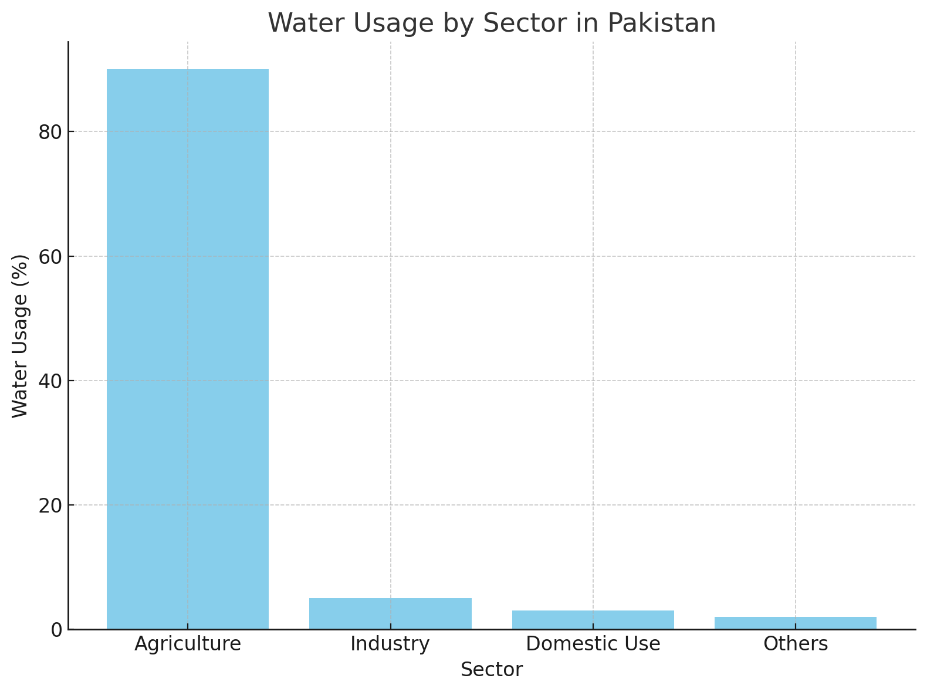
Table 1 Water Usage Data in Pakistan
| Sector | Water Usage (%) |
| Agriculture | 90 |
| Industry | 5 |
| Domestic Use | 3 |
| Others | 2 |
Data Analysis
The research data was analyzed using several methods to reveal the complete connections between climate change and water security when obtained from surveys and interviews and secondary sources.
Limitations
Despite that, some limitations should be acknowledged about the research methodology, because of its comprehensive nature. Nevertheless, a major drawback is that water stress is most critical in some of the remote and politically unstable areas of Pakistan that are difficult to reach. For this reason, information collected from these regions might not be representative of the most marginalized community in these areas that namely the most vulnerable community to water insecurity in these regions, and especially in Baluchistan and Sindh, which were difficult to visit in terms of security.
In addition, the research relied on interviews with many expert water, politicians, and field representative voices, but the voices of the least marginalized are perhaps not heard, namely those who suffer water scarcity most, the marginalized groups, such as women and small farmers. Research gaps must include wider perspectives, especially such at-risk groups, and most especially those which are most at risk of water insecurity (Khan & Batool, 2025).
I finally conclude that this mixed-method data approach (the primary and secondary data sources) will provide a solid platform for the study of the connection between climate change and water security in Pakistan. A holistic assessment of current water management policies will be offered through carried out research based on both qualitative and quantitative analysis, filling major gaps, and strategic responses to ensure available water in the context of climate change.
Results
The results of this study highlight several significant gaps in Pakistan's approach to water security in the context of climate change. The growing awareness of the impacts of climate change by the various stakeholders and the focus on urban areas is a major finding. Many urban residents and policymakers have started to understand that there are huge risks to water availability caused by climate change. But, in rural areas, such awareness is not as visible, and neither is it so prevalent among farmers who are unaware of the likely effects of climate change on water resources. For even this, there is a knowledge gap, since more rural communities are not able to adapt to changing water availability and are therefore left exposed to climate change, such as water shortages, as well as other climate-related risks.
Another important findings include the policy implementation gaps. Pakistan has declared the National Water Policy an important initiative in resolving the water security problem, yet the study reveals that this policy has not been properly implemented. The component is an important barrier to successful execution: coordination between federal and provincial authorities. Water management practices are regionally defined, and there is no process for such water to be equally distributed (Hussain et al., 2020). However, this inefficiency has been due to inconsistent policy enactment that as some areas have operated out of a serious water shortage while others have overpumped the quantities that the resources can provide. Indeed, however, the growth in facing pressures from climate change on the availability of water has not been met with an effective response due to the lack of a coordinated strategy to respond to the pressures.
The study, however, points out that some communities have adopted water-saving technologies such as drip irrigation to some extent, but the level is quite low. But limited adoption of such technologies is due to high initial cost, lack of intellectual support, and lack of or negligible government support. However, this is so wasteful to the extent that much organizational water use continues to be wasted due to poor irrigation practices - a phenomenon, combined with the country's water scarcity, makes it worse. As the water in the agricultural industry uses the most water, there are few efforts devoted to water conservation, while there are many inefficiencies in water usage, especially these.
At last, it is shown that water governance in Pakistan involves such a strong fragmentation among several governmental agencies at the federal, provincial, and local levels. It has been a waste of decision-making and policies set in place to manage water (Ali & Sanauddin, 2023). Because there is no discernible articulated water governance strategy, policies aimed at addressing water security have ad hoc, unlinked approaches to coping with the challenges posed by climate change. The study avers that for water security to be strengthened, governance of water resources should be done more integrated, coordinated, and more equitable, and efficient manner.
Discussion
The threat of climate change is compounded by the threat of water insecurity, and this research shows that urgent reforms are necessary in Pakistan's water management policies. A fragmented governance system is a key challenge to developing effective water management. The National Water Policy is a step in the right direction, and fulfillment should suggest stronger coordination between all federal and provincial governments. Integration and well-defined roles of levels of government should be incorporated into water governance.
The water distribution, however, is as inefficient as it is; then, combined with it, the old, dilapidated infrastructure is added to the tiers of stress. But the study finds, however, that large-scale infrastructure projects like dams and canals are not sufficient to offset climate-induced variability. Climate risks need to be integrated with water management plans using adaptive strategies. Desalination and better storage facilities have a way of supplementing traditional sources of water and can also be used to fight against climate change.
This study and the literature imply that Pakistan should integrate water resource management in order to fulfill the requirements of all stakeholders (agriculture, industry, and domestic) under the guidance of integrated water resource management (IWRM). Secondly, it will be crucial to attract participation in the water conservation and awareness campaign of the public so that water resources can be sustainable in the long run. There are also attempts to look at water pricing mechanisms to promote waste reduction and conservation.
Conclusion
Climate change in all its various dimensions - water availability, changed patterns of the monsoon, and raised temperatures - is compromising Pakistan's water security as a whole. The large majority of these changes have put such heavy pressure on the nation's water resources, and above all, they have placed a great threat on water-hungry industries, particularly the sector of agriculture that is directly dependent on the uninterrupted availability of water in sufficient quantity and quality for crop irrigation. Close to 90 percent of the country's water, allocated to agriculture, is affected by a break in the water supply, and the financial and social impact can be great. Fragmentation of water governance only contributes to the overall progressive fragmentation that is currently being imposed on the country's existing water management infrastructure. Current policies inadequately deal with the challenge of water climate change, especially when there is insufficient integration and coordination among them.
This lack of coherence in Pakistan's water governance across federal, provincial, and local levels causes poor, inefficient decisions and implementation. The inability of different government agencies to coordinate on the management of the country's water resources has resulted in misallocated water, wasted on distribution, and non-enforceable policies. The National Water Policy in 2018 is a step in the right direction in dealing with these issues, especially the poor, incomplete, and vaguely formulated. Pakistan has not prepared well to deal with future water crises because of the lack of clear enforcement mechanisms, a lack of a cohesive strategy to distribute water, and an unwillingness to integrate water distribution with compounding climate adaptation measures.
Through this study, I point towards the necessity of the need for comprehensive reforms in the existing water management policy and practice of Pakistan. In an attempt to solve these water security challenges, weaning in hands by the effects of Climate Change, Water Resource Management (IWRM) strategies should be incorporated by the country. IWRM is the main feature that has developed an integrated approach to link existing efforts from different sectoral and governance levels to coordinate water resources in a sustainable manner. IWRM would allow for the management of Pakistan's water resources in a holistic manner, in and efficient manner, for the various stakeholders (agriculture, industry, and urban populations).
The study emphasizes the need to improve federal as well as provincial governance structures. As a result, a more coordinated approach to water management must be substituted with a better organized one that deals with this piecemeal approach that starts locally and goes up to the central government, which descriptively takes on clear responsibilities and roles for each level of government. Communication and collaboration amongst these bodies help them to have effective communication and fair national priorities in terms of water distribution and management. Such redundancy (and policies not being followed in all the states) will be eliminated by the establishment of an authority at the federal level to control the manner in which all other states in the country conduct water management practices.
It is advisable to incorporate climate-adaptive strategies in response as a strategic response to water security in Pakistan. It is about expanding water storage capacity, increasing irrigation efficiency to steal water out of everywhere as everywhere, and promoting water conservation both locally, nationally, and globally. On the other hand, the practices of agriculture, industry, and urban planning should be integrated, together, with sustainable water use. This may be the mass use of water-saving technology (drip irrigation, rainwater harvesting, and efficient use of groundwater resources) in the context of agriculture. Likewise, when it comes to reducing pressure on Pakistan's water supply, these practices would provide powerful tools.
Besides, Pakistan has to take immediate steps to modernize and upgrade its obsolete water infrastructure and improve water efficiency and conservation. Inefficiency and large water losses are found in the country's existing water storage and distribution systems. If these systems are to be updated and maintained to reduce inefficiencies, improve water delivery, and minimize water shortages, it will be important. The government should devote investments to modern technologies and infrastructure improvements, along with a long-term maintenance and upgrade plan.
Additionally, there will have to be better coordination between federal and provincial authorities to make sure the water is distributed equally and used such that the greatest possible good results from the combined water resources of the two countries. This must be done by dialogue and the setting up of a transparent, fair, and legally binding framework for water distribution between provinces in the midst of ongoing tensions between provinces in terms of water allocation. It is also necessary to involve the local communities more in the decisions regarding water management because they are most impacted by water insecurity.
If Pakistan adopts these recommendations, it will become much more resilient to climate change and more capable of managing its water resources through sustainable means. Releasing water appropriately will not only guarantee the country's future water supply, but it will also facilitate the future of Pakistan's agriculture sector, its economy, and social well-being. Not only does strengthening Pakistan's water security help Pakistan address the challenges of climate change, it is also critical for securing a prosperous and peaceful future for its population, which is on the increase.
References
- Ali, Z., & Sanauddin, N. (2023). China-Pakistan Economic Corridor: Opportunities and challenges for local inhabitants of Gwadar, Balochistan. Journal of Pakistan-China Studies (JPCS), 4(1), 77–102. https://doi.org/10.55733/jpcs.v4i1.60
- Amna, N. (2024). Socio-political and economic impacts of China-Pakistan Economic Corridor (CPEC) on the region: A case study of CPEC [Master’s thesis, Norwegian University of Life Sciences].
- Ch, N. a. A., & Mushtaq, N. D. a. Q. (2025). CPEC: Socio, Cultural and Economic Effects on Gilgit-Baltistan. the Critical Review of Social Sciences Studies, 3(1), 2090–2103. https://doi.org/10.59075/2gww0v15
- Hafeez, M., Hussain, N., Saqib, G., Farooq, S. M., & Rehman, A. (2021). China-Pakistan Economic Corridor—Historical perspective and future prospects of Baluchistan linked with economic corridor. Psychology and Education, 58(1), 5222–5233.
- Hanif, A. (2021). Role of local community in mega development initiative as economic corridor: The case of China-Pakistan Economic Corridor (CPEC) in Balochistan, Pakistan [Doctoral dissertation, RMIT University].
- Hassan, M. S. (2024). Socio economics impacts of CPEC on Pakistan; the dark side of the project. The Critical Review of Social Sciences Studies, 2(2), 244–255. http://dx.doi.org/10.59075/wnf9kj78
- Hussain, S., Sohail, A., Yu, C., Manzoor, S., & Zahid, A. (2020). China-Pakistan Economic Corridor (CPEC’s) socio-economic impacts on Pakistan. International Journal of Management & Entrepreneurship Research, 2(6), 416–436. http://dx.doi.org/10.51594/ijmer.v2i6.176
- Karim, E. U. (2022). The socio-economic impacts of China-Pakistan Economic Corridor on Pakistan [Master’s thesis, Ritsumeikan Asia Pacific University].
- Khalid, U. (2021). Assessing Implications of Social Welfare of CPEC: A Provincial level analysis. Global Pakistan Studies Research Review, IV(II), 1–12. https://doi.org/10.31703/gpsrr.2021(iv-ii).01
- Khan, M. A., & Batool, S. (2025). Indian hybrid warfare tools in Baluchistan and its impact on CPEC: A critical analysis. Contemporary Journal of Social Science Review, 3(1), 1725–1741.
- Khan, W. (2024). The impact of CPEC on human capital in Balochistan: A case study of Gwadar [Master’s thesis, School of Social Sciences & Humanities, S3H-NUST].
- Rana, Ashmita. 2022. "CPEC: An Assessment of Its Socio-economic Impact on Pakistan." E-International Relations 1: 1-9. https://www.e-ir.info/pdf/95852
- Sadiq, W., Bashir, S., Zafar, H., Zarar, R., Naudani, T., & Ali, T. (2022). Exploring the perceived concerns of people of Baluchistan province related to Pakistan’s signature project, the China Pakistan Economic Corridor. Central European Management Journal, 30(3), 214–222. http://dx.doi.org/10.57030/23364890.cemj.30.3.18
- Ullah, H. A., Kainaat, F., Wajid, H., & Sarwar, M. (2024). Analyzing the impact of the China-Pakistan Economic Corridor (CPEC) on Pakistani economy and society. Al-Mahdi Research Journal (MRJ), 5(4), 769–780. Retrieved from https://ojs.mrj.com.pk/index.php/MRJ/article/view/448
- Ullah, S. (2020). Socio-political significance of China-Pakistan Economic Corridor (CPEC) and its impact on regional politics [Unpublished manuscript or thesis, if applicable].
- Ullah, S., Khan, U., Rahman, K. U., & Ullah, A. (2021). Problems and Benefits of the China-Pakistan Economic Corridor (CPEC) for Local People in Pakistan: A Critical review. Asian Perspective, 45(4), 861–876. https://doi.org/10.1353/apr.2021.0036
- Zafar, H., Ali, M., & Manzoor, R. (2024). CPEC as a socioeconomic stability: The view of Balochistan future. Contemporary Journal of Social Science Review, 2(4), 497–510.
Cite this article
-
APA : Malik, M. S., Akhtar, U., & Arshad, U. (2025). Climate Change and Water Security in Pakistan: Policy Gaps and Strategic Responses. Global Social Sciences Review, X(II), 280-289. https://doi.org/10.31703/gssr.2025(X-II).22
-
CHICAGO : Malik, Muhammad Shoaib, Umbreen Akhtar, and Umair Arshad. 2025. "Climate Change and Water Security in Pakistan: Policy Gaps and Strategic Responses." Global Social Sciences Review, X (II): 280-289 doi: 10.31703/gssr.2025(X-II).22
-
HARVARD : MALIK, M. S., AKHTAR, U. & ARSHAD, U. 2025. Climate Change and Water Security in Pakistan: Policy Gaps and Strategic Responses. Global Social Sciences Review, X, 280-289.
-
MHRA : Malik, Muhammad Shoaib, Umbreen Akhtar, and Umair Arshad. 2025. "Climate Change and Water Security in Pakistan: Policy Gaps and Strategic Responses." Global Social Sciences Review, X: 280-289
-
MLA : Malik, Muhammad Shoaib, Umbreen Akhtar, and Umair Arshad. "Climate Change and Water Security in Pakistan: Policy Gaps and Strategic Responses." Global Social Sciences Review, X.II (2025): 280-289 Print.
-
OXFORD : Malik, Muhammad Shoaib, Akhtar, Umbreen, and Arshad, Umair (2025), "Climate Change and Water Security in Pakistan: Policy Gaps and Strategic Responses", Global Social Sciences Review, X (II), 280-289
-
TURABIAN : Malik, Muhammad Shoaib, Umbreen Akhtar, and Umair Arshad. "Climate Change and Water Security in Pakistan: Policy Gaps and Strategic Responses." Global Social Sciences Review X, no. II (2025): 280-289. https://doi.org/10.31703/gssr.2025(X-II).22