
- What ideologies are embedded in creating interpersonal meanings in textbooks?
- How the textbooks published through PTB construe and distribute identities?
- What linguistic choices and patterns do writers engage with in order to construe the representation of characters in children's literature?
- How these ways of speaking play into the dynamics of relationship-building and power relations among characters?
Abstract
The current study investigates social representation of characters in Pakistani children literature that is utilized within schools and specifically with the Punjab Textbook Board (PTB) textbooks in Grade 5-8. Utilizing an SFL, Interpersonal Meta-function as developed by Halliday, the study explores the issue of relationships, power and ideology of education as represented in any of the texts by linguistics choice. By establishing the method as Critical Discourse Analysis (CDA) and using pronouns, mood, and modality as analysis points, the study will seek to determine how language can construct or challenge dominant ideologies. Through qualitative analysis of selected texts, one examines character interactions to indicate patterns of who are included or marginalized representation, social groups, and power structures which were present. This study has its significance in various fields of education such as in the fields of curriculum engineering, linguistic analysis, and Discourse analysis.
Keywords
Systemic Functional Linguistics; Critical Discourse Analysis; Modality; Power Dynamics; Curriculum Development
Introduction
C
ritical Discourse Analysis (CDA) is a methodological approach which sees language as social practice and sets out to explore how discourse on the one hand reflects, but also maintains, on the other hand, power relations, ideologies and identities. Out of the work of Michel Foucault, Norman Fairclough and Teun van Dijk emerged CDA, which counteracts both structuralist and functionalist models by arguing that discourse is not mere passive reflection but also actively constructs and maintains social inequality. It analyses language in terms of power and control, especially through the media, politics and education. Whilst these two models explain why it is important to study discourse as a site of power, CDA offers us three 'dimensions' (text, discursive practice and social practice) through which such relationships between the language and societal dominance may be maintained or challenged. The tenets of CDA are that language is not neutral, and meanings need to be understood in their social and historical context. By scrutinizing texts such as news reports, political speeches and educational literature for example CDA reveals how discourse works to make ideologies appear as common sense so that they can take-for-granted and remain unquestioned. In media studies, for example, CDA unmasks the ideological bias in reporting; in politics, it uncovers how linguistic framing maintains authority; and in education it dissects textbooks to detect hidden messages about class, gender and culture. Through this CDA not only explicates but also seeks to raise social consciousness and change by querying the ideology in power. Moreover, CDA is allied with Systemic Functional Linguistics (SFL). Both refer to the manner in which linguistic forms produce meaning by action of three metafunctions (ideational, interpersonal, and textual), as established in SFL but CDA is oriented towards a socio-politics setting of those meanings. Collectively, they present a comprehensive model for examining the ways in which language constructs and limits meaning and enforces social power. SFL offers the linguistic tools with which to engage in close textual analysis that CDA then processes through ideological and critical perspectives. Their union provides a complex model of the relations between discourse-thinking and social reality.
Literature Review
Systemic Functional Linguistics (SFL) primarily deals with a social semiotic framework for understanding how meaning making phenomenon is construed. SFL has since influenced various fields within applied linguistics such as educational linguistics, multimodal studies, and critical discourse analysis. In that case, Halliday's model of functional linguistics is immensely used to understand how power dynamics operationalize in society. It is evident that ideology and discourse formulate dialectics and in order to understand this complex mechanism, one has to explore the idea how discourse actually works and in this regard Halliday's key contribution lies in this view of grammar tool for meaning-making resource. These meanings are related to our ideas, opinions, descriptions, cognition, actions, happenings, identities, perspectives, behaviors, appearances and narratives etc., (Halliday & Hasan, 1985) which is totally different from structural approaches to language. Based on this theory, SFL argues that understanding language and other systems of meaning requires analyzing the specific context (Halliday & Hasan, 1985). Children's fiction can offer deeper and more complex meanings that engage readers on multiple levels. It challenges the notion that literature written for children is very simple suggesting that even adults can find joy and depth in it while children cannot fully understand adult literature adults on the other hand can connect with children's perspectives by revisiting their own inner child (Markovic, 1973). By avoiding complex stylistic techniques including metaphors, allusions and symbols, the children's literature remains easily understandable. Petrović (2005, p. 192) says that the poetics of children's fiction owes mostly to its simplicity.
Discourse construction in literature is seen as an artistic process that reflects both the objective and subjective worlds (Hasan, 1985). The beauty of literary text is largely based on its aesthetic appreciation. Language is not only meant for communication but rather it represents the world, maintains social relations and organizes discourse and further language education contributes to develop children's thinking. In children's fiction a number of devices are being employed like coherence, parallelism and the antithesis etc. Additionally, the arrangement of characters, words and sentences should create a sense of structural beauty (Xiao yang, 2020).
According to Widdowson (2007), pronouns can also be ideologically driven because they can express agency in discourse and especially in this regard he (Ibid) views that the use of pronouns in discourse reflects power dynamics such as inclusive 'we' and exclusive 'we' etc., because this dichotomy is inherently ideological supported by Wood and Kroger's (2000) argument that pronoun usage is inherently ideological. For example, the use of 'I' can highlight the speaker's responsibility, competence and authority over their audience.
In Lord of the Flies, as evidenced by Wang (2021), declarative mood is extensively used which is deployed to communicate certain facts and states of affair. For example: 'You are a silly little boy, just an ignorant, silly little boy', 'they think you are batty', 'there isn't anyone to help you. Only me. And I'm the beast', 'Fancy thinking the beast was something you could hunt and kill' and 'I'm warning you. I'm going to get angry' (Golding, 1954, pp. 199-201). All these clauses are sometimes intimidated by exclamatory clauses too which showcase power dynamics (Ibid).
Raza (2017) states that these themes reflect Islamic ethical teachings promoting kindness etc., such as the character of Ali Khan in 'Ali ki Madad' is represented to have been helping poor classmate (Ali and Shaheen, 2019). These stories not only promote positive values but also encourage them to act compassionately. In these stories, characters employ formal honorifics and respectful language when addressing to elders and authoritative figures reflecting infrastructure of Pakistani society (Aziz, 2022). In that case, different characters deploy codeswitching in order to maintain integrity of relationships (Hameed, 2021). Mood is a lexicogrammatical feature that conveys the speakers' attitudinal meanings towards the action of the verb. It is important in shaping the emotional landscape of narratives. In Pakistani literature in fiction for children, various moods such as indicative, imperative and subjunctive are employed to create specific effects. Now we try to discuss mood system in children literature. The indicative mood is used to state facts and describe states of affairs and events. For example, in stories where characters go for adventurous tour the indicative mood is especially highlighted to communicate the facts. As highlighted in Mahmood (2018) "the indicative mood facilitates the clear portrayal of events, allowing young readers to understand the sequence of actions" (p. 45).
The imperative mood is used to express commands and requests which is used for motivating young readers to be socialized. For example, the directives are used to communicate certain moral principles. Khan (2020) says that "the use of imperatives can actively involve children in the narrative, encouraging them to reflect on their own choices" (p. 78). While imperative mood is used to communicate directions, subjunctive mood is used to communicate wishes and other hypothetical situations. Raza (2021) demonstrates that, "the subjunctive mood introduces an element of fantasy that captivates children's imaginations, allowing them to explore 'what if' scenarios" (p. 112).
Children's literature significantly influences young readers by shaping their personalities and leaving a lasting impression on their development and in doing so the most important thing is that it provides a range of literary options which are, undoubtedly, crucial to help children navigate their future smoothly and effectively. In this context, when they grow old, they practically apply those ethics and moral principles which they have learned in their childhood. In that case, adults especially parents, educators and other caregivers have a key responsibility in guiding children's reading experiences. So far as the plot of children's fiction is concerned, it is not that much complicated but offers presents the story in an engaging and captivating way so that they could be able to understand. These plots are presented often in an allegorical style such as Orwell's Animals Farm (1945) is written in allegory because superficially it describes a story for children but inwardly it sheds light on Russian revolution.
The complex plots of such kind of literature contribute not only to cognitive growth but also to emotional and spiritual aspects of personality. These tales shape discourse of children, and they enhance academic skills like emotional intelligence which help them for future achievements. Apart with that, the plot of these stories is crafted skillfully to reflect current standards of morality and societal norms. The researchers emphasize that children's literature fosters an appreciation for both one's cultural heritage and the cultures of others (Norton & Norton, 2011).
Research Methodology
According to analytical method CDA, language represents social practice and therefore traces the relationship between language use and power that makes explicit how discourse reflects and reproduces power relations while conveying ideologies. CDA interrogates the structuralist and functionalist assumptions stating that discourse simply reflects social structures and it can be seen as an active agent. It examines how language can perpetuate domination and control, particularly as it is employed in media, politics and education to frame percepts and support ideologies.
Data
The source of the data comprises PTB textbooks included in teaching of English as the second language. In this case, English for class 6, 7 and 8 are included into the source of the data. Therefore, the stories included in the primary data from English 6 are as under: English for class such as, Harmony in Society, First Aid Saves Life, Corruption, Education is my Right while the stories taken from English class 7 are as under: Eid-ul-Adah, The Wise Old Woman, The Young Boy's Adventure. While stories taken from English for class 8 are as under: Clever Mirchu, A Great Virtue. The present research is designed to answer the following questions:
Research Framework
In Systemic Functional Linguistics, clause works out three meanings simultaneously and, in this case, clause is also used as exchange of meanings between interlocutors. This is generally termed as interpersonal metafunction of a clause. First of all, we talk about different speech roles performed by participants. The two basic speech roles are 'giving' and 'demanding'. These two dimensions further expand into 'goods-&-services and 'information'. The interlocutors either give goods and services or demand it. Similarly, they either give chunks of information or demand them. All these speech roles work at the level of discourse, and these roles are directly linked with semantic categories as explained below:
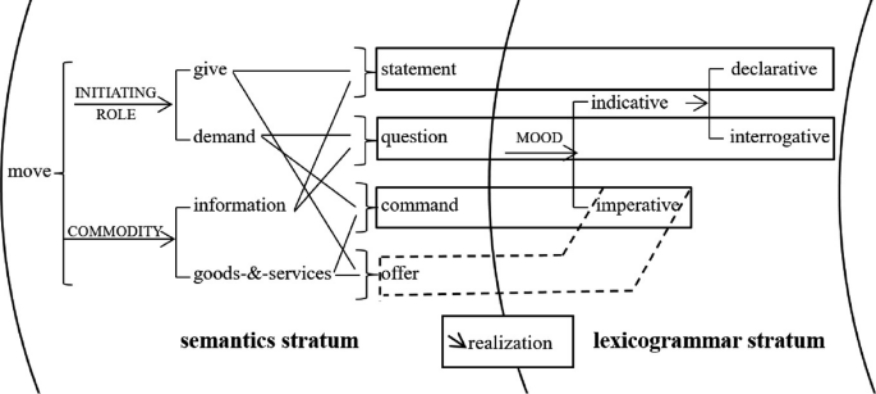
In Interpersonal metafunction, the exchange of meanings is performed through certain moves by speakers. In it, there are two dimensions like 'initiating roles and 'commodity'. In the former one, there are further two options such as 'give' and 'demand'. In this case, what is given or demanded might be some set of information or some goods-&-services. These things fall in the semantic stratum. Broadly speaking, if the initiating role is 'giving' information and goods-&-services, it is in the form of statements and offers respectively. Similarly, if the initiating role is demanding information and goods-&-services, it is in the form of questions and commands respectively. Semantic stratum is realized in lexicogrammatical stratum. For these speech roles, there is a mood system in grammar as illustrated below:
Table 2
| Speech Roles (Moves) | Semantics | Grammar |
| Giving: information | Statements | Declarative Mood |
| Giving: goods-&-services | Offers | Interrogative Mood |
| Demanding: information | Questions | Interrogative Mood |
| Demanding: goods-&-services | Commands | Imperative Mood |
These speech functions illicit responses which have binary pairs. In this case, an offer is either accepted or rejected, command is either undertaken or refused, statement is either acknowledged or contradicted, and question is either answered or disclaimed. The initiation and the corresponding response types are illustrated below:
Table 2
| Initiation | (Semantics) | Response |
| Expected | Discretionary | Contradiction |
| Statements | Acknowledgement | Rejection |
| Offers | Acceptance | Disclaimer |
| Offers | Answer | Refusal |
| Commands | Undertaking |
Thus, the main aim of this research study is the analysis of linguistic choices in Pakistani children's literature in relation to interpersonal relationships and character interactions. The study wants to explore the way power is portrayed in the texts vis-a-vis social-cultural ideologies especially when it comes to the representation of central characters. To further investigate this topic, the study analyzes the components of pronouns, mood, modality, and appraisal in the construction of a character and their relationships. A second major goal is to investigate how the features of marginalization, voice, and solidarity are constructed linguistically within these texts. Understanding authorial presence in LTL texts 478 These results will expand our understanding of how texts inform young people's understandings of authority, power relations, and social hierarchies.
Research Questions
The central research question that guides this study is the following:
It also seeks to trace the political ideologies that inform these narratives and how those ideologies shape young readers' understanding of their own lives. Hence, by tackling these queries, the present study will provide a synthetic linguistic insight into the portrayal of characters in the Pakistani EFL children's literature.
Significance of the Research
The implications of this discovery are various and the most compelling among them is the fact that it has an implication on linguistics, education and social discourse, in general. Language innovations It makes contributions to discourse analysis by using Systemic Functional linguistics to children literature and offers information about how language interventions form interpersonal relationships. In the education perspective, the qualitative findings may enlighten the textbook developers, teachers, and policy makers on implicit messages on the language transportation on textbooks. This knowledge can contribute to the development of more balanced, inclusive, and representative educational content. On a sociocultural level, the study exposes the ways power relations, gender roles, and cultural ideologies are woven into children's literature, shaping young readers' perceptions of power dynamics and interpersonal relationships. It can be included in the discussions of equity and representation in education resources, leading to the changes towards textbooks that are more diverse and inclusive.
Data Analysis:
Interpersonal Meanings in Lesson Stories of English-6 (PTB)
Harmony in Society
Equality and fair laws are important, yes, but the story of Ahmad and Haziq in "Harmony in Society" looked at those tighter reiterations of social bonds that connect our compassion. The showing language demonstrated Halliday's interpersonal metafunction as characters' interactions, dominance and feelings, roles, and preferences emerged. Events were mostly described through facts and in so doing, the imperatives appear very rarely. On the top of that, this structure communicates moral instruction quietly. Questions from Ahmad and Haziq signify curiosity and changed outlooks in cases of inclusion. They were expected to be arrogant, but the kind of dialog changed their mindset that emphasize that through engagement and dialog-friendly environment is the only way how people understand and realize that they belong together. Furthermore, vividly expressed emotions offering hostility, slightly diminished hostility and kept resolution possible. There is an aura and respect in the disputes between and in the interactions and all individuals were dignified. This balance embraced diversity as well as teaching tolerance advances society more than isolation or accusation.
Sentence Constructions
Your delivery of a message can significantly impact how a person interprets the meaning and emotion being expressed. The interpersonal indicators used in this lesson such as "may," "could," and "might" briefly tell us how uncertain, able and possible things are instead of being definitive orders. For instance, when Ahmad and Haziq's mother tells her children to greet all the neighbors properly and appropriately, it is meant culturally oriented talk and not religiously obligatory. On the other hand, the commonly used expression such as "We should always express gratitude to Allah" is very defective in the sense because while saying so is a substitute for saying but, it is a zestful and devoted sentiment and emotions. But in the story, majority of the modal phrases come down stronger particularly among the children when individual interest takes precedence over rigorous enforcement, and in doing so, the story's theme on social cohesion comes amidst from a place of genuine interest and not just bare compliance. Anyhow, through the roles and dynamics between characters, implicit hierarchies and social positions are further revealed, explained and consumed by masses. In cases of Ahmad and Haziq, their mother leads by recommendation and not by obligation crafting her messages to help the boys internalize virtues like respect and kindness without any external pressure which is expressed to allow them to bring snacks directly to the neighbors and engage face-to-face interaction instead of following route instructions. Using this method, the narrative quietly promotes that the best way to grow moral people is through firsthand experience rather than just instruction about what to do and what not to do.
Gatha had appeared to be very quiet, but the challenges she faced soon came out through interaction. This particular difference basically emphasizes the development in human connections to break prejudices. There are few glimpses from rejection behind her reluctance to make friendship, as well, that highlights the acceptance. This turning point came in responding to Anil and Rahul's kindness breaking down the walls of isolation and distrust. One of the characteristics was the speech of the characters that changed when the story developed. In the beginning, the instructions and actions had the light authority of a mother, however, later Anil and Rahul spoke confidently. Their actions reflect duty that turn into choice. These changes reflect internal transformations of the characters, a way of adoption of ethical systems that's freely chosen rather than solely obeying hierarchical orders. On the top of that, the moral themes depicted in the story pushes personal morals to examine wider networks of society. It argued for a collective responsibility to understand marginalized human beings such as Jasim not just an individual responsibility while the acceptance is reinforced in the end where Jasim is an active member of the society. Those moments of laughter and play became a vital sign of unity in the end which is a reminder.
In addition to it, religious framing is positioned here ideologically. For example, in the references to giving thanks to Allah, the moral lessons were framed in a spiritual dimension where not only reinforcing ethics but also aligning them with a higher order to common values. By employing the word of "always" in reference to his talks show the superiority of religion in discourse. The desire to be kind not only feeds Jasim, but it also opens my eyes to something. Both the psychological and emotional concerns weight much in the passage.
The use of descriptors such as "melancholy," "pensive," and "reluctant" describe Jasim's initial attitude that evokes a sense of loneliness and separation, which heightens the poignancy of his eventual acceptance. Similarly, clauses such as "the earth crackled with the laughter of kids" illustrate the change in his personality which showcases a stark contrast of his forlornness to a warmth of acceptance. Such poetic choices serve to draw the reader into a relationship with the narrative that not only covers the emotional ground but also requires the structure of the story. The story begins with misunderstanding and builds through discovery and action and then ends with resolution and enlightenment. This reinforces the theme of moral progress by a process. Ahmad and Haziq are hardly aware of what Jasim has been through, but their slowly growing awareness and their attempts to befriend him prove that real empathy takes time and effort. Such type of storytelling corresponds to Halliday's interpersonal meaning because the relationships and attitudes behind the words influence the way the readers perceive the message.
The story mainly uses declarative sentences to present it as an observation rather than imposition, but the use of mood and modality within the story is intentional and follows the changing perceptions of the characters whilst taking the readers along with them towards understanding. Through the narrative, the manner of the composition of the characterization to the ideological framing of the subject forest itself indicate that social harmony propelled by genuine human bonds and empathy is not a question of obligation, is the core of the different visualization of "Harmony in Society". The linguistic stalk-and-branching of the tale, and the variations in flow and complexities of its sentences mirror the harmonious yet variegated weaves of society itself most daintily, perhaps most astutely. The lesson entitled as "Harmony in Society" is a moral structure that highlights the cooperation, respect, and unity in character, actions and messages while choices of modality probability, habit, possibility and necessity govern the way throughout the discourse. Further variation in the modalities enhances the certainty or improbability of actions and their consequences facilitating the communication of the theme in terms of social cohesion.
Inclination
The modality of likelihood being a key in showing the desire of the characters to keep things peaceful while clauses such as "People should always value each other's rights," represent moral investment in peaceful co-existence. Such conduct is mentioned as "should" by the word "should". In another example, a simple but multifaceted sentence "They wished to resolve their differences through thoughtful dialogue" conveys moderate likelihood based on the usage of the word "wished" as it represents a personal desire, and not an outright need. Such a nuanced approach to modality demonstrates intentionally over a phenomenon which simply happens.
Usuality
The mode of the habit in the story places emphasis on the common social customs and, as such, instantiates the philosophy that order is ensured by a ritual of respectful exchanges. Literally, the clause "Neighbors often assist one another when a neighbor is in crisis" displays habit meaning mutual help is a great social norm. Thus, by virtue of putting forth this claim in the form of being indefeasible, the text guarantees that helping others and make themselves available which is characteristic natural traits natural that embed in the matrix. On the other side, the clause "Some neglect courtesies in difficult times" is an example of moderate typicality and this behavior is not universal but familiar as denoted by "some" and "often." A balance between this dichotomy maintains the society by making both the courtesies and behaviors important and defining the necessity of having equilibrium between them and intermittent disturbance that befall the society.
Probability
Probability modality presents the consequences that a cooperation or hostility in a community can assume. Phrases that insist that "conflicts are the byproducts of discord" bear high probability and indicate that a lack of mutual esteem will always lead to social disorder. It's a certainty that allows no option to doubt that specifies respect and understanding as an imperative to avoid community collapse. By using the word "may", it means that this will reduce conflicts through effective interaction but does not promise peace in every case. This well-balanced view acknowledges that while decent equivalence is desirable, it must have additional requirements in order to achieve long-term public peace.
Obligation
It is the modality of obligation that emphasizes on the accountabilities of people who owe to one another stating that it must respect the rights of others conveying a high obligation that leaves no room for exceptions. The term "must" show an unconditional obligation which emphasizes mutual respect which is fundamental to social cohesion. This subtle modulation of expectation communicates moral lessons without the reinforcement of rigid enforcement that inspires thought instead.
Degrees of Modality
The text balances the necessary requirements intentionally, and, therefore, its larger purpose of relating to social cohesion comes out clearly and persuasively. The expressions of ethical universals, and unavoidable consequences, are not made in optional terms. Puns such as without harmony, a community will fall apart are bound to sound absolutely sure since the emphasis is on the most important thing, which is collaboration. This also applies to such phrases as "Individuals should always respect each other which provide inviolable principles. In cases of single contracts, medium necessity is employed in statements and this implies that though they permit latitudes, they also steer conduct. A word such as, If people listen to each other, they may solve their troubles, means that listening is one of the solutions but does not guarantee that it will solve it. This subtle approach recognizes the social interaction complexity excluding the absolute claim making.
Low uncertainty exists in high need statements. Indicatively, something like people can differ and still be friends presupposes that the chances of all dissents resulting in a breaking down of their relationship are low. Also, this right to assertions of idealistic mind makes this passage remain realistic instead of utopian. And this story which was called "Harmony in Society" met the powers of modal verbs very well to prove the necessity to be compassionate, to talk, to work together with others. Uncompromising adherence to principles of community was exhibited by firm claims, and habitual modality extended the conception community behavior must dominate quotidian existence. Potential modality provided a caution on the potential threat of societal divisions, yet obligation verbs showed us what we owed to one another. One means by which the odd story established reconciliation between a moralism and realism was by her altering the certitude of the statements, as in a manner that tended to assure the reader that its moral alarm was still reverberating through the interrelations of the human person in all his variety.
Eid-ul-Adah
The story describes the profound meaning of this important Islamic festival. Readers learn of Prophet Ibrahim's readiness to sacrifice his beloved son Ismail when he heard the command from God, and the manner in which God replaced the son with a ram at the last minute. The dialogue-based narrative between siblings Aaliyah and Ahmed provides a glimpse into the preparation and observance of Eid traditions in their family.
Questions posed by the children lead to a discussion that can be had about history, religious lessons and modern customs. We learn how Muslims throughout the world commemorate Ibrahim's act of submission to Allah by ritualistically sacrificing livestock. The meat is then shared between one's family, friends and those in need -and re-enforces Islamic teachings of compassion. Celebrations also involve new clothes, and the exchange of greetings as well as communal praying at the mosque.
Sentence Constructions
A variety of sentence structures help to improve the flow of the story and help with comprehension. The declarative statements obviously give some background facts about the origin and significance of Eid al-Adha. Interrogatives are used to stimulate curiosity as Aaliyah and Ahmed ask their parents about information about the celebration. Imperatives suggest moral and religious duties when we are talking about proper distribution of sacrificial meat. Descriptive sentences create a colorful picture of festive Eid preparations and rituals in Muslim communities worldwide. In summary, writing skillfully keeps the young readers engaged with a varied use of different types of sentences. Eid-ul-Adah is a portrayal of divine intervention in the form of the sacrifice of Hazarat Ibrahim (AS) who submitted himself to the command of Allah willingly through the expression of the awesome exclamation "This was a miracle of Allah!"
Clever Mirchu
It is the story of the poor woodcutter and his wife who cannot feed their 7 children. The youngest, Mirchu,
is small of stature, but sharp. Over a period of intense famine, the parents leave their kids in the woods in the hope that they would be found and cared for. But with his wit and clever scheming, Mirchu ensures that he and his brothers make it home again. It is a story of parental desperation and resourcefulness, of triumph, of intelligence against adversity.
Sentence Construction
For the most part, the story just uses declarative sentences to relate what happens, place descriptions, and what people are like. "The woodcutter and his wife were so poor that at times they did not know where to get money to buy food for their children." This kind of sentence is making some factual statements about the family's financial distress. Important structures which contain interrogative features are more apparent here, especially in the dialogue. "How did the Mirchu go to his mother?" The style of questioning is an engaging one, focusing on important moments in the narrative. Also, exclamatory sentences, as in What joy and happiness there was in the woodcutter's cottage that night! help to express emotions and build tension for the story to come to a conclusion.
Modality
In the story modality refers to a range of different assessment, as the inclination, the usuality, the possibility and the obligation, and they construct the relations between characters and actions.
Inclination
This shows want and intentions of the characters. "A poor wife cried and cried," for example. She was so full of sorrow to hear this." The repetition of "cried" helps to emphasize her emotional disposition and her determination not to give up on her kids.
Usuality
Usuality is localized to the descriptions of the routines of the characters and the constant pressure of hardship. "As the children were growing so fast, they were always hungry." "Always" suggests a perpetual state of being deprived.
Probability
The great majority of events that we are not sure thus reflect the probability. The rich man taking care of his children assumption from the woodcutter as seen in "May be some rich man finds them and takes them home." The usage of modal verb "may" suggest the uncertainty in the outcome of his decision, which emphasizes his desperation.
Obligation
Parents exercise a sort of authority, in which commands and directives result in responsibility. You all must help your father and fetch some firewood for we are without a penny to buy any edibles left. You have to and must fall into a category of necessity and the repetition of must urges the children to obey the stressing the few options available to people in poverty.
Degrees of Modality
The speech and actions of the characters are endowed with different degrees of modality, communicating the degrees of certainty, necessity or inclination:
High Modality: Then the woodcutter said, "I will fell the small trees." The "will" use is associated with a high degree of determination and assurance.
Data Source: Medium Uncertainty is created by the use of "perhaps": it is clear that even Mirchu knows that she may be turned down.
Low Modality: "Well, we'll sit outside the cabin for a little while and see." The statement "let us" is not a command, but it is a tentative suggestion.
From the perspective of the interpersonal metafunction of systemic functional linguistics, the use of various kinds of sentence types, modality and degrees of certainty in the story serve to emphasize the emotional tensions, power relations and social roles of protagonists. Mirchu's intelligence distinguishes him from the desperation of his parents and teaches him the interpersonal dynamics that will go on to drive the narrative. Overall, the story illustrates the use of literary language options to create meaning and engagement.
Conclusion
It is a thesis about the integration of language in moral and ethical cognition in the form of stories in English classes, concepts spanning, and specific language use in Systemic Functional linguistic (SFL). As opposed to the representation of language as a passive vehicle, the work perceives language as an active social process which quietly influences the process of how the reader thinks, feels and acts. Through the presence of interpersonal meaning, especially mood and modality, the study focusses on the fact that lesson stories transcend beyond the entertainment and surface message delivery and underpins the growth of ethical awareness, social responsibility and moral reasoning even at an early reader development stage.
The main assumption in this study is that language choices matter. The way characters address each other, give orders, ask questions or show feelings creates interaction patterns, which the young readers internalize in the long run. It is possible to observe the patterns through the SFL prism and make them analyzable. The results indicate that the strength of interpersonal meta-functions is particularly high in the narratives about lessons because of the role that they take concerning authority, choice, obligation, and empathy. By balancing between instruction and introspection, the stories enable the readers to become morally responsible individuals as opposed to being instruction-followers. This is among the greatest contributions of storytelling in education.
Analyzing various kinds of sentences, observes the functioning of grammar to various kinds of moral. The facts that make declarative sentences stable and reliable are the description of moral truths or shared values. Imperative sentences involve action and responsibility and also encourage the readers without being manipulative and coercive. Interrogative sentences, perhaps, are the most significant in terms of the ethical aspect as it provides an invitation to thought and self-doubt. Rather than instructing the readers on what to think, these questions challenge the reader to form his own judgment. Use of exclamatory sentence is moderate however, it is rites emotional appeal and focus on greenness of the moral moments. These kinds of sentences put together create an atmosphere within which such moral education takes place in layers and instruction, reflection, and emotion coexist.
The issue of modality plays a significant role in determining ethical meaning. The common modal resources in the study that an author may utilize in expressing moral expectations include inclination, usuality, probability, and obligation. High-obligation modality is a form of expression of obligation and duty, inclination is a behavior that allows choice and agency and Usuality are behaviors that are viewed as norms in the society, which helps to support the values of a community. Probability comes into the scene and brings about uncertainty and critical thinking mind. With a tactical approach to employing these various modalities, authors approach ethical behavior without commanding it to their subordinates. This underuse of modality conveys an applicable fact; that development of morality is more effective and more effective when the learner feels to be involved rather than dictated.
Selective stories were read closely in the lesson to demonstrate the work of linguistic choices in the lessons. In "Harmony in Society," language is a pathway translocation between misunderstanding and understanding between being in a conflict situation and the resolution situation occurring through dialogue and reflection. The increasing variation of tone and communication is the indicator of the moral development, introducing the elements of inclusiveness and social reconciliation. In the story First Aid Saves Lives, imperative forms and obligation modality are used to underline preparedness and shared responsibility: it is taught that ethical action is a firm and timely action. The extreme character of language is characteristic of the real life when the indecisiveness can result in serious costs.
The story describes the construction of power and wisdom in the character modality and interaction in the Wisdom Old Man. The juxtaposition of commanding speech and pensive advice helps the readers to establish the difference between pseudo power - forcible - and respect acquired. The other theme, Show Generosity and honesty is in high-unusual modality to present the dominance of the social norms of generosity and honesty, to present the ethical behavior as a community life but not a remarkable action. Dubious details in the narration provide the reader with a provocation to consider ethical issues, which explains why ethics are choice and consequence.
Along with conduct of analysis of the text, the study has some serious even thinking to education. Its findings point out that the moral education is best done when it is developed with assistance of natural language patterns rather than it is being instructed in a certain manner. The probability of the students acquiring the same values will be enhanced by demonstrating to them the ethical values by the characters whom the students can identify with and in consequential interactions. There may be something to learn in the insights of teachers and curriculum developers based on the influence of linguistic choices in the lenses of interpretation, engagement and moral reflection. Awareness of consciously aware books which balance authority and agency can be helpful in curbing inhibition of individuality and the establishment of ethical awareness.
Cultural context is another, more interesting aspect of the modality, interpersonal meaning interpretations. The work has realized the fact that the view of duties, choice and responsibility is influenced by the views of collectivism and individualism. Awareness of these elements of culture will equip teachers with a means of generating learning materials anchored on the social reality of the students and at the same time leading to the establishment of universal morals such as empathy, honesty, responsibility etc. Language will thus provide the point of convergence between the cultural mores and the ethical presupposition. The work also belongs to the global problems in linguistics and education by reinforcing the applicability of SFL as an instrument of analysis of the discourse involved in education. Placing interpersonal meanings on the foreground, the study shows that linguistic analysis can reveal the passing of moral ideologies in common texts that cannot be deciphered. This challenges the notion that language analysis is uncoupled with social problems and highlights the possibility of language analysis as a way of social consciousness and moral training.
Although the work is written with consideration to tales taught in English classes, the study has implications outside the printed textbooks. With the increased use of digital learning landscapes and the emergence of digital interactive environments, a conceptualization of the role the language assumes in the ethical interaction in digital space will be critical. A question that may be posed in future research would be as follows: How do the same linguistic patterns play in digital stories, multimedia instruction or teaching resources about cross-culture? Comparison of languages and systems of education would help in having a clear picture of the correlation between language and social values.
In conclusion, this thesis demonstrates that language is not merely a tool that fulfils the role of teaching, but it is a very effective tool within the context of moral and social development. Based on the SFL framework, the research demonstrates that lesson stories promote ethical awareness, compassion and good citizenship. With our increased focus on decision-making with regard to language selection, as teachers and curriculum developers, we can devise learning resources which not only impart language competencies, but which, in addition, assist in producing considerate, moral, and socially conscious citizens. By so doing, language will continue to be not just an instrument of communication, but a source of a more just, more thoughtful, and more encompassing society
References
- Ali, M., & Shaheen, F. (2019). Ali ki Madad: A portrayal of empathy and kindness in children’s literature. Pakistani Journal of Children’s Literature, 8(3), 55–68.
- Aziz, R. (2022). Language, hierarchy, and respect in Pakistani children’s stories. Journal of Language and Culture Studies, 15(4), 103–118.
- Golding, W. (1954). Lord of the flies. Faber & Faber.
- Halliday, M. A. K., & Hasan, R. (1985). Language, context, and text: Aspects of language in a social-semiotic perspective. Deakin University Press.
- Hameed, Z. (2021). Language blending and cultural identity in Pakistani children’s narratives. Linguistics in South Asia, 5(4), 119–132.
- Hasan, R. (1985). Linguistics, language and verbal art. Oxford University Press.
- Khan, R. (2020). Engaging young minds: The role of mood in children’s fiction. Oxford University Press.
- Mahmood, T. (2018). Narrative structures in Pakistani children’s literature. Peshawar University Press.
- Markovic, S. (1973). Notes on children’s literature. News and Publishing Institution.
- Norton, D. E., & Norton, S. (2011). Through the eyes of a child: An introduction to children’s literature (8th ed.). Pearson.
- Orwell, G. (1945). Animal farm. Secker & Warburg.
- Petrović, T. (2005). Children’s literature – theory. Faculty of Education.
- Raza, H. (2021). Magical realism in children’s storytelling: A linguistic analysis. South Punjab Publishers.
- Raza, S. (2017). Islamic ethics in Pakistani children’s stories: A study of compassion and kindness. Islamic Studies in Literature, 3(1), 55–67.
- Wang, Q., & Leichtman, M. (2000). Same beginnings, different stories: A comparison of American and Chinese children’s narratives. Child Development, 71, 1329–1346. https://doi.org/10.1111/1467-8624.00231
- Widdowson, H. G. (2007). Discourse analysis. Oxford University Press.
- Wood, L. A., & Kroger, R. O. (2000). Doing discourse analysis: Methods for studying action in talk and text. Sage. https://doi.org/10.4135/9781452233291
- Xiao, Y. (2020). Brief exposition on the language characteristics of children’s literature from the perspective of “whole language.” Advances in Social Science, Education and Humanities Research, 451. https://doi.org/10.2991/assehr.k.200727.099
Cite this article
-
APA : Ashraf, A., Tehseem, T., & Nazar, A. (2026). Exploring the Interpersonal Portrayal in Pakistani Children Literature: A Systemic Functional Perspective. Global Social Sciences Review, XI(I), 49-60. https://doi.org/10.31703/gssr.2026(XI-I).05
-
CHICAGO : Ashraf, Aqsa, Tazanfal Tehseem, and Asad Nazar. 2026. "Exploring the Interpersonal Portrayal in Pakistani Children Literature: A Systemic Functional Perspective." Global Social Sciences Review, XI (I): 49-60 doi: 10.31703/gssr.2026(XI-I).05
-
HARVARD : ASHRAF, A., TEHSEEM, T. & NAZAR, A. 2026. Exploring the Interpersonal Portrayal in Pakistani Children Literature: A Systemic Functional Perspective. Global Social Sciences Review, XI, 49-60.
-
MHRA : Ashraf, Aqsa, Tazanfal Tehseem, and Asad Nazar. 2026. "Exploring the Interpersonal Portrayal in Pakistani Children Literature: A Systemic Functional Perspective." Global Social Sciences Review, XI: 49-60
-
MLA : Ashraf, Aqsa, Tazanfal Tehseem, and Asad Nazar. "Exploring the Interpersonal Portrayal in Pakistani Children Literature: A Systemic Functional Perspective." Global Social Sciences Review, XI.I (2026): 49-60 Print.
-
OXFORD : Ashraf, Aqsa, Tehseem, Tazanfal, and Nazar, Asad (2026), "Exploring the Interpersonal Portrayal in Pakistani Children Literature: A Systemic Functional Perspective", Global Social Sciences Review, XI (I), 49-60
-
TURABIAN : Ashraf, Aqsa, Tazanfal Tehseem, and Asad Nazar. "Exploring the Interpersonal Portrayal in Pakistani Children Literature: A Systemic Functional Perspective." Global Social Sciences Review XI, no. I (2026): 49-60. https://doi.org/10.31703/gssr.2026(XI-I).05