
- How are multimodal elements used to construct the discourse of infidelity in the Charles-Diana marriage in The Crown?
- How does Judith Butler's theory of gender performativity explain the differing representation of Charles's and Diana's infidelity-related conduct?
- In what ways do Diana's public performances function as subversive repetitions of the royal consort script?
Abstract
This study examines the politics of infidelity discourse in Netflix's The Crown, using Multimodal Critical Discourse Analysis (Kress & van Leeuwen, 2006) and Judith Butler's (1990) theory of gender performativity. It focuses on the relationship between Prince Charles and Princess Diana. This paper investigates how the interplay of verbal and visual elements with gender-performative roles helps define marital infidelity as an institutional, rather than a purely personal, failure. Findings show that Prince Charles's infidelity is discursively constructed as an act of institutional escape and masculine re-signification, in contrast to Princess Diana's responses, including her public dancing, her audio confessions, her revenge dress, and her BBC interview, which are constructed as subversive repetitions that expose and destabilise the gendered script of the royal marriage. This study argues that The Crown uses multimodal storytelling to demonstrate that infidelity is a gendered and institutionally imposed performance rather than a moral transgression.
Keywords
The Crown, Marriage, Monarchy, Infidelity, Gender Performativity, Media Discourse, Royal Family, Kress & van Leeuwen, MCDA, Judith Butler (1990)
Introduction
P
eter Morgan's Netflix series The Crown provides a historical account of Queen Elizabeth II's life (Morgan, Executive Producer, 2016-2023). The production has received widespread acclaim and important accolades, including the Golden Globe for Best Television Series, by situating the internal conflicts of the monarchy within the significant historical turning points of the late 20th and early 21st centuries (Kark & Cohen, 2024). The Crown (Netflix, 2016-2023) plays a crucial role in the international development of television drama. Its debut is a prime example of the 2016 turning point for Netflix's commissioning strategies, as it was one of the first direct-commissioned dramas produced outside of the United States (Afilipoaie et al., 2021) Launched in 2016, The Crown is a multi-season Netflix drama that chronicles the British monarchy during Queen Elizabeth II's lengthy reign. Although the series is renowned for its painstaking depiction of British social history and the inner lives of the royals, its historical accuracy has been called into question. Netflix, a global streaming giant with over 325 million customers worldwide, has transformed the cultural landscape by bringing the inner workings of the palace into the home. This study is basically about multimodality, and according to van Leeuwen (2005 as cited in Hussein & Al-Sa' ati, 2026, p. 281) "multimodality is the combination of different semiotic modes - for example, language and music - in a communicative artefact or event." A developing field of study centered on representation and communication studies, multimodality refers to the combination of different semiotic resources in communication, including images, speech, writing, layout, gestures, and proxemics (Hussein & Al-Sa' ati, 2026).
For instance, images can convey information that words cannot, and vice versa. Each mode has a unique meaning that varies and shifts depending on the society(Jancsary et al., 2016). When examining visual media, such as movies, commercials, and animated content, multimodal analysis has proven particularly helpful. These frequently use both verbal and nonverbal cues to tell tales and elicit feelings (Jamasbi & Ghazvineh, 2023, as cited in Malik et al., 2025).
Present Study
The current study investigates the verbal techniques (dialogues, conversations and narrative structure) and the visual techniques (gestures, settings, costumes, gaze, camera angle, social distance and cinematic techniques) that together construct the discourse of infidelity in the marital relationship of Prince Charles and Princess Diana as portrayed in The Crown. Through this analysis, the researcher attempts to expose the underlying ideologies about monarchy, marriage and infidelity as presented in the portrayal of royal relationships. In particular, the study examines how these multimodal resources reveal the rigid gender performances and power relations imposed on Charles and Diana, and how the discourse of infidelity that arises from this ultimately shapes the constructed image of the British monarchy. In this study, the researchers elaborate on how infidelity is constructed as a gendered performance, rather than a simple moral failing.
The present research is based on answering the following research questions:
This study is limited to eight purposively sampled scenes from Season 4 (episodes 9 and 10) and Season 5 (episodes 2, 5, and 8) of The Crown, focusing exclusively on the Charles-Diana marriage. The analysis draws on Kress and van Leeuwen's (2006) visual grammar through Multimodal critical discourse analysis using different modes, like linguistic, gaze, camera angles, social distance, body gestures and Kress and van Leeuwen's (2006) representational, interactive and compositional metafunctions, while also employing Judith Butler's (1990) gender performativity for gender power analysis. This study does not address the audience reception, or the historical accuracy of the series.
This study is significant in the way it examines how The Crown employs multimodal semiotic resources such as language, sound, visual imagery, embodied gestures and verbal discourse in constructing the politics of infidelity in the British monarchy. In order to show its engagement with questions of power, legitimacy and gendered double standards, the series contextualizes specific marital transgressions in broader geopolitical frames. The study has demonstrated how a particular cultural-historical context - the British monarchy in the mid-20th century - shapes and normalizes a particular discourse about it through representation of infidelity in The Crown. This study has shown how a media text can humanise historic figures and their struggle with obligation, desire and institutional pressure, and the gap between public perception and private reality.
Literature Review
The Netflix series The Crown (2016) has been widely studied from a number of viewpoints using various frameworks.
Ziqiang Huang (2023) examines The Crown's visual dramaturgy, arguing that the sumptuous costumes and production design, on the one hand, seduce the viewer into the mystery of royal court life and, on the other hand, expose the disillusionment of this visual spectacle. However, in contrast to traditional historical themes, the royal family and its court culture is based on the separation from public perception, which is essential for their very existence.
Pozzo di Borgo (2023) examines The Crown (2016-2023) with the Sartrean and Beauvoirian existentialism which allows the viewer to understand the personality of Queen Elizabeth II. From this perspective, the queen is a singular figure within the monarchy who makes an accommodation between institutional accountability and existential liberty and eventually reconciles her traditional position with her sense of authenticity. He argues the monarchy deliberately constructs an "inhuman" façade, attempting to portray itself as ideals in the abstract rather than as real people of flesh and blood.
Darko (2023) employs postcolonial critical discourse analysis to analyze the "Dear Mrs. Kennedy" episode of The Crown on Netflix. The main purpose of this work was to demonstrate the use of postcolonial theory and critical discourse analysis in describing, interpreting and explaining education-related discourses.
According to Kark & Cohen (2024), the main focus of the fourth season, which takes place in the years between Margaret Thatcher's landmark election in 1979 and the end of her tenure in 1990, is this particular period that is mainly concerned with the complex dynamic between three iconic women: Queen Elizabeth II, Princess Diana and Prime Minister Thatcher. This season explores how these leaders handled their official responsibilities, the pressure of public scrutiny, and yet tried to maintain their personal identity and integrity away from the spotlight.
Rodríguez-Díaz, Chavero and Paula-Veloz (2024) study the effect of The Crown on popular discourse on the death and funeral of Queen Elizabeth II.
Researchers studied over 1.48 million tweets with the hashtag #TheCrown to examine the show's effect on collective cultural memory and digital engagements with royal history.
The prior studies have often neglected the integrative role of language, images and cinematic approaches. Importantly, the way the series talks about infidelity has not been studied enough from the point of view of MCDA. This leaves a gap in knowledge of how different ways of doing things affect how royal relationships and the monarchy are shown. Therefore, the researchers conducted the research on The Crown Netflix series using the MCDA approach as an analytical tool, assisted by Judith Butler's (1990) Gender Performativity theory.
Methodology & Theoretical Framework
This study employed a qualitative method through the use of visual grammar (2006) by Kress and Van Leeuwen (representational, interactive and compositional metafunctions) as an analytical tool to analyze the multimodality of The Crown. Data for the study has been collected from specific episodes of the series The Crown. Moreover, by employing Judith Butler's theory of gender performativity (1990), the study analyzes how the visual elements of the show disclose that the royal gender roles are not natural, effortless identities, but social acts that are rehearsed very carefully. For this study, the primary ideas of Butler, such as performative acts, repetition, subversive repetition, and heterosexual matrix, are employed to analyze the construction and transgression of gender roles and marital expectations in The Crown. The study examines the ways in which the acts of infidelity of royal figures function as a transgression of normative gender performance, revealing and challenging the ideological foundations of monarchical respectability.
The researchers have worked on the representation of the infidelity in the royal family with regard to Prince Charles and Princess Diana, as shown in the Netflix series The Crown. The researchers used the purposive sampling technique to select the data and analyzed a total of 8 scenes of married life portrayed by Princess Diana and Prince Charles. The study purposively sampled certain scenes from the series that implicitly or explicitly represent the discourse of infidelity. The chosen scenes were considered information rich and relevant for the purpose of conducting the multimodal critical discourse analysis and applying the theoretical framework of Gender performativity (1990). Selected episodes from Season 4 include episodes 9 and 10; in Season 5, Episodes 2, 5 and 8 have been selected. The present research has studied visual, linguistic and gestural components in the form of dialogue, gaze, gestures and camera angles.
Data was collected from the selected episodes and analyzed for visual, verbal, and gender performance components. This research has addressed several modalities, for example, language, gaze, gestures, social distance, and camera angles, and their interaction in meaning-making. This architecture allows for a nuanced, interpretative approach to understanding multimodal storytelling in the series. The researchers use Kress and van Leeuwen's Visual Grammar (2006) for multimodal critical discourse analysis and Judith Butler's Gender Performativity (1990) as a supporting theory, focusing on the implicit and explicit infidelity politics of Prince Charles and Princess Diana.
Analysis and Discussion
The researchers have used three categories of analysis in this research: visual analysis through MCDA, linguistic analysis (through lexical and grammatical features), and Butler's gender performativity (1990).
Scene 1: Dance Performance (Season 4, Episode 9)
In this scene, Prince Charles is arguing with Princess Diana over the solo dance performance she gave in public for his birthday, a performance he did not like.
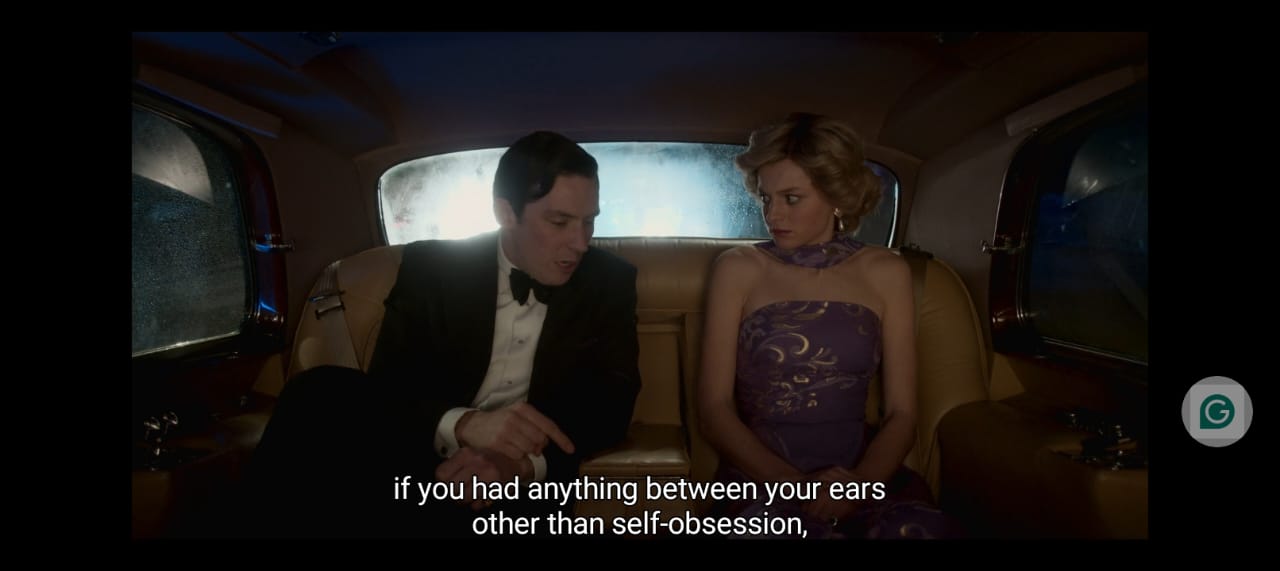
Prince Charles's birthday scene shows a basic contradiction in his performance of masculine sovereignty. Captured at eye level in a frontal horizontal angle (with an offer gaze), his face and body remain composed in public while Diana's dance operates as an open, affectively legible counter-discourse, warm and emotionally sensitive in a way the royal consort script forbids. This situation is the major visual text that MCDA foregrounds in the transition between these two physical performances, public stoicism and private aggression. According to the representational meta-function of Kress and van Leeuwen (2006), Prince Charles's conscious public stoicism operates as a semiotic act of sovereign control, and the compositional meta-function encodes the spatial and emotional contrast between his public and private performances as an ideological binary of institutional mask versus private aggression.
In private, his language changes entirely. His single line, "if you had anything between your ears other than self-obsession...," (43:58) deliberately leaves the conditional clause incomplete, creating a strategic ellipsis that allows the insult to bear without ever being fully spoken. At the lexical level, the compound noun 'self-obsession' is a undermining lexical choice that reframes Diana's emotional expression as an intellectual failure. The grammatical level is the deliberately unfinished conditional clause 'if you had' which is referred to as deliberate omission, whereby the discursive force of the insult is increased by suppressing the main clause.
Read through Butler's (1990) gender performativity, Diana's public dance is a subversive repetition of the consort script, replacing expected submission and invisibility with visible affection, and it destabilizes Charles's performance of hegemonic masculine control by showing that the devotion he cannot command comes easily to her. Diana performs to gain Charles's affection; Charles performs to maintain the institution. She wanted his affection, and he wanted her audience, this is the basic irony of the marriage.
Scene 2: Avalanche (Season 4, Episode 9)
Prince Charles calls Camilla Parker Bowles after a near-fatal avalanche and tells her that his marriage is an institutional imposition and that he wants her, not Diana, as his wife.
Figure 2 Avalanche
The visual grammar of the scene makes this telephone call the only place of authenticity for Charles. A multimodal critical discourse analysis of this scene shows that captured at eye level in a frontal horizontal angle (with offer gaze), Prince Charles' facial expressions are those of a man who is at the peak of his emotions. His unmasked emotions in this scene speaks of private relief and grief that contrasts with his composed public face, and the private telephone setting itself becomes a marker of emotional truth absent from his institutional marriage. Charles's unmasked facial expression and private phone setting serve the interactive meta-function of Kress and van Leeuwen (2006), creating a social relation of genuine emotional disclosure that is entirely absent from his institutional public appearances.
Charles use of the phrase, "As my wife" (28:57) is grammatically showing that the possessive word 'my' is of ownership, not partnership. The noun 'wife' is divested of legal weight and attached to emotional reality. Camilla, not Diana, is identified as his true wife. Language is the instrument here, the instrument by which he wants to fill the distance between the private self and the public act, to make words do what monarchy will not allow him to do, in fact. Grammatically, the prepositional phrase 'as my wife' acts as a discursive reframing device, the possessive 'my' encoding ownership and emotional claim, and lexically the noun 'wife' is stripped of legal institutional meaning and reattached to private emotional reality.
From a Butlerian perspective, his private male performance here, of love, of the need for emotional unity, is one more repetition of traditional male scripts. He is not destroying the husband and patriarch role; he is casting for a new member of the same role. Butler's (1990) concept of re-signification is applied here as Charles attempts to transfer the category of 'wife' from its legal subject to his emotional reality, yet this performative act does not escape the heteronormative script but merely substitutes one woman for another within the same gendered framework.
Scene 3: One True Love (Season 4, Episode 10)
Camilla tells Charles that she cannot be his queen while Charles is confessing his love for her and rejects the institutional pressure imposed on him.
Figure 3 One True Love
Through visual analysis, this scene is captured at eye level in a frontal horizontal angle, (with offer-gaze) close-up, Charles's response to Camilla shows an emotional openness entirely absent from his public appearances, and this visual intimacy is itself a discursive claim to authenticity. The facial warmth and emotional openness of Charles with Camilla activates the interactive meta-function of Kress and van Leeuwen (2006), building a social relation of true private intimacy, which the compositional meta-function encodes as visually and spatially separate from the controlled, composed grammar of his institutional appearances.
And linguistically, his fragmentary declaration, "My one, true love," (24:24) strips the sentence of grammatical complexity, and the adjective "true" implicitly marks his legal marriage to Diana as false. The removal of words between "one" and "true" is the most delicate moment in the phrase. At the grammatical level the noun phrase fragment 'my one true love' functions as a performative utterance that removes institutional complexity and reduces emotional truth to its most ideologically loaded form. At the lexical level the adjective 'true' functions as a binary marker that implicitly places the legal marriage as false.
Butler's (1990) concept of performative insurrection is portrayed here, Charles breaks away from the repetitive script of the faithful husband to another masculine performance based on private emotional truth. But the revolt is not done yet. Charles's gender identity as husband, lover, patriarch, is intact; he simply changes his devoted-partner performance from one woman to another. This shows that how monarchy imposed marriage upon him through an institution that demands public loyalty but there leaves no room for Prince Charles real feeling. So the most instructional aspect of the scene in Butlerian terms is the double standard of his performance. "Society and institutions forced Charles to perform two simultaneous heteronormative roles at once: that one of the dutiful husband in public and of the other as devoted lover in private.
Scene 4: Grotesque Misalliance (Season 4, Episode 10)
Princess Diana is back from her solo trip to New York, and Charles is arguing with her, explaining that he can no longer be part of this marriage and calling it a grotesque misalliance.
Figure 4 Grotesque Misalliance
The shot is an eye-level, frontal horizontal angle (with offer-gaze). Charles's body language is anxious, an expression of institutional desperation, not patriarchal security on his face. The visual portrayal of this scene is not that of a prince with controlling behavior but of a man losing control of the story that he tries to manage in this whole episode. Charles' loss of bodily control provides the interactive meta-function of Kress and van Leeuwen (2006), giving a social relation of performative collapse in which the institutional sovereign mask fails to contain the private rage of a man whose masculine narrative authority has been challenged by the rising public prominence of Diana.
"I refuse to be blamed any longer for this grotesque misalliance!" (16:07)
The sentence starts with "I refuse," and that straight forwardness is instantly apparent. This sentence gives the passive infinitive to be blamed. It is an important word which makes him a victim, not a participant. The speaker is not necessarily claiming total innocence, but that the guilt is not being imposed. It turns him from worthy targets to passive victim of unfair judgment.
Meanwhile the phrase "any longer" brings in the heavy burden of time. At the lexical level the compound noun phrase 'grotesque misalliance' constructs the marriage, through the evaluative adjective 'grotesque,' as a violation of the natural order. The performative declarative 'I refuse' is an institutional self-repositioning at the level of grammar, through which Prince Charles locates the moral responsibility for the collapse of the marriage entirely on Diana.
According to Butler (1990), this is a moment of performative rupture: the stylized repetition of dignified prince masculinity is no longer sustainable, once Diana's independence and popularity expose it as scripted rather than natural. Charles unwittingly admits that the marriage is a 'misalliance' because the gendered union has always been a fiction, imposed upon the couple by institutional power, and never a true expression of feeling. Diana's increasing popularity has made the fiction impossible to maintain. The term "misalliance" reveals that the royal marriage was always a scripted fiction rather than a true gendered reality, and Charles's outburst highlights the point at which the stylized repetition of stoic sovereign masculinity becomes unsustainable. Butler's (1990) concept of performative rupture is applied here.
Scene 5: Self-Disclosure (Season 5, Episode 2)
Princess Diana records her private audio tapes with a trusted friend describing her painful married life, tapes later published in Andrew Morton's book named as Diana: Her True Story.
Figure 5 Self-Disclosure
In this scene recording her tapes in an intimate, unscripted setting rather than any institutional space, Diana is framed at eye level in a frontal horizontal angle, , (with offer gaze) and unguarded expression visually marking the moment as authentic rather than performed. The interactive meta-function of Kress and van Leeuwen (2006) is operative through the intimate spatial setting of Diana's private self-disclosure, constructing a social relation of unguarded authenticity that visually signals to the viewer that what follows belongs to her private truth rather than to any scripted institutional performance.
Her line, "well, there was always the other one," (21:09) never names Camilla directly; the indefinite reduction to "one" and the adverb "always" together recast the affair not as an episode but as a permanent structural feature of the marriage.
At the lexical level, the adverb 'always' is the most analytically destructive word in the utterance, encoding Camilla's presence not as an episode but as a permanent structural feature of the marriage. Grammatically, the definite article 'the' before 'other one' portrays Camilla as known and present but not named. In Butlerian terms, Diana's choice to speak, even privately, is a subversive repetition. She begins to turn private pain into a social and political act, rather than continuing the stylized performance of the composed, royal wife she has maintained for the media.
There is a point where Diana's gendered performance becomes the act of resistance to institutional power as she turns private suffering into a public and political act, that directly challenges the institutional authority of the monarchy over her gendered narrative. Here, Butler's (1990) idea of performative resistance is used, as Diana's private self-disclosure is a subversive act of repetition, where the stylized position of the created royal wife is replicated and actively deconstructed.
Scene 6: "Diana: Her True Story" (Season 5, Episode 2)
Andrew Morton discusses his book Diana: Her True Story on a live talk show, revealing that Diana is deeply unhappy and that the couple's public image is just a facade.
Figure 6 "Diana: Her True Story"
Captured at eye level in a frontal horizontal angle (with offer gaze), her intentional choice of clothing, her constructed smile, her erect and graceful posture, and her sophisticated public persona are all visual signifiers of happiness, privilege, and successful marriage. These things combine to produce the gorgeous image of a fairy tale princess that the audience believes and absorbs. In this scene, the visual grammar is stripped away by Morton's television appearance, which Diana has always been expected to perform: all revealing it as costume, not character. The representational meta-function of Kress and van Leeuwen (2006) is applied to Diana's constructed public image, her clothing, posture and smile, which functions as a conceptual semiotic performance of institutional identity rather than authentic selfhood. Morton's book functions as a multimodal disclosure device, stripping the compositional grammar of that image of its legitimacy.
The line, "the fact is, behind the glamorous public facade, what we have is a woman who is deeply unhappy," (04:51) is framed by the truth-claiming device "the fact is." The architectural noun "facade" portrays Diana's glamor as a surface built to conceal rather than express .And the fact of The fairy tale is revealed that it was always fiction and the woman in the costume was suffering. This is the obvious implicature of the sentence. Here, the language is not used to sustain the illusion of monarchy, but to dismiss it altogether.
At a grammatical level, the framing device 'the fact is' acts as a truth-claiming marker that situates Morton's statement as objective reality rather than interpretation, while at a lexical level the architectural noun 'facade' encodes Diana's public glamour as a deliberately constructed surface that conceals rather than discloses critical discursive reframing of institutional narrative as institutional deception.
The beautiful, happy princess was never a reflection of her interior life but that was a mask assigned to her by the institution she served. For Butler, this repetition is subversive, a moment in which the script of the normative is not just repeated but broken and exposed. Diana's agency is restored not by dropping out of the performance altogether but by renouncing the institution of the right to be the exclusive writer of the tale that her performance has always been conveying. Here, Butler's (1990) concept of discursive revolt is used as Diana and Morton's joint public act of truth-telling is a subversive repetition that not only continues the normative script of the institutionally devoted Princess but breaks and publicly exposes it, restoring Diana's agency by dismantling the monarchy's exclusive authorship of her gendered public identity.
Scene 7: Revenge Dress (Season 5, Episode 5)
On the night Prince Charles's televised confession of his affair with Camilla Parker Bowles airs, Princess Diana appears in public wearing a black dress, a color reserved for royal mourning, an act that is known as the Revenge Dress.
Figure 7 Revenge Dress
The scene contains no significant dialogue; the whole discourse is carried by color, posture, and setting. Filmed at eye level in a frontal and horizontal angle (with offer gaze), Diana's confident, open body language visually replace the anxious, controlled comportment expected of the royal consort with unmistakable poise. However, the black gown is a semiotic object that encodes the death of an institutional identity and not a fashion choice, which applies the representational meta-function of Kress and van Leeuwen (2006). The compositional meta-function provides an information value of self-reclamation through Diana's confident body language and facial composure, immediately replacing visual grammar of submission and institutional loyalty.
In the language of Butler (1990), this is subversive repetition pushed to its most radical extreme: Diana does not give up on public performance, but rather repeats the act of royal public appearance with a difference drastic enough to completely destroy its meaning. Her once modest and demure outfit is now replaced by a bold, noncompliant gown that, without a single word being spoken, signals the symbolic death of her institutional identity and the birth of a new one.
The dress is not a fashion statement. It is a performative act of self-reclamation. According to Butler (1990), this is the most politically significant gender performance Diana performs across the series, because it does not simply resist the institutional narrative. It replaces it with a new one authored entirely by Diana herself.
Scene 8: BBC Interview (Season 5, Episode 8)
Princess Diana talked for the first time in public about Prince Charles's affair with Camilla Parker Bowles in a televised interview with BBC journalist Martin Bashir.
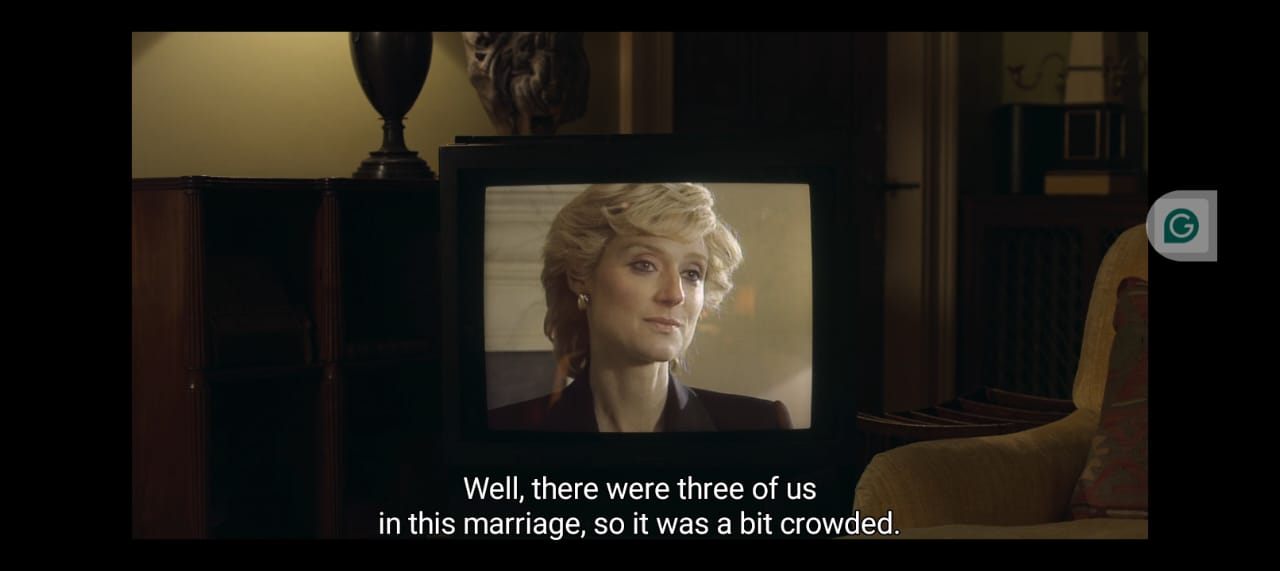
The interview stages Diana in an intimate, non-institutional setting, and the close camera framing eliminates the visual distance ordinarily maintained between royal subjects and the public gaze. Her composed, eye-level expression, captured at eye level in a frontal horizontal angle (with offer gaze), construct her as measured and credible rather than unstable, directly showing the institution's earlier characterization of her. The interactive meta-function of Kress and van Leeuwen (2006) is in operation through the intimate close-up camera framing and the emotionally balanced facial expression of Diana, establishing a social relation of composed and credible personal truth, thus directly opposing the institutional representation of her as unstable. The compositional meta-function encodes the private setting as a visual marker of unmediated authenticity.
Her understated line, "Well, there were three of us in this marriage, so it was a bit crowded," (09:28)
It opens with "well," that familiar discourse marker. That by now gives something carefully measured is about to be delivered, not impulsively but with full awareness of its weight. The sentence construction is deceptively simple. It is a short declarative sentence delivered in a linguistic mode. This gives to it the nature of a rough comment rather than that of a carefully convayed public statement. The spatial adjective 'crowded' is a domestic metaphor at the lexical level. Which converts the private pain of infidelity into a public statement that is universally readable. At the grammatical level the discourse marker 'well' and the conscious understatement of 'a bit', are the best examples of strategic minimization. In this case the reduction of tone paradoxically magnifies the ideological weight of the disclosure.
Read through Butler (1990), the interview is the most politically consequential act of subversive repetition in Diana's public life dismantling through a single composed performance the institutional fiction of the silent and devoted consort that the monarchy has sustained through years of enforced performative compliance. Rather than continuing the stylized performance of the silent, dutiful consort, she uses that same public platform to expose the royal marriage as a fragile fabrication sustained only through enforced silence, demonstrating that altering the performance can permanently unsettle the institutional reality it once secured.
Conclusion
Across these eight scenes, The Crown constructs the Charles-Diana marriage as a site where gendered performances of legitimacy compete against each other and cannot be reconciled. Multimodal critical discourse analysis reveals that camera angle, gaze and gesture do more ideological work than dialogue alone. Charles's publicly stoic performance, shot at eye level with an offer gaze that withholds visible emotion, functions as a semiotic act of sovereign control, while his private scenes with Camilla show an emotional openness which institution never allows him in public. It's a visual divide that says more than any line of discourse. The monarchy dictates not only how its members are meant to behave in a public environment, but how they are allowed to feel in a private one, even if that feeling is contradictory to institutional duty. Charles's infidelity is performed again and again as an act of institutional escape and re-signification through Butler's (1990) theory of gender performativity. Charles does not refuse the role of devoted husband but rather reframes it. Shifting the performance of a loyal partner from Diana to Camilla, never operating outside the heterosexual matrix that characterizes that role. And Diana's answers are of a different kind altogether. Her dancing in public, her audio confessions to Andrew Morton, her revenge dress, and her BBC interview, all replay a script allotted to her, the loyal, decorative, silent consort.
But each replays that script with a huge difference, powerful enough to expose and destabilize it rather than reproduce it. Charles's actions maintain the gendered structure of the institution in silence. While Diana's performances seek to dismantle it, transforming private grief into public evidence that the institution cannot hide. This imbalance has a more general effect on the image of the monarchy itself as defined by The Crown. Prince Charles calm, measured camerawork and his own words like "as my wife" and "my one, true love" constantly position Charles's infidelity as a private emotional truth that is repressed by institutional demand. By contrast, Diana's near-infidelity revelations are portrayed as acts of survival and resistance against to an institution that denied her genuine partnership and public voice.
The series exposes the gendered double standard of a couple's infidelity under the monarchy. Official silence swallows and protects male transgression, but female exposure, regardless of how it exposes the same institutional imbalance, becomes a destabilizing act of resistance.
This research concentrates on eight selected sequences from Season 4 and Season 5 of The Crown. Future work could expand this multimodal approach throughout the course of the series or apply the approach comparatively to other royal biopics and historical dramas that depict institutional control on gendered interactions. Using Kress and van Leeuwen's Visual Grammar (2006) and Butler's (1990) idea of gender performativity, the study argues that infidelity in The Crown is never simply a moral failure. It is a discursive site in which gendered performance, institutional control and multimodal storytelling intersect. And in it the framing of gaze and gesture by the camera often has more ideological weight than the discourse that accompanies it.
References
- Afilipoaie, A., Iordache, C., & Raats, T. (2021). The ‘Netflix Original’ and what it means for the production of European television content. Critical Studies in Television, 16(3), 304–325. https://doi.org/10.1177/17496020211023271
- Butler, J. (1990). Gender trouble: Feminism and the subversion of identity. Routledge.
- Darko, W. K. (2023). A postcolonial critical discourse analysis: The “Dear Mrs. Kennedy” episode of the Netflix series The Crown (Publication No. 102) [Doctoral dissertation, University of Iceland]. Skemman.
- Huang, Z. (2023). Visual presentation of court culture: The seduction and disenchantment in TV series “The Crown.” SHS Web of Conferences, 179, Article 03001. https://doi.org/10.1051/shsconf/202317903001
- Hussein, S. A., & Al-Sa’ati, N. M. (2026). Understanding images themes by children: A multicritical discourse approach to “Cinderella.” College of Basic Education Research Journal, 22(1), 288–320.
- Jancsary, D., Höllerer, M. A., & Meyer, R. E. (2016). Critical analysis of visual and multimodal texts. In R. Wodak & M. Meyer (Eds.), Methods of critical discourse studies (3rd ed., pp. 180–204). SAGE Publications.
- Kark, R., & Cohen, B. S. (2024). The crown must always win: Rethinking authentic leadership through The Crown series. Journal of Management & Organization, 30(6), 1699–1727. https://doi.org/10.1017/jmo.2024.70
- Kress, G., & van Leeuwen, T. (2006). Reading images: The grammar of visual design (2nd ed.). Routledge.
- Malik, M., ur Rehman, H. J., & Sikandar, N. (2025). Multimodal analysis of the movie Tangled (2010). ASSAJ, 3(01), 1031–1055.
- Pozzo di Borgo, G. (2023). Freedom and the weight of the crown: Sartrean and Beauvoirian existentialism in Peter Morgan’s The Crown. Film-Philosophy, 27(2), 326–352. https://doi.org/10.3366/film.2023.0232
- Rodríguez-Díaz, R., Chavero, P., & Paula-Veloz, N. (2024). Between fact and fiction: Elizabeth II’s funeral and its connection to The Crown on X (Twitter). Societies, 14(8), Article 146. https://doi.org/10.3390/soc14080146
Cite this article
-
APA : Waris, S., & Rabbani, M. (2026). Marriage, Monarchy, and Media: A Multimodal Critical Discourse Analysis of the Politics of Infidelity in Netflix's The Crown. Global Social Sciences Review, XI(I), 238-249. https://doi.org/10.31703/gssr.2026(XI-I).20
-
CHICAGO : Waris, Sara, and Munazzah Rabbani. 2026. "Marriage, Monarchy, and Media: A Multimodal Critical Discourse Analysis of the Politics of Infidelity in Netflix's The Crown." Global Social Sciences Review, XI (I): 238-249 doi: 10.31703/gssr.2026(XI-I).20
-
HARVARD : WARIS, S. & RABBANI, M. 2026. Marriage, Monarchy, and Media: A Multimodal Critical Discourse Analysis of the Politics of Infidelity in Netflix's The Crown. Global Social Sciences Review, XI, 238-249.
-
MHRA : Waris, Sara, and Munazzah Rabbani. 2026. "Marriage, Monarchy, and Media: A Multimodal Critical Discourse Analysis of the Politics of Infidelity in Netflix's The Crown." Global Social Sciences Review, XI: 238-249
-
MLA : Waris, Sara, and Munazzah Rabbani. "Marriage, Monarchy, and Media: A Multimodal Critical Discourse Analysis of the Politics of Infidelity in Netflix's The Crown." Global Social Sciences Review, XI.I (2026): 238-249 Print.
-
OXFORD : Waris, Sara and Rabbani, Munazzah (2026), "Marriage, Monarchy, and Media: A Multimodal Critical Discourse Analysis of the Politics of Infidelity in Netflix's The Crown", Global Social Sciences Review, XI (I), 238-249
-
TURABIAN : Waris, Sara, and Munazzah Rabbani. "Marriage, Monarchy, and Media: A Multimodal Critical Discourse Analysis of the Politics of Infidelity in Netflix's The Crown." Global Social Sciences Review XI, no. I (2026): 238-249. https://doi.org/10.31703/gssr.2026(XI-I).20