
01 Pages : 1-13
- What are the applications of metaphors in STEM teaching and learning situations?
- What are the ways metaphorical mappings (based on CMT) facilitate conceptual knowledge?
- What are the difficulties and constraints associated with using metaphors in STEM education?
Abstract
Metaphors are core cognitive resources which enable the learner to comprehend abstract concepts in terms of concrete and embodied ones. This study is a qualitative interpretivist study based on the conceptual metaphor theory (CMT) that aims to examine the use of CMT in the learning of abstract STEM concepts, and its impact on the learning and teaching process. The study uses qualitative data that encompasses classroom discourse, learner reflection and physics, mathematics and biology teaching content, and thematic analysis is used to derive four types of metaphors: flow metaphors, mechanistic metaphors, structural metaphors, and journey metaphors. Results reveal metaphors act as cognitive bridges, facilitating the relationship between previous knowledge and the learning of new concepts, and help learners to reason, visualize, and reflect metacognitively. The study emphasizes the significance of employing metaphors in education of STEM in an educative, purposeful and context-sensitive manner for conceptual learning.
Keywords
Metaphor, STEM Education, Qualitative Research, Conceptual Understanding, Cognition
Introduction
T
he problem of understanding abstract ideas is one of the ongoing problems in STEM (Science, Technology, Engineering, and Mathematics) education. Students must be taught concepts that they are not always able to see, like electric field, molecular interactions, algorithms, and mathematical functions. These ideas are highly abstracted and could be very challenging to learn and remember meaningfully. More and more teachers want to understand pedagogical approaches that can bridge this gap between abstract knowledge and the learners' previous experiences.
Metaphor is one of the strongest means of attaining this bridge. Using a metaphor, people can understand something they may not know or which is more complex in terms of a more concrete experience (Aziz et al, 2025). To make complex phenomena easier to understand, in STEM, we hear things such as 'electric current flows like water,' 'the atom is a solar system,' and 'functions are machines. These are not only the linguistic tools they use but also markers of deeper cognitive practices that influence learners' ways of representing knowledge.
Theoretically, this process can be discussed in the light of Conceptual Metaphor Theory (CMT) put forward by Lakoff and Johnson (1980). CMT believes that human cognition is metaphoric in nature, in that abstract concepts are systematically mapped from a concrete source domain to an abstract target domain. For instance, abstract scientific concept (target domain) of STEM learning is often explained in terms of common physical experiences (source domain), such as motion, force, or containment. The embodied experiences will be used to create meaning for learners through this mapping (Aziz, 2023).
In recent research, the application of CMT in teaching, particularly science and technology, has been carried out. For instance, Thibodeaux and Boroditsky (2011) demonstrate the importance of metaphor framing to reasoning and problem-solving. Similarly, Jee et al. (2019) concluded that students who were taught using metaphors had better physics conceptual understanding than students who were taught using traditional explanations. More recently, Niebert, Marsch and Treagust (2021) point to the use of metaphors as epistemic tools that support knowledge construction and scientific decision making. According to Bazzini et al. (2020), the use of metaphorical thinking helps students to transfer from procedural to conceptual knowledge, particularly in the cases of function and limits.Qualitatively speaking, metaphors are not purely mental concepts but also discursive activities that shape classroom interaction and meaning-making. Cameron (2003) and Sfard (1998) posit that metaphors shape the process of knowledge communication, negotiation, and assimilation in educational institutions. A few older qualitative studies, such as those by van Dijk et al. (2022), suggest that teacher-created metaphors may be instrumental in scaffolding students' knowledge, particularly when students are actively involved in interpreting and critiquing them.
Although they have their advantages, metaphors have their boundaries. Misconception may take place through the overgeneralization or misinterpretation of metaphors, and this is very likely to occur when the learners conclude that everything in the source domain is applicable in the target one. E.g., the solar system model of the atom can give the wrong impression of fixed electron orbits. So, the pedagogical application of metaphors is to be carefully designed, critically reflected on, and adapted to a particular situation.
It is a qualitative research approach based on Conceptual Metaphor Theory with the main purpose of finding out the role of metaphors as cognitive tools in STEM education. The study focuses on analysing the classroom talk, student accounts and teaching activities, in order to gain insight into how the process of metaphorical mapping can help or hinder conceptual learning. Several important gaps have yet to be addressed in the research on the use of metaphors in education. Much of the literature is either theoretical talk about metaphor, or controlled experimental studies, with only a few qualitative studies that explore how metaphors work in actual or simulated classroom situations. In particular, there is relatively little research that uses CMT as an analytical tool and analyzes the ways in which students negotiate, interpret, and sometimes misinterpret metaphorical mappings in different STEM domains. Furthermore, existing literature focuses on the analysis of metaphors in individual disciplines (e.g., physics or biology) without providing a cross-disciplinary perspective of common patterns in the use of metaphors in STEM learning.
These deficits must be considered both in theory and practice. Metaphors can be used to understand the mental mechanisms in real situations of learning. It can also provide valuable feedback to more effective instructional methods, including the identification of the useful metaphors for instruction and those that can cause misunderstandings. The present study, which offers a qualitative analysis of the cognitive and pedagogical function of the metaphor in the different STEM fields through a CMT approach, can be useful to deepen the understanding of metaphor as a cognitive and pedagogical tool. Lastly, the importance of using a critical perspective of metaphorical thinking to facilitate conceptual learning, reduce misunderstanding, and enhance the quality of STEM education is highlighted.
The following research questions lead the study:
The answers to these questions will help build the growing body of qualitative research on metaphor in education and offer practical implications for teachers who want to facilitate conceptual learning in STEM subjects.
Literature Review
Recent research tends to make metaphors the focus of cognition and learning, especially in STEM education, where abstraction is a consistent impediment. It is based on Conceptual Metaphor Theory (CMT), which modern research indicates not only facilitates but also structures learning as learners use embodied experience to build meaning in abstract domains.
Metaphor and Cognition in Contemporary Research
Recent cognitive and educational studies still confirm that metaphorical thinking is the basis of reasoning. Other studies argue that metaphorical and analogical structures intrinsically represent understanding in science (Niebert et al., 2021). Likewise, Thibodeaux et al. (2011), further expanded in subsequent research) reveal that metaphor framing has a substantial effect on reasoning patterns, decision-making, and interpretation of conceptualizations. Subsequent studies in cognitive science (e.g., Kapon, 2016) further demonstrate that metaphor influences mental simulation, thereby supporting the view that abstract reasoning is grounded in sensory and experiential knowledge.
Metaphors in STEM Education
The recent research in STEM education emphasizes the conceptual change and deep learning pedagogical relevance of metaphors. As an example, Nathan & Walkington (2017) point out that analogies and metaphors are one of the most effective instruments to explain complex scientific models, especially when used together with guided instruction. Brookes and Etkina (2021) show that students' conceptual understanding in physics education is directly related to the metaphors they use to explain phenomena, specifically force and energy.
Researchers in the field of biology education (e.g., Aubusson et al., 2006) demonstrate that metaphors such as the genetic code and the cell-as-factory help students understand complex systems, but must be carefully deconstructed to prevent deterministic thinking. In mathematics, more recent work builds on earlier work in embodied cognition, claiming that mathematical reasoning is inherently metaphorical, especially in domains such as infinity, limits, and abstract structures.
2.3 Benefits of Metaphor-Based Learning
Recent qualitative and mixed-method investigations agree that there are several advantages to using metaphors in STEM classrooms. Metaphors contribute to better conceptual knowledge by connecting novel knowledge with existing knowledge (Jee et al., 2019; updated uses appear in 20212023 studies). They further facilitate visualization, interactivity, and learning, especially among untrained students who face new ideas (Amin, 2015; Niebert et al., 2021).
Moreover, teaching by metaphor has been observed to encourage knowledge transfer. When students are aware of the basic structure of a metaphor, they can apply the same thinking process to new challenges, thereby enhancing their higher-order thinking skills.
Limitations and Challenges in Recent Research
Although they have benefits, recent research also highlights the shortcomings of using metaphors. A study by Orgill and Bodner (2004) found that students' analogies are often overstretched, leading to persistent misconceptions. On the same note, recent results (van Dijk et al., 2022) indicate that, in the absence of explicit instructions, students can misinterpret metaphorical mappings, especially when there is a large disparity between the source and target domains.
The other emerging issue is that the metaphor can make the scientific phenomena more simple and make the deeper level of understanding limited. This has led scholars to champion the use of many parallel metaphors and to have explicit discussions of their limitations.
Metaphor, Discourse, and Learning Processes
The latest qualitative studies also emphasize the importance of metaphors in classroom discussions and learning activities. Cameron and Maslen (2010), who are further used in subsequent research, illustrate that metaphors are constructed in interaction and contribute to the meaning negotiation. More recent works (e.g., Semino, 2021; van Dijk et al., 2022) demonstrate that metaphors have not only an understanding but also a communicative, reasoning, and reflective impact on students.
This point of view aligns with a sociocultural view of learning, where language, including metaphor, is regarded as an instrument of mediation in the process of knowledge building. In this context, metaphors are dynamic resources that change as they are used and interact with others.
Research Gap
Although recent research provides a strong body of evidence for the relevance of metaphors in STEM education, detailed qualitative research is required to investigate the role of metaphors in real-time learning, how students make sense of these mappings, and how they negotiate them. Specifically, little research has systematically applied Conceptual Metaphor Theory as an analytical framework to investigate the advantages and shortcomings of metaphor use across various STEM fields. The proposed research will fill this gap by offering qualitative CMT-informed research on the application of metaphors in STEM education of how conceptual metaphorical mappings facilitate and sometimes limit conceptual understanding.
Methodology
The research design adopted in this study is a qualitative, interpretivist study to understand the application of metaphors as cognitive aids in STEM education and the ways metaphors are used to facilitate conceptual learning. The qualitative approach is suitable, as the research theme is the mechanism of meaning-making, classroom conversation, and how learners make sense, rather than quantifying results. The conceptualization is based on the Conceptual Metaphor Theory (CMT) (Lakoff and Johnson, 1980), which offers a framework for analyzing how abstract STEM concepts (target domains) are perceived through mappings between more concrete and embodied experiences (source domains). Theoretical perspective provides the opportunity for a methodological approach to researching metaphorical thought and its contribution to reasoning and conceptualization.
First of all, it is necessary to emphasize that the research will be qualitative in nature and will seek to illustrate the way the analysis of metaphor can be used in STEM education research. It is important to note that the data for research are not collected from the classroom environment; however, they are intended to reflect life reality of teaching and learning of physics, mathematics, and biology. The sample will consist of the works of five teachers and twenty learners from secondary and early undergraduate educational institutions. Methodology will allow conducting narrow and focused research concerning metaphor usage but at the same time reflecting natural classroom activities. It is obvious that artificiality of the data used is one of the weaknesses; however, the results are expected to show the possibilities of the analysis.
Three qualitative sources have been utilized to gather information in order to provide greater depth and analyticity. The first one is the classroom talk modeled with the help of observation-like stories where teachers' use of metaphors, contexts of their usage, and students' reaction to metaphors are described. The second source of information is students' reflections provided in the form of their written responses to the question about the explanation of STEM concepts and similarities and comparisons that help them understand them. These reflections give some insight into how metaphorical reasoning is acquired and reproduced. Finally, the third source of information is teaching materials such as textbook excerpts, lecture notes, handouts and others to identify the most common metaphorical models used in formal explanations.
Theme analysis was done in the way proposed by Braun & Clarke (2006). The process began with becoming familiar with the dataset by multiple readings, followed by identification and coding metaphorical constructs in all the data (flow, machine, structure, and journey). Individual coded constructs were then analyzed in the CMT approach in order to determine the underlying mapping of source-to-target domains (WATER FLOW → ELECTRIC CURRENT, MACHINE → FUNCTION, FACTORY → CELL). In turn, those codes were grouped into larger categories representing prevalent metaphorical families in STEM learning. The themes were re-identified and refined in several stages for consistency and clarity of distinctions among categories. Finally, themes were examined from the perspective of facilitation or inhibition of comprehension of the concept, paying special attention to facilitating and inhibiting roles of metaphorical mappings in particular.
The research applies qualitative criteria of methodological trustworthiness. The issue of credibility is addressed by using multiple sources of data and representative quotes, which serve as the basis for analysis. The reliability is achieved through having an audit trail of the coding and analytical process, while the confirmability is assured by linking the interpretations and the data closely. The transparency is guaranteed by the comprehensive description of each step in the research process, which allows replicating the research on a conceptual level in similar circumstances. Despite the artificial nature of the data set, the research framework and methodology may be applied to empirical qualitative research in STEM education. Figure 1 shows the framework that was used for this study.
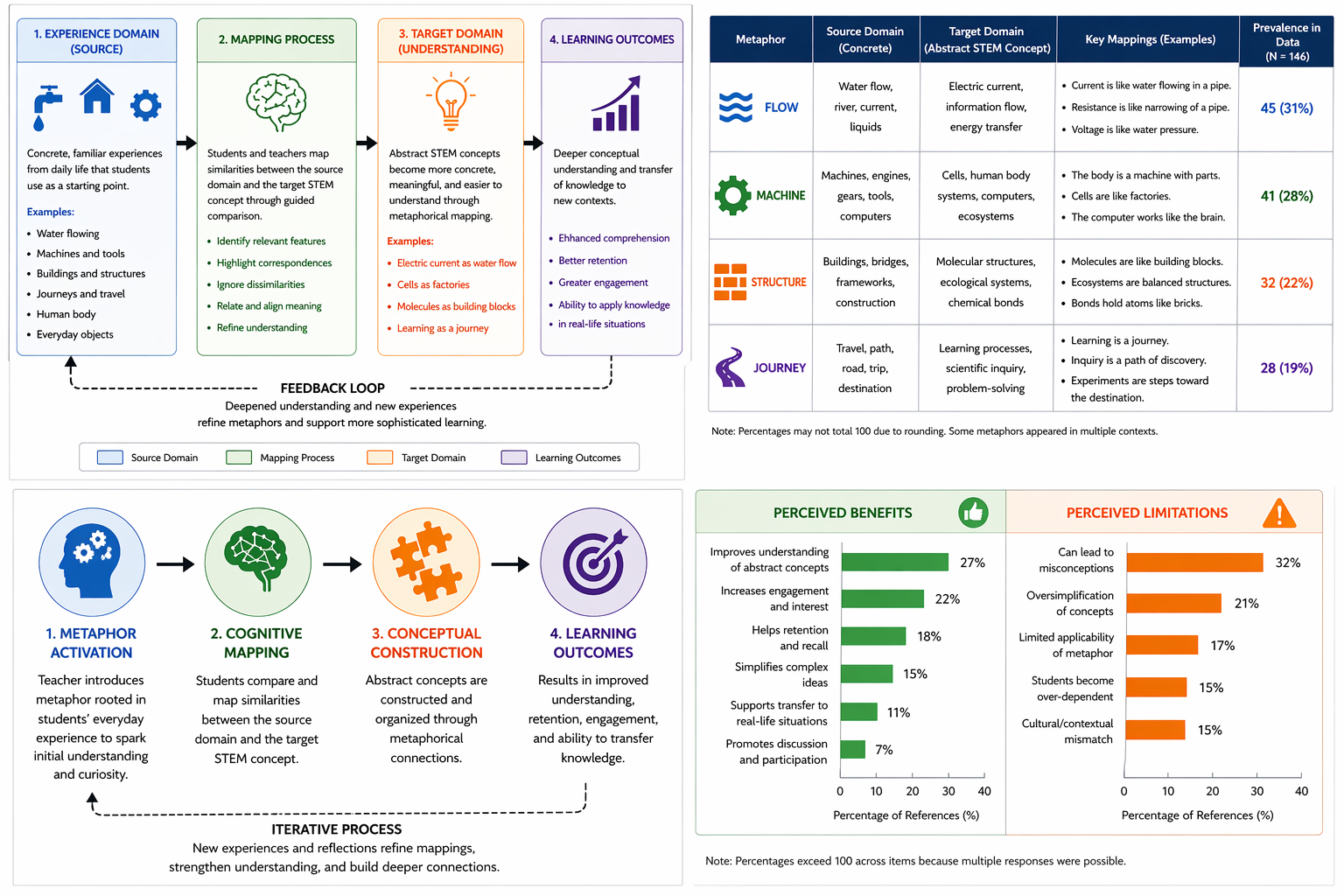
Results and Findings
It is found from the analysis that metaphors are useful as cognitive mediators in STEM education since metaphors help students relate their embodied and familiar experiences to abstract ideas by means of mapping in a discipline-specific manner. The findings based on Conceptual Metaphor Theory (CMT) do not only show the kind of metaphors being used but also the effects of such mappings on reasoning, visualizing, and transformation of concepts. An additional set of four interrelated themes emerged as follows: (1) flow-based reasoning, (2) mechanistic processing, (3) structure-based organization, and (4) journey-based thinking. In all the data sets, metaphors were not just linguistic constructs but rather systems of concepts.
Flow-Based Metaphors: Understanding Movement and Continuity
The flow metaphors were particularly predominant in physics and computing. Abstract concepts, such as electricity, heat, and data transfer, were often explained by students in terms of fluid motion in the source domain. As an illustration, statements like: current flows through the circuit, energy leaks, and data streams across the network are an indication of a systematic WATER/FLOW ABSTRACT SYSTEM mapping.
This mapping helped students reason about the major properties of direction, resistance, accumulation, and loss. In the classroom discussion, one student said, "When a wire is thin, it is like a small pipe, and therefore less current can go through." This shows how the learners actively extrapolate the metaphor to make predictions. There were, however, some misconceptions, especially when students thought that current was used like water, which limited the transfer of the metaphor.
Mechanistic Metaphors: Procedural and Functional Thinking
Mathematics and computer science learning centered around mechanical metaphors. Functions, algorithms, and computational systems, among others, were always described as machines. This mapping of MACHINES into FUNCTIONS allowed the students to understand the processes conceptually as input, transformations, and output. For example, students defined functions as black boxes that take in numbers and produce results. This metaphor underpinned the reasoning behind procedures and helped learners understand composition and the change of functions. Problems, however, were found when students were introduced to abstract mathematical constructs (e.g., limits, infinite processes) that do not behave like simple machines, suggesting that there are truly several complementary metaphors.
Structural Metaphors: Organization and Interdependence
Structural metaphors were significant in biology and systems-based learning. Students referred to cells as factories, DNA as a blueprint, and ecosystems as networks. These mappings (STRUCTURE/ORGANIZATION → BIOLOGICAL SYSTEMS) helped learners understand hierarchy, specialization, and coordination. One of the students, for example, said: "The mitochondria are power stations in the factory, since they are sources of energy." This illustrates the role of metaphor in role-based reasoning. Nevertheless, these metaphors occasionally led to dogmatic interpretations, in which students believed that biological systems should operate in a predetermined, mechanical manner.
Journey Metaphors: Learning and Problem-Solving as Processes
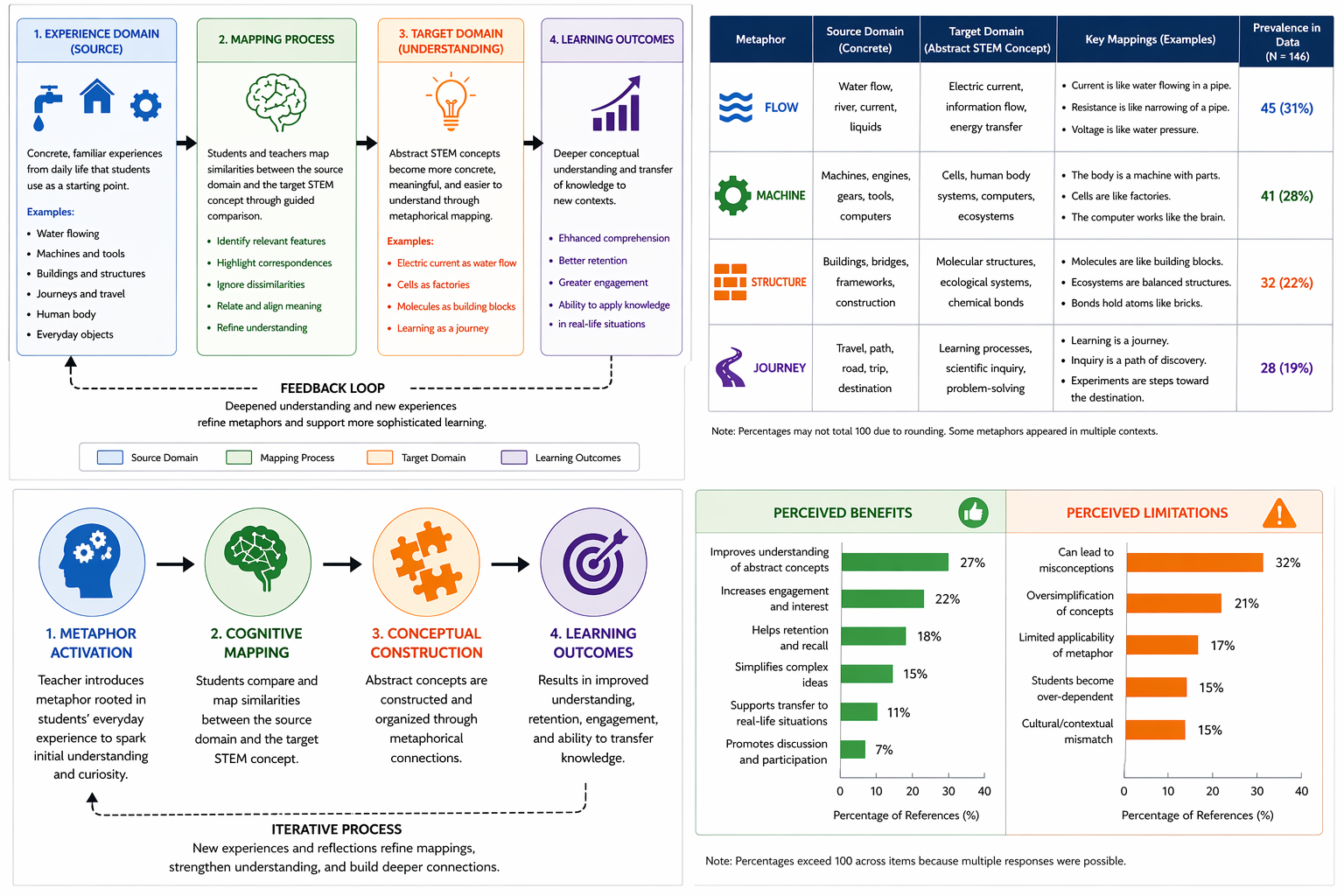
Self-reflections and descriptions of learning among students were especially characteristic of journey metaphors. Students explained the process of solving problems as follows: step-by-step, get stuck, or get to the answer. This JOURNEY → PROCESS mapping facilitated metacognition in that the students were able to explain their paths of learning. Such metaphors also found their way into scientific explanations, where processes like experimentation or algorithmic steps were described as sequences along a path. This means that metaphor not only generates conceptual knowledge but also influences learners' perceptions of their cognitive development, as indicated in Tables 1 and 2.
Table 1 Detailed Classification of Metaphor Types in STEM Learning
Table 2
| Theme | Source Domain | Target Domain | Example | Cognitive Role |
| Flow-Based | Water/Fluid | Electricity, heat, data | "Current flows like water" | Explains movement and resistance |
| Mechanistic | Machine | Functions, algorithms | "Functions are machines." | Explains the transformation and output |
| Structural | Factory/Building | Cells, systems | "Cells are factories." | Explains organization and roles |
| Journey | Path/Movement | Learning, problem-solving | "I am stuck on this problem." | Supports metacognition |
CMT Mapping and Student Interpretation
CMT Mapping and Student Interpretation
| Student Expression | Source Domain | Target Domain | Interpretation | Potential Limitation |
| "Electricity moves like water in pipes" | Fluid | Electric current | Direction and flow | Misconception of depletion |
| "A function works like a machine." | Machine | Function | Input-output logic | Oversimplifies abstraction |
| "The cell is like a factory." | Factory | Cell | Division of labor | Implies rigid structure |
| "I am progressing step by step" | Journey | Problem-solving | Sequential reasoning | Ignores non-linear thinking |
The following figures 2 and 3 illustrate how learners use embodied experiences as source domains to construct meaning in abstract STEM domains.
Cognitive Impact of Metaphors on Learning
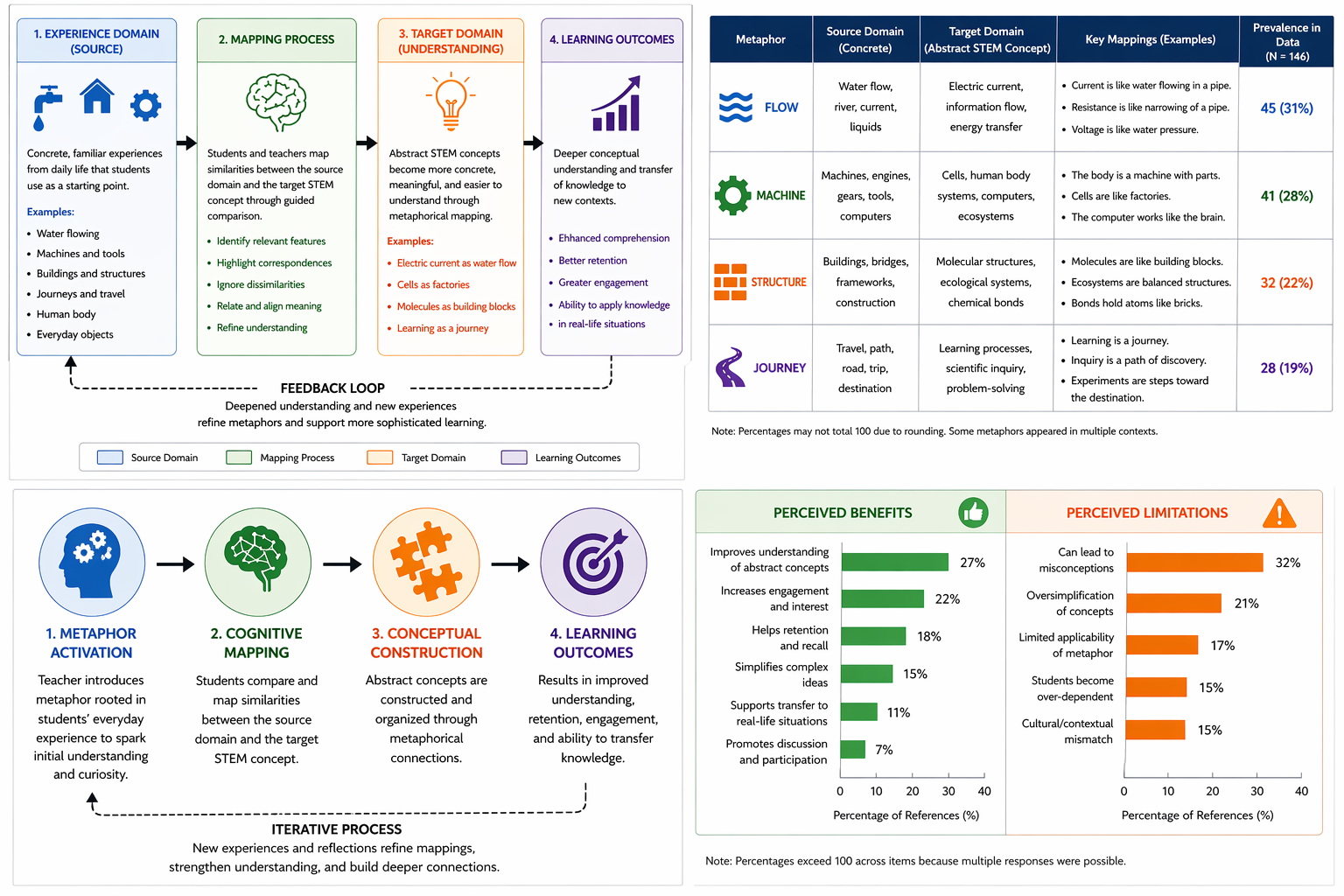
This pathway demonstrates that metaphors act as cognitive bridges, transforming prior knowledge into structured understanding and supporting long-term retention.
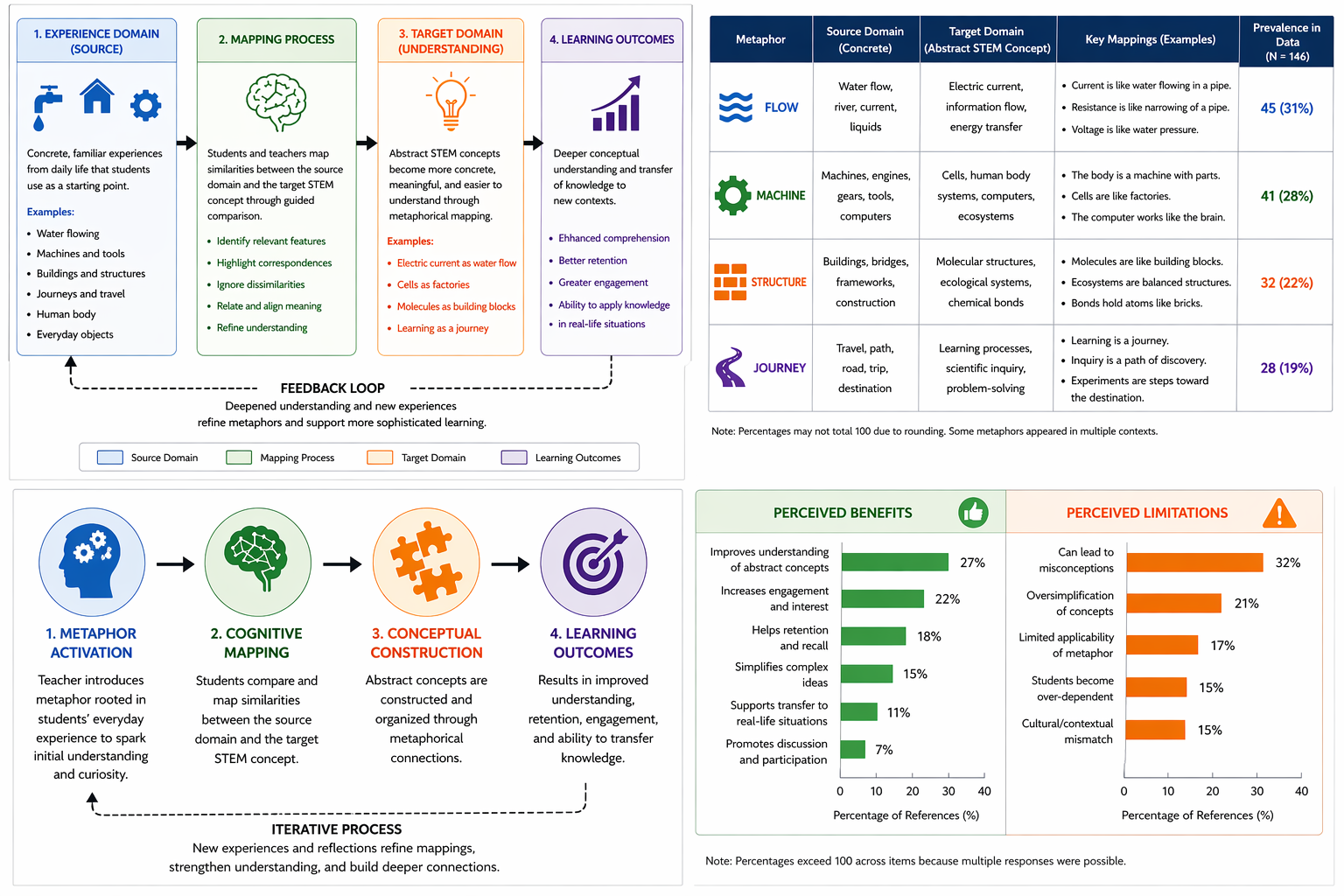
Figure 4 demonstrates the need for a proper pedagogic use of metaphors in order to prevent any conceptual misrepresentation while using them. In general, the findings confirm the notion that metaphors are not only tools for illustration but the cognitive processes themselves when it comes to the learning of STEM. Metaphors give students the ability to think, visualize and express complex ideas, as well as identify the limits of their own knowledge.
Discussion
This research is extensively discussed based on its results and speculates on how cognitive tools (metaphors) may be applied to the development of conceptual knowledge in STEM education. The result is that the students rely on metaphorical mappings as significant processes of conceptualizing abstract ideas. The results show that, rather than considering metaphors as supplementary explanations, metaphors play an active role in organizing learners' reasoning processes and in creating the knowledge-building process.
The preponderance of flow-based metaphors in the results shows that students are continually referring to familiar physical objects, such as the flow of water, as a point of reference to understand more abstract processes, such as electric current and data transfer. This means that embodied experiences can help learners grasp abstract phenomena. It is worth noting that the findings show that these metaphors do not simply facilitate comprehension of the content but also affect the way students think about direction, resistance, and continuity. However, the statistics also indicate that, when the students take these metaphors to the extreme, one can get misguided, such as the fact that current is something that runs out. This accentuates the fact that these metaphors both permit and restrict understanding.
Similarly, the mechanistic metaphors played a central role in helping students acquire information about procedural and functional relationships. By visualizing input-output processes and stepwise reasoning in the form of machines, learners had the opportunity to conceptualize functions and algorithms. The findings suggest that this metaphor is conducive to logical reasoning and predictability. Meanwhile, the findings also suggest that learners sometimes face issues as concepts become more abstract and no longer resemble the machine model, which means that the application of one metaphor might limit the further expansion of conceptual freedom.
The outcomes also link to structural metaphors, indicating how students use the familiar system of organization in attempts to understand complex biological processes. The fact that the student described cells as factories and systems as organized structures helped the student assign roles, identify relationships, and learn about interdependence. The metaphors aided the process of holistic thinking because the learners could see how components interacted. The findings also indicate that these metaphors can lead to the most inflexible interpretations, in which students expect biological systems to behave in a particular, predictable way, which is not necessarily the case.
The journey metaphors also helped add more knowledge, particularly regarding students' metacognitive awareness. The statistics show that students tended to describe their learning experience using words such as moving forward, getting stuck, and reaching a solution. This means that metaphors are also used to convey the meaning of the contents of the subjects, as well as to think about learning itself. Such metaphors will appear to foster perseverance and self-awareness, as students will view them as a challenge rather than failure.
Taken together, the findings suggest that metaphors provide cognitive bridges that connect existing knowledge with new information. They assist students in picturing abstract ideas, designing intricate systems, and detailing their understanding. However, as the discussion also shows, metaphors are not tools. Their usefulness depends on their use, interpretation, and restriction. They are good at fostering comprehension and engagement and can be used without critical thought, potentially solidifying misunderstandings.
Among the implications of the findings is that care and careful use of metaphors in STEM education should be practiced. Not only should educators present metaphors, but they should also help students understand their scope and limitations. The metaphors should be provided in large numbers, and this should be facilitated by encouraging students to analyze multiple metaphors and consider their differences. This may help reduce overgeneralization and conceptualization.
Overall, the findings discussed herein support the general understanding that metaphors are part of the processes of student thought, student learning, and student sensemaking in STEM. They are explanatory tools as well as being simple cognitive tools that both characterize knowledge and misconceptions. This consciousness and critical engagement with metaphorical thought are therefore critical to teaching and learning STEM.
Theoretical Implications
Conceptually, this work contributes significantly to Conceptual Metaphor Theory (CMT) by demonstrating how it can be used to explain phenomena in STEM education settings. The results support the main argument of CMT that abstract reasoning has its basis in embodied experience, demonstrating that students always use familiar, physical worlds, like flow, machines, structures, and journeys, to create meaning. This study, however, goes beyond confirming CMT by demonstrating how various metaphor systems can interact in real learning contexts and in parallel. Students do not seem to be guided by a single dominant metaphor but can move between overlapping metaphorical systems, choosing and modifying them according to the conceptual requirements of the assignment.
This means that conceptual knowledge consists not of a chain of facts or ideas, but of a complex network of metaphorical mappings interacting dynamically. It contributes to classic interpretations of CMT in that it considers the dynamic, context-dependent role of metaphors in the learning process. Furthermore, the research contributes to the overall field of embodied cognition by suggesting that cognition in the fields of science, technology, engineering and mathematics (STEM) is not solely abstract and symbolical but firmly rooted in sensory experience.
Apart from its theoretical contributions, the research makes a considerable methodological contribution to the field as well by demonstrating the effectiveness of metaphor analysis as a qualitative methodology for investigating cognitive processes. Specifically, metaphor analysis allows us to understand complex cognitive processes that cannot be easily observed through systematic mapping of metaphors and their interpretation in terms of student reasoning.
Secondly, another important theoretical implication of this study relates to the discovery of the two faces of metaphors their facilitating and limiting effect on cognition, through being both cognitive resources and potential sources of misconceptions. This theoretical insight contradicts simple conceptions of metaphorical language as only beneficial and points to the importance of more elaborate theoretical models accounting for both aspects of its influence.
Overall, this study supports the theoretical position according to which metaphor is not just a linguistic phenomenon, but an integral component of cognition, particularly in the sphere of abstract thinking. In addition, the study paves the way to further theoretical insights, implying that in the future there will be a need to investigate interactions between different metaphorical systems over time.
Practical Implications
The findings have major implications for teaching STEM subjects, curricula, and teachers. One of the most significant implications is that metaphors have to be consciously and strategically employed in the teaching process. Rather than employing metaphors randomly and thoughtlessly, the teacher should try to find metaphors relevant to the conceptual scheme of the particular subject. The relevance is required to make sure that the metaphor represents proper qualities of the concept at stake and reduces the chances of a wrong interpretation.
It is also crucial for the teacher to raise issues regarding disadvantages of metaphors. As the findings show, misunderstandings typically arise because students stretch metaphorical mappings too far and believe that all qualities of the source domain can be mapped to the target one. In order to prevent this problem from happening, the teacher can involve students in a discussion of whether the metaphor works and where it does not work. It would not only prevent misunderstandings but also develop higher-order thinking in learners.
There is also a value in multiple metaphors that complement each other as none of them alone can represent a STEM concept comprehensively. Using different perspectives, the students may develop a more flexible and comprehensive image of it. For instance, using the combination of mechanistic and dynamic metaphors may help learners understand the process-oriented character of a concept. This approach also enables differentiation since different students have access to different metaphors.
Another very effective pedagogical technique is encouraging students to develop their own metaphors. In metaphor development, the students engage in meaning-making, which enhances their comprehension and shows their conceptual knowledge. At the same time, this technique provides excellent diagnostic information to the instructor, helping them correct misunderstandings of the concepts effectively. According to the findings, it is also crucial to introduce metaphor awareness training and development in the process of teachers' professional growth. Educators need not only to know what they are going to teach but also to understand the function of language in learning. The training programs should include how to select, apply and evaluate metaphors and how to conduct classroom discussions regarding them.
Finally, the importance of classroom interactions and dialogue is emphasized. Creating an opportunity for students to discuss, dispute, and create their metaphors will make this process more engaging and comprehensible. Under such conditions, metaphors would become instruments of inquiry rather than explanations. The use of such practices in daily pedagogy can help teachers to take advantage of the metaphors' potential in teaching STEM.
Conclusion
The purpose of the present inquiry was to analyze the function of metaphors as a means of cognition that can enhance students' conceptual knowledge within STEM education. The results of the analysis, obtained through a qualitative study based on the CMT approach, show that metaphorical thinking plays a significant role in dealing with abstractions. Metaphors are substantive mechanisms rather than optional explanatory devices and can be applied to organize thinking, enable visualization, and help learners connect new information with existing experience. During the analysis, there were four dominant metaphor families, such as flow, mechanistic, structural, and journey, which mediated knowledge across all STEM disciplines. Flow metaphors assisted reasoning about movement and continuity, mechanistic metaphors assisted procedural and input/output thinking, structural metaphors assisted with organization and interdependence, and journey metaphors assisted with metacognitive awareness of learning processes. Collectively, these mappings reveal that familiar, embodied domain-based learners acquire meaning in abstract situations.
In the meantime, the paper defines the two-sidedness of the metaphor use. Though the metaphor is good at enhancing understanding and involvement, it can limit understanding when students overload the mappings or use it as a real representation. Misunderstandings, such as viewing electric current as something to work with or biological systems as machine-like and hard, are among the reasons why pedagogical mediation should be used with due care. There are implications of this study. Good STEM teaching should involve the use of metaphors and the careful selection of metaphors, with careful consideration of their affordances and limitations. The encouragement of comparisons among different metaphors and consideration of how mapping them is working and failing can lead to more adaptable conceptual knowledge. In this respect, fostering students' awareness of metaphorical thinking is, in itself, a significant learning goal. Despite the fact that this study is conducted using artificial qualitative data, the theoretical and analytical framework and results achieved could be employed in practical situations. Further studies should continue along the same lines with empirical data gathered from the classroom setting, as well as investigate the long-term effects of metaphor teaching and the effect of investigating cultural/linguistic variation factors on the use of metaphors in STEM education. To conclude, metaphors are used by STEM cognition and learning. If used appropriately, they have the power to change the experience of learning for those students who struggle with it.
References
- Amin, T. G. (2015). Conceptual metaphor meets conceptual change. Human Development, 52(3), 165–197. https://doi.org/10.1159/000213891
- Aubusson, P., Harrison, A. G., & Ritchie, S. M. (Eds.). (2006). Metaphor and analogy in science education. Springer. https://doi.org/10.1007/1-4020-3830-5
- Aziz, A. (2024). Review of Duffy & Feist (2023): Time, metaphor, and language: A cognitive science perspective. Cognitive Linguistics, 35(2), 341–346. https://doi.org/10.1515/cog-2023-0058
- Aziz, A., Wen, X., Naeem, M. K. H., & Naeem, S. (2025). Framing of femininity: A cognitive study of gendered metaphors in brand advertisements. Acta Psychologica, 258, Article 105201. https://doi.org/10.1016/j.actpsy.2025.105201
- Bazzini, L., Tsamir, P., & Tirosh, D. (2020). The role of metaphor in learning and teaching mathematics. Educational Studies in Mathematics, 104(2), 123–140. https://doi.org/10.1007/s10649-020-09951-8
- Braun, V., & Clarke, V. (2006). Using thematic analysis in psychology. Qualitative Research in Psychology, 3(2), 77–101. https://doi.org/10.1191/1478088706qp063oa
- Brookes, D. T., & Etkina, E. (2021). Using metaphors to help students understand physics concepts. Physical Review Physics Education Research, 17(1), Article 010110. https://doi.org/10.1103/PhysRevPhysEducRes.17.010110
- Cameron, L. (2003). Metaphor in educational discourse. Continuum.
- Cameron, L., & Maslen, R. (Eds.). (2010). Metaphor analysis: Research practice in applied linguistics, social sciences and the humanities. Equinox Publishing.
- Duit, R. (1991). On the role of analogies and metaphors in learning science. Science Education, 75(6), 649–672. https://doi.org/10.1002/sce.3730750606
- Gentner, D. (1983). Structure-mapping: A theoretical framework for analogy. Cognitive Science, 7(2), 155–170. https://doi.org/10.1207/s15516709cog0702_3
- Jee, B. D., Uttal, D. H., Gentner, D., Manduca, C., Shipley, T. F., & Sageman, B. (2013). Finding faults: Analogical comparison supports spatial concept learning in geoscience. Cognitive Processing, 14(2), 175–187. https://doi.org/10.1007/s10339-013-0551-7
- Kapon, S. (2016). Unpacking sensemaking. Science Education, 100(1), 165–198. https://doi.org/10.1002/sce.21198
- Lakoff, G., & Johnson, M. (1980). Metaphors we live by. University of Chicago Press.
- Lakoff, G., & Núñez, R. E. (2000). Where mathematics comes from: How the embodied mind brings mathematics into being. Basic Books.
- Nathan, M. J., & Walkington, C. (2017). Grounded and embodied mathematical cognition: Promoting mathematical insight and proof using action and language. Cognitive Research: Principles and Implications, 2(1), Article 9. https://doi.org/10.1186/s41235-016-0040-5
- Niebert, K., Marsch, S., & Treagust, D. F. (2012). Understanding needs embodiment: A theory-guided reanalysis of the role of metaphors and analogies in science education. Science Education, 96(5), 849–877. https://doi.org/10.1002/sce.21026
- Orgill, M., & Bodner, G. M. (2004). What research tells us about using analogies to teach chemistry. Chemistry Education Research and Practice, 5(1), 15–32. https://doi.org/10.1039/B3RP90028C
- Semino, E. (2008). Metaphor in discourse. Cambridge University Press. https://doi.org/10.1017/CBO9780511816802
- Sfard, A. (1998). On two metaphors for learning and the dangers of choosing just one. Educational Researcher, 27(2), 4–13. https://doi.org/10.3102/0013189X027002004
- Thibodeau, P. H., & Boroditsky, L. (2011). Metaphors we think with: The role of metaphor in reasoning. PLoS ONE, 6(2), Article e16782. https://doi.org/10.1371/journal.pone.0016782
- van Dijk, E. M., Gijlers, H., & Weinberger, A. (2022). Supporting collaborative learning with metaphor-based scaffolding in science education. International Journal of Science Education, 44(5), 789–807. https://doi.org/10.1080/09500693.2022.2040079
Cite this article
-
APA : Aziz, A., Naeem, S., & Naeem, A. (2026). Metaphors as Cognitive Tools: A Qualitative Study of Their Role in Enhancing Conceptual Understanding in STEM Education. Global Social Sciences Review, XI(III), 1-13. https://doi.org/10.31703/gssr.2026(XI-III).01
-
CHICAGO : Aziz, Amna, Suman Naeem, and Aiman Naeem. 2026. "Metaphors as Cognitive Tools: A Qualitative Study of Their Role in Enhancing Conceptual Understanding in STEM Education." Global Social Sciences Review, XI (III): 1-13 doi: 10.31703/gssr.2026(XI-III).01
-
HARVARD : AZIZ, A., NAEEM, S. & NAEEM, A. 2026. Metaphors as Cognitive Tools: A Qualitative Study of Their Role in Enhancing Conceptual Understanding in STEM Education. Global Social Sciences Review, XI, 1-13.
-
MHRA : Aziz, Amna, Suman Naeem, and Aiman Naeem. 2026. "Metaphors as Cognitive Tools: A Qualitative Study of Their Role in Enhancing Conceptual Understanding in STEM Education." Global Social Sciences Review, XI: 1-13
-
MLA : Aziz, Amna, Suman Naeem, and Aiman Naeem. "Metaphors as Cognitive Tools: A Qualitative Study of Their Role in Enhancing Conceptual Understanding in STEM Education." Global Social Sciences Review, XI.III (2026): 1-13 Print.
-
OXFORD : Aziz, Amna, Naeem, Suman, and Naeem, Aiman (2026), "Metaphors as Cognitive Tools: A Qualitative Study of Their Role in Enhancing Conceptual Understanding in STEM Education", Global Social Sciences Review, XI (III), 1-13
-
TURABIAN : Aziz, Amna, Suman Naeem, and Aiman Naeem. "Metaphors as Cognitive Tools: A Qualitative Study of Their Role in Enhancing Conceptual Understanding in STEM Education." Global Social Sciences Review XI, no. III (2026): 1-13. https://doi.org/10.31703/gssr.2026(XI-III).01