
Abstract
Introduction
Objectives of the Study
Hypotheses of the Study
Research Methodology
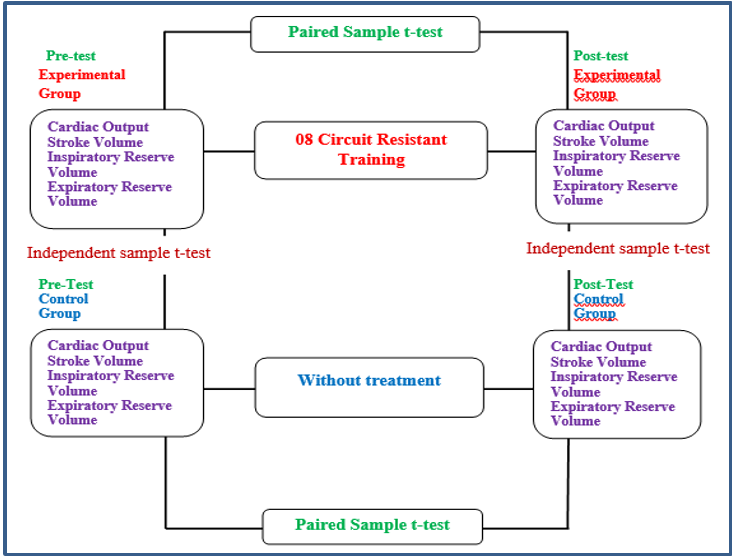
Result
| Variable | Control Group (20) | Experimental Group (20) |
| t-value p-value | t-value p-value | |
| PRE HC- POST HC -1.000 | 0.330 | 3.198 .005 |
| PRE WHR- POST WHR -0.138 | 0.892 | 1.775 .092 |
| PRE BMI- POST BMI -3.329 | 0.004 | 2.144 .045 |
HC: Hip Circumference, WHR: Waist-hip ratio, BMI: Body mass index
| Variable | Control Group (20) | Experimental Group (20) |
| t-value p-value | t-value p-value | |
| PRE CO- POST CO -0.136 | 0.893 | -2.254 .036 |
| PRE SV- POST SV -1.000 | 0.330 | -2.722 .014 |
Key: CO: Cardiac Output, SV: Stroke Volume
| Variable | Control Group (20) | Experimental Group (20) |
| t-value p-value | t-value p-value | |
| PRE IRV- POST IRV -0.010 | 0.992 | -2.470 .023 |
| PRE ERV-POST ERV 1.121 | 0.276 | -2.275 .035 |
Key: IRV: Inspiratory Reserve Volume, ERV: Expiratory Reserve Volume
Discussion
The present research was conducted to evaluate the Circuit Resistant Training (CRT) program on cardio-respiratory endurance of adults aging 18-22. In the current study forty (40) healthy volunteers equally divided into two different groups namely, the experimental group (EG) and a control group (CG) were selected for the study. According to the analyzed data, the participants of an experimental group showed a statistical significant differences in Hip Circumference (HP), Waist-hip ratio (WHR), and Body mass index (BMI) (Table 4.8). Furthermore, the results of the t-test revealed a significant increase in the cardiorespiratory indices (CO, SV, IRV, ERV) among the participants of the experimental group (Table 4.9 & 4.10). These results tend to interpret that the cardiorespiratory fitness of adults can be improved with the help of 06 week (CRT) program. These results are substantiated by previous research that studied the effects of a circuit training program on different components of health-related fitness (Romero-Arenas et al., 2013), but little have investigated the effect of circuit-resistant training (CRT) among adults at higher educational institutions. Therefore, the findings of the current add to the existing body of literature. Similar studies have found that circuit training helps in increasing VO2 max (Brentano et al., 2008). Research studies using CT have also revealed the same results of improvement in various indices of cardiorespiratory fitness among other populace (Wong et al., 2015). One study indicated that a least-duration CT program helps in enhancing VO2 max (Romero-Arenas et al., 2013). One of the most important outcomes of the current study was that circuit-resistant training, which lasted six weeks, was helpful for enhancing and maintaining cardiorespiratory endurance in adults. Despite the fact that further research is required to validate these findings, detraining and following management systems are hoped to become a core factor of this regard. It is suggested that further studies could include a longitudinal follow-up to assess the fairly long consequences of circuit-resistant training in this particular group of population. Therefore, CRT is a realistic and successful solution to exercise training.
Findings
Conclusion
Limitations
Future Action
References
- Amaro-Gahete, F. J. (2019). Changes in physical fitness after 12 weeks of structured concurrent exercise training, high-intensity interval training, or whole-body electromyostimulation training in sedentary middle-aged adults: A randomized controlled trial. Frontiers in physiology, 10. https://doi.org/10.3389/fphys.2019.00451
- Biolo, G., Ciocchi, B., Stulle, M., Piccoli, A., Lorenzon, S., Dal Mas, V., & Guarnieri, G. (2005). Metabolic consequences of physical inactivity. Journal of renal nutrition, 15(1), 49-53. https://doi.org/10.1053/j.jrn.2004.09.009
- Bompa, T. O., Di Pasquale, M., & Cornacchia, L. (2012). Serious strength training. Human Kinetics. ISBN: 9781492575917
- Cheng, J. C., Chiu, C. Y., & Su, T. J. (2019). Training and Evaluation of Human Cardiorespiratory Endurance Based on a Fuzzy Algorithm. International journal of environmental research and public health, 16(13), 2390. https://doi.org/10.3390/ijerph16132390
- Church, T. S., Earnest, C. P., Skinner, J. S., & Blair, S. N. (2007). Effects of different doses of physical activity on cardiorespiratory fitness among sedentary, overweight or obese postmenopausal women with elevated blood pressure: a randomized controlled trial. Jama, 297(19), 2081-2091. https://doi.org/10.1001/jama.297.19.2081
- Clausen, J. S., Marott, J. L., Holtermann, A., Gyntelberg, F., & Jensen, M. T. (2018). Midlife cardiorespiratory fitness and the long-term risk of mortality: 46 years
- Daussin, F. N., Zoll, J., Dufour, S. P., Ponsot, E., Lonsdorfer-Wolf, E., Doutreleau, S., & Richard, R. (2008). Effect of interval versus continuous training on cardiorespiratory and mitochondrial functions: relationship to aerobic performance improvements in sedentary subjects. American Journal of Physiology-Regulatory, Integrative, and Comparative Physiology. https://doi.org/10.1152/ajpregu.00875.2007
- Gander, J. C., Sui, X., Hébert, J. R., Hazlett, L. J., Cai, B., Lavie, C. J., & Blair, S. N. (2015, October). Association of cardiorespiratory fitness with coronary heart disease in asymptomatic men. In Mayo Clinic Proceedings 90(10), 1372-1379). Elsevier. https://doi.org/10.1016/j.mayocp.2015.07.017
- Gu, X., Chang, M., & Solmon, M. A. (2016). Physical activity, physical fitness, and health-related quality of life in school-aged children. Journal of Teaching in Physical Education, 35(2), 117-126. https://doi.org/10.1123/jtpe.2015-0110
- Häkkinen, K., Alen, M., Kraemer, W. J., Gorostiaga, E., Izquierdo, M., Rusko, H., & Romu, S. (2003). Neuromuscular adaptations during concurrent strength and endurance training versus strength training. European journal of applied physiology, 89(1), 42-52. https://doi.org/10.1007/s00421-002-0751-9
- Jackson, A. S., Sui, X., Hebert, J. R., Church, T. S., & Blair, S. N. (2009). Role of lifestyle and aging on the longitudinal change in cardiorespiratory fitness. Archives of internal medicine, 169(19), 1781-1787. https://doi.org/10.1001/archinternmed.2009.312
- Kohl 3rd, H. W., Craig, C. L., Lambert, E. V., Inoue, S., Alkandari, J. R., Leetongin, G., & Lancet Physical Activity Series Working Group. (2012). The pandemic of physical inactivity: global action for public health. The lancet, 380(9838), 294-305. https://doi.org/10.1016/S0140-6736(12)60898-8
- Kruk, J. (2014). Health and economic costs of physical inactivity. Asian Pac J Cancer Prev, 15(18), 7499-503. https://doi.org/10.7314/apjcp.2014.15.18.7499
- Lee, I. M., Shiroma, E. J., Lobelo, F., Puska, P., Blair, S. N., Katzmarzyk, P. T., & Lancet Physical Activity Series Working Group. (2012). Effect of physical inactivity on major non-communicable diseases worldwide: an analysis of burden of disease and life expectancy. The lancet, 380(9838), 219-229. https://doi.org/10.1016/S0140-6736(12)61031-9
- Nygaard, V., Løland, A., Holden, M., Langaas, M., Rue, H., Liu, F., & Smith-Sørensen, B. (2003). Effects of mRNA amplification on gene expression ratios in cDNA experiments estimated by analysis of variance. BMC genomics, 4(1), 11. https://doi.org/10.1186/1471-2164-4-11
- Romero-Arenas, S., Martínez-Pascual, M., & Alcaraz, P. E. (2013). Impact of resistance circuit training on neuromuscular, cardiorespiratory and body composition adaptations in the elderly. Aging and disease, 4(5), 256. https://doi.org/10.14336/AD.2013.0400256
- Sui, X., Sarzynski, M. A., Lee, D. C., Lavie, C. J., Zhang, J., Kokkinos, P. F., & Blair, S. N. (2017). Longitudinal patterns of cardiorespiratory fitness predict the development of hypertension among men and women. The American journal of medicine, 130(4), 469-476. https://doi.org/10.1016/j.amjmed.2016.11.017
- Velez, A., Golem, D. L., & Arent, S. M. (2010). The impact of a 12-week resistance training program on strength, body composition, and self-concept of Hispanic adolescents. The Journal of Strength & Conditioning Research, 24(4), 1065-1073. https://doi.org/10.1519/JSC.0b013e3181cc230a
- Wang, C. Y., Haskell, W. L., Farrell, S. W., LaMonte, M. J., Blair, S. N., Curtin, L. R., & Burt, V. L. (2010). Cardiorespiratory fitness levels among US adults 20–49 years of age: findings from the 1999–2004 National Health and Nutrition Examination Survey. American journal of epidemiology, 171(4), 426-435. https://doi.org/10.1093/aje/kwp412
- Wong, C. N., Chaddock-Heyman, L., Voss, M. W., Burzynska, A. Z., Basak, C., Erickson, K. I., & Mailey, E. L. (2015). Brain activation during dual-task processing is associated with cardiorespiratory fitness and performance in older adults. Frontiers in aging neuroscience, 7, 154. https://doi.org/10.3389/fnagi.2015.00154
Cite this article
-
APA : Samad, A., Khan, I., & Hussain, M. (2024). Parents' Advice-Based Discipline Selection and its Impact on Academic Performance in Higher Education: Insights from Students’ Perceptions. Global Social Sciences Review, IX(III), 21-36. https://doi.org/10.31703/gssr.2024(IX-III).03
-
CHICAGO : Samad, Abdus, Irfanullah Khan, and Mudassar Hussain. 2024. "Parents' Advice-Based Discipline Selection and its Impact on Academic Performance in Higher Education: Insights from Students’ Perceptions." Global Social Sciences Review, IX (III): 21-36 doi: 10.31703/gssr.2024(IX-III).03
-
HARVARD : SAMAD, A., KHAN, I. & HUSSAIN, M. 2024. Parents' Advice-Based Discipline Selection and its Impact on Academic Performance in Higher Education: Insights from Students’ Perceptions. Global Social Sciences Review, IX, 21-36.
-
MHRA : Samad, Abdus, Irfanullah Khan, and Mudassar Hussain. 2024. "Parents' Advice-Based Discipline Selection and its Impact on Academic Performance in Higher Education: Insights from Students’ Perceptions." Global Social Sciences Review, IX: 21-36
-
MLA : Samad, Abdus, Irfanullah Khan, and Mudassar Hussain. "Parents' Advice-Based Discipline Selection and its Impact on Academic Performance in Higher Education: Insights from Students’ Perceptions." Global Social Sciences Review, IX.III (2024): 21-36 Print.
-
OXFORD : Samad, Abdus, Khan, Irfanullah, and Hussain, Mudassar (2024), "Parents' Advice-Based Discipline Selection and its Impact on Academic Performance in Higher Education: Insights from Students’ Perceptions", Global Social Sciences Review, IX (III), 21-36
-
TURABIAN : Samad, Abdus, Irfanullah Khan, and Mudassar Hussain. "Parents' Advice-Based Discipline Selection and its Impact on Academic Performance in Higher Education: Insights from Students’ Perceptions." Global Social Sciences Review IX, no. III (2024): 21-36. https://doi.org/10.31703/gssr.2024(IX-III).03