
Abstract
Urban parks are the essential city elements which provide eco benefits in the current time of rapid urbanization and industrialization. Climate change produced due to such human activities generated significant impacts. Climate change is a major phenomenon observed in the environment at global level. Pakistan is among the top ten countries who are facing climate change at the fastest rate. Indicators are the parameters which can measure the climate change rate and adaptation level of urban parks for appropriate monitoring and outcomes. Certain factors and indicators are required to be identified and a framework should be established to evaluate the urban parks. A system is required to be developed to assign the weightages to the established indicators for evaluation and monitoring of urban parks to increase their effectiveness and functionality. Urban parks can provide sustainable adaptation if monitored and evaluated successfully.
Keywords:
Urban Parks, Climate Change, Adaptation, Indicators
Introduction:
Urban Parks and Climate Change
Urban parks have numerous benefits, ranging from health promotion to biodiversity conservation and environmental sustainability. Parks are in existence in almost all the densely populated cities. The need of the time is to make them functional according to the current adaptation requirements of a changing climate. Sustainable food production, conservation of nature, and city resilience are the critical issues required to be resolved for better livability(Rinaldi & Tan, 2019).
Urban parks are required to be ecological, restorative, and aesthetically pleasing in unison. The unison of all three is the challenge for many densely populated and highly urbanized cities like New York, Seoul, and Singapore, where space is a limited commodity. The growth in urban population, worldwide, is permeating the demand for resilience and adaptation to climate change (Rinaldi & Tan, 2019).
The idea of planning urban parks within and around the city for environmental sustainability and pleasing aesthetics started in 1867 in England. Liverpool was one of the largest industrial cities of earlier times. Sefton Park was planned as a public park to balance the industrial elements and to generate a pleasing space for the citizens (Programmes, n.d.).
Urban parks are considered to be the strategic elements for sustainable development and quality livability in modern cities also especially those that are facing challenges like industrial functions and increasing population (Taghizadehvehed, 2019).
In Urban South (including India, Brazil, Kenya, and South Africa), urban parks can be considered as tools for spatial segmentation while considering biodiversity conservation and environment(Landy, 2012).
The need of the time is to adapt to climate change. Climate change is impacting globally. Almost all countries are victims of climate change. The regions like Latin America and Asia are among the highly vulnerable countries. One billion citizens are living below the poverty line in these areas. It is expected that by 2030, 77 million people from urban areas will be added to the list if climate change is not addressed (Institute, n.d.).
The need and capacity to adapt are not being considered in planning and policies. The development should consider adaptation to enhance the resilience (Institute).
According to a study, by 2050 two two-thirds of the world population will be living in cities. The rise in urbanization will be a more critical challenge while considering resilience. The biodiversity conservation, resilience, and adaptation plans are required to be thought out in the current times to save future centuries. Urban parks provide many beneficial opportunities to plant trees and to develop rain gardens within the park's landscape (Conservancy, 2020).
Planting trees in city parks can benefit the environment with great deliverables. Conserved trees in protected landscapes and in urban parks can store more carbon dioxide than younger ones. The aligned trees, i.e., planted in a row as generally in park boundaries, can act both as barriers and storage spaces that can store pollutants to re-enter the surrounding communities (Conservancy, 2020).
According to research conducted in 56 cities around the globe, including all continents, urban parks are working as carbon reservoirs, as the soil sampling of urban parks showed the equivalent amount of carbon as in natural areas near the cities. So, the role of urban parks is extremely important in climate change adaptation. The urban parks are the city features that provide the cities with a strength to be resilient (Council, 2023).
Adaptation through Urban Parks
Parks are the heart of cities around the globe. They directly improve the lives of nearby residents by providing health benefits, recreational opportunities, and minimizing the impact of climate change. They act as cooling islands and provide relief from heat. They also increase the process of evapotranspiration while maintaining the green coverage. The shade available in parks is crucial for the neighboring communities. This shade reduces the solar radiation, providing many health benefits like protection from skin cancer and liver spots. Parks in urban areas act as a sponge to filter heat and pollutants through branches and leaves, thus reducing air temperature in surrounding areas (Sjoholm, 2022).
Focusing on the adaptability, environmental criteria, including energy, water management, transportation, waste recycling, etc., are important elements. These elements can be transformed and made more beneficial through urban parks. Thus, to increase the adaptability in the cities, urban parks can play a vital role (Taghizadehvehed, 2019).
Identification and Evaluation of Indicators
The current and future plans are required to be considered by adopting adaptation parameters worldwide. Numerous measures have already been taken and planned for future considerations to address this issue. The need of the time is to evaluate the effectiveness of these implemented measures, so that it can be observed what needs to be improved for appropriate adaptation to climate change (Pearce-Higgins et al., 2022).
To evaluate the effectiveness and progress, factors and indicators should be identified and should be measured. This evaluation and monitoring of factors and indicators will provide evidence of success or failure. The interventions taken in this regard can be checked on the ground and can also be tracked to determine whether the actions resulted in the expected response (Pearce-Higgins et al., 2022).
Significance of Indicators for Urban Parks Worldwide
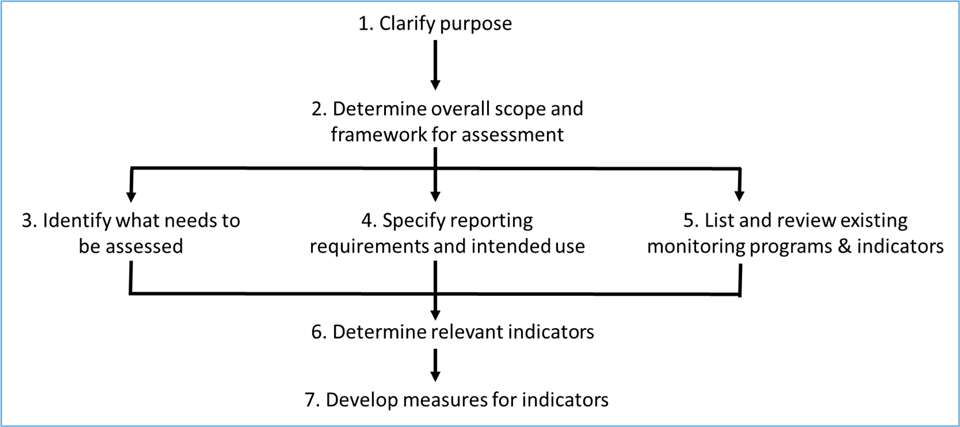
Indicators are the things that can be measured. The success or failure threshold can be observed while identifying the related indicators and further evaluating them (Facility).
The identification and monitoring process of indicators has been illustrated in Figure 1 as follows:
Figure-1
Urban regeneration is significant at the current time, to be integrated with urban resilience. This can result in conserved biodiversity and ecosystems. Every element of the urban area is required to be dealt with while considering suitable solutions to increase the resilience in the aspect of climate change worldwide (Lehmann, 2023).
The concept of "Urban Metabolism" should be applied, in which cities are believed to be living organisms. Natural ecosystems and human-generated activities should balance each other for a sustainable environment (Lehmann, 2023).
The cities are increasing in density, and to balance it, access to urban green spaces like parks should be enhanced. Although the need for financial benefits and facilities is stretching the population from rural to urban areas due to which requires more infrastructure and built area. But this can be balanced with urban parks, as can be seen in Sweden's city of Malmö, which is known as "City of Parks". Malmö is providing economic and social benefits in combination with environmental sustainability and resilience at the same time (Lehmann, 2023).
The urban parks effectiveness to build resilience or microclimates needs to be monitored and measured. This can be done through identifying and evaluating the indicators. Indicators are the yardsticks to observe the functions of urban parks. Urban parks indicators are much more significant nowadays, as compared to park policies and operations (Chan et al., 2018).
The indicators can show the measurement of important park elements by considering which relevant actions can be planned to minimize the problems. The overall condition and quality of the park can be measured through indicators (Chan et al., 2018).
Evaluation of identified indicators is a process by which urban parks can be assessed. The assessment is based on the necessities that are essential to be generated from the parks. The value and worth of the park can be assessed while considering required features like security, environmental sustainability, climate change adaptation, etc. The progress for achieving goals can be monitored through evaluation. The quality, usefulness and development funding can be planned according to the assessment made(Wang et al., 2022).
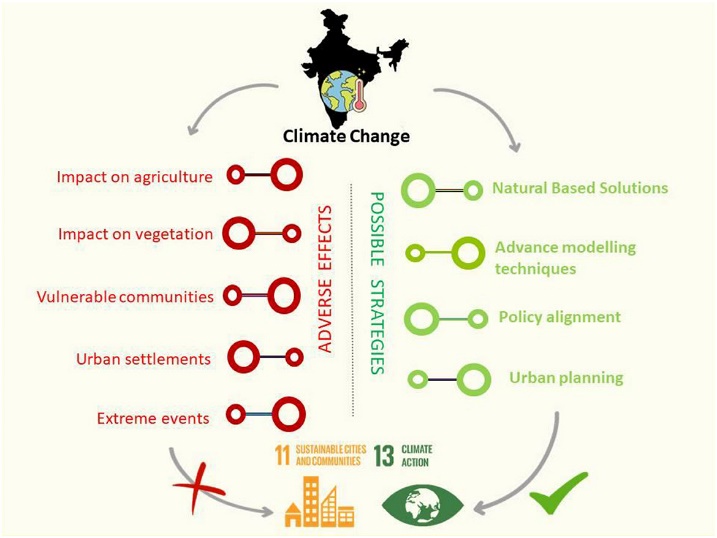
The efforts to minimize the impacts of climate change are in process at the global level. Countries from all over the world are concerned about climate change and its adaptation. Asian countries are also working on it. India is very concerned about climate change. It was ranked 7th in 2019 among all countries of the world that are facing extreme weather issues due to climate change. The country was highlighted in recent years as having the world's most polluted cities. To mitigate the climate-related issues, India is working on nature-based solutions. The country is advocating resilient cities by promoting green infrastructure and environmental sustainability. The researchers are indexing and measuring the factors and indicators related to the impacts of climate change(Hussain et al., 2024). The country is working on possible strategies for their mitigation and to achieve Sustainable Development Goals (SDGs) 11 and 13, as illustrated in Figure 2:
Figure-2
Strategies to adapt to climate change through urban parks and other green spaces are also being focused on in other Asian cities, other than India, like Taipei from Taiwan, Fukuoka from Japan, and Hanoi from Vietnam(Mabon & Shih, 2021).
Research and practices related to climate change adaptation are focused on Europe and North America, but the focus in Asian cities is limited. Due to the growing need and significance of climate-related issues and concerns, Asia is putting efforts into adaptation strategies(Mabon & Shih, 2021).
All three cities, i.e., Taipei, Fukuoka, and Hanoi, have existing plans for climate change adaptation, but the coordination among knowledge, research, and implementation needs to be improved for better adaptation. Each city has its own social, economic, and political context, for which climate change adaptation factors and indicators will be different. Some indicators might be the same due to the common subtropical environment of these cities. Rapid urbanization and development are also being channelized and balanced with the urban green spaces. Thus, these countries are focusing on improving the climate by identifying proper concerns to get appropriate results(Mabon & Shih, 2021).
Malaysia is also a country in Asia having growing cities. Industrial emissions, carbon production, and energy consumption attributes are focused indicators for climate change adaptation, as illustrated in Figure 3:
Figure-3
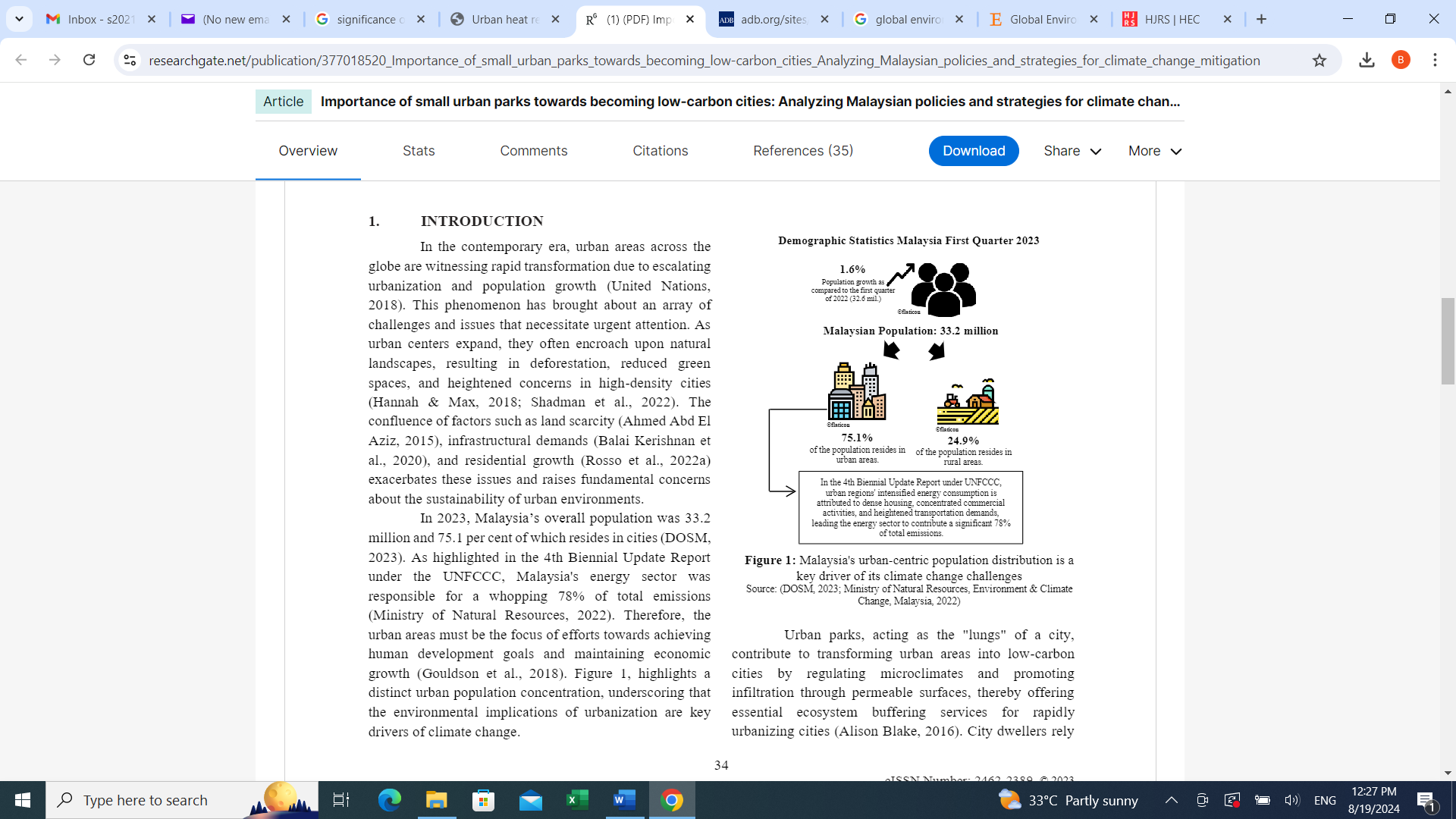
Urban green spaces, particularly small urban parks, are considered to be crucial city components to adapt the climate change in Malaysia. They are being studied for their high benefits related to ecosystems and improving the quality of life in cities (Mohammad Sabri et al., 2023).
Selection of Indicators
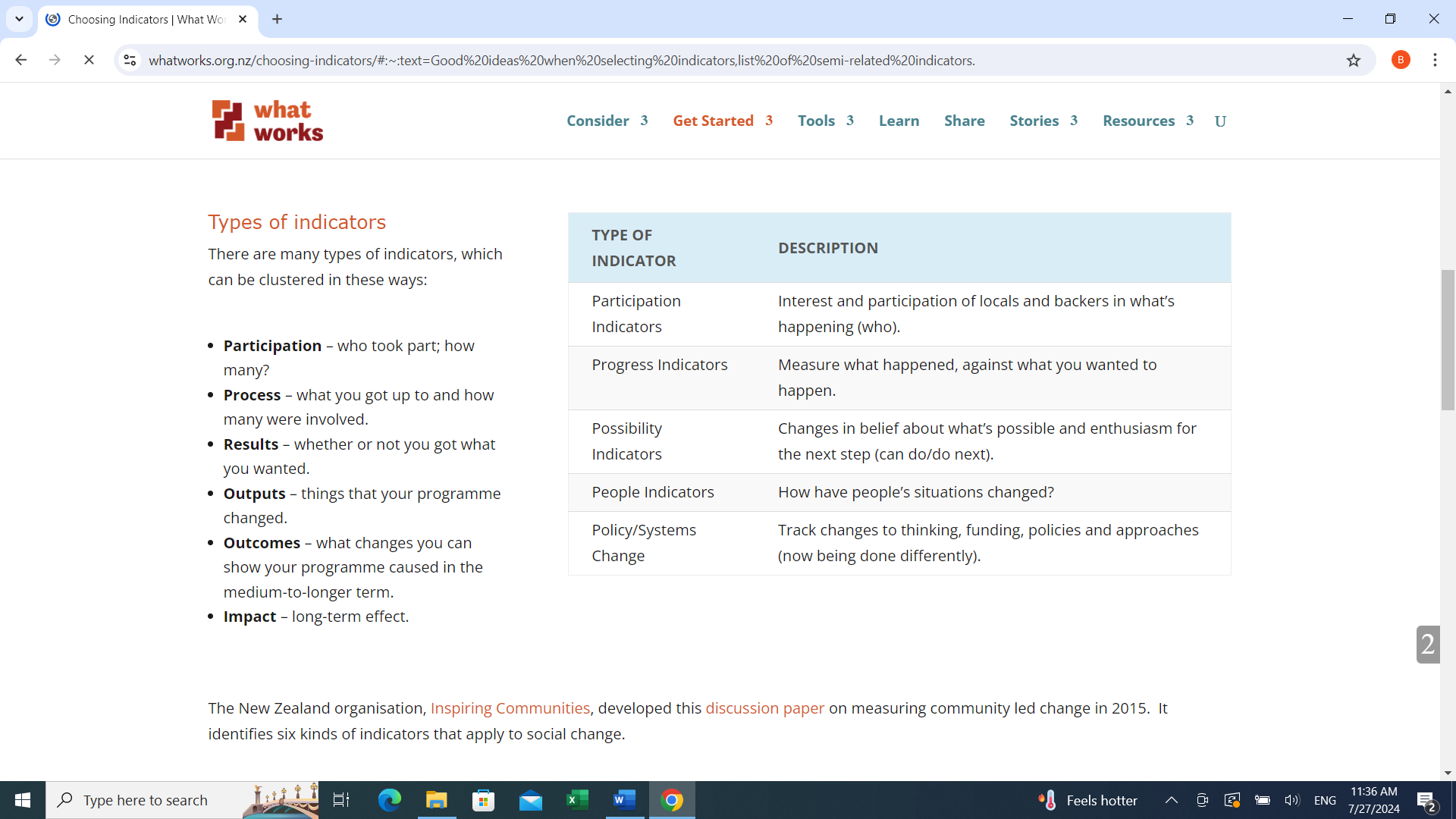
The selection of indicators is based on the identified problem, adaptation action, and attribute. For example, floods are being caused due to climate change. The adaptation action will define the indicators for the said problem, i.e., number of old houses (which can be eroded), etc. (Facility, n.d.)
The indicators are of many types. What type of indicator is required for the research is based on the action or result we need to obtain. Some important types of indicators are illustrated in Figure 4 as below:
Figure-4
Functions and Typologies of Urban Parks in Different Regions
The function and typologies of urban parks in different regional zones are important to identify for the analysis of sustainable development, urban greening, and climate change resilience. Categorization of urban parks is essential to be studied to observe the impact of urban parks in the zone of their location.
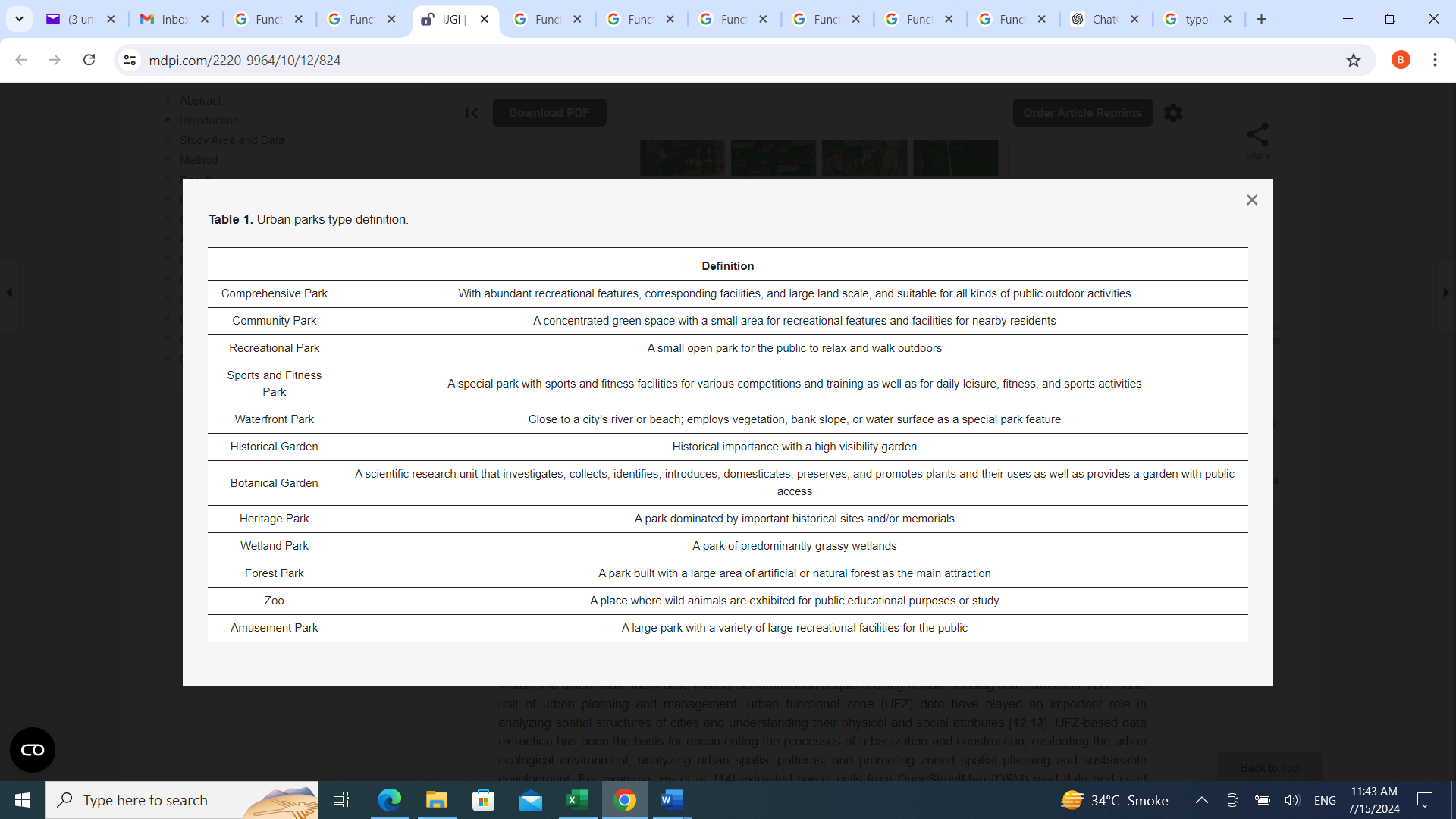
Each park has a particular function to facilitate the public, which identifies its typology. A study conducted in China identifies 12 typologies of urban parks illustrated in Figure 1 (a&b) as under:
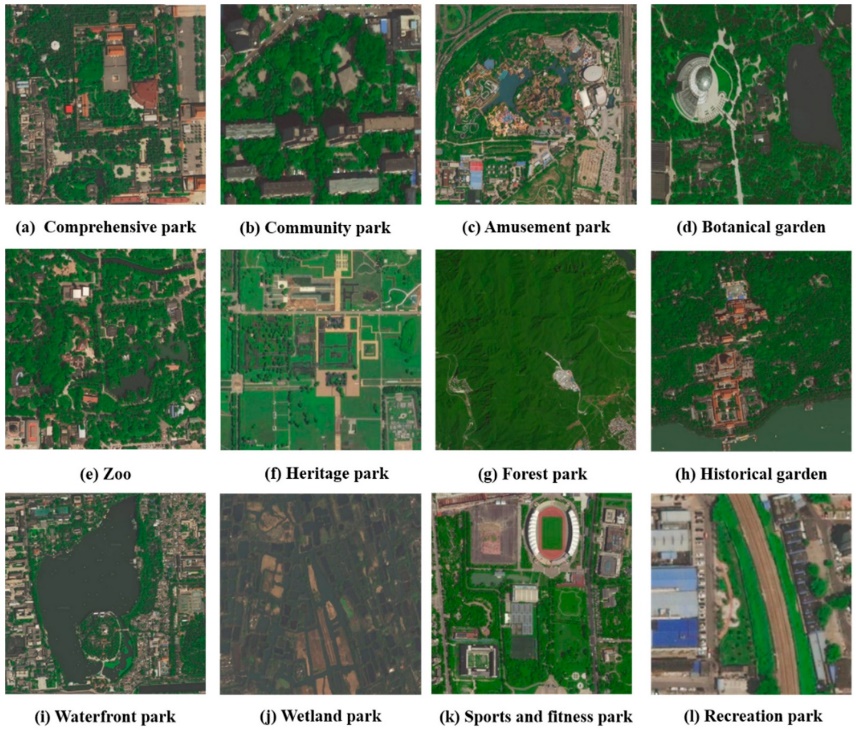
Figure-5(b)
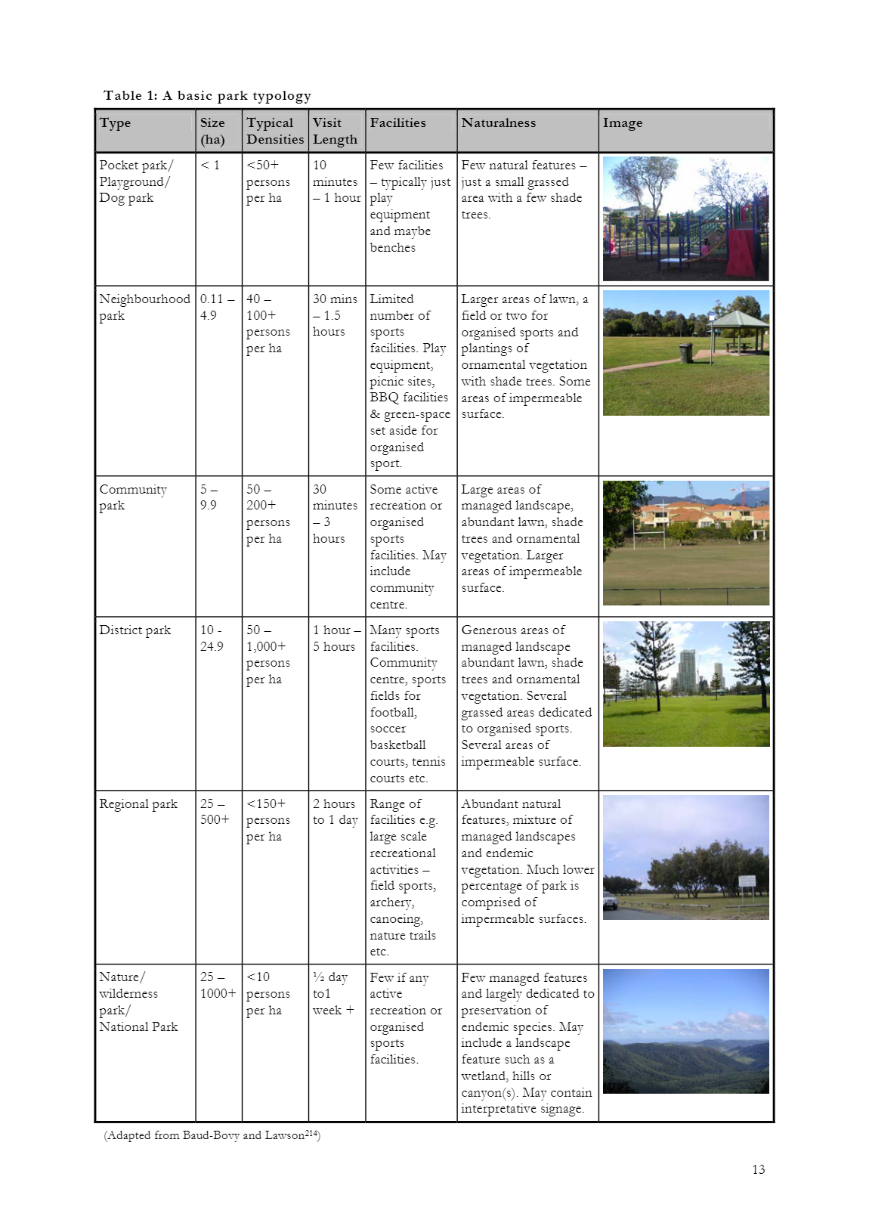
Research conducted in Australia explains that every park is different from another park, i.e., no two urban parks can be similar, as every park has its own age, type, surroundings, land development practices, funding constraints, facilities, and size. Every park has its own behavior to adapt (Byrne & Sipe, 2010).
While considering the above-mentioned characteristics, there are 6 types of parks depending upon their functions as illustrated in Figure 6:
Figure-6
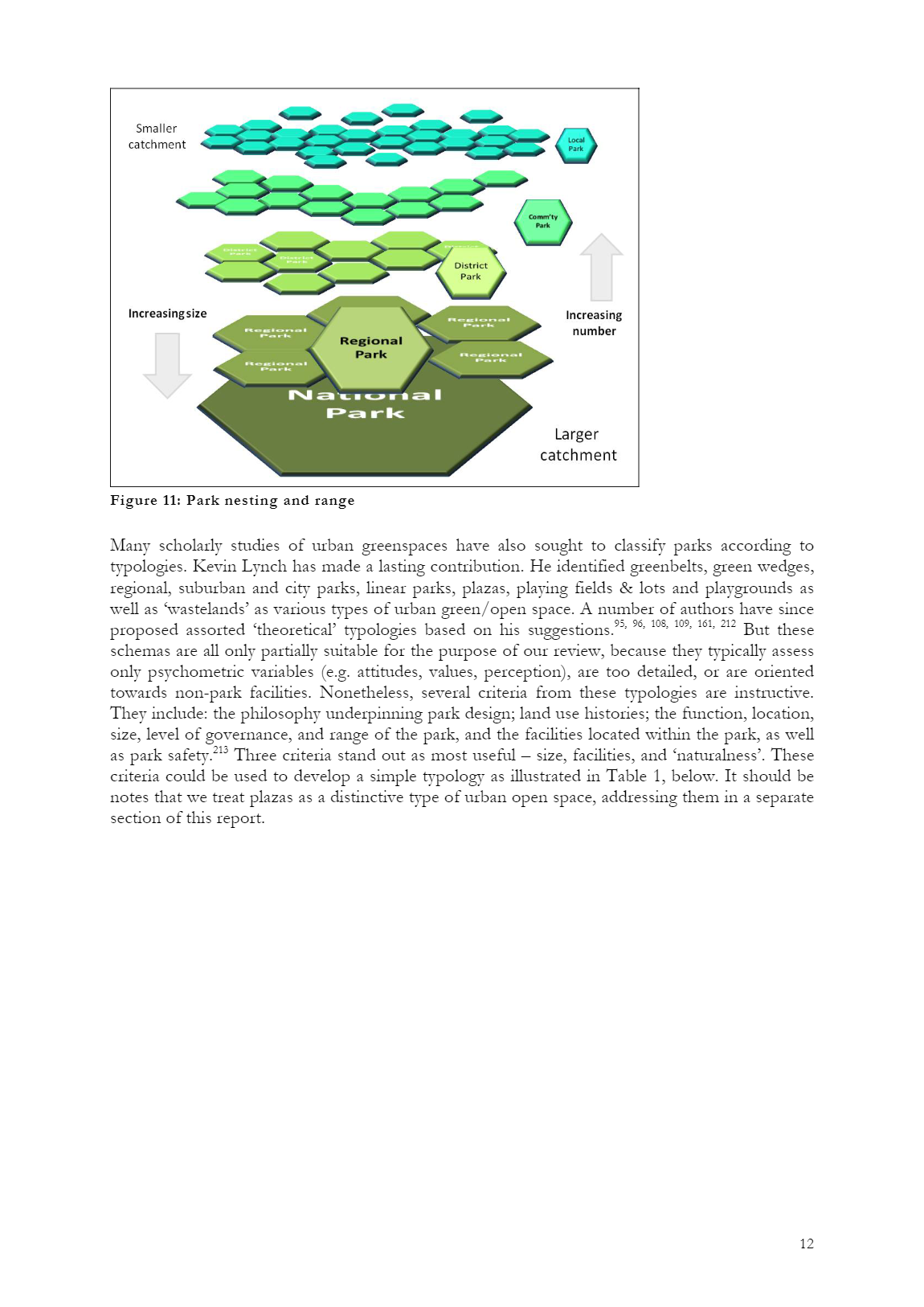
All the above-mentioned parks increase in size and number, i.e., larger parks exist in smaller numbers and small parks exist in larger numbers, as illustrated in Figure 7:
Figure-7
In the United States of America, there are many parks with different typologies depending on their functionality. The parks of the US are illustrated in Table 1 as below:
Table-1
Types of parks in the United States of America
| Sr.# | Park type | Area | Target Population/ Use | Example |
| 1. | Pocket Park (County) | Less than 1 acre | For people living and working in the immediate area/ for providing a limited casual open space | A pocket park in Arlington County) |
| 2. | Common Green (County) | Minimum 1 acre | For people living in a neighborhood or larger area/ for relaxing in green lawns, recreational activities, festivals, performances, and special events | Point State Park in Pittsburgh (County) |
| 3. | Civic Plaza (County) | Minimum of 1 acre | For people from larger areas and generally located at urban squares or street intersections/ for recreational, commercial, special events, or festivals related activities | Reston Town Center (County) |
| 4. | Recreational Park (County) | The size of the park depends on the facilities provided | In a densely populated urban area, for local people, workers, and visitors/including athletic fields, multi-use courts, and recreational facilities, the size of the park depends upon the facilities provided | A recreational park in Fairfax County) |
| 5. | Linear parks (County, .) | Minimum 8 feet wide and length depends upon the adjacent trail, including trailheads, way finding signage and ornamental features | An example of linear park (County) | |
| 6. | State Park (Beggs et al, ..) | Size is smaller than national park | For national and international visitors/ to preserve natural area like dessert, water feature, trees etc. | John Pennekamp Coral Reef State Park, USA (Park) |
| 7. | National Parks (Beggs et al, ..) | Size depends upon the identified area to be preserved but greater than state park | For national people and international visitors/ they preserve the natural geographic features | Grand Canyon National Park, Arizona (Service, .) |
In Pakistan following types of parks are being used as illustrated in Table-2:
Table-2
Types of Parks in Pakistan
| Sr.# | Park type | Area | Use/Target Population | Example |
| 1. | National Park (Embassy of Pakistan Copenhagen, .) | Size depends upon site identified generally a minimum of several hundred acres | To conserve the identified natural areas/ for national and international visitors | Margalla Hills (Embassy of Pakistan Copenhagen) |
| 2. | Provincial Parks (G. o. T. Punjab) | Size depends on site identified | To conserve the identified natural area or built heritage/ for national and international visitors | Greater Iqbal Park (G. o. T. Punjab) |
| 3. | Recreational Parks (Pakistan, .) | Size is upto several acres or depends upon the facilities provided | Include cultural activities, sports area, play area, green lawns etc./ for local people and visitors | Fatima Jinnah Park Islamabad (Pakistan) |
| 4. | Central Parks (Travelot, .) | Size is upto few acres | Include festivals, sports activities, play areas, water features etc./for local people and visitors | Bagh-e-Jinnah Faisalabad (G. o. T. Punjab) |
| 5. | Local Parks (Victoria, .) | Size is up to a couple of acres | Include lawns, water features, sport facilities, etc./for local residents. | Azizabad Park at Karachi (Rao, ) |
An Analysis of Urban Parks in Punjab, Pakistan
Pakistan is among the top ten countries of the world that are highly vulnerable to climate change. Pakistan has seen 10,000 fatalities and a loss of $4 billion due to climate-related weather events like floods, heatwaves, droughts, food insecurity, etc. Due to climate-related concerns, people are moving from rural to urban areas for better life opportunities, and a great burden is being created on the cities that are not able to manage the previous load of urbanization (Siddiqui, 2022).
The country has four provinces. Punjab is the most populous province of Pakistan. It has more than half of the total population of the country. It is the second-largest province of the country by area (Britannica, 2024).
Urban Parks of Punjab
Out of the 194 urban areas, five cities have been selected in this research to study the urban parks. 1 mega city, i.e., Lahore, which is the only mega city of the province. 2 large cities, i.e., Faisalabad and Rawalpindi. 2 intermediate cities, i.e., Bahawalpur and Dera Ghazi Khan, also known as DG Khan. Figure-8 is illustrates the classification of cities in Punjab Province:
Figure-8
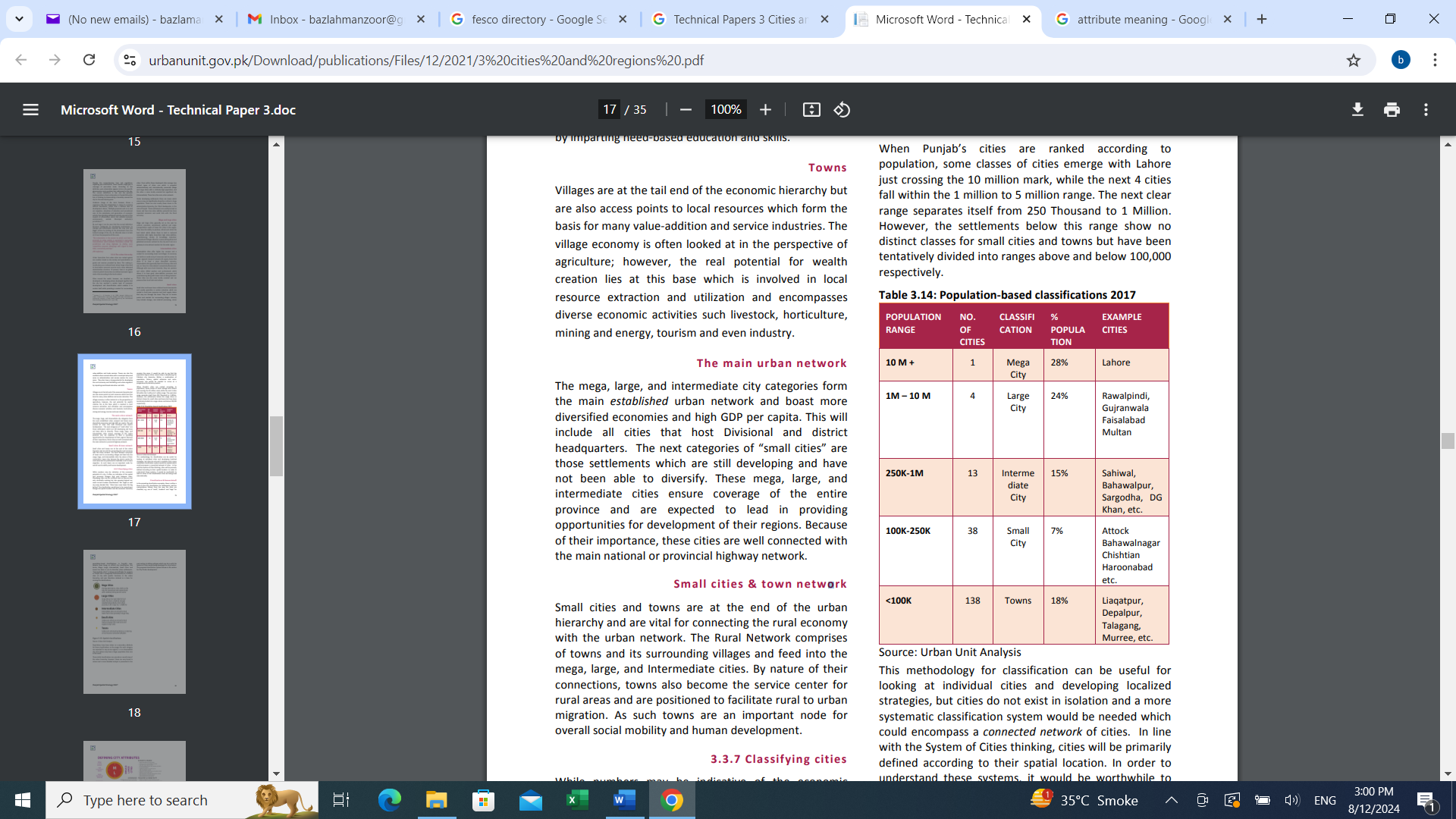
The selected cities not only represent the major urban areas of Punjab but also cover almost all directions of the province, geographically, to have a combined picture from every part of the province, i.e., North, South, East, West, and Central. The selected cities are also the divisional headquarters.
The parks of all these cities are planned and managed by the Parks and Horticulture Authority of the respective city. The details of the parks of each selected city have been illustrated in Table 3 as under:
Table-3
Details of Parks in Selected Cities
| City Name | Total Parks | Total Area | Major Parks | Sustainable Initiatives Taken |
| Lahore | 893(L. Parks and Horticulture Authority, ) | 2209.55 Acres(L. Parks and Horticulture Authority, 2024b) | Bagh-e-Jinnah Racecourse Park Greater Iqbal park Gulshan-e-Iqbal Park (L. Parks and Horticulture Authority, 2024b) | Miyawaki Forest Afforestation Food gardening Rainwater Harvesting (L. Parks and Horticulture Authority, 2024b) |
| Faisalabad | 355 (F. Parks and Horticulture Authority, ) | 485.33 Acres (F. Parks and Horticulture Authority, ) | Bagh-e-Jinnah Kaleem Shaheed Park Canal Park D-Ground Park Dhobi Ghat park Nawaz Sharif Park (F. Parks and Horticulture Authority, ) | Miyawaki Forests Urban Forest Afforestation Green-composting Food gardening (F. Parks and Horticulture Authority, 2024) |
| Rawalpindi | 52 (R. Parks and Horticulture Authority, ) | 872.34 Kanals (R. Parks and Horticulture Authority, 2024) | Allama Iqbal Park Potohar Park Rawal Park (R. Parks and Horticulture Authority, 2024) | Rainwater harvesting Miyawaki Forests (R. Parks and Horticulture Authority, 2024) |
| Bahawalpur | 23 (B. Parks and Horticulture Authority, 2024) | 52.81 Acres (B. Parks and Horticulture Authority, ) | Fareed Park Commercial Area Madr - e - Millat Ladies Park Shadrah Children Park Special Children Park Eid Gah Park Rohi Park (B. Parks and Horticulture Authority, 2024) | Urban Forest Miyawaki Forest (B. Parks and Horticulture Authority, 2024) |
| DG Khan | 21 (D. G. K. Parks and Horticulture Authority, 2024) | 77.59 Acres (D. G. K. Parks and Horticulture Authority, 2024) | Jinnah Park Kashmir park Ghazi park (D. G. K. Parks and Horticulture Authority, 2024) | Miyawaki Forest (D. G. K. Parks and Horticulture Authority, 2024) |
The role of management and current pictures of the major parks are explained below:
Urban Parks of Lahore
Urban parks of Lahore are being planned and managed by the Parks and Horticulture Authority Lahore (PHA-Lahore). PHA Lahore was established in 1998 by the Government of the Punjab-Housing, Urban Development & Public Health Engineering Department (L. Parks and Horticulture Authority, 2024a).
The city has 893 parks in total. Major parks are Bagh-e-Jinnah, Jilani Park, Greater Iqbal Park, and Gulshan-e-Iqbal Park (L. Parks and Horticulture Authority, 2024b)
The details of the major parks of Lahore are as under:
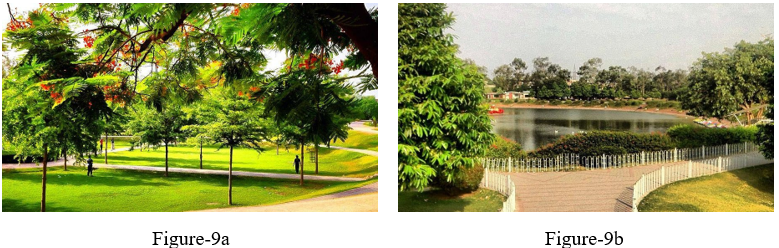
Gulashan-e-Iqbal Park, near Allama Iqbal Town, is one of the largest parks of Lahore. Its total area is 67 acres. The park includes green lawns, rides, a manmade lake, and a small zoo (Taimoor, 2022).
Some of the park's glimpses are as follows:
Figure-9 (a&b)
Bagh-e-Jinnah
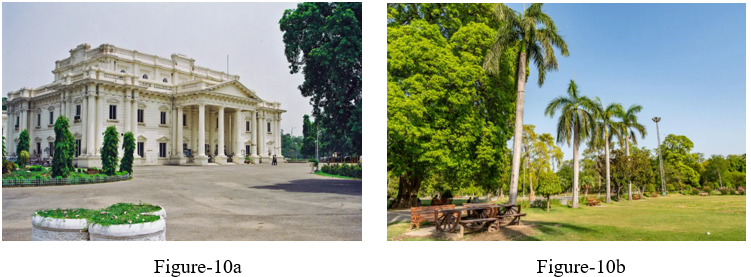
Bagh-e-Jinnah is a historical park in Lahore. Its old name was Lawrence Gardens. The parks include a library, Mosque, botanical garden, green lawns, and children's play area (L. Parks and Horticulture Authority, 2024b).
Some of its pictures are as follows:
Figure-10 (a&b)
Jilani Park
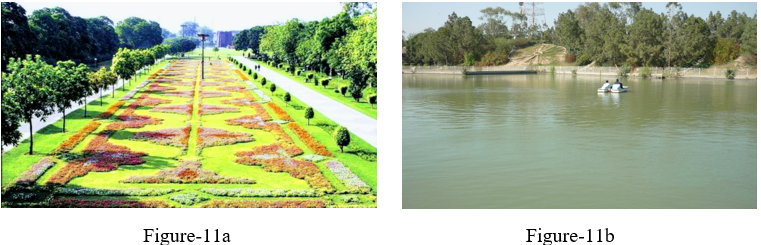
Jilani Park, previously known as Race Course Park, is a famous park in Lahore located at Jail Road. The park includes green lawns, an artificial lake with a waterfall, a restaurant, and a children's play area. The park was best known for horse racing till the 1970s; later, the race course was shifted to another place (L. Parks and Horticulture Authority, 2024b).
Some glimpses of the park are as under:
Figure-11 (a&b)
Jilani park (Jilani (Race Course) Park)
Greater Iqbal Park
Greater Iqbal Park was previously known as Minto Park. The park has a 125-acre area in total. It includes an artificial lake, 800 feet 800-foot-long dancing fountain, a library, a food court, and green lawns (G. O. Punjab).
An aerial view and pictures of the park are as follows:
Figure-12
Greater Iqbal Park (Atlas, 2023)
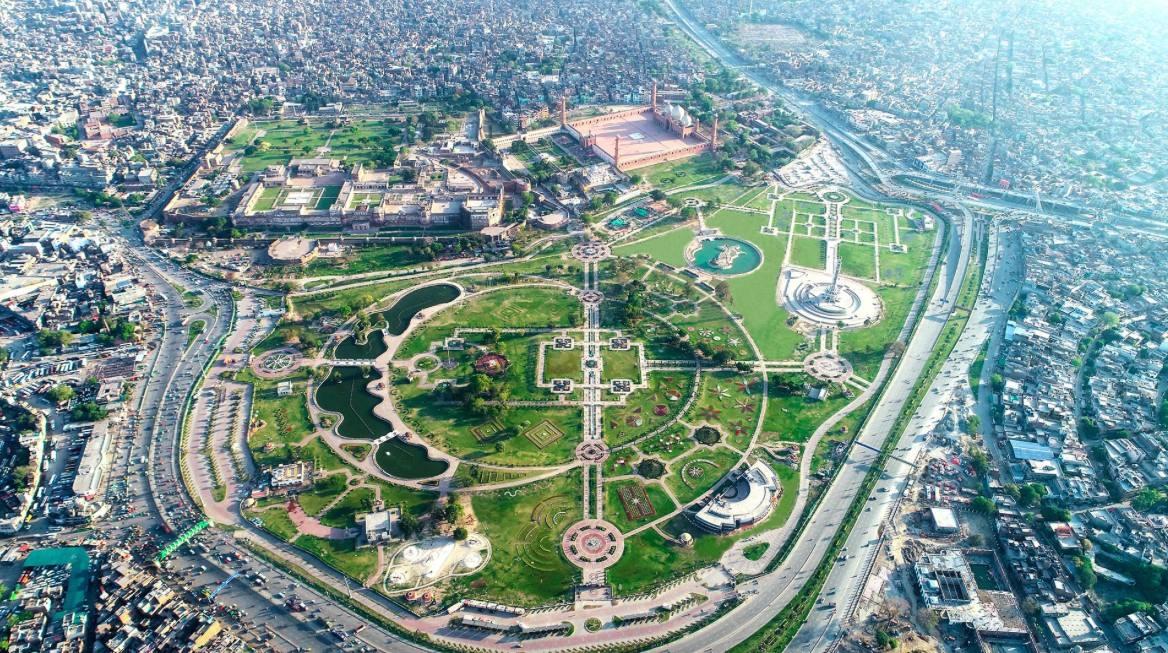
From the above pictures, it can be observed that the parks of Lahore are being managed properly for the general public. Hard and soft landscape elements are being provided for the user's benefit.
Urban Parks of Faisalabad
There are 355 parks in Faisalabad managed by PHA Faisalabad since 2014. Major parks of the city are Bagh-e-Jinnah, Kaleem Shaheed park, Canal park, D-Ground Park, Dhobi Ghat park and Nawaz Sharif Park (F. Parks and Horticulture Authority, 2024).
The details of the major parks of Faisalabad are as under:
Bagh-e-Jinnah
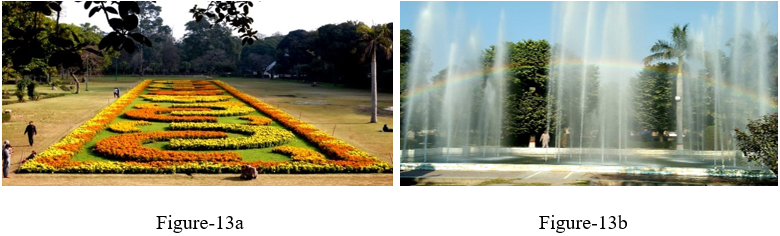
It is the primary park of the city with an area of 32 acres. It was built in 1902 by the British Government. Main features of the park are green lawns, historic and modern fountains, rides, and Miyawaki forest (Parks and Horticulture Authority-Faisalabad, 2024). Pictures of the park are as under:
Figure-13 (a&b)
Bagh-e-Jinnah (F. Parks and Horticulture Authority, 2024)
Kaleem Shaheed Park
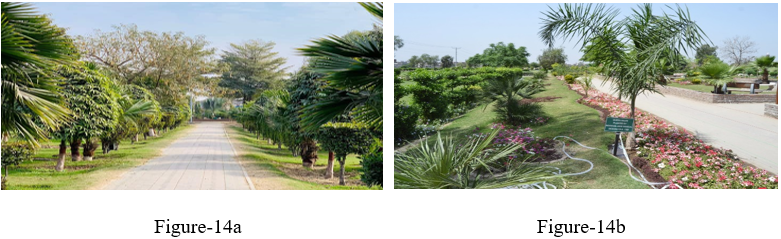
It is the largest park in the city with an area of 52 acres. It was built in the 1980s. Its main features are green lawns, a children's play area, and food gardening (F. Parks and Horticulture Authority, 2024). Its pictures are as under:
Figure-14 (a&b)
Kaleem Shaheed Park (F. Parks and Horticulture Authority, 2024)
Canal Park
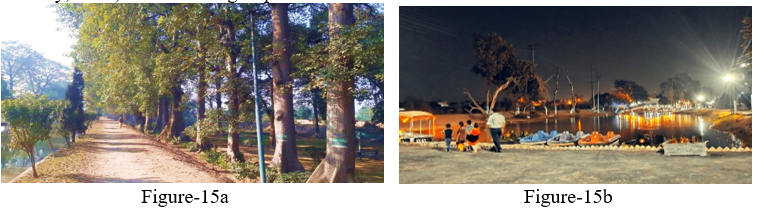
Canal Park is the longest park in the city, with an area of 14 acres. It was built in the 1990s. Its main features are a canal, an artificial lake, a zoo, a children's play area, and a food court (F. Parks and Horticulture Authority, 2024). Some of its glimpses are as under:
Figure-15 (a&b)
Canal Park (F. Parks and Horticulture Authority, 2024)
D-Ground Park
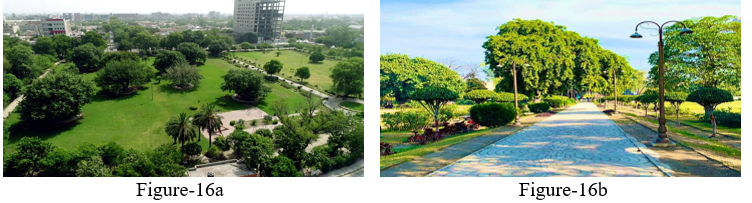
This park is located in one of the main commercial areas of the city. The total area of the park is 8 acres. It was built in the 1960s. It includes green lawns, flower beds, and a children's play area (F. Parks and Horticulture Authority, 2024). Some of its glimpses are as under:
Figure-16 (a&b)
D-Ground Park (F. Parks and Horticulture Authority, 2024)
Dhobi Ghat Park
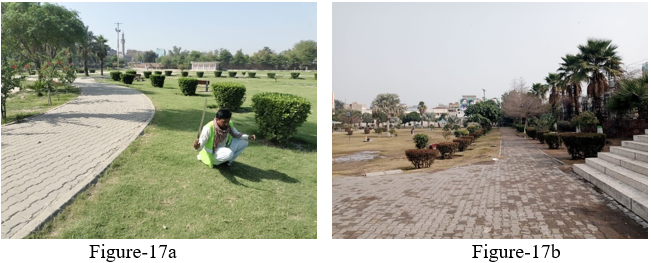
Dhobi Ghat park was built before the independence of Pakistan by the British Government in early 1900s. It was developed in the 1950s with an area of 6 acres. The park has two sections, i.e., one for recreational activities and green area, and the other for political and religious activities like religious camping, political gatherings, rallies, etc. (F. Parks and Horticulture Authority, 2024). Some of its glimpses are as under:
Figure-17 (a&b)
Nawaz Sharif Park
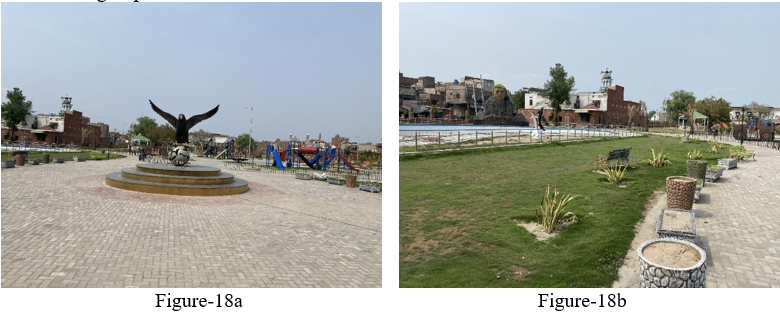
Nawaz Sharif Park is a newly built park inaugurated in August 2024. Its area is 6 acres. It includes green lawns, a children's play area, and an artificial lake (F. Parks and Horticulture Authority, 2024).
Some of its glimpses are as under:
Figure-18 (a&b)
Urban Parks of Rawalpindi
There are 52 parks in Rawalpindi managed by PHA Rawalpindi since 2014. Major parks of the city are Allama Iqbal Park, Rawal Park, and Potohar Park (R. Parks and Horticulture Authority, 2024). The details of the major parks of Faisalabad are as under:
Allama Iqbal Park
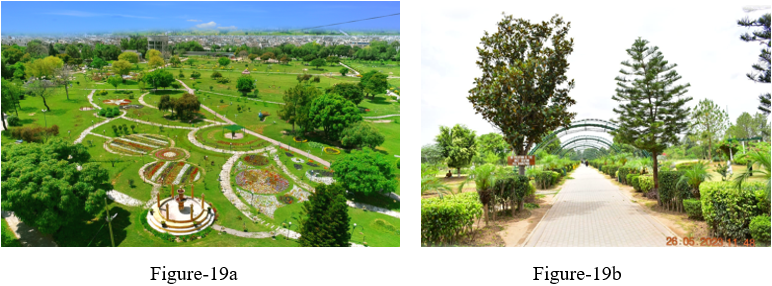
Allama Iqbal Park, previously known as Nawaz Sharif Park, is located on Murree Road, Rawalpindi. The park has green lawns, flower beds, open badminton courts, and a children's play area (R. Parks and Horticulture Authority, 2024). Some glimpses of the park are as follows:
Figure-19 (a&b)
Rawal Park
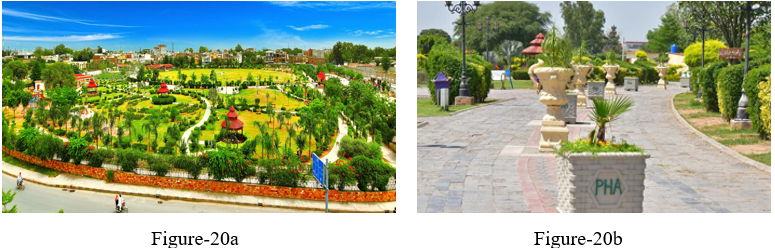
Rawal Park is located on Rawal Road. The park has green lawns with ornamental plantations, a cricket playing area, and a children's play area (R. Parks and Horticulture Authority, 2024). Some glimpses of the park are as follows:
Figure-20 (a&b)
Potohar Park
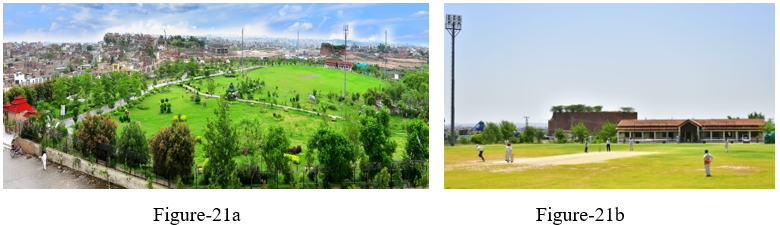
Potohar park is located on Dhoke Munshi road. The park has huge green lawns, a cricket play area, and a children's play area. Some glimpses of the park are as follows:
Figure-21 (a&b)
Urban Parks of Bahawalpur
There are 22 parks in Bahawalpur with an area of 52.81 acres managed by PHA Bahawalpur since 2014. Major parks of the city are Madar-e-Millat Ladies Park, Fareed Park, Rohi Park, and Eidgah Park (B. Parks and Horticulture Authority, 2024). The details of the major parks of Bahawalpur are as under:
Madar-e-Millat Ladies Park
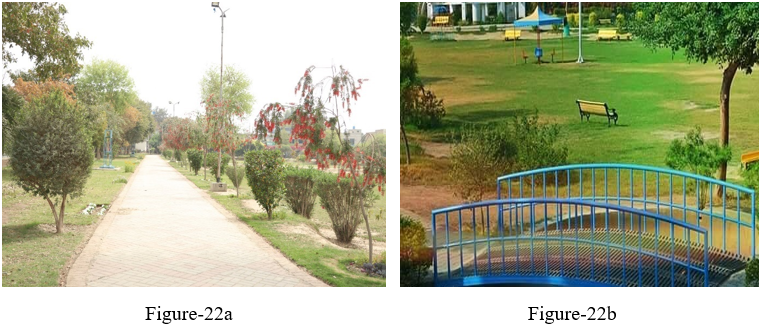
Madar-e-Millat park has green lawns, flower beds, and a children's play area. Some glimpses of the park can be seen as follows:
Figure-22 (a&b)
Fareed Park
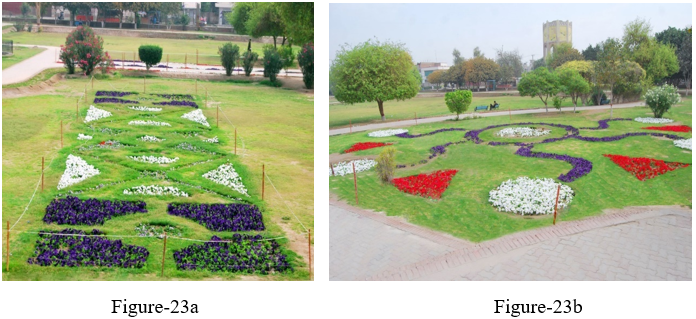
Fareed Park has green lawns, flower beds, and a children's play area (B. Parks and Horticulture Authority, 2024). Some glimpses of the park area are as follows:
Figure-23 (a&b)
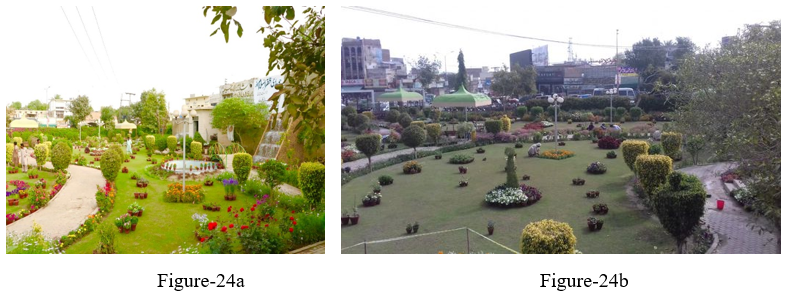
Rohi Park
Rohi Park is located on Ahmedpur Road. The park has green lawns, flower beds, and a children's play area (B. Parks and Horticulture Authority, 2024). Some glimpses of the park are as under:
Figure-24 (a&b)
Eidgah Park
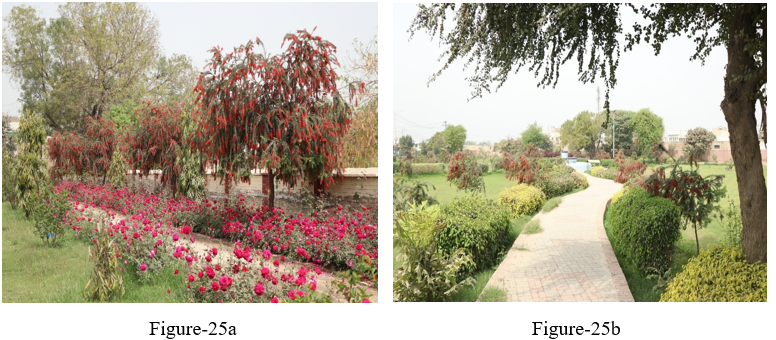
Eidgah Park has green lawns, flower beds, and a children's play area (B. Parks and Horticulture Authority, 2024). Some glimpses of the park are as under:
Figure-25 (a&b)
Eidgah Park (B. Parks and Horticulture Authority, 2024)
Urban Parks of DG Khan
There are 21 parks in DG Khan with an area of 77.59 acres managed by PHA DG Khan since 2015. Major parks of the city are Jinnah Park, Kashmir Park, and Ghazi Park (D. G. K. Parks and Horticulture Authority, 2024). The details of the major parks of DG Khan are as under:
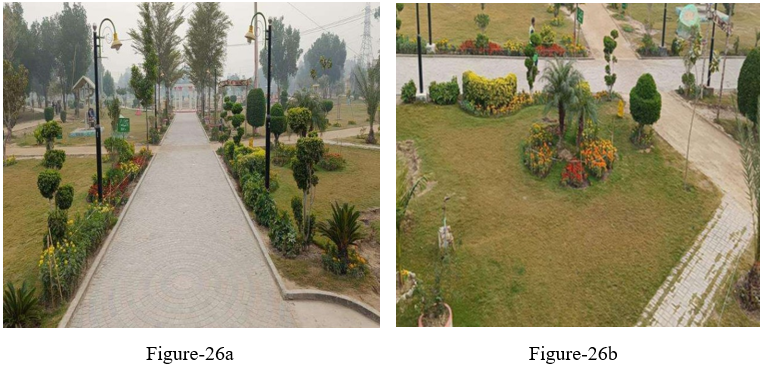
Jinnah Park
Jinnah Park is located on Jail Road. The park has green lawns, flower beds, and a children's play area (D. G. K. Parks and Horticulture Authority, 2024). Some glimpses of the park are as under:
Figure-26 (a&b)
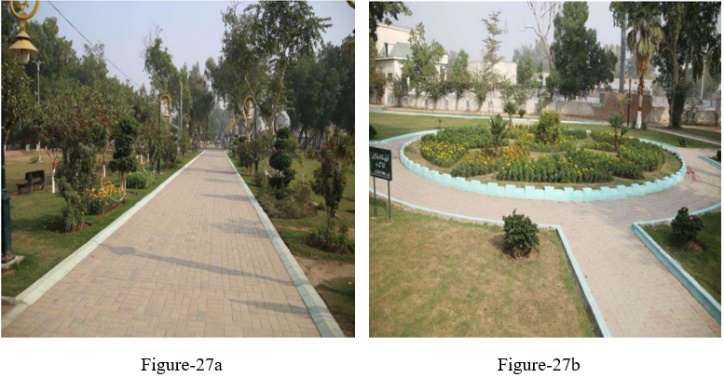
Kashmir Park
Jinnah Park is located on Jail Road. The park has a public library, green lawns, flower beds, and a children's play area (D. G. K. Parks and Horticulture Authority, 2024). Some glimpses of the park are as under:
Figure-27 (a&b)
Kashmir Park (D. G. K. Parks and Horticulture Authority, 2024)
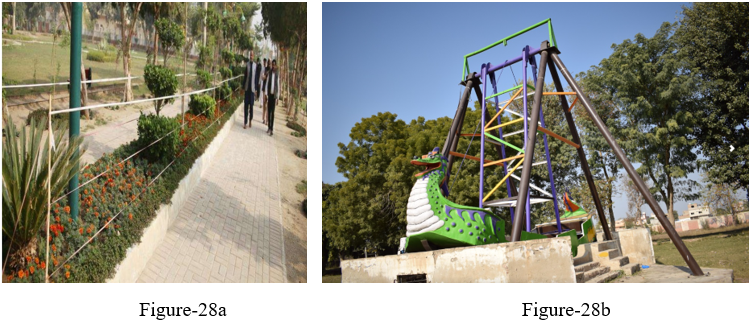
Ghazi Park
Ghazi Park is located on Vidor Road. The park has mechanical rides, green lawns, flower beds, and a children's play area (D. G. K. Parks and Horticulture Authority, 2024). Some glimpses of the park are as under:
Figure-28 (a&b)
Results and Discussions:
From table 1 and figures 5(a&b), 6, and 7, it can be deduced that similar typologies of parks are available, at the international level, based upon their functionality. Names can be different, which can vary country to country, like neighborhood parks in Australia are known as local parks in Pakistan. Regional parks in China are known as central parks in Pakistan. Hence, urban parks are available in all countries and for all related activities. They may vary in number and towards climate change adaptability.
Urban parks are the key elements for a city through which the relationship between residents and nature can be regenerated. Ecosystems and biodiversity conservation can be enhanced by providing parks in cities to balance between the built and green areas. At present, the Earth is facing issues related to climate change. The impacts of climate change can be minimized through urban parks while taking actions for the regeneration of nature. It can be done through intelligent landscaping and by taking sustainable initiatives like reducing pollution levels, sustainable production of food, and conserving nature through urban parks.
Conclusions and Recommendations
Management of urban parks around the globe is working to introduce sustainable initiatives and to conserve nature through various techniques. But still, adaptation to climate change through urban parks has not been observed. The adaptation level can be observed by identifying indicators and estimating the contribution of urban parks to this cause. Consequently, the required parameters can be deduced through which the existing situation of urban parks can be estimated for further planning for the future.
Adapting to the changing climate is a big challenge at the current time. New initiatives and measures are being taken by the concerned authorities, scientists, and researchers to minimize the adverse impact on the environment. But still, there is a huge space that needs to be filled with the new knowledge for the betterment of our Earth.
Through this research, the importance of urban parks in climate change adaptation has been highlighted. Further research is essential through which a comprehensive framework, based upon factors and indicators, is required to be established. This framework should include a systematic and comprehensive literature review to identify and develop the indicators. These established indicators are further important to be ranked according to their significance. Their validation should also be checked for its relevance. Weightages to these indicators should be assigned based on an appropriate methodology.
Finally, a matrix comprising all of the above-mentioned parameters should be developed to estimate the contribution of city parks in adaptation towards climate change. That matrix should apply to all urban parks worldwide. The validation of this matrix can be checked by applying it to certain selected parks initially.
This monitoring of urban parks will play a pivotal role in taking appropriate decisions regarding the adaptation to climate change.
References
- Ali, S. (2023). All you need to know about Bagh-e-Jinnah, Lahore. https://www.graana.com/blog/all-you-need-to-know-about-bagh-e-jinnah/
- Atlas, U. N. (2023). The Greater Iqbal Park. https://una.city/nbs/lahore/greater-iqbal-park
- Beggs, B. A., Mull, R. F., Renneisen, M., & Mulvaney, M. A. (n.d.). Understanding the many different types of parks. https://us.humankinetics.com/blogs/excerpt/understanding-the-many-different-types-of-parks
- Britannica, T. E. o. E. (2024). Punjab. https://www.britannica.com/place/Punjab-province-Pakistan
- Byrne, J., & Sipe, N. (2010). Green and open space planning for urban consolidation – A review of the literature and best practice.
- Cao, S., Du, S., Yang, S., & Du, S. (2021). Functional Classification of Urban Parks Based on Urban Functional Zone and Crowd-Sourced Geographical Data. ISPRS International Journal of Geo-Information, 10(12), 824. http://dx.doi.org/10.3390/ijgi10120824
- Centre, C. a. V. S. R. (2015). Choosing indicators. https://whatworks.org.nz/choosing-indicators/#:~:text=Good%20ideas%20when%20selecting%20indicators,list%20of%20semi%2Drelated%20indicators.
- Chan, C., Si, F. H., & Marafa, L. M. (2018). Indicator development for sustainable urban park management in Hong Kong. Urban Forestry & Urban Greening, 31, 1–14. https://doi.org/10.1016/j.ufug.2018.01.025
- Conservancy, T. N. (2020). 6 Ways Trees Benefit All of Us. The Nature Conservancy. https://www.nature.org/en-us/what-we-do/our-priorities/build-healthy-cities/cities-stories/benefits-of-trees-forests/
- Conservancy, T. N. Build healthy cities. https://www.nature.org/en-us/what-we-do/our-priorities/build-healthy-cities/
- Council, S. N. R. (2023). The Role of Urban Parks in the Fight Against Climate Change. https://phys.org/news/2023-03-role-climate.html#:~:text=%22Our%20study%20shows%20that%20urban,lead%20author%20of%20the%20article
- County, Fairfax County Urban Parks Framework. https://www.fairfaxcounty.gov/tysons/sites/tysons/files/assets/documents/pdf/parks/urban_parks.pdf
- Embassy of Pakistan, Copenhagen, D. Parks of Pakistan. https://www.pakistanembassy.dk/tourism-in-pakistan/what-to-see/parks-of-pakistan/
- Facility, N. C. C. A. R. (n.d.). Identifying indicators for monitoring and evaluation. https://coastadapt.com.au/how-to-pages/identifying-indicators-monitoring-and-evaluation#:~:text=Indicators%20are%20things%20that%20we,threshold%20or%20trigger%20for%20action
- Hussain, S., Hussain, E., Saxena, P., Sharma, A., Thathola, P., & Sonwani, S. (2024). Navigating the impact of climate change in India: a perspective on climate action (SDG13) and sustainable cities and communities (SDG11). Frontiers in Sustainable Cities, 5. https://doi.org/10.3389/frsc.2023.1308684
- Institute, W. R. Urban Development. World Resources Institute. https://www.wri.org/initiatives/urban-community-resilience-assessment
- Jilani (Race Course) Park. https://www.google.com.pk/travel/entity/key/ChYIz-Tu25mkqtp4GgovbS8wZGdyMXdsEAQ/photos?utm_campaign=sharing&utm_medium=link&utm_source=htls&ts=CAEaBAoCGgAqBAoAGgA
- Landy, F. (2012). Urban National Parks in Emerging Countries – UNPEC. https://anr.fr/en/funded-projects-and-impact/funded-projects/project/funded/project/b2d9d3668f92a3b9fbbf7866072501ef-c4f17b8dc4/?tx_anrprojects_funded%5Bcontroller%5D=Funded&cHash=43b21f7d4ba155cd13f36cd14dfbe024
- Lehmann, S. (2019). Reconnecting with nature: developing urban spaces in the age of climate change. Emerald Open Research, 1(5). https://doi.org/10.1108/eor-05-2023-0001
- Mabon, L., & Shih, W. (2021). Urban greenspace as a climate change adaptation strategy for subtropical Asian cities: A comparative study across cities in three countries. Global Environmental Change, 68, 102248. https://doi.org/10.1016/j.gloenvcha.2021.102248
- Pakistan, G. T. Fatima Jinnah Park. https://guidetopakistan.pk/destination/fatima-jinnah-park/
- Park, J. P. C. R. S. Park Amenities. https://pennekamppark.com/activities/
- Parks and Horticulture Authority, B. (2024). Parks and Horticulture Authority, Bahawalpur.
- Parks and Horticulture Authority, D. G. K. (2024). Parks and Horticulture Authority, Dera Ghazi Khan.
- Parks and Horticulture Authority, F. (2024). Parks and Horticulture Authority, Faisalabad.
- Parks and Horticulture Authority, L. (2024a). History. https://pha.gop.pk/history
- Parks and Horticulture Authority, L. (2024b). Parks and Horticulture Authority, Lahore.
- Parks and Horticulture Authority, R. (2024). Parks and Horticulture Authority, Rawalpindi.
- Pearce-Higgins, J., Antão, L., Bates, R., Bowgen, K., Bradshaw, C., Duffield, S., Ffoulkes, C., Franco, A., Geschke, J., Gregory, R., Harley, M., Hodgson, J., Jenkins, R., Kapos, V., Maltby, K., Watts, O., Willis, S., & Morecroft, M. (2022). A framework for climate change adaptation indicators for the natural environment. Ecological Indicators, 136, 108690. https://doi.org/10.1016/j.ecolind.2022.108690
- Programmes, R. P. Urban Parks: From Industrial Wasteland to Palaces and Pavilions. https://artsandculture.google.com/story/urban-parks-from-industrial-wasteland-to-palaces-and-pavilions-royal-institute-of-british-architects/CwUhe_UxKsqSdw?hl=en
- Punjab, G.O. Lahore. https://lahoredivision.punjab.gov.pk/projects-lahore
- Punjab, G.O.T. Important Places. https://faisalabad.punjab.gov.pk/important-places
- Punjab, G.O.T. Lahore. https://lahoredivision.punjab.gov.pk/projects-lahore
- Rao, S. (2021). Azizabad Park. https://lh5.googleusercontent.com/p/AF1QipP5j_8IWLA0Z-4twDv85J67cecf6JGZtW2Wj6v1=w143-h143-n-k-no-l80-ckm
- Rinaldi, B., & Tan, P. Y. (2019). Urban Landscapes in High-Density Cities. Parks, Streetscapes. Ecosystems.
- Sabri, S. a. M., Ponrahono, Z., Bakar, A. A., & Aziz, F. A. (2023). Importance of small urban parks towards becoming low-carbon cities: Analyzing Malaysian policies and strategies for climate change mitigation. Journal of Tropical Resources and Sustainable Science/Journal of Tropical Resources and Sustainable Science, 11(2), 34–40. https://doi.org/10.47253/jtrss.v11i2.1239
- Service, N. P. Grand Canyon National Park, Arizona. https://www.nps.gov/grca/planyourvisit/trail-closures.htm
- Siddiqui, J. (2022). Pakistan’s Climate Challenges Pose a National Security Emergency.
- Sjoholm, D. (2022). How urban parks will improve your life and save the world. https://www.theclimatechangereview.com/post/how-urban-parks-will-improve-your-life-and-save-the-world
- Taghizadehvehed, N. (2019). The role of urban parks in sustainable cities and quality of life: Laleh Park, Tehran. First International Conference on Civil, Architecture and Urbanism of Iran, Tehran. https://www.researchgate.net/publication/337651385_The_Role_of_Urban_Park_in_Sustainable_Cities_and_Quality_of_Life_Laleh_Park_Tehran
- Taimoor, N. (2022). List of the best parks in Lahore. https://www.graana.com/blog/parks-in-lahore/
- Travelot. Jinnah Garden. https://travelot.pk/destination/jinnah-garden
- Tripadvisor. Gulshan-e-Iqbal Park. https://www.tripadvisor.com/Attraction_Review-g295413-d4496067-Reviews-Gulshan_e_Iqbal_Park-Lahore_Punjab_Province.html
- Unit, T. U. Technical Papers 3 Cities and Regions. https://urbanunit.gov.pk/Download/publications/Files/12/2021/3%20cities%20and%20regions%20.pdf
- Victoria, S. G. o. Local Parks. https://www.planning.vic.gov.au/guides-and-resources/guides/urban-design-guidelines-for-victoria/public-spaces/local-parks
- Wang, A., Yang, Y., Sun, S., Zuo, Y., Wang, Z., & Sun, H. (2022). Developing an evaluation model to measure the intelligence level of smart industrial parks. Buildings, 12(10), 1533. https://doi.org/10.3390/buildings12101533
Cite this article
-
APA : Manzoor, B., Gulzar, S., & Basheer, M. A. (2025). Role of Urban Parks in Climate Change Adaptation: The Fundamentals for Establishment of Indicators with a special focus on Punjab, Pakistan. Global Social Sciences Review, X(II), 80-103. https://doi.org/10.31703/gssr.2025(X-II).07
-
CHICAGO : Manzoor, Bazla, Saima Gulzar, and Muhammad Aamir Basheer. 2025. "Role of Urban Parks in Climate Change Adaptation: The Fundamentals for Establishment of Indicators with a special focus on Punjab, Pakistan." Global Social Sciences Review, X (II): 80-103 doi: 10.31703/gssr.2025(X-II).07
-
HARVARD : MANZOOR, B., GULZAR, S. & BASHEER, M. A. 2025. Role of Urban Parks in Climate Change Adaptation: The Fundamentals for Establishment of Indicators with a special focus on Punjab, Pakistan. Global Social Sciences Review, X, 80-103.
-
MHRA : Manzoor, Bazla, Saima Gulzar, and Muhammad Aamir Basheer. 2025. "Role of Urban Parks in Climate Change Adaptation: The Fundamentals for Establishment of Indicators with a special focus on Punjab, Pakistan." Global Social Sciences Review, X: 80-103
-
MLA : Manzoor, Bazla, Saima Gulzar, and Muhammad Aamir Basheer. "Role of Urban Parks in Climate Change Adaptation: The Fundamentals for Establishment of Indicators with a special focus on Punjab, Pakistan." Global Social Sciences Review, X.II (2025): 80-103 Print.
-
OXFORD : Manzoor, Bazla, Gulzar, Saima, and Basheer, Muhammad Aamir (2025), "Role of Urban Parks in Climate Change Adaptation: The Fundamentals for Establishment of Indicators with a special focus on Punjab, Pakistan", Global Social Sciences Review, X (II), 80-103
-
TURABIAN : Manzoor, Bazla, Saima Gulzar, and Muhammad Aamir Basheer. "Role of Urban Parks in Climate Change Adaptation: The Fundamentals for Establishment of Indicators with a special focus on Punjab, Pakistan." Global Social Sciences Review X, no. II (2025): 80-103. https://doi.org/10.31703/gssr.2025(X-II).07