
Abstract
Saudi Arabia's Vision 2030 positions economic diversification and knowledge-intensive industrial upgrading as national imperatives; however, the mechanisms through which refinery digitalization can plausibly contribute to these objectives remain theoretically underdeveloped. This study develops a multi-level conceptual framework explaining how artificial intelligence (AI) adoption and knowledge management (KM) capability co-evolve in Saudi Arabian refineries and how this co-evolution generates transformation outcomes aligned with Vision 2030 diversification goals. Integrating the knowledge-based view, dynamic capabilities theory, and technology-organization-environment (TOE) framework, the model positions KM capability maturity as the central mediating mechanism through which AI adoption translates into operational excellence, sustainability-oriented innovation, and cross-site scaling outcomes. Trust in AI and sustainability orientation are theorized as boundary condition moderators. Six testable propositions and a three-phase empirical research agenda are advanced. The framework contributes an integrative, refinery-specific conceptual model that bridges Saudi institutional evidence, hydrocarbon-sector AI-KM research, and digital refinery scholarship.
Keywords
Artificial Intelligence Adoption; Knowledge Management Capability; Economic Diversification; Saudi Arabia; Vision 2030; Downstream Refineries; Dynamic Capabilities; Sustainability Orientation
Introduction
Background and motivation
T
he concept of economic diversification and competitive advantage through innovation stands at the heart of Saudi Arabia's Vision 2030. Downstream hydrocarbon assets, notably refineries and refinery-petrochemical plants, are of particular strategic significance because of their high investment and longevity in terms of value generation as well as their connection to multiple industrial value chains. The worldwide refining industry is currently witnessing rapid digitalization, with artificial intelligence, including machine learning, deep learning, and natural language processing techniques, taking on the role of enabler in maintenance prediction, process optimization, and decision-making. However, while the power of AI in refineries is based on not only advanced algorithms but also effective knowledge management (KM), which determines how AI-driven knowledge is acquired, validated, distributed, and institutionalized, little research has been conducted on the interaction between AI and KM in this area of business. This study presents a conceptual framework for such an interaction and links it to diversification strategies in Vision 2030.
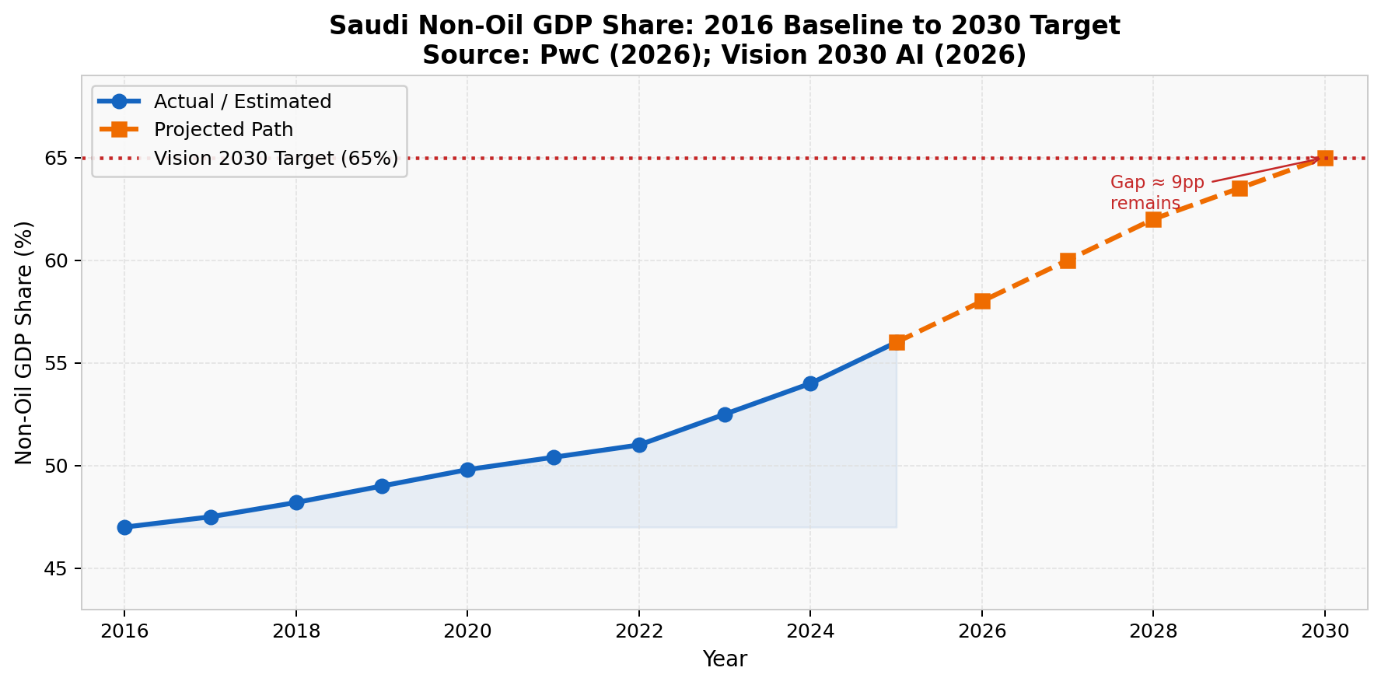
The central problem: AI value depends on knowledge conversion, not only algorithms
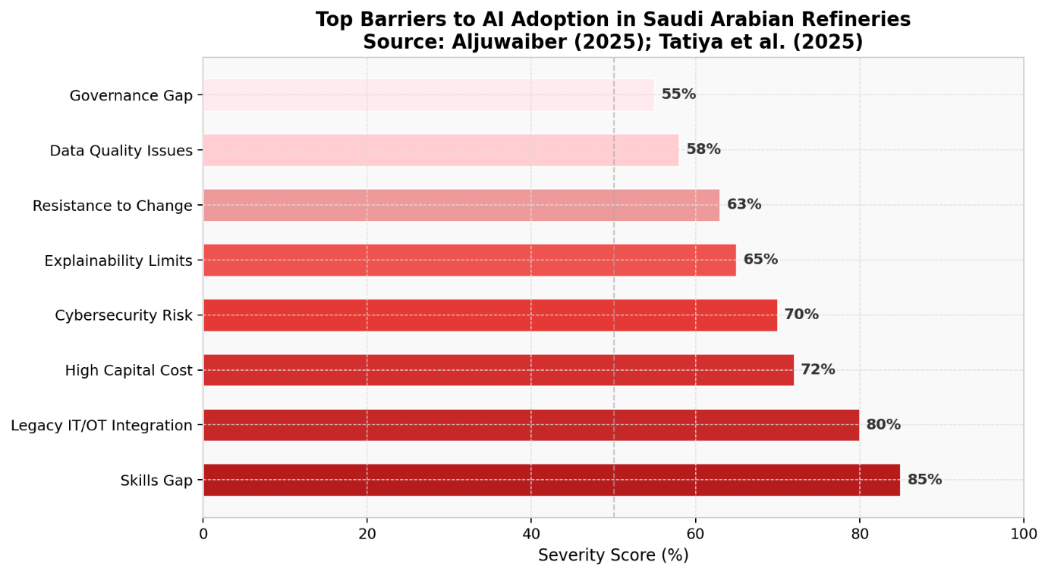
An important constraint in the discussion of AI use in refinery operations is the assumption that knowledge is implicit, that knowledge implies data access, or even the success of models. Research findings from Saudi firms have shown that the use of AI techniques can promote knowledge exchange and collaboration; however, adoption is limited by a lack of expertise, cost constraints, and resistance to change. Related literature in the oil industry considers KM processes as the main channel by which AI implementation leads to innovation effects, with trust and a sustainability orientation acting as moderators. The key issue examined in this study is not the adoption of AI at Saudi refineries but whether AI adoption is integrated into the institutional KM capabilities that support the realization of diversification goals outlined in Vision 2030. This section outlines the theoretical framework for analyzing this gap.
Research Gap and Positioning of this Study
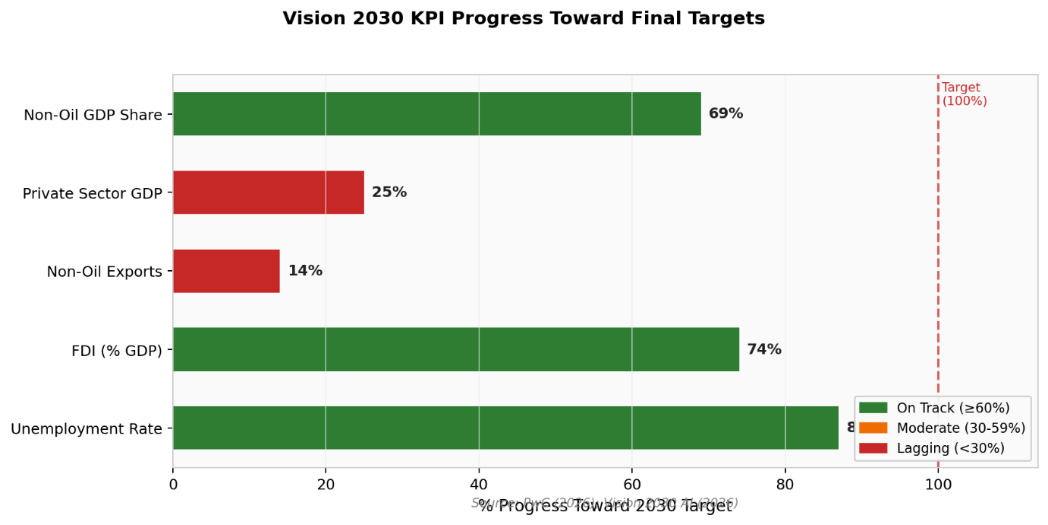
Although the literature on technical AI in refinery applications (process control, predictive analytics, digital twin, configuration optimization, and enterprise architecture for refinery digital transformation) has grown rapidly, there is still much fragmentation in at least three partially overlapping areas:
Saudi studies of AI-KM-vision 2030 provide policy-relevant perspectives and organizational insights; however, their scope is usually broader and focused on cross-sectoral innovation and/or SMEs, not refineries.
Studies in the oil and gas sectors that focus on AI-KM mechanisms are grounded in empirical evidence and emphasize trust and sustainability orientation but fail to address the particular case of Saudi downstream refineries and the diversification logic behind Vision 2030 (Abdulmuhsin et al., 2024, 2026).
Studies on refinery AI and "digital refineries" describe very detailed operational mechanisms and architectures but fail to theorize sufficiently about KM capabilities and the connections between local innovations and sectoral/strategic goals.
In this context, an important conceptual gap can be identified: the literature lacks an integrative theory of Saudi refineries' AI and KM adoption processes and of the potential paths by which these could lead to organizational transformation and sectoral innovation spillover aligned with the diversification strategy. Crucially, this paper does not suggest that the macroeconomic impacts of AI have been empirically established; it only suggests that the existing evidence provides a solid foundation for a conceptual and empirically testable model.
Purpose, Scope, and Research Questions
The proposed research framework is intended to provide a multi-level conceptualization of AI implementation and knowledge management practices in Saudi Arabian refineries. More specifically, this framework will identify the links between such AI-enabled activities and (i) the transformation of refineries as reflected in enhanced operational excellence, safety, reliability, and sustainability/green innovation, and (ii) sectoral trajectories compatible with the economic diversification goals of Vision 2030 (such as capability localization, digitalization of plant operations, and the formation of knowledge-based service ecosystems around refinery activities).
Building on previous research findings indicating KM as the mechanism mediating the impact of AI capabilities on innovation, the conceptualization of KM used in this research framework is broader than "document management." KM includes various organizational capabilities associated with knowledge creation/acquisition, coding/encoding, storage, dissemination, application, and knowledge management governance. In addition, various sociotechnically enablers of AI implementation in refineries (integration of legacy systems, cybersecurity, explainability, etc.) are considered together with the influence of human (trust, adoption credibility, etc.) and cultural factors (Yusuf & Al-Qallaf, 2025; Abdulmuhsin et al., 2024, 2026).
Accordingly, this study was guided by the following research questions:
RQ1: How can AI adoption in Saudi refineries be conceptualized as a capability-building process that depends on and simultaneously reshapes knowledge management practices?
RQ2: Through what mechanisms does KM mediate the relationship between refinery AI adoption and transformation outcomes, such as operational excellence and sustainability-oriented innovation?
RQ3: What organizational, technological, and institutional conditions (e.g., trust, sustainability orientation, skill constraints, integration, and cybersecurity challenges, and policy support) are likely to enable or constrain AI-KM co-evolution in Saudi refineries?
RQ4: What are the plausible pathways through which refinery-level AI-KM capabilities could generate sectoral spillovers relevant to Vision 2030 economic diversification, and how can these pathways be formulated as testable propositions for future empirical research?
Contributions and expected value of the framework
The following are the four contributions of this study. First, it bridges theory-heavy research on AI-KM and mechanism-based studies on refinery AI, addressing a deficiency in formulating digital transformation plans without due consideration for knowledge institutionalization (Gulati et al., 2020; Tatiya et al., 2025). Second, it highlights KM in refinery AI by specifying both the inputs needed by AI and the outputs produced by AI. Third, it introduces empirically derived socio-technical variables, trust, and sustainability orientation, which have been used in studies of neighboring oil industries. Finally, it provides a well-defined conceptual roadmap from transformation at the refinery level to sectoral development through Vision 2030, which entails the identification of mediating variables.
Context: Vision 2030, downstream upgrading, and why refineries are special (Saudi-specific framing):
Vision 2030 diversification logic: why downstream capabilities matter
Vision 2030 strategy presents a vision for a national development strategy geared towards reducing reliance on revenues from crude oil through growth in non-oil sectors, increased value addition industrial activities, and the development of knowledge-based capabilities that possess competitive advantages in the international arena. The key instrument that supports the implementation of this vision is industrial upgrading, which entails the transition from extractive industries to processing, advanced manufacturing, export services, and innovation-based productivity. In this respect, downstream refineries act as transition platforms in relation to two principles: adding value per barrel through focusing on refined products and petrochemical feedstock, and acting as capability development instruments that have technical, organizational, and governance capabilities that can be transferred to adjacent industries. Recent studies from Saudi organizations have found that senior management believes that an AI-based knowledge management (KM) capability is indispensable to gain competitiveness and innovation in line with Vision 2030 mandates. Moreover, a study conducted among small and medium-sized firms found that the sustainability performance of AI capabilities is optimal when proper KM and institutions are present.
Vision 2030 priorities translated into downstream (refinery) upgrading levers
Vision 2030 priority (macro intent)
Refinery-level capability focus
AI + KM relevance (mechanism)
Increase value added from hydrocarbons
Planning sophistication; integration across LP planning-scheduling-operations
AI improves forecasting/optimization; KM codifies decision logic and enables replication across sites (Gulati et al., 2020; Valliyatt et al., 2024)
Improve productivity & competitiveness
Reliability engineering; energy management; cross-functional execution
AI for predictive maintenance/anomaly detection; KM institutionalizes lessons learned and model governance (Tatiya et al., 2025; Yusuf & Al-Qallaf, 2025)
Develop human capital & knowledge economy
Data literacy; OT/IT collaboration; model lifecycle ownership
AI requires/creates new knowledge artifacts; KM enables knowledge transfer and scaling (Aljuwaiber, 2025; Alshammakhi & Sheikh, 2025)
Strengthen sustainability & environmental performance
Monitoring + control + reporting routines
AI supports emissions/compliance analytics; KM mediates AI→innovation outcomes and helps diffuse practices (Abdulmuhsin et al., 2024, 2026; Bom et al., 2025)
Stimulate local ecosystems & services (diversification pathway)
Industrial digital services; standards and interoperability
AI creates demand for integrators; KM standardizes data/model practices lowering barriers for local providers (Alshammakhi & Sheikh, 2025; Gulati et al., 2020)
Note. Vision 2030 is the national strategy source; this table operationalizes its intent for downstream upgrading as a conceptual bridge .
Why refineries are "special" assets for AI + KM (and for sectoral upgrading)
Saudi Arabian refineries are not simple production facilities; they can be viewed as sociotechnical systems marked by (a) safety criticality, (b) highly specialized assets and long lifespans, (c) strongly coupled process interdependencies, and (d) trade-offs between yield, energy usage, quality, emissions, and reliability. Such features make Saudi refining installations particularly significant - as well as challenging - for the use of AI and KM institutionalization.
Complexity, coupling, and multi-objective optimization
Refineries are networks of tightly coupled process units that interact in terms of mass-energy balances and are, hence, capable of exhibiting systemic effects triggered by local changes (Gulati et al., 2020). These properties of such sociotechnical systems benefit from AI-based modeling, allowing the provision of near-real-time prescriptive recommendations if KM allows the diffusion of insights gained via AI technologies across departments and sites. The use of AI in refinery configuration, involving KM-driven interpretation of sophisticated technical information by means of business narratives, provides an example of KM translation.
Constraints imposed by safety-criticality and the need for trustworthy knowledge
Safety-critical installations imply a higher value of interpretability and integration into safety and quality assurance processes, in addition to accurate predictions made by AI models (Tatiya et al., 2025). From the KM perspective, such environments require knowledge governance, namely, the documentation of all aspects of model development and implementation and the explicit indication of conditions under which they can be used reliably. Hybrid digital twins combining physics-based engineering knowledge with machine learning solutions serve as an example, as their output may impact process setpoints; hence, rigorous knowledge management becomes essential.
Knowledge intensity: tacit expertise, codification, and "model knowledge"
Refineries require consistent and systematic updating of implicit operators' knowledge by codified standards, inspection records, and heuristic planning principles. Introducing AI to such sociotechnical systems increases knowledge intensity by bringing in yet another type of knowledge: model knowledge, which comprises definitions of variables, learning algorithms, and relearning policies along with institutional memories about successful applications. Evidence from the oil industry confirms that KM practices moderate the effect of AI use on green innovation outcomes by acting as conduits, while trust and sustainability orientation play a moderating role (Abdulmuhsin et al., 2024, 2026).
Realism of adoption: staff acceptance and "fit" with existing workflows
One of the common challenges in the implementation of AI technologies is staff acceptance of AI solutions viewed as too complex or not integrated with current workflows. Using existing tools to incorporate AI models has been suggested as a strategy to gain staff trust and confidence in using AI. This strategy appears to fit well with Saudi cross-sector evidence showing skills constraints and resistance to change as major barriers to AI-empowered KM adoption (Aljuwaiber, 2025).
Defining "sectoral transformation" for this paper (and how it can be measured)
In this study, sectoral transformation is described as capability development and diffusion processes, whereby the adoption of AI and KM within refineries facilitates upgrading in the downstream industry ecosystem. This study purposefully excludes the assumption of macroeconomic effects and focuses on quantifiable intermediate outcomes. These include the following: (1) the replicability of AI applications across sites through standardized knowledge products (Gulati et al., 2020); (2) KM maturity metrics, such as modeling libraries, validation papers, and lessons-learned frameworks (Abdulmuhsin et al., 2026; Alshammakhi & Sheikh, 2025); (3) sustainability innovation and compliance metrics as proxy innovation metrics (Bom et al., 2025); and (4) specialized internal and external service offerings, such as data engineering, model governance, and OT/IT services, as proximate KIS growth metrics.
Conceptual Foundations and Theoretical Lenses
This research suggests a conceptual framework to clarify how the implementation of AI technology and KM practices evolves together at Saudi Arabia's oil refineries and the plausible role played by such co-evolution in supporting industrial upgrading and economic diversification, consistent with the goals set forth in Vision 2030. As the phenomenon of interest is not merely technical (i.e., AI technology) but also organizational and institutional in nature, none of the theories alone will be sufficient for the purpose. Therefore, four perspectives are combined into an analytical framework: knowledge-based view/KM, dynamic capabilities and absorptive capacity, institutional theory, and socio-technical/TOE.
Knowledge-based view (KBV) and knowledge management as a strategic capability
According to the KBV, different organizational performances derive from the processes of creating, integrating, and applying knowledge, especially when knowledge is complex, tacit, and dispersed among specialists. Refinery organizations serve as a case in point because their performance is contingent upon the integration of tacit knowledge of operators, engineers' knowledge, process safety knowledge, maintenance and inspection records, heuristic planning approaches, and market knowledge. This explains why the KBV serves as an appropriate basis for interpreting "AI adoption" in terms of knowledge integration.
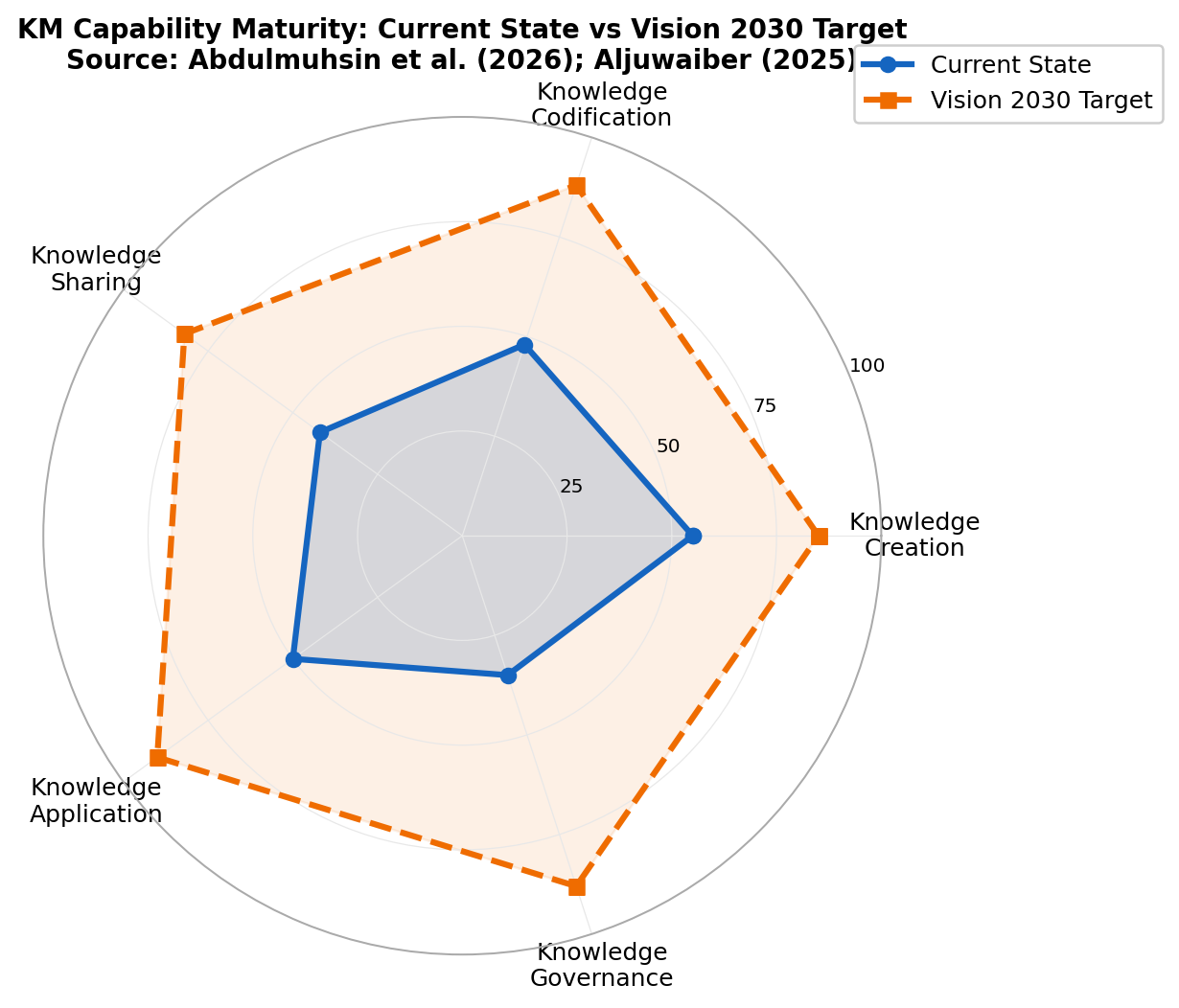
In the knowledge management (KM) literature, organizational learning involves the processes that transform and mobilize knowledge, whether it is tacit or explicit. Such processes are of utmost importance for refineries because they imply the constant integration of tacit heuristics employed by operators and explicit engineering standards. In this respect, artificial intelligence contributes to this challenge by developing models that require KM processes to generate value by making these models meaningful and reliable at multiple organizational levels. Therefore, KM is conceptualized in accordance with the KBV as the capability of interrelated processes associated with the acquisition, storage, sharing, and application of knowledge, exactly as KM was operationalized in the oil sector in connection with KM processes, green innovation, and AI adoption (Abdulmuhsin et al., 2024, 2026).
From a KBV perspective, some AI uses within refineries should be conceptualized as mechanisms of knowledge codification and translation. Hybrid digital twins that combine physics-based models (codified engineering knowledge) and machine learning (knowledge acquired through the learning of plant operations) result in integrative decision artifacts. Likewise, the employment of LLMs for translating complex configuration outputs into more comprehensible narratives for business stakeholders implies knowledge translation from engineering specialists' domain to the managerial one.
Dynamic capabilities and absorptive capacity: from tools to repeatable transformation
formulated the dynamic capabilities approach, which defines the capabilities of an organization in terms of its ability to sense, seize, and reconfigure. In relation to Saudi refineries operating in the Vision 2030 context, this conceptualization clarifies the need for AI and KM systems to adapt in response to emerging needs rather than being fixed implementations. Sensing refers to the use of AI to detect anomalies in real-time, track emissions, and respond to changes in the market. Seizing refers to an organization's decision to invest in AI and KM infrastructure. Finally, reconfiguring occurs when an organization's procedures, maintenance schedules, and KM infrastructure across sites are modified because of machine learning loops enabled by AI.
In contrast, absorptive capacity theory states that the ability of organizations to recognize, assimilate, and utilize external knowledge depends on their current knowledge base and KM mechanisms. For example, in the case of Saudi refineries, absorptive capacity explains why a refinery that has better data governance, a more developed model validation process, and more robust communities of practice can leverage its investments in AI to produce better results. Based on this theoretical understanding, the researcher treats KM capability maturity as a mediating variable.
Institutional theory and policy context: Vision 2030 as an enabling and constraining environment
According to institutional theory, organizational strategy and structure are formed based on the rules, norms, and cultural-cognitive expectations in the environments in which they exist. Traditional studies have established coercive pressure, normative pressure, and mimicry pressure as factors influencing adoption behavior in situations where adoption may be done for efficiency considerations. The above theory applies to AI adoption in Vision 2030, which creates strong incentives for organizations to adopt technologies, demonstrate progress, and comply with emergent standards regarding data governance, cybersecurity, localization, and sustainability.
Vision 2030 can be viewed as a comprehensive institutional framework that sets diversification and modernization goals to establish the adoption of digital technology, AI, and others as strategic national goals. From empirical studies conducted in Saudi organizations, it has been established that decision-makers consider the adoption of knowledge management systems based on artificial intelligence technology competitive and innovative; however, there are issues with expertise, cost, and change resistance (Aljuwaiber, 2025). In the case of SMEs, supportive government policies are considered institutional facilitators in achieving sustainability through the conversion of knowledge into capabilities; however, such policies create risks because dependency on incentives can encourage compliance behavior instead of capability-building processes (Alshammakhi & Sheikh, 2025). Despite differences between refineries and SMEs in organizational structure, the above insight is significant because it highlights the distinction between "adoption" and "capability building."
Consequently, the model uses institutional theory for two reasons. First, it contextualizes the support and expectations surrounding Vision 2030 policies in terms of an enabling environment that would allow for accelerated investments in digital infrastructure, capacity building, and inter-organizational collaboration. Second, it highlights a possible misalignment between adoption and quality, suggesting that pressure from institutions might increase adoption without necessarily improving the maturity of knowledge management (KM), modeling governance, and continuous learning, unless the initiative is specifically structured to encourage capability-based outcomes (such as reuse and scalability).
Socio-technical systems and the TOE perspective: structuring adoption conditions in refineries
The implementation of AI in oil refineries constitutes a classic sociotechnical problem, in which results are a product of the optimization of technology, organizational processes, and human elements. To formalize this complex set of interrelated factors, the technology-organization-environment (TOE) framework is used to structure adoption criteria. TOE is not viewed as an alternative to the body of theories of knowledge-based view, dynamic capabilities, or institutional approach to technology adoption; instead, it is seen as an effective analytical tool to outline the factors necessary for the functioning of AI-KM processes.
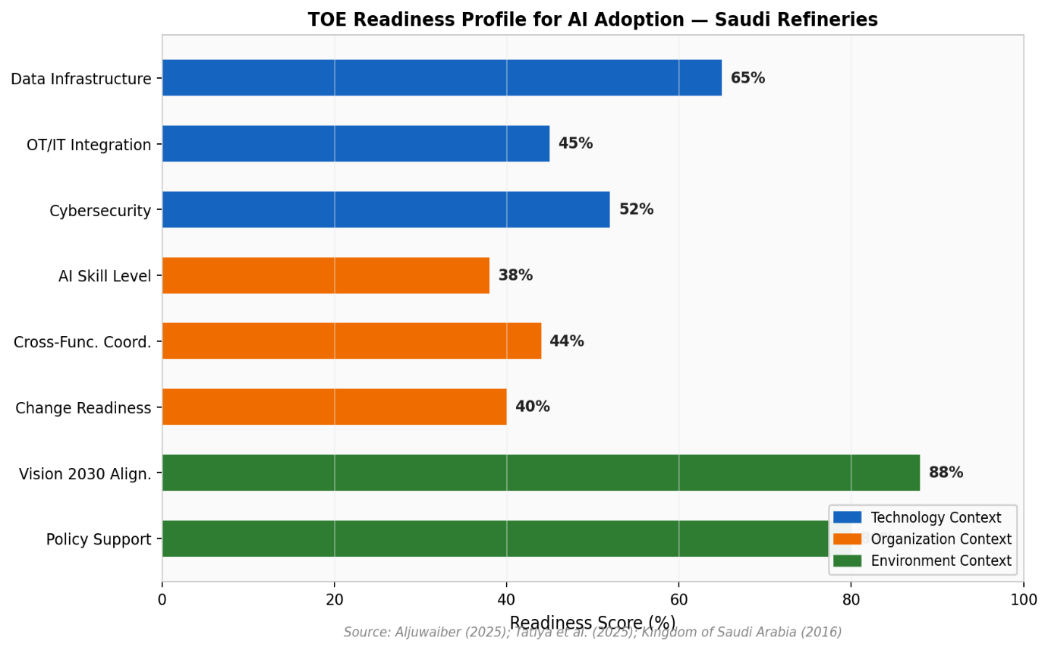
Technology context: The implementation of AI in refineries should conform to existing operational technologies and information systems and meet requirements related to cybersecurity and the transparency of operations. Such criteria occur regularly when evaluating AI in the oil refinery industry, being regarded as necessary technological readiness and risk management factors (Tatiya et al., 2025). Digital twins provide another example of how highly valued solutions often require a combination of physics-informed models with data-driven AI techniques, adding extra prerequisites for management.
Organizational context: From an organizational perspective, competencies, cross-functional collaboration, routines for knowledge exchange, and trust are important factors. In Saudi Arabia, empirical evidence suggests that skill limitations and resistance to change continue to pose barriers to AI-assisted KM (Aljuwaiber, 2025). Trust turns out to be an important moderator of the effect that AI and KM have on innovations in the oil industry (Abdulmuhsin et al., 2024, 2026). Furthermore, from a more practical implementation perspective, it is possible to note that the successful adoption of new solutions will depend on matching the design of the tool with existing engineering processes (Yusuf & Al-Qallaf, 2025). These considerations provide a sufficient basis for considering KM maturity, trust, and adoption credibility as organizational factors governing the transformation into tangible benefits.
Environmental context: Regarding the environmental dimension, institutions, including Vision 2030 and policy initiatives, can be identified as key factors shaping incentives, legitimacy, and resource accessibility. Moreover, certain pressures associated with the environmental dimension may be considered in terms of their impact on the relevance of specific types of use cases for AI solutions (e.g., those related to CO2 emission reductions).
By combining socio-technical analysis with the TOE framework, it becomes possible to overcome one of the main limitations associated with studies on AI technologies in the oil sector, such as considering adoption solely as a technological issue. Specifically, it becomes possible to define AI adoption outcomes as resulting from a coupled system consisting of technology readiness and governance, the organization's KM and trust relations, and environmental incentives and adoption quality.
Literature Review
This subsection collates the relevant literature regarding the underlying logic of the proposed framework, covering (i) environmental and policy drivers (e.g., Vision 2030 and its institutional enablers), (ii) organizational capabilities (especially knowledge management maturity, trust, and change readiness), and (iii) technological capability and implementation reality (AI applications and integration in refineries). Instead of organizing studies chronologically, the synthesis of knowledge is organized along the lines of the constructs and causal pathways in the proposed framework: input → mechanisms (AI/KM) → output, highlighting what is supported by evidence, what may be reasonably implied, and what is left unsupported in the context of Saudi refineries.
Saudi Arabia: AI + KM in the framework of Vision 2030 (supportive evidence, but limited application to refineries)
The second Saudi literature stream explicitly develops a theoretically informed construct of capabilities that demonstrates how AI capabilities enable transformation towards sustainability by supporting KM systems that convert digital insights into action (Alshammakhi & Sheikh, 2025). Moreover, the research models the influence of policy support provided by the government as an institutional enabler that improves the positive association between AI capabilities, KM, and outcomes, while noting that policy incentives may foster a complacent approach that replaces transformational processes. Despite its specific empirical focus on SMEs, the theoretical structure directly applies to the case of refiners' AI-enabled KM under Vision 2030: merely being capable of AI is insufficient, and success depends on the extent to which digital outputs can be transformed into organizational procedures with the help of KM systems.
Implications for the model. Overall, the Saudi literature supports the importance of Vision 2030 as a powerful strategic and institutional framework that shapes expectations, resources, and legitimacy in the area of AI-driven KM; yet, it draws attention to practical limitations in terms of skills shortages and resistance to change, which could negatively impact the emergence of AI capabilities (Aljuwaiber, 2025; Alshammakhi & Sheikh, 2025). However, an important gap remains: the existing body of research does not discuss the specifics of AI-enabled KM in refining organizations and their implications for downstream upgrading capabilities.
Oil and Gas Organizations: AI + KM mechanisms for innovation and sustainability (mechanism evidence, limited Vision 2030 alignment)
Second, this stream includes empirical research on actual examples of AI-KM dynamics in hydrocarbon sector firms and, more specifically, their effects on innovation and sustainability outcomes. This is important because it goes beyond generic "digital transformation" discussions and provides evidence on the relationships among the variables in question and the influence of sociocultural contexts, such as trust.
Oil and gas government organizations were found to be characterized by a positive relationship between AI adoption and KM processes and a positive influence of both AI utilization and KM on proactive green innovation; additionally, trust and organizational commitment to sustainability were shown to enhance the effects in question. Another study focused on the traditional oil sector, distinguished between proactive and reactive green innovations, and proposed modeling KM as a mediation mechanism transforming AI capability into innovation outcomes, with trust and sustainability orientation as moderating variables. Despite the fact that both research streams did not cover Saudi refineries, they offer several structural implications:
KM as a conversion mechanism: In addition to enhancing KM itself, the capability of AI utilization may realize its outcome precisely via KM operations (Abdulmuhsin et al., 2026).
Trust as an adoption factor: The level of trust in the technologies used affects the impact of AI utilization and KM on firm activities, consistent with the assumption about the importance of interpretability, reliability, and governance required to maintain technology in operation (Abdulmuhsin et al., 2024, 2026).
Sustainability orientation as a moderating factor: When the focus of management activities and institutions shifts towards sustainability, it contributes to achieving better outcomes from AI and KM (Abdulmuhsin et al., 2024, 2026).
Implication for the model: These studies support the need to model KM as a mediator between AI adoption and higher-order outcomes (innovation and sustainability). At the same time, trust and sustainability orientation can be included in the model as factors facilitating or weakening the effects of AI utilization on the firm. Unfortunately, this stream does not provide insights into refinery-specific implementation processes (such as legacy systems' integration and model governance in control-environment conditions), nor does it directly relate to the Vision 2030 agenda.
Refinery AI and "digital refinery" work: technical mechanisms, governance constraints, and implicit KM
A third group of studies explores the application of AI in refineries but focuses on operational details and regards knowledge management as an implicit form, such as data availability and information integration, without explicitly identifying it as a separate area. Digital refinery paradigms argue that workflow silos result in value leakage in downstream value chains, recommending enterprise-wide orchestration of operations, supply chain management, and process optimization using AI and prescriptive models. This is where a crucial organizational implication emerges: the most effective transformation should be cross-functional and end-to-end based on knowledge management foundations, including common definitions, best practice codification, and rationale visibility. Reviewing systematic papers helps summarize the key AI applications, such as predictive maintenance, anomaly detection, autonomous optimization, and process control, highlighting security, compatibility with legacy infrastructure, and explainability as persistent barriers related to KM issues of model governance, validation process, and documentation (Tatiya et al., 2025; Bom et al., 2025).
Hybrid digital twins demonstrate knowledge integration by integrating physics-based engineering knowledge into operational artifacts, along with machine learning, and LLM-based configuration translation represents knowledge management as a knowledge translation tool that layers machine learning on top of engineering complexity and managerial decision-making. Finally, empirical studies exploring adoption conditions show that they are socio-technical, not just technical (Yusuf & Al-Qallaf, 2025; Aljuwaiber, 2025). This allows us to identify the research gap addressed by the current study, which is turning KM into a mechanism that enables the repeatability and scalability of AI applications.
Literature Review
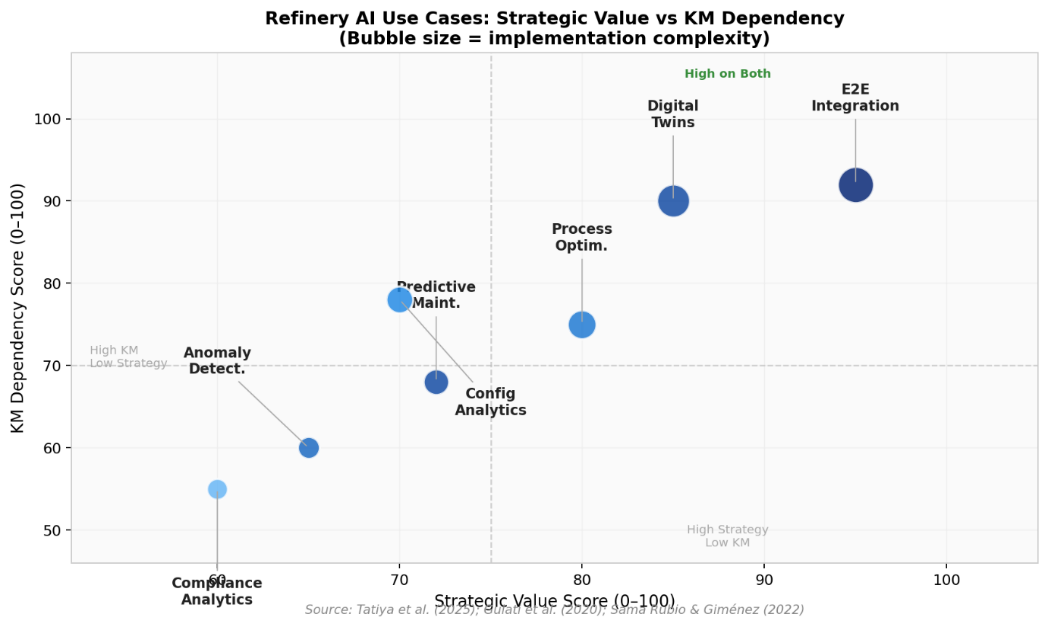
Refinery AI use cases and the corresponding KM "inputs" and "knowledge artifacts"
| Refinery AI use case (examples) | Typical AI methods (illustrative) | KM inputs required (before AI works) | KM outputs created (after AI is deployed) | Key adoption constraints |
| Predictive maintenance / asset health | ML/DL on historian + CMMS signals | Failure taxonomies; maintenance history quality; expert labeling | Failure mode playbooks; model cards; alert interpretation guidance | Skepticism, data gaps; integration (Tatiya et al., 2025; Yusuf & Al-Qallaf, 2025) |
| Anomaly detection & process monitoring | ML/DL; multivariate models | Operating envelopes; quality-tagging; validated historian signals | "Known anomaly" library; root-cause knowledge base | Explainability; false positives (Tatiya et al., 2025) |
| Hybrid digital twins for unit optimization | Physics + ML hybrid | Calibrated base models; domain assumptions; operating regimes knowledge | Codified optimization targets; reusable twin templates | Model governance; narrow-range validity (Sama Rubio & Giménez, 2022) |
| Planning/configuration optimization | Predictive models + optimization | Unit interaction knowledge; economic assumptions; planning heuristics | Configuration playbooks; scenario library; manager-facing explanations | Cross-functional alignment; trust in outputs (Valliyatt et al., 2024) |
| Environmental compliance analytics | Predictive analytics; forecasting | Emissions factor knowledge; reporting requirements; sensor integrity | Compliance reporting templates; exception-handling knowledge | Data completeness; auditability (Bom et al., 2025) |
| End-to-end value chain optimization | Prescriptive models across silos | Shared data model; standard definitions of KPIs | Integrated decision workflows; standardized "single source of truth" | Organizational silos; platform integration (Gulati et al., 2020) |
Integrative synthesis: what is known, what is implied, and what remains missing for Saudi refineries
The literature review highlights several structural aspects underlying the proposed theoretical framework, namely, that (1) AI and KM capabilities are not mutually exclusive and are complementary (Aljuwaiber, 2025; Alshammakhi & Sheikh, 2025); (2) KM acts as a mediator between AI and innovation outcomes in hydrocarbon sector organizations (Abdulmuhsin et al., 2024, 2026); (3) refinery AI mechanisms have been thoroughly analyzed from a technological perspective but still require theorizing in the context of KM governance and lifecycles (Gulati et al., 2020; Tatiya et al., 2025); and (4) the tie-in with Vision 2030 remains conceptual until empirical validation in the context of refinery sector organizations. The proposed framework in Section 5 seeks to fill these gaps.
Although the research gaps identified in this study become evident when reviewing the current literature, the literature review provides a strong foundation for constructing the framework because it provides several elements that can serve as building blocks. In particular, the literature provides a solid foundation in terms of Saudi institutionalization of AI-enabled KM, empirically verified AI-KM mechanism models applicable in the context of hydrocarbon enterprises, and a thorough analysis of the technical aspects of refinery AI applications. The proposed framework connects Vision 2030 institutional drivers, refinery AI capabilities, and KM governance.
Proposed Conceptual Framework:
Overview and Organizing Logic
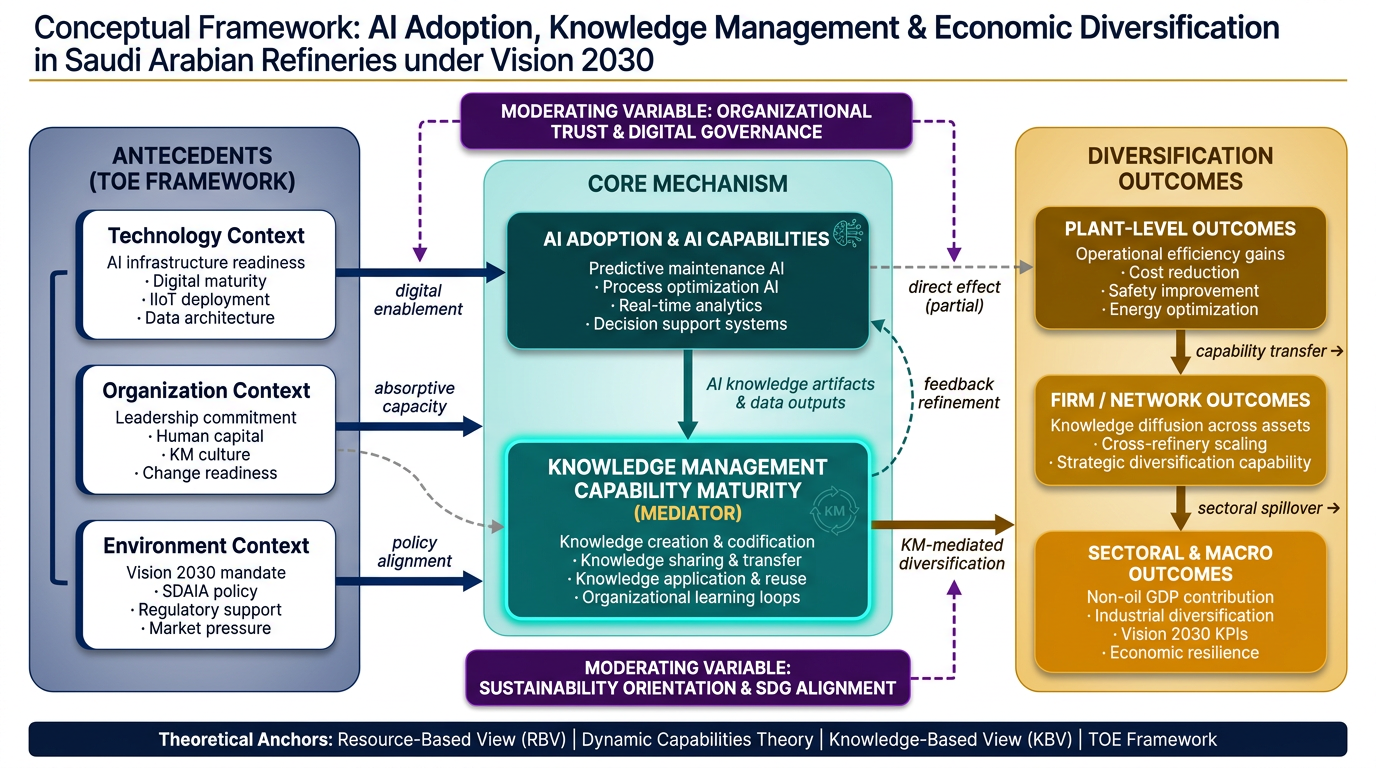
As illustrated in Figure 4, the integrated theoretical framework formulated on the basis of the analysis conducted under Section 3 of the four lenses as well as Section 4's review of literature consists of three interrelated layers: first, TOE-like antecedents that determine the extent to which organizations adopt AI technology and develop KM capability; second, an intermediate level based on KM capability maturity as the mediating variable; and third, a multi-level outcome layer comprising plant, organization, and sectoral levels, which correspond to Vision 2030 outcomes. Two moderating variables, trust and sustainability orientation, moderate the paths.
Core constructs and definitions
Table 3 Construct definitions and indicative dimensions for the proposed framework
| Construct | Definition |
| AI adoption | The extent to which AI-enabled systems are implemented and embedded in refinery workflows across the asset and value chain |
| AI capabilities (refinery) | The technical and organizational ability to build, deploy, govern, and improve AI systems in safety-critical refinery contexts |
| KM capability maturity | The organizational capacity to systematically acquire, codify, store, share, and apply knowledge-including AI "model knowledge"-across sites and functions |
| Technology readiness/constraints | The degree to which refinery infrastructure enables AI deployment while managing cybersecurity and reliability risks |
| Organizational readiness | Human and structural conditions supporting AI-KM co-evolution |
| Institutional/policy support (Vision 2030 context) | External enabling pressures/resources shaping AI and KM investments |
| Trust in AI/technology | Users' and managers' confidence that AI systems are reliable, safe, and appropriate for operational decision contexts |
| Sustainability orientation | The strategic salience of environmental performance and sustainability commitments in decision-making |
| Operational excellence outcomes | Performance improvements at plant level attributable to improved decision quality and reduced variability |
| Innovation outcomes (including green innovation) | Development of new or improved practices, routines, or solutions that enhance sustainability and competitiveness |
| Scaling and diffusion outcomes | Replication of validated AI-KM solutions across units/sites and institutionalization into organizational routines |
| Sectoral spillovers (macro-proximate) | Capability and ecosystem effects beyond the focal refinery/firm that plausibly support diversification |
Note. The definitions synthesize constructs used in empirical AI-KM studies (Abdulmuhsin et al., 2024, 2026; Alshammakhi & Sheikh, 2025) with refinery AI adoption constraints (Tatiya et al., 2025) and end-to-end digital refinery integration logic (Gulati et al., 2020).
5.3 Model Structure: Inputs → Mechanisms → Outcomes (with feedback loops)
5.3.1 Inputs (TOE antecedents) shaping AI and KM capability formation
This framework starts with antecedents structured using technology-organization-environment (TOE) logic: technology readiness/constraints, organizational readiness, and institutional/environmental support. Antecedents affect (a) the rate and extent of AI uptake and (b) the degree of sophistication of KM processes that regulate learning and reuse.
Technology readiness/constraints are significant because AI in refineries must integrate into existing operational systems and meet cybersecurity and assurance requirements. In reviews of refinery AI, technology readiness is one of the recurring barriers, indicating that building capability involves not only models but also architecture and governance processes (Tatiya et al., 2025).
Organizational readiness is important because AI requires skilled labor, teamwork, and adaptability from organizations. In research on AI and KM adoption in Saudi Arabian companies, a lack of expertise and resistance to change have been identified as obstacles (Aljuwaiber, 2025). Research on KM tools at refineries shows that adoptability is greater when tools are consistent with established processes (Yusuf & Al-Qallaf, 2025).
The institutional and policy environment is important because Vision 2030 serves both as an enabling force and a legitimacy signal regarding AI and KM investments (Kingdom of Saudi Arabia, 2016). Nevertheless, policy frameworks matter too: capability development may become more superficial if policies reward compliance with KM rather than learning and reuse (Alshammakhi & Sheikh, 2025).
Core mechanism: AI capabilities generate value through KM-mediated knowledge conversion
The conceptual framework is based on the assertion that the maturity of KM capability serves as a mediating factor between AI capabilities/adoption and outcomes at refineries. The output of AI capabilities creates potential value through predictive, prescriptive, and diagnostic outputs. Nevertheless, the impact on operations can only occur when such outputs are turned into validated and repeated procedure activities that fall under the scope of KM.
Such reasoning correlates well with research demonstrating that KM mediates AI's impact on transformation outcomes in Saudi SMEs (Alshammakhi & Sheikh, 2025) and mediates AI's impact on green innovation outcomes in oil-related organizations (Abdulmuhsin et al., 2026). At oil refining facilities, where safety-critical and complex decisions are concerned, the role of KM mediation is magnified by the requirement to have models that are documented, circumscribed, validated, and integrated into organizational decisions with clear accountability.
The proposed model features another important mechanism: the coevolutionary effect of AI on the organization through KM. In essence, AI does not remain unaffected by KM but rather simultaneously creates artifacts such as model cards, variations of hybrid digital twins, configuration playbooks, and explanation narratives that, in turn, change the KM system. In the case of digital twins, AI serves as a database for knowledge integration and management, whereas in the context of translating technical configurations into business narratives using large language models, one observes codification and dissemination via KM enabled by AI technology.
Moderators: trust and sustainability orientation as conditions for conversion effectiveness
The framework considers two moderators that help adjust the strength of the relationships between AI and KM, and between KM and the outcome variables.
Technology/AI trust: Studies indicate that trust plays a role in reinforcing the connection between AI and KM, as well as innovation output in hydrocarbon companies (Abdulmuhsin et al., 2024, 2026). Trust plays a special role in refinery settings, where decision support should be used in contexts of uncertainty and risk. As factors contributing to technology trust, we can consider elements such as interpretability, governance legitimacy, and previous success, which were also emphasized in studies of technology AI adoption (Tatiya et al., 2025; Yusuf & Al-Qallaf, 2025).
Sustainability orientation: Evidence shows that sustainability orientation impacts the relationship between AI, KM, and green innovation outcomes (Abdulmuhsin et al., 2024, 2026). A sustainable orientation could increase attention to AI applications in refinery firms dealing with reducing emissions, increasing energy efficiency, and ensuring regulatory compliance. Such an orientation would encourage investments in KM processes.
Outcomes: from plant performance to scaling and diversification-relevant spillovers
These levels of outcome serve as the basis for aligning transformation initiatives in the refinery industry with Vision 2030 through a robust conceptual foundation.
Plant-Level Outcomes (Micro)
The literature on AI in refineries shows the benefits associated with increased safety, efficiency, and reduced emissions, while also emphasizing constraints (Tatiya et al., 2025). Studies based on reviews that have considered compliance and sustainability issues have recognized the role of AI-powered predictive analysis in achieving cost-effectiveness and sustainability. In the proposed framework, such outcomes can be considered proximate and measurable.
Firm/Network-Level Outcomes (Meso)
From a refinery perspective in the digital age, the greatest gains accrue from integrating optimization and decision-making activities across the entire value chain, underlining the need for institutionalized cross-functional processes (Gulati et al., 2020). Within this framework, KM maturity facilitates scaling through support for standardization, taxonomy, and cross-site replication procedures.
Sectoral Spillovers (Macro-Proximate)
In contrast to the assumption that improved refinery performance would inherently result in macroeconomic diversification, the framework considers plausible macro-proximate spillover effects, such as the rise of specialty digital services in industries, increasing integration skills, and enhancing local problem-solving capabilities, that align with the vision of Vision 2030 concerning innovation-led competitiveness and empirical evidence from Saudi Arabia, where AI-enabled KM has been recognized as an innovation and entrepreneurship facilitator (Aljuwaiber, 2025).
Testable propositions (hypothesis-style statements)
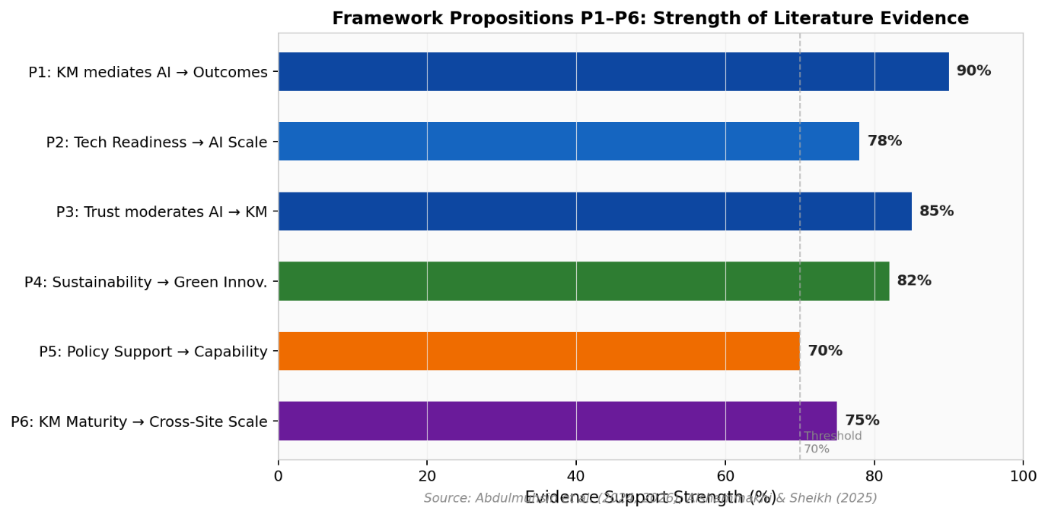
To improve rigor and empirical validation, the framework provides the following propositions:
P1 (Mediation - Core Mechanism)
Empirically, KM has been shown to mediate the relationship between AI usage and innovation performance in the oil industry (Abdulmuhsin et al., 2026). Without KM as a mechanism for converting performance improvements into capabilities, AI results can remain isolated improvements in individual performance.
P2 (Constraints - Technology Readiness, Conditionality)
Factors associated with technology readiness, including integration capabilities, cybersecurity stance, and explainability/assurance capacity, positively moderate the link between AI adoption and AI capabilities, enhancing the feasibility and scalability of AI deployments in refineries (Tatiya et al., 2025).
P3 (Behavioral Moderator - Trust in AI/Technology)
Trust in AI/technology positively moderates the AI-to-KM and KM-to-innovation links, helping translate AI insights into routine practice and innovation success (Abdulmuhsin et al., 2024, 2026).
P4 (Strategic Moderator - Sustainability Orientation)
Sustainability orientation positively moderates the link between KM capability maturity and sustainability-oriented innovation outcomes (e.g., green innovations and compliance performance improvements), increasing the priority given to such AI use cases (Abdulmuhsin et al., 2024, 2026; Bom et al., 2025).
P5 (Enabling Role of Institutional Support, With Potential for Distortion)
Vision 2030-linked institutional support enhances investments in AI and KM capabilities; an overemphasis on policy incentives can distort capability development by encouraging only compliance-oriented adoption and not institutionalization and reuse of insights gained.
P6 (Scaling through KM)
Higher KM maturity improves the ability to replicate AI insights across refineries and reuse KM artifacts (models, digital twins, and playbooks) to support scaling efforts.
Boundary Conditions and Assumptions
This framework would primarily apply in downstream refining activities, especially where refineries have been combined with petrochemical plants such that (i) AI is used in critical decision-making processes and (ii) the firm intends to spread the learning process to more than one unit. This framework would not be ideal where AI technologies are merely experimented with but without integrating them into the operation or where minimal KM systems exist, with critical decisions being made locally. While the framework conforms to the Vision 2030 framework, it does not automatically assume that diversification impacts will arise at the national level; such impacts must be proven empirically.
Research Agenda: Empirically Testing the Framework in Saudi Refineries
A conceptual framework is valuable when it is empirically tractable. The five empirical research questions have a direct origin in Propositions P1-P6, discussed in Section 5.5, and are therefore not repeated here. Instead, attention is drawn to each of these questions in terms of how they might be operationalized and empirically addressed using an effective research design.
Phase 1 - Embedded Case Study: Mechanism Discovery
The first phase will benefit from using embedded multiple case studies of at least two to four Saudi refineries or sites in one large downstream company, involving predictive maintenance, energy optimization, and planning analytics programs as embedded cases. Data will be collected through interviews with people working in operations, process engineering, reliability, HSSE, and OT/IT cyber security, supported by document analysis of validation reports, change management documents, and training resources. This research design makes sense because sociotechnical systems require the grounding of constructs in how decision-making occurs. This can be demonstrated using case-based research to understand how AI artifacts are institutionalized in terms of governing knowledge: AI model cards, digital twin governance procedures, and configuration playbooks as per end-to-end digital transformation logic (Gulati et al., 2020) and the knowledge-integration approach to refinery AI.
Phase 2 - Survey and SEM: Structural Hypothesis Testing
Next, we examine the relationships in the proposed framework for mediation and moderation via a cross-sectional survey of managers and engineers from various refining plants or business units using structural equation modeling (SEM) analysis, consistent with past AI-KM research in hydrocarbon firms (Abdulmuhsin et al., 2024, 2026; Alshammakhi & Sheikh, 2025). The deployment of AI technologies must be examined at two levels: breadth and depth. Breadth is defined by the variety of applications in areas such as maintenance, process control, planning, and compliance, whereas depth is measured by the degree to which suggestions have been incorporated into the workflow and are not confined to recommendation dashboards (Gulati et al., 2020; Tatiya et al., 2025). In addition, KM development should be quantified based on factors such as knowledge creation, storage, sharing, utilization, and management, along with further measures regarding enabling constraints, such as skill shortages, expense issues, and resistance to change, derived from prior Saudi cross-industry findings (Aljuwaiber, 2025). The effects of common-method bias can be addressed by administering multi-source surveys in conjunction with objective criteria, such as retraining rates and artifact reuse, across sites.
Phase 3 - Longitudinal Evaluation: Causal Validation
In the third phase, it would be necessary to leverage natural variations in the staggered implementation of AI in refineries through ITQAS, DID, or matched-comparison methods to provide credible causal inferences beyond the possibilities that cross-sectional surveys offer (Tatiya et al., 2025). The use of longitudinal data is necessary to investigate whether KM maturity leads to the replication and institutionalization of AI technologies and to identify proximate macro indicators of spillover effects, including an increasing demand for dedicated data engineering specialists, collaboration with local intermediaries, and training on AI governance in line with Vision 2030 capacity-building aspirations. Measurement invariance, digital maturity control variables, and governance variables that capture explainability practices and rigorous validation protocols should be incorporated in all stages (Tatiya et al., 2025). This three-stage research program fosters cumulative theory development through the successive refinement of constructs, exploration of structural relationships, and causal inference that allows researchers to discern whether knowledge systems powered by AI technology in Saudi Arabian refineries are capable of serving as drivers of industry transformation under Vision 2030.
Implications
Because this study is conceptual, the implications below are framed as actionable inferences grounded in the synthesized literature rather than empirically verified causal claims for Saudi refineries.
Managerial Implications
Refinery leaders need to view AI efforts through the lens of knowledge management initiatives and make model documentation, bounded applicability statements, and continuous post-deployment learning essential components of every project with dedicated funding alongside technical deliverables. Instead of counting the number of pilots deployed, companies should track capability scaling measures, such as artifact re-use across facilities or time-to-replication, consistent with end-to-end orchestration considerations, which aim to maximize the benefits of digital transformations (Gulati et al., 2020). AI systems must have trustworthiness built-in starting with the procurement process, rather than tacked on later, due to safety-sensitive operations where interpretability cannot be merely an additional requirement but a matter of necessity (Tatiya et al., 2025; Yusuf & Al-Qallaf, 2025). Lastly, sustainability-driven AI portfolios deliver better innovation performance only when analytical insights become part of standard operating procedures and training curricula through routine knowledge management processes, and not just a feature of emission dashboards (Abdulmuhsin et al., 2024, 2026; Bom et al., 2025).
Policy Implications
AI policies in the context of Vision 2030 need to move away from reward mechanisms based on mere uptake counts and focus on measurable capability-building outputs, with mandatory governance structures, scaling documentation, and knowledge transfer as the basis of public support for any digital initiatives (Alshammakhi & Sheikh, 2025; Kingdom of Saudi Arabia, 2016). Sector-specific AI guidelines for assurance purposes and testbeds that combine OT/IT and process engineering with good governance will help ease diffusion barriers and ensure a sustainable demand for local expertise. This will create positive spillover effects consistent with diversification objectives (Gulati et al., 2020; Aljuwaiber, 2025).
Theoretical Implications
The model extends KBV theory by conceptualizing AI as a means of codifying and translating knowledge to provide governance frameworks. This theory emphasizes replication across sites rather than pilots alone as a unit of transformational analysis. Institutional theory is extended through a distinction between mere compliance aspects and capability-building processes in light of Vision 2030 policy pressure (Alshammakhi & Sheikh, 2025).
Conclusion
Conclusion and Contribution
This study develops a multi-level conceptual framework for understanding the co-evolution of the implementation of AI and KM and its potential role in facilitating economic diversification as per Saudi Arabia's Vision 2030. This synthesis is based on three literature reviews with partial overlaps, including a review of studies on AI and KM adoption in Saudi Arabia (Aljuwaiber, 2025; Alshammakhi & Sheikh, 2025), studies on innovation in AI and KM in the hydrocarbon industry (Abdulmuhsin et al., 2024, 2026), and studies on digital transformation in the refining industry (Gulati et al., 2020; Tatiya et al., 2025). The unique contribution of this framework is its integration of the Saudi institutional context and adoption knowledge with empirically validated AI and KM mechanisms and refinery industry context, resulting in six propositions and a three-phase research agenda.
Limitations
This study has three limitations that require attention. To begin with, this framework is generated based on the synthesis of adjacent bodies of knowledge instead of being generated based on primary data gathered at Saudi Arabia refineries. Therefore, all propositions must be empirically validated. Second, key challenges associated with refineries, such as cybersecurity issues, explainability, and legacy system integrations, are not yet standardized in the current literature (Tatiya et al., 2025). Finally, there is inherent difficulty in tracing the macroeconomic results of refineries' AI investments.
Future Recommendations
Empirical studies conducted in the downstream sector of Saudi Arabia must explicitly examine the maturity and governance of KM, track the institutionalization and reproduction of AI-related knowledge artifacts, and analyze the dynamics of scaling using multi-survey modeling and quasi-experimental longitudinal designs. Future research should consider expanding the model to include other GCC downstream sectors and explore whether generative AI and large language models provide a fundamentally novel approach for translating KM. In doing so, the academic community will be able to conclude whether AI-driven knowledge systems operating in the refining industry represent true engines of transformation, rather than a series of separate digital projects within the context of Vision 2030.
References
- Abdulmuhsin, A. A., Alkhwaldi, A. F., Rehman, S., Thabit, S. M. M., Hussein, H. D., & Dbesan, A. H. (2026). Empowering AI ‐Driven Proactive and Reactive Green Innovation: Exploring Knowledge Management, Trust and Sustainability. Knowledge and Process Management. https://doi.org/10.1002/kpm.70026
- Abdulmuhsin, A. A., Hussein, H. D., Al‐Abrrow, H., Masa’deh, R., & Alkhwaldi, A. F. (2024). Impact of artificial intelligence and knowledge management on proactive green innovation: the moderating role of trust and sustainability. Asia-Pacific Journal of Business Administration. https://doi.org/10.1108/apjba-05-2024-0301
- Albaroudi, E., Mansouri, T., Hatamleh, M., & Alameer, A. (2025). Saudi Arabia’s Vision 2030: Leveraging Generative Artificial Intelligence to Enhance Software Engineering. 2025 Eighth International Women in Data Science Conference at Prince Sultan University (WiDS PSU), 1-6-1–6. https://doi.org/10.1109/WiDS-PSU64963.2025.00024
- Algahtani, K. (2019). Knowledge management practices in the Kingdom of Saudi Arabia public sector organisations. Thesis dissertation. https://wlv.openrepository.com/items/5b2ff6ee-9b67-4260-bffb-8b1b6a808880
- Aljuwaiber, A. (2025). Fostering Knowledge Management Practices Through Artificial Intelligence: Vision 2030 as a Catalyst. European Conference on Knowledge Management. https://doi.org/10.34190/eckm.26.1.3580
- ALSaoudi, T., Acquaye, A., Khalfan, M., & Swarnakar, V. (2024). Enhancing Sustainable Performance Through Circular Economy and Industry 4.0: A Conceptual Framework for Leveraging Drivers and Mitigating Barriers. 2024 IEEE International Conference on Industrial Engineering and Engineering Management (IEEM), 755-759-755–759. https://doi.org/10.1109/IEEM62345.2024.10857117
- Alshammakhi, Q., & Sheikh, R. (2025). Driving Sustainable Entrepreneurship Through AI and Knowledge Management: Evidence from SMEs in Emerging Economies. Sustainability. https://doi.org/10.3390/su172410928
- Arpaci, I., Yardimci, Y. C., Ozkan, S., & Turetken, O. (2012). Organizational adoption of information technologies: A literature review. International Journal of Ebusiness and Egovernment Studies, 4(2), 37–50.
- Benhamlaoui, N. (2025). Digital Transformation Strategies In The Kingdom Of Saudi Arabia Under Vision 2030. مجلة البحوث الاقتصادية والمالية. https://doi.org/10.37164/2056-012-002-028
- Bom, C., Chijioke-Churuba, J. N., & Matthews, J. (2025). Evaluating Cost-Benefit Implications of Ai-Driven Predictive Analytics for Environmental Compliance and Sustainability in Oil and Gas Refinery Operations. Current Journal of Applied Science and Technology. https://doi.org/10.9734/cjast/2025/v44i74576
- Cohen, W. M., & Levinthal, D. A. (1990). Absorptive capacity: A new perspective on learning and innovation. Administrative Science Quarterly, 35(1), 128–152.
- Grant, R. (1996). Toward a Knowledge-Based Theory of the Firm,” Strategic Management Journal (17), pp. Unknown Journal, 109-122-109–122. https://doi.org/10.1002/SMJ.4250171110
- Gulati, H. G., Mcmullen, J., & Awad, M. (2020). Refinery Digital Transformation: Driving an End-to-End Value Chain Optimization Strategy with AI and Prescriptive Models. Unknown Journal. https://doi.org/10.2118/203369-ms
- Ismail, R., Lai, Y. M., Ayub, Z. A., Ahmad, A. R., & Wan, C. Da. (2016). Kingdom of Saudi Arabia. In Higher education in the Middle East and North Africa: Exploring regional and country specific potentials (pp. 127–146). Springer.
- Koronatov, N. N., Kalyazina, S., & Levina, A. (2022). Business model of an oil refinery in the context of digital transformation. KANT. https://doi.org/10.24923/2222-243x.2022-43.8
- Memish, Z., Altuwaijri, M. M., Almoeen, A. H., & Enani, S. M. (2021). The Saudi Data & Artificial Intelligence Authority (SDAIA) Vision: Leading the Kingdom’s Journey toward Global Leadership. Journal of Epidemiology and Global Health, 11, 140-142-140–142. https://doi.org/10.2991/jegh.k.210405.001
- Nonaka, I. (1994). A dynamic theory of organizational knowledge creation. Organization Science, 5(1), 14–37.
- Rubio, S. S., & Giménez, T. (2022). Implementing a Hybrid Digital Twin Approach in a Crude Unit Operation. Day 2 Tue, November 01, 2022. https://doi.org/10.2118/211044-ms
- Scott, J. (2014). A matter of record: Documentary sources in social research. John Wiley & Sons.
- Selim, M. M., & Alshareef, N. (2025). Trends and opportunities in renewable energy investment in Saudi Arabia: Insights for achieving vision 2030 and enhancing environmental sustainability. Alexandria Engineering Journal. https://doi.org/10.1016/j.aej.2024.10.107
- Tatiya, M., Shinde, B. A., Pokale, N. B., Sarada, M., Bulhe, M. M., Murali, G., Kadam, V. R., Kurhade, A. S., & Waware, S. Y. (2025). AI-Driven Process Control for Enhancing Safety and Efficiency in Oil Refining. Applied Chemical Engineering. https://doi.org/10.59429/ace.v8i4.5792
- Teece, D. J., Pisano, G., & Shuen, A. (1997). Dynamic capabilities and strategic management. Strategic Management Journal, 18(7), 509–533.
- Trist, E. L., & Bamforth, K. W. (1951). Some social and psychological consequences of the longwall method of coal-getting: An examination of the psychological situation and defences of a work group in relation to the social structure and technological content of the work system. Human Relations, 4(1), 3–38.
- Valliyatt, M. P., Tharayil, S. M., Razhi, A. A., Alqarni, S. M., & AlThubaiti, L. (2024). AI-Driven Optimization of Refinery Configurations: A Novel Approach to Predicting Production Outputs and Capacities. SPE Annual Technical Conference and Exhibition. https://doi.org/10.2118/220241-ms
- Yusuf, T. M., & Al-Qallaf, Y. (2025). Adopting AI-Enabled Solutions for Asset Optimization Towards Operational Excellence. ADIPEC. https://doi.org/10.2118/230071-ms
- .
Cite this article
-
APA : Sajid, J. A., Munir, H., & Nawaz, M. (2026). From Digital Refinery to Diversified Economy: A Conceptual Framework Linking AI Adoption, Knowledge Management, and Vision 2030 Industrial Transformation in Saudi Arabia. Global Social Sciences Review, XI(I), 173-194. https://doi.org/10.31703/gssr.2026(XI-I).15
-
CHICAGO : Sajid, Jahanzaib Abdul, Humaira Munir, and Mohammad Nawaz. 2026. "From Digital Refinery to Diversified Economy: A Conceptual Framework Linking AI Adoption, Knowledge Management, and Vision 2030 Industrial Transformation in Saudi Arabia." Global Social Sciences Review, XI (I): 173-194 doi: 10.31703/gssr.2026(XI-I).15
-
HARVARD : SAJID, J. A., MUNIR, H. & NAWAZ, M. 2026. From Digital Refinery to Diversified Economy: A Conceptual Framework Linking AI Adoption, Knowledge Management, and Vision 2030 Industrial Transformation in Saudi Arabia. Global Social Sciences Review, XI, 173-194.
-
MHRA : Sajid, Jahanzaib Abdul, Humaira Munir, and Mohammad Nawaz. 2026. "From Digital Refinery to Diversified Economy: A Conceptual Framework Linking AI Adoption, Knowledge Management, and Vision 2030 Industrial Transformation in Saudi Arabia." Global Social Sciences Review, XI: 173-194
-
MLA : Sajid, Jahanzaib Abdul, Humaira Munir, and Mohammad Nawaz. "From Digital Refinery to Diversified Economy: A Conceptual Framework Linking AI Adoption, Knowledge Management, and Vision 2030 Industrial Transformation in Saudi Arabia." Global Social Sciences Review, XI.I (2026): 173-194 Print.
-
OXFORD : Sajid, Jahanzaib Abdul, Munir, Humaira, and Nawaz, Mohammad (2026), "From Digital Refinery to Diversified Economy: A Conceptual Framework Linking AI Adoption, Knowledge Management, and Vision 2030 Industrial Transformation in Saudi Arabia", Global Social Sciences Review, XI (I), 173-194
-
TURABIAN : Sajid, Jahanzaib Abdul, Humaira Munir, and Mohammad Nawaz. "From Digital Refinery to Diversified Economy: A Conceptual Framework Linking AI Adoption, Knowledge Management, and Vision 2030 Industrial Transformation in Saudi Arabia." Global Social Sciences Review XI, no. I (2026): 173-194. https://doi.org/10.31703/gssr.2026(XI-I).15